











Open infrastructure for healthcare data applications.
Connect Python pipelines and applications to live FHIR APIs, build and validate structured output, and deliver it through REST, CDS Hooks, CDA, MCP, or LangChain.
Installation
pip install healthchain
What HealthChain Does
HealthChain puts a consistent FHIR boundary around your Python code: live data in, your own logic in the middle, and validated FHIR out. Built for research software, healthcare data, and AI teams.
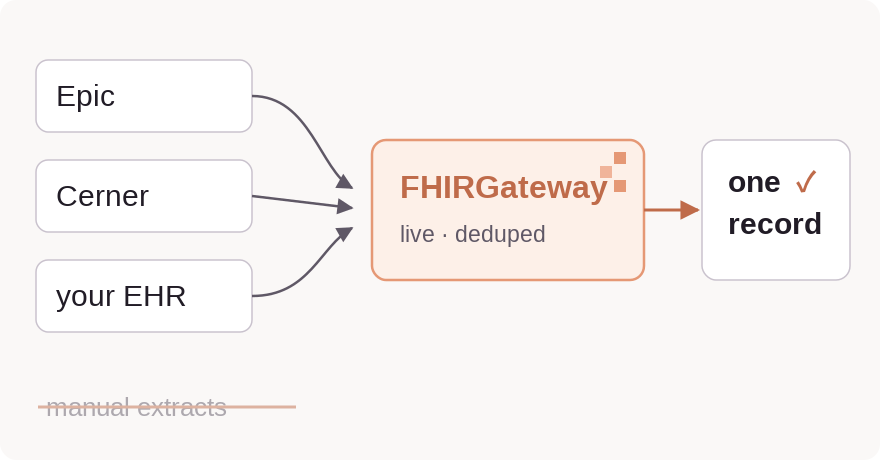
🔌 Connect to Live FHIR APIs Connect to Epic, Cerner, Medplum, and other FHIR R4 servers through one interface that handles authentication, source routing, and common FHIR operations. Getting Started → |
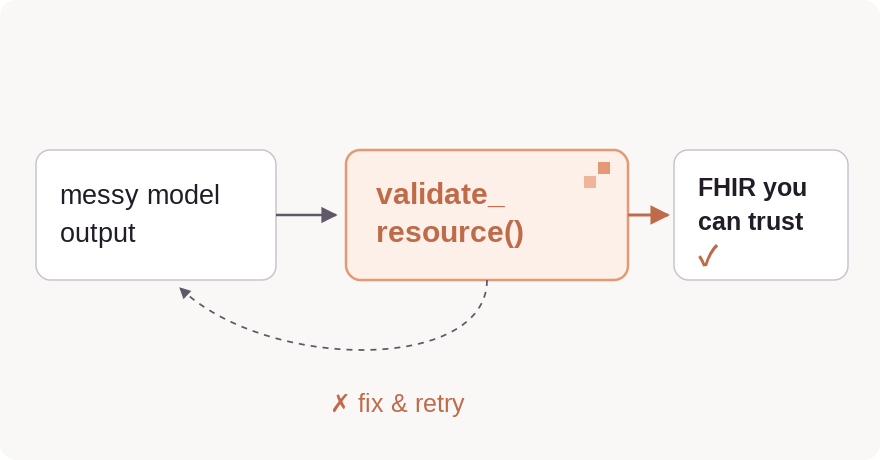
🔥 Build and Validate FHIR Build typed resources without hand-writing deeply nested FHIR. Structured validation identifies failing fields and invalid required codes before delivery. Getting Started → |
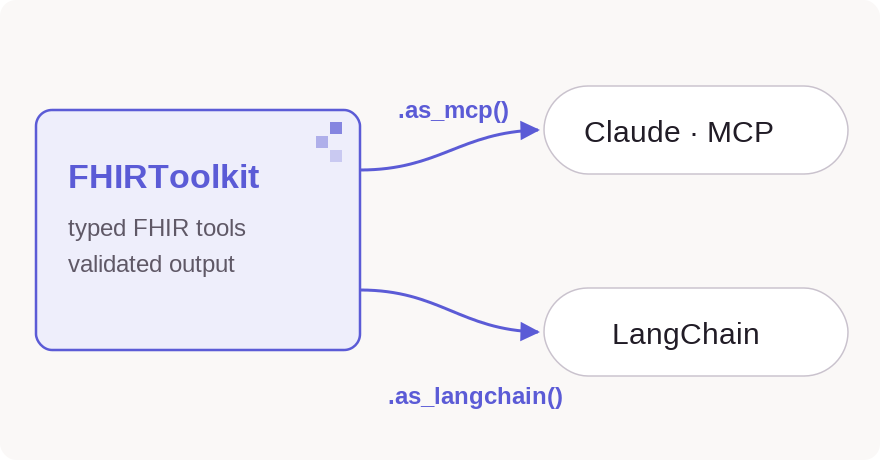
🤖 Use the Same Tools with Agents Expose the same build, validate, read, and terminology operations over MCP or LangChain, with structured errors an agent can inspect and correct. Getting Started → |
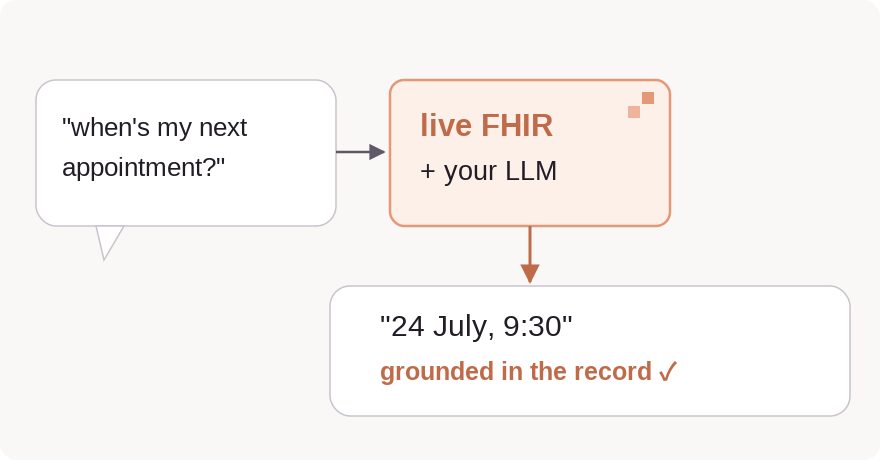
💬 Build FHIR-Backed Applications Use live or local FHIR data in research software, patient-facing applications, analytics, decision support, and AI-assisted workflows. Getting Started → |
Why HealthChain?
Every healthcare data team rebuilds the same integration layer. Whether your logic is rule-based, a logistic regression, or an agent, it needs authenticated access to real FHIR APIs and a reliable way to turn output into coded FHIR. Pipelines tied to one site's warehouse don't travel, and structural or coding errors may only be discovered downstream.
HealthChain handles that layer so you can focus on your logic and your domain.
- Live data, not exports — Connect to live FHIR APIs instead of site-specific warehouse queries and stale extracts
- Keep connection details out of pipeline logic — Load endpoints and credentials from environment-backed configuration
- Build FHIR with less boilerplate — Use flat, typed helpers instead of manually assembling deeply nested resources
- Catch errors early — Get structured validation reports with failing field paths and actionable diagnostics
- Resolve codes instead of guessing them — Map free text through a swappable terminology lookup before building a resource
- Choose how to deliver the result — Expose output through FHIR REST services, CDS Hooks, SOAP/CDA, MCP, or LangChain
🏆 Recognition & Community
Featured & Presented:
- Featured in TLDR AI Newsletter (900K+ developers)
- Featured by Medplum for open source integration with Epic
- Presented at NHS Python Open Source Conference (watch talk)
- Built from NHS AI deployment experience – read the origin story
🤝 Pilots & Partnerships
Exploring HealthChain for your product or organization? Get in touch to discuss integrations, pilots, or collaborations, or join our Discord to connect with the community.
Usage Examples
Build a FHIR Service
Expose Multiple FHIR Sources [Docs]
from healthchain.gateway import HealthChainAPI, FHIRGateway
from healthchain.gateway.clients import FHIRAuthConfig
from healthchain.fhir.r4b import Bundle, Patient

# Create a FHIR-connected service
app = HealthChainAPI(title="Multi-EHR Patient Data")

# Credentials are loaded from EPIC_* and CERNER_* environment variables
fhir = FHIRGateway()
fhir.add_source("epic", FHIRAuthConfig.from_env("EPIC").to_connection_string())
fhir.add_source("cerner", FHIRAuthConfig.from_env("CERNER").to_connection_string())

@fhir.aggregate(Patient)
def patient_data(id: str, source: str) -> Bundle:
    """Fetch patient data from any configured FHIR source."""
    bundle = fhir.search(
        Patient,
        {"_id": id},
        source,
        add_provenance=True,
        provenance_tag="healthchain-source",
    )
    return bundle

app.register_gateway(fhir)

# Available at: GET /fhir/aggregate/Patient?id=123&sources=epic&sources=cerner

if __name__ == "__main__":
    app.run(port=8888)
Scaffold with the CLI
Turn a working pipeline into a configurable FHIR service:
healthchain new my-app -t fhir-gateway
cd my-app
healthchain serve

Add your logic in app.py. Use healthchain.yaml to configure FHIR sources and service settings while keeping credentials in environment variables. See the CLI reference for all commands.
Agent and Assistant Workflows
Give an Agent FHIR Tools [Docs]
from healthchain.tools import FHIRToolkit

# One toolkit: build, validate, read, and code FHIR — as typed agent tools
kit = FHIRToolkit(bundle="patient_bundle.json")

kit.as_mcp().run()          # serve to Claude or any MCP client
tools = kit.as_langchain()  # or drop into a LangChain agent
Or serve the tools straight from the terminal:
healthchain mcp --bundle patient_bundle.json
Build with an AI Assistant
Install the HealthChain plugin to give Claude Code or Codex the current API, CLI, and recipes:
# Claude Code
/plugin marketplace add healthchainai/HealthChain
/plugin install healthchain@healthchain

# Codex
codex plugin marketplace add healthchainai/HealthChain
codex plugin add healthchain@healthchain
Or point any assistant at llms.txt for a map of the current API docs.
🛣️ What we're building towards
- 🔌 Deeper FHIR connectivity — more authentication patterns, write workflows, and real-world examples from pilot deployments
- 🧪 Broader validation — cover more resource types and value-set bindings, with clearer correction reports and optional server-backed profile validation
- 🧭 Terminology integrations — connect the
TerminologyLookupinterface to FHIR terminology servers and licensed vocabularies - 🔎 Traceable data movement — carry provenance, validation results, and source errors through transformations and downstream delivery
- 🧱 Reusable data workflows — strengthen the patterns for moving research extracts, claims, and application data behind consistent FHIR interfaces
🤝 Contributing
- Building research software or working with healthcare data? Contribute a cookbook — bring your use case, and I'll personally support you through it
- Read CONTRIBUTING.md for guidelines
- Technical questions and ideas → GitHub Discussions
- Pilots and partnerships → email
🤗 Acknowledgements
This project builds on fhir.resources and CDS Hooks standards developed by HL7 and Boston Children's Hospital.
© 2024–2026 dotimplement ai. HealthChain is an open source project maintained by dotimplement ai.
2 maintainers


Metadata
2 maintainers
Release files for healthchain 0.17.0
For a detailed explanation of source distributions (sdists) and built distributions (wheels), please see the package formats documentation.
Source distribution (sdist)
| File | Size | Uploaded | Provenance | Actions |
|---|---|---|---|---|
| healthchain-0.17.0.tar.gz | 3.5 MB | With provenance | Details for healthchain-0.17.0.tar.gz |
Built distribution (wheel)
| File | Interpreter | ABI | Platform | Actions Reset |
|---|---|---|---|---|
| healthchain-0.17.0-py3-none-any.whl | Python 3 | none | any | Details for healthchain-0.17.0-py3-none-any.whl |
Total release size: 3.8 MB
Release files / healthchain-0.17.0.tar.gz
| Download URL | healthchain-0.17.0.tar.gz |
|---|---|
| Size | 3.5 MB |
| Tags | Source |
|
SHA-256 checksum How to use checksums |
a5c952c4ca2f2963c3249b4a75560c7b5442331560b6b6e323dc0c8b91e561ba
|
|
BLAKE2b-256 checksum How to use checksums |
caeec0627dc7b42fcad6469aa508b1021e7c7f7771f9852af9d2090260323683
|
| Upload date | |
|
Uploaded using Trusted Publishing? What is trusted publishing? |
Yes |
| Uploaded via |
twine/7.0.0 CPython/3.13.16
|
Provenance
Provenance describes where a file came from. On PyPI, provenance is shared via attestations, which provide a verifiable record of the build or publishing details. View details, limitations and caveats.


PyPI Publish Attestation
PyPI verified that this artifact, at this checksum, originated from the publisher listed below.
Signed by GitHub Actions, verified by PyPI on Nov 20, 2026.
Transparency logRelease files / healthchain-0.17.0-py3-none-any.whl
| Download URL | healthchain-0.17.0-py3-none-any.whl |
|---|---|
| Size | 261.0 kB |
| Tags | Python 3 |
|
SHA-256 checksum How to use checksums |
dcd907a71021276e5dcf3b6a7adc8f44138c117854bdbffa0c18a43d6c814c80
|
|
BLAKE2b-256 checksum How to use checksums |
f1cac7927678130007a9aa1bc324afa0841ee7a7df849c1b5528ccbf59a60c92
|
| Upload date | |
|
Uploaded using Trusted Publishing? What is trusted publishing? |
Yes |
| Uploaded via |
twine/7.0.0 CPython/3.13.16
|
Provenance
Provenance describes where a file came from. On PyPI, provenance is shared via attestations, which provide a verifiable record of the build or publishing details. View details, limitations and caveats.
PyPI Publish Attestation
PyPI verified that this artifact, at this checksum, originated from the publisher listed below.
Signed by GitHub Actions, verified by PyPI on Nov 20, 2026.
Transparency logSecurity for healthchain 0.17.0
Provenance
Provenance describes where a file came from. On PyPI, provenance is shared via attestations, which provide a verifiable record of the build or publishing details. View details, limitations and caveats.
Full provenance
Both files in this release have been uploaded with provenance metadata.
Attestation for healthchain-0.17.0.tar.gz
PyPI Publish Attestation
PyPI verified that this artifact, at this checksum, originated from the publisher listed below.
Signed by GitHub Actions, verified by PyPI on Nov 20, 2026.
Transparency logA note on package security
PyPI is a repository for distributing packages, not a service for auditing them. While third-party security researchers and our staff do their best to detect and remove malicious packages, PyPI cannot guarantee the quality, security or suitability of any given package.
To learn more about protecting yourself from malicious actors, visit our package security documentation.














