
heki

🧱 heki (壁, Japanese for "wall") is a static checker for Python, written in Rust. It tracks side effects and mutations across function calls.
By default, it catches blocking calls in async code, database queries in loops, quadratic
loops, and in-place changes to read-only parameters and to lru_cache results. You can also add
rules in pyproject.toml to restrict which functions may mutate state or reach I/O.
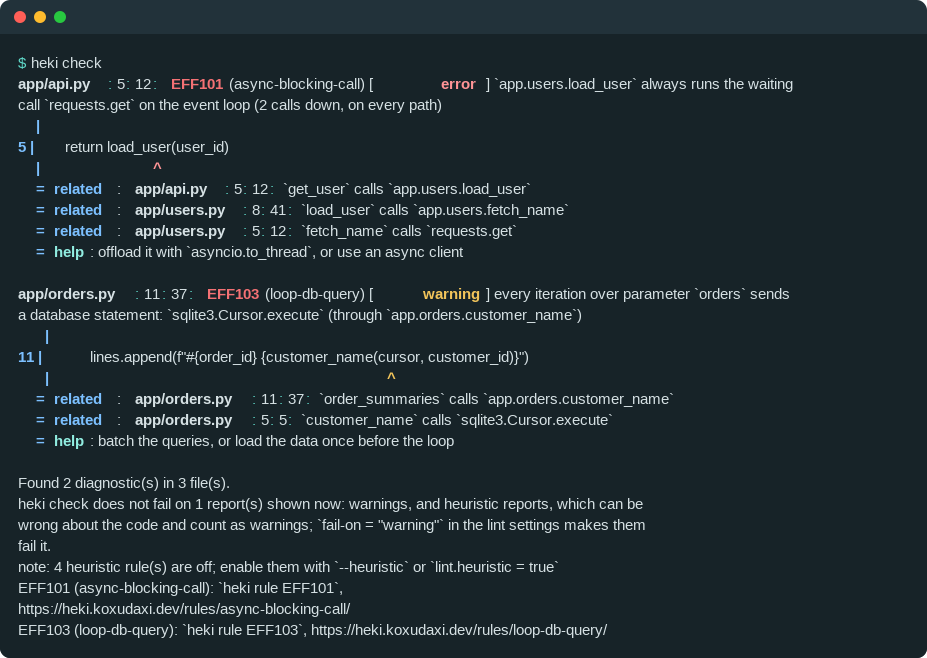
These reports are exact: built only from facts heki established, by rules whose every report on a corpus was checked by hand (Rule precision).
📚 Documentation · 🚀 Getting started · 📏 Rules




⚡ Try it in your project's root, without installing: uvx heki check
A blocking call two helpers below an async def
# app/users.py
import requests

def fetch_name(user_id: int) -> str:
    return requests.get(f"https://api.example.com/users/{user_id}", timeout=5).text

def load_user(user_id: int) -> dict[str, str]:
    return {"id": str(user_id), "name": fetch_name(user_id)}
# app/api.py
from app.users import load_user

async def get_user(user_id: int) -> dict[str, str]:
    return load_user(user_id)
$ heki check
app/api.py:5:12: EFF101 (async-blocking-call) [error] `app.users.load_user` always runs the waiting call `requests.get` on the event loop (2 calls down, on every path)
  |
5 |     return load_user(user_id)
  |            ^
  = related: app/api.py:5:12: `get_user` calls `app.users.load_user`
  = related: app/users.py:8:41: `load_user` calls `app.users.fetch_name`
  = related: app/users.py:5:12: `fetch_name` calls `requests.get`
  = help: offload it with `asyncio.to_thread`, or use an async client

Found 1 diagnostic(s) in 2 file(s).
note: 3 heuristic rule(s) are off; enable them with `--heuristic` or `lint.heuristic = true`
EFF101 (async-blocking-call): `heki rule EFF101`, https://heki.koxudaxi.dev/rules/async-blocking-call/
A query one helper below a loop
# app/orders.py
import sqlite3

def customer_name(cursor: sqlite3.Cursor, customer_id: int) -> str:
    cursor.execute("SELECT name FROM customers WHERE id = ?", (customer_id,))
    return str(cursor.fetchone()[0])

def order_summaries(cursor: sqlite3.Cursor, orders: list[tuple[int, int]]) -> list[str]:
    lines: list[str] = []
    for order_id, customer_id in orders:
        lines.append(f"#{order_id} {customer_name(cursor, customer_id)}")
    return lines
$ heki check
app/orders.py:11:37: EFF103 (loop-db-query) [warning] every iteration over parameter `orders` sends a database statement: `sqlite3.Cursor.execute` (through `app.orders.customer_name`)
   |
11 |         lines.append(f"#{order_id} {customer_name(cursor, customer_id)}")
   |                                     ^
  = related: app/orders.py:11:37: `order_summaries` calls `app.orders.customer_name`
  = related: app/orders.py:5:5: `customer_name` calls `sqlite3.Cursor.execute`
  = help: batch the queries, or load the data once before the loop

Found 1 diagnostic(s) in 1 file(s).
note: 3 heuristic rule(s) are off; enable them with `--heuristic` or `lint.heuristic = true`
EFF103 (loop-db-query): `heki rule EFF103`, https://heki.koxudaxi.dev/rules/loop-db-query/
Ruff, ty, Pyrefly, pyright, and mypy report nothing for either example with their default settings.
How heki differs
The difference is the model, not reaching across files: type checkers already follow types across modules. heki models effects and aliases, what code does:
| Tool | Models | heki adds |
|---|---|---|
| Ruff | syntax and style | the effects behind a call: a blocking call, a query, or a write, wherever it happens |
| ty, Pyrefly, pyright, mypy | declared types | in-place changes, through aliases and helpers, to frozen, ReadOnly, and Final fields and to Sequence / Mapping arguments |
| tach, import-linter | which modules may import which | which functions write or read a field, call a function, or reach I/O; which modules may import which, knowing when each import runs (experimental); planned: these tools' contracts read as heki contracts |
Their stricter settings do not close the gap. The second example above is fully annotated and
passes Ruff's annotation rules (ANN), mypy --strict, pyright's strict mode, and Pyrefly's
strict preset, yet it sends one query per order: the types are right, and what the code does
is slow. heki leaves syntax, style, and types to these tools, and keeps doing so as they grow:
use it next to them.
What a first run shows
Run uvx heki check (or heki check once installed) in the directory with pyproject.toml:
- An error reports a bug that can be critical: a wrong result, an exception, a lost update, a deadlock, an event loop held up for every other task, like the first example above, or a broken contract. A warning reports slower code, like the second, or a bug that is rarely harmful.
- An exact error fails the run (exit code 1). Warnings, and heuristic reports, which can be
wrong about the code, are printed and do not fail it (exit code 0).
--fail-on warning(lint.fail-on = "warning") makes them fail it too. - A note at the end says how many heuristic rules were left off;
--heuristicruns them. - Next,
heki recommend(experimental) says which rules would report on the project, what heki could not see, and the contracts the code already keeps, with the keys to add.
Your conventions, checked instead of reviewed
The checks above need no configuration: EFF101 and EFF103 are exact and run by default.
The rules of your own project, which you keep today by review, by AST scripts, or by run-time
guards in tests, and which a coding agent cannot know unless a check tells it, can be added as a
few lines of it.
For example, these lines say that only the functions in app.store may change Order.items:
[[tool.heki.write-owners]]
name = "order-store"
targets = ["app.models.Order.items"]
allowed-writers = ["app.store.*"]
A function in app/api.py that appends to order.items through a helper breaks it:
$ heki check
app/api.py:9:5: MUT201 (write-owner-violation) [error, heuristic] `add_gift_wrap` writes `app.models.Order.items` (through a helper) via `app.api._append` outside the write owners of `order-store`
  |
9 |     _append(order.items, "gift-wrap")
  |     ^
  = related: app/api.py:9:5: `add_gift_wrap` calls `app.api._append`
The report is heuristic: the contract rules are not
certified yet, and a MUT201 report can
rest on an alias or a helper's write on one path only.
heki follows aliases, helpers, and subclasses, with no decorators and nothing running at run time. Each kind of rule has its own contract:
| What you want to keep | Contract | Main keys |
|---|---|---|
Only app.store changes Order.items |
write-owners |
targets = ["Order.items"], allowed-writers = ["app.store.*"] |
Only app.billing reads Order.card_token |
read-owners |
targets = ["Order.card_token"], allowed-readers = ["app.billing.*"] |
Only app.admin calls app.db.reset |
call-owners |
targets = ["app.db.reset"], allowed-callers = ["app.admin.*"] |
No caller changes the settings load_settings returns to everyone |
readonly-returns |
producers = ["app.config.load_settings"], deep = true |
Every change of Order.items is followed by order_changed() |
invalidation |
targets = ["Order.items"], invalidators = ["app.cache.order_changed"] |
Code in app.render makes no blocking call |
effect-boundaries |
scopes = ["app.render.*"], forbid = ["blocking"] |
app.domain imports nothing from app.web, even lazily or inside a function |
import-boundaries |
importers = ["app.domain.*"], forbidden-imports = ["app.web", "app.web.*"] |
See Contracts for every key.
A safety net for reviews and coding agents
- The language server checks while you edit and re-checks only what an edit can affect.
heki snapshotrecords what each public function does, andMUT103reports a function that gained an effect, which a diff does not show.- Coding agents get the same checks as JSON, and an Agent Skill teaches them the workflow.
heki inspect(experimental) says what one function does, so an agent does not read its callees to find out.
✨ Why heki?
Types say what values are; heki checks what code does:
- Aliases and in-place changes: which objects a function changes, through any alias, helper, or subclass.
- Contracts: who may write, read, or call what, which code may reach I/O, and which modules may import which.
- Proven rewrites: quadratic patterns are rewritten only when the rewrite is proven, not guessed.
What code does, not what types it has
These rules are exact and run by default. Each report shows the chain of calls that leads to it.
| What goes wrong | Rule |
|---|---|
A blocking call that a call in an async def always runs, several helpers below |
EFF101 |
| A database statement on every iteration of a loop over data | EFF103 |
A Sequence / Mapping argument changed in place by a helper |
MUT110 |
A list, dict, or set that an lru_cache / cache function returned, changed in place |
MUT114 |
A change of a builtin container that is lost because the object is new and nothing holds it (list(xs).sort()) |
MUT119 |
| A DataFrame or array concatenated with itself on every loop iteration | DATA101 |
| A list rebuilt, or a dict or set merged, on every loop iteration, and a nested-loop join | OPT101, OPT102, OPT113 |
The size-dependent rewrites (OPT103, OPT110, OPT111, OPT120, OPT121, OPT130) are exact
too, but opt-in: the loops they report were rarely large enough to matter
(Rule precision).
To certify a rule, two reviewers check by hand every exact report it makes on the development
corpus (378 packages and 30.75 million lines, plus packages added for rules with few reports), and
one run on a frozen holdout of 100 packages is checked too. Neither may hold a false claim.
EFF101 and EFF103, the rules of the two examples above, had 287 and 103 reports on the corpus
and 152 and 122 on the holdout, none false.
Rule precision lists every certified rule.
Heuristic reports can be wrong about the code. They are opt-in (heki check --heuristic), and
every output labels them.
The other rules are heuristic or opt-in, and the contract rules run once you declare a contract: see Rules and Rule precision.
Fast, quiet, and easy to adopt
- A 100,000-line project is checked in a few seconds.
heki recommend(experimental) prints advice on the project's configuration, with the keys to add to[tool.heki].- A report needs evidence: when heki cannot tell, it stays quiet.
- Configuration, suppression comments, and output formats follow Ruff, and a baseline fails CI only on new findings.
🔓 What Python leaves open
Rust enforces ownership, Haskell puts IO in the type, and static types let a compiler prove a
rewrite. Python enforces none of these. heki checks what they would catch: objects changed
through helpers, effects behind a call, stale shared state, and quadratic patterns. See the
comparison.
🔧 Rewrites proven under CPython's semantics
The OPT rules find quadratic list, dict, set, bytes, and queue patterns. heki check --fix
rewrites one only when it proves that the program behaves the same:
- it trusts no type annotation (a subclass can override
__add__); - any other reference to the object blocks an in-place update;
- evaluation order and exceptions are kept;
- builtins count only while the module does not rebind them.
A collections.deque rewrite also updates the annotation and adds the import:
$ heki check --diff --include-size-dependent jobs.py
--- a/jobs.py
+++ b/jobs.py
@@ -1,11 +1,12 @@
 """Job queue."""

+import collections
 import os


 def drain(jobs: list[int]) -> int:
-    queue: list[int] = list(jobs)
+    queue: collections.deque[int] = collections.deque(list(jobs))
     total = 0
     while queue:
-        total += queue.pop(0)
+        total += queue.popleft()
     return total
Would fix 1 issue(s) in 1 file(s).
--fix alone applies the rewrites that are faster for every input (OPT101, OPT102). A
size-dependent one like this comes from an opt-in rule: --include-size-dependent runs those
rules and applies their rewrites.
The scope analysis is checked against CPython's symtable on 3.11 to 3.15, and adversarial
programs that break a naive rewrite must all be blocked on CPython. When a proof fails, the
report names the missing obligation instead of offering a fix.
🎯 Scope
- Its knowledge comes from its own analysis, a catalog of library behavior, contracts you
declare in
pyproject.toml, and type annotations, which only help it resolve calls: rewrites never trust them. - When it cannot tell, it stays quiet. Annotations, catalog entries, and contracts close the findings it misses.
- It does not model
__getattr__proxies, metaclasses, or framework machinery, and it never runs your code.
See Scope and limitations for the details.
📦 Installation
$ uv tool install heki      # or: pipx install heki / pip install heki
$ uvx heki check            # run without installing
🏃 Usage
$ heki check                                    # check the project
$ heki check --heuristic                        # also run the heuristic rules
$ heki check --diff                             # preview proven-safe fixes
$ heki check --fix                              # apply them
$ heki check --baseline heki-baseline.toml      # fail only on new findings
$ heki rule EFF101                              # explain a rule
$ heki server                                   # LSP server for editors
$ heki inspect app.users.load_user              # what one function does (experimental)
$ heki recommend                                # configuration advice (experimental)
See Coding agents
for heki inspect and Configuration advice for
heki recommend.
🪜 pre-commit and CI
A pre-commit hook. heki follows calls across files, so the hook analyzes the whole project and
passes the staged files to --touched: it shows and fails on the reports in those files and the
reports whose call chain reaches them, so old findings elsewhere do not block a commit. The
heki-pre-commit repository installs heki from its PyPI
wheel, so there is no compile and no Rust toolchain:
# .pre-commit-config.yaml
repos:
  - repo: https://github.com/koxudaxi/heki-pre-commit
    rev: v0.2.7
    hooks:
      - id: heki
Its tags follow heki releases, so pre-commit autoupdate works. To build heki from source instead,
use repo: https://github.com/koxudaxi/heki with a release rev; pre-commit then builds that
release with cargo on the first run, which takes a few minutes, and installs Rust for the build when
cargo is missing.
A local hook can run any version of the PyPI wheel, also without a compile:
# .pre-commit-config.yaml
repos:
  - repo: local
    hooks:
      - id: heki
        name: heki
        entry: uvx heki check --touched
        language: system   # needs uv on PATH
        types: [python]
        pass_filenames: true
        require_serial: true
        verbose: true      # show warnings: they do not fail the hook
A GitHub Actions workflow with code-scanning alerts (SARIF) and annotations:
# .github/workflows/heki.yml
name: heki
on: [push, pull_request]
permissions:
  contents: read
  security-events: write   # for the SARIF upload
jobs:
  heki:
    runs-on: ubuntu-latest
    steps:
      - uses: actions/checkout@v7
      - uses: astral-sh/setup-uv@v10
      - run: uvx heki check --output-format sarif > heki.sarif || test "$?" -eq 1
      - uses: github/codeql-action/upload-sarif@v4
        with:
          sarif_file: heki.sarif
      - run: uvx heki check --output-format github
Exact errors, such as EFF101 reports, fail the hook and the last step. Warnings, such as
EFF103 reports, and heuristic reports do not, unless you add --fail-on warning or set
fail-on = "warning" in [tool.heki.lint]. The SARIF step keeps findings as alerts and fails
only on a configuration, read, or syntax error. See
Adopting heki for a hook without uv and a Ratchet baseline
that records today's errors, so that only new ones fail.
📚 Documentation
- 🚀 Getting started - run heki on a project, read a diagnostic, apply a fix
- 🎯 Scope and limitations - what heki checks and what it leaves to other tools
- ⚙️ Configuration - rule selection, contracts, the Python version
- 📏 Rules - all 53 rules
- 📐 Rule precision - exact and heuristic rules, and how they are measured
- 🔧 Fixes and safety - how rewrites are proven safe
- 🪜 Adopting heki - Ratchet baselines, pre-commit, CI
- 🖥️ Editors (LSP) - VS Code, Neovim, and any LSP client
- 🤖 Coding agents - JSON output and agent setup
- ⌨️ CLI reference - every command and option
- 🛠️ Development - building, testing, and the gates
- 📝 Changelog
📛 Name
heki is 壁, "wall", in its Sino-Japanese (on) reading, the one used in compounds such as 防火壁 (bōkaheki, "firewall"). On its own the character is usually read kabe.
📄 License
1 maintainer

Metadata
1 maintainer
Release files for heki 0.4.0
For a detailed explanation of source distributions (sdists) and built distributions (wheels), please see the package formats documentation.
Source distribution (sdist)
| File | Size | Uploaded | Provenance | Actions |
|---|---|---|---|---|
| heki-0.4.0.tar.gz | 3.0 MB | With provenance | Details for heki-0.4.0.tar.gz |
Built distributions (wheels)
| File | Actions Reset | |||
|---|---|---|---|---|
| heki-0.4.0-py3-none-win_amd64.whl | Python 3 | none | Windows x86-64 | Details for heki-0.4.0-py3-none-win_amd64.whl |
| heki-0.4.0-py3-none-musllinux_1_2_x86_64.whl | Python 3 | none | Linux musl 1.2+ x86-64 | Details for heki-0.4.0-py3-none-musllinux_1_2_x86_64.whl |
| heki-0.4.0-py3-none-manylinux_2_28_x86_64.whl | Python 3 | none | Linux glibc 2.28+ x86-64 | Details for heki-0.4.0-py3-none-manylinux_2_28_x86_64.whl |
| heki-0.4.0-py3-none-manylinux_2_28_aarch64.whl | Python 3 | none | Linux glibc 2.28+ ARM64 | Details for heki-0.4.0-py3-none-manylinux_2_28_aarch64.whl |
| heki-0.4.0-py3-none-macosx_11_0_arm64.whl | Python 3 | none | macOS 11.0+ ARM64 | Details for heki-0.4.0-py3-none-macosx_11_0_arm64.whl |
| heki-0.4.0-py3-none-macosx_10_12_x86_64.whl | Python 3 | none | macOS 10.12+ x86-64 | Details for heki-0.4.0-py3-none-macosx_10_12_x86_64.whl |
Total release size: 70.3 MB
Release files / heki-0.4.0.tar.gz
| Download URL | heki-0.4.0.tar.gz |
|---|---|
| Size | 3.0 MB |
| Tags | Source |
|
SHA-256 checksum How to use checksums |
c56527de33970cf9dfae53a6b197dc22f2e3ed797892a0adca87ad1f33a15dff
|
|
BLAKE2b-256 checksum How to use checksums |
12c83467799bff554befa2323b12bc435f093ad319b38121ef6566d50dfc3163
|
| Upload date | |
|
Uploaded using Trusted Publishing? What is trusted publishing? |
Yes |
| Uploaded via |
twine/7.0.0 CPython/3.13.16
|
Provenance
Provenance describes where a file came from. On PyPI, provenance is shared via attestations, which provide a verifiable record of the build or publishing details. View details, limitations and caveats.


PyPI Publish Attestation
PyPI verified that this artifact, at this checksum, originated from the publisher listed below.
Signed by GitHub Actions, verified by PyPI on Nov 24, 2026.
Transparency logRelease files / heki-0.4.0-py3-none-win_amd64.whl
| Download URL | heki-0.4.0-py3-none-win_amd64.whl |
|---|---|
| Size | 10.6 MB |
| Tags | Python 3 Windows x86-64 |
|
SHA-256 checksum How to use checksums |
168a7210c0e822e97c47d19a9e18e03ac981862f355ef376ea4f899fa2af0aed
|
|
BLAKE2b-256 checksum How to use checksums |
316cb63a1b685adf10c3246878ef8cbcfd5f06f9541ad6d70ea9cba5ac690fff
|
| Upload date | |
|
Uploaded using Trusted Publishing? What is trusted publishing? |
Yes |
| Uploaded via |
twine/7.0.0 CPython/3.13.16
|
Provenance
Provenance describes where a file came from. On PyPI, provenance is shared via attestations, which provide a verifiable record of the build or publishing details. View details, limitations and caveats.
PyPI Publish Attestation
PyPI verified that this artifact, at this checksum, originated from the publisher listed below.
Signed by GitHub Actions, verified by PyPI on Nov 24, 2026.
Transparency logRelease files / heki-0.4.0-py3-none-musllinux_1_2_x86_64.whl
| Download URL | heki-0.4.0-py3-none-musllinux_1_2_x86_64.whl |
|---|---|
| Size | 12.0 MB |
| Tags | Linux musl 1.2+ x86-64 Python 3 |
|
SHA-256 checksum How to use checksums |
daaf7fa4cd37b0c66445a3f92bf79ee8c0a63747c957b56426b9854567124589
|
|
BLAKE2b-256 checksum How to use checksums |
3eb594ad72de5fc871e36fc178f8477adb2040fca3c46df86d319ceb0140a226
|
| Upload date | |
|
Uploaded using Trusted Publishing? What is trusted publishing? |
Yes |
| Uploaded via |
twine/7.0.0 CPython/3.13.16
|
Provenance
Provenance describes where a file came from. On PyPI, provenance is shared via attestations, which provide a verifiable record of the build or publishing details. View details, limitations and caveats.
PyPI Publish Attestation
PyPI verified that this artifact, at this checksum, originated from the publisher listed below.
Signed by GitHub Actions, verified by PyPI on Nov 24, 2026.
Transparency logRelease files / heki-0.4.0-py3-none-manylinux_2_28_x86_64.whl
| Download URL | heki-0.4.0-py3-none-manylinux_2_28_x86_64.whl |
|---|---|
| Size | 11.6 MB |
| Tags | Linux glibc 2.28+ x86-64 Python 3 |
|
SHA-256 checksum How to use checksums |
07569879d8759f97af64ba8f9dad43c9a76a620a9a51662a2713e37ba2b9c702
|
|
BLAKE2b-256 checksum How to use checksums |
ed2b3ad86d2e1e62c682d7df43edeecc586ba042fbf9f8ed31d268aa868db7f6
|
| Upload date | |
|
Uploaded using Trusted Publishing? What is trusted publishing? |
Yes |
| Uploaded via |
twine/7.0.0 CPython/3.13.16
|
Provenance
Provenance describes where a file came from. On PyPI, provenance is shared via attestations, which provide a verifiable record of the build or publishing details. View details, limitations and caveats.
PyPI Publish Attestation
PyPI verified that this artifact, at this checksum, originated from the publisher listed below.
Signed by GitHub Actions, verified by PyPI on Nov 24, 2026.
Transparency logRelease files / heki-0.4.0-py3-none-manylinux_2_28_aarch64.whl
| Download URL | heki-0.4.0-py3-none-manylinux_2_28_aarch64.whl |
|---|---|
| Size | 11.2 MB |
| Tags | Linux glibc 2.28+ ARM64 Python 3 |
|
SHA-256 checksum How to use checksums |
f55ab87fa9590f6df4ab7862848feb66587fad5c5b6cec58ce5a58306e89af1b
|
|
BLAKE2b-256 checksum How to use checksums |
b47f60d3ddcdaad5cc5d866298d1fe7b01e244575acd09b10da67eeefb484ece
|
| Upload date | |
|
Uploaded using Trusted Publishing? What is trusted publishing? |
Yes |
| Uploaded via |
twine/7.0.0 CPython/3.13.16
|
Provenance
Provenance describes where a file came from. On PyPI, provenance is shared via attestations, which provide a verifiable record of the build or publishing details. View details, limitations and caveats.
PyPI Publish Attestation
PyPI verified that this artifact, at this checksum, originated from the publisher listed below.
Signed by GitHub Actions, verified by PyPI on Nov 24, 2026.
Transparency logRelease files / heki-0.4.0-py3-none-macosx_11_0_arm64.whl
| Download URL | heki-0.4.0-py3-none-macosx_11_0_arm64.whl |
|---|---|
| Size | 10.7 MB |
| Tags | Python 3 macOS 11.0+ ARM64 |
|
SHA-256 checksum How to use checksums |
a44446b9c2effdda79a73b483a9a0bdab8854676a6f4b4b9a2f5bdaf5b7c942b
|
|
BLAKE2b-256 checksum How to use checksums |
d3a0776f58e8ae6bc18a5d01ac336e8028137347bf6fb2623908469764e4e546
|
| Upload date | |
|
Uploaded using Trusted Publishing? What is trusted publishing? |
Yes |
| Uploaded via |
twine/7.0.0 CPython/3.13.16
|
Provenance
Provenance describes where a file came from. On PyPI, provenance is shared via attestations, which provide a verifiable record of the build or publishing details. View details, limitations and caveats.
PyPI Publish Attestation
PyPI verified that this artifact, at this checksum, originated from the publisher listed below.
Signed by GitHub Actions, verified by PyPI on Nov 24, 2026.
Transparency logRelease files / heki-0.4.0-py3-none-macosx_10_12_x86_64.whl
| Download URL | heki-0.4.0-py3-none-macosx_10_12_x86_64.whl |
|---|---|
| Size | 11.3 MB |
| Tags | Python 3 macOS 10.12+ x86-64 |
|
SHA-256 checksum How to use checksums |
731359d05f0196bab3e11ba0a81e0c28eaf3187726ee5922defd8cbe5cbc2b1c
|
|
BLAKE2b-256 checksum How to use checksums |
e77999b9bb0b4a85ffde2dbf888b181a8613d5b86e9b926d6f4c5cf0350f3da6
|
| Upload date | |
|
Uploaded using Trusted Publishing? What is trusted publishing? |
Yes |
| Uploaded via |
twine/7.0.0 CPython/3.13.16
|
Provenance
Provenance describes where a file came from. On PyPI, provenance is shared via attestations, which provide a verifiable record of the build or publishing details. View details, limitations and caveats.
PyPI Publish Attestation
PyPI verified that this artifact, at this checksum, originated from the publisher listed below.
Signed by GitHub Actions, verified by PyPI on Nov 24, 2026.
Transparency logSecurity for heki 0.4.0
Provenance
Provenance describes where a file came from. On PyPI, provenance is shared via attestations, which provide a verifiable record of the build or publishing details. View details, limitations and caveats.
Full provenance
All 7 files in this release have been uploaded with provenance metadata.
Attestation for heki-0.4.0.tar.gz
PyPI Publish Attestation
PyPI verified that this artifact, at this checksum, originated from the publisher listed below.
Signed by GitHub Actions, verified by PyPI on Nov 24, 2026.
Transparency logA note on package security
PyPI is a repository for distributing packages, not a service for auditing them. While third-party security researchers and our staff do their best to detect and remove malicious packages, PyPI cannot guarantee the quality, security or suitability of any given package.
To learn more about protecting yourself from malicious actors, visit our package security documentation.














