
Helix — a declarative DSL and compiler for reproducible gene-editing design.

Project description

Helix
A declarative DSL & compiler for reproducible gene-editing design.





Quickstart · Highlights · The language · Architecture · MCP server · Deep dive
Most agentic gene-editing tools are chat interfaces that produce a one-off answer. Helix treats an editing experiment as source code: you write a small declarative spec (the intent), and a deterministic compiler — assisted by narrowly-scoped LLM agents — turns it into a fully resolved, provenance-stamped design you can diff, version, review, and re-run.
The key rule: agents may only emit or edit a spec; only the deterministic compiler produces the design. That keeps the trust boundary auditable and every run reproducible — the same audit trail that protects a human protects an agent.
Highlights
- 🧬 8 modalities — knockout · base editing (CBE/ABE/CGBE) · prime editing · HDR knock-in · dual-cut deletion · CRISPRi / CRISPRa.
- 🎯 Constraints are first-class — the compiler solves against them and reports infeasibility, instead of silently returning "the top N".
- 🔬 Protein-consequence aware — every coding edit is called silent · missense · premature-STOP (iSTOP) · stop-loss · frameshift, with guaranteed-synonymous HDR PAM-blocks.
- 🧪 Variant-aware guides — flags common population SNPs in the seed/PAM (a SNP there abolishes binding in carriers).
- 🔌 Injectable backends — swap a heuristic for a real tool (Cas-OFFinder, inDelphi, BE-Hive, PRIDICT, Ensembl/NCBI, ESMFold) by editing the spec, not the code.
- 🤖 MCP server + LLM agents — any agent can drive the compiler through the spec → compile boundary.
- 🖥️ Web UI — syntax-highlighting editor, interactive 3D helix, order-ready oligos, and results analysis.
- ♻️ Reproducible & auditable — every design is provenance-stamped; diff and version it in git.
Quickstart
pip install helix-dsl                                       # or: pip install -e '.[all]'

helix compile examples/tp53_ko.hx -o out                    # knockout (SpCas9)
helix compile examples/istop_base_edit.hx                   # base editing → iSTOP knockout
helix compile examples/tp53_prime_edit.hx                   # prime editing (pegRNA)
helix compile examples/tp53_knock_in.hx                     # HDR knock-in (cut + donor)
helix compile examples/tp53_ko_ensembl.hx                   # resolves TP53 from Ensembl (network)
helix validate examples/tp53_ko.hx                          # parse + safety screen only
compile prints a Markdown protocol and (with -o) writes out/design.json (the
reproducible record) and out/protocol.md (what a bench scientist reads). See all
eight modalities in examples/.
The language
A Helix spec can be written in the Helix grammar (.hx) or YAML — both compile
to the same validated ExperimentSpec.
helix "TP53_KO_HEK293" {
  organism: human(GRCh38)
  profile:  strict                                 # preset efficiency / off-target / GC / hairpin defaults
  target: gene(TP53) { goal: knockout; region: exon(2..4); frame: 0 }
  strategy { modality: crispr_ko; enzyme: auto }   # `auto` → the compiler picks (delivery-aware)
  constraints {
    on_target.min_efficiency: 0.5
    off_target.max_cfd: 0.2
    gc.min: 0.4                                     # spacer GC window
    guides.count: 3
    avoid: [ homopolymer(>=4), self_complementary(>=8), common_variant(>=0.01) ]
  }
  simulate { sequence_provider: ensembl; on_target: rule_set_1; variant_source: ensembl }
  deliver: rnp
  validate: amplicon_seq
}
- Guide-quality constraints — GC window, hairpin/self-complementarity, homopolymer, and restriction-site filters, each reported as a pass/fail check in the drill-down.
profile: strict | lenient | screen | quickpresets sensible defaults; anything you write overrides them. frame: 0unlocks the protein-consequence calls above and the guaranteed-synonymous HDR PAM-block.variant_source: ensembl+avoid: [common_variant(>=0.01)]reject guides with a common SNP in the seed/PAM.
Full grammar → GRAMMAR.md.
Architecture
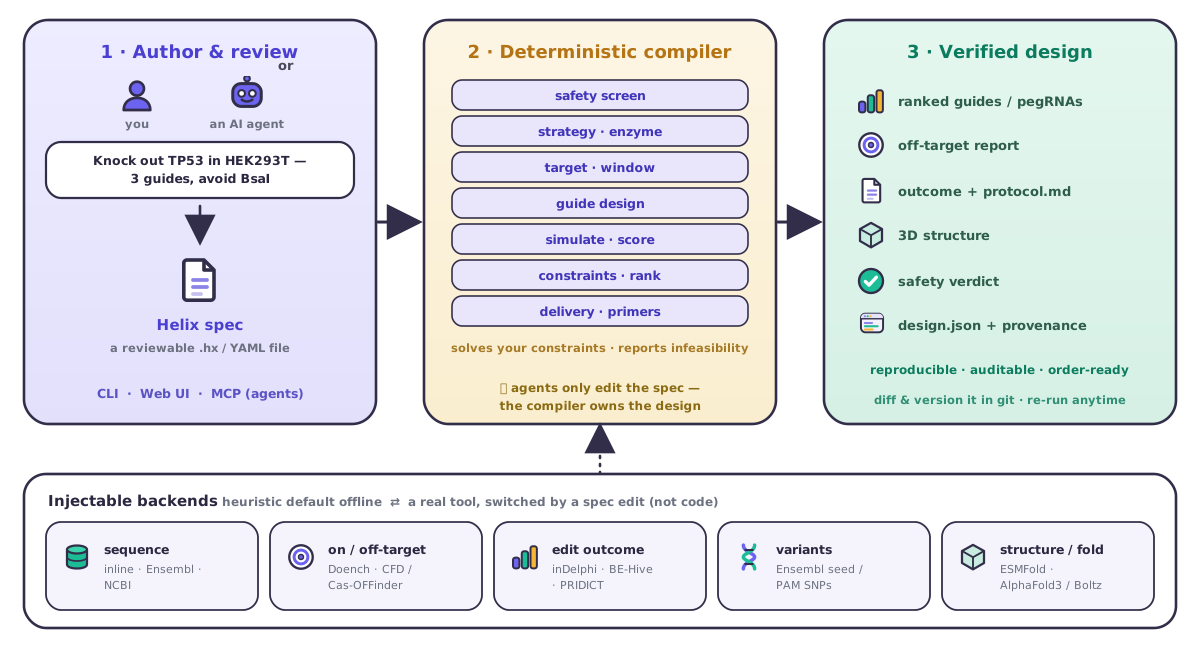
Three layers:
- Helix Studio — author and review a spec via the CLI, Web UI, or MCP (agents). The spec is the reviewable artifact.
- Deterministic compiler — a fixed pipeline (safety → strategy → target → guides → simulate → constraints → primers) plus narrowly-scoped LLM agents/builders and a provenance-stamped design store. Agents only touch the spec; the compiler owns the design.
- Simulate & score — pluggable backends score each candidate. Heuristics run offline by default; a spec edit swaps in a real tool.
Everything routes through injectable adapter Protocols, so the whole spine is testable offline and a real tool drops in behind the same interface. Deep dive → ARCHITECTURE.md.
MCP server — gene-editing design for agents
Agents are good at writing a constrained spec and bad at safely orchestrating raw bioinformatics tools — exactly the split Helix is built around. So Helix ships as an MCP server: any MCP-capable agent (Claude, etc.) drives the compiler, but only through the spec → compile boundary.
helix mcp # stdio JSON-RPC server, zero extra deps (== python3 -m helix.mcp)
// register with an MCP client
{ "mcpServers": { "helix": { "command": "helix", "args": ["mcp"] } } }
Tools: helix_reference (grammar + guide + examples), helix_compile (spec →
ranked, safety-screened design summary), helix_resolve_gene (symbol → sequence +
locus), helix_list_models (selectable backends). MCP is simply a fourth transport
(alongside HTTP / subprocess / import) that connects agents to the compiler.
Backends
The deterministic spine runs fully offline on honest, clearly-labelled heuristics; each is a drop-in target for a real tool behind the same Protocol — selected by a spec edit.
| role | built-in | real tool (same interface) | status |
|---|---|---|---|
| sequence | inline |
ensembl, ncbi, fallback (Ensembl→NCBI) |
✅ live + fallback |
| on-target | heuristic_gc |
rule_set_1 (Doench 2014) |
✅ wired |
| off-target | mock_seed |
cas_offinder_cfd (CFD; scan needs a genome) |
✅ wired |
| repair outcome | mock_indel |
indelphi (Shen 2018) |
✅ wired |
| base-edit outcome | window_heuristic |
behive (Arbab 2020) |
✅ wired |
| prime-edit outcome | pe_heuristic |
pridict (Mathis 2023) |
✅ wired |
| structure / folding | esmfold (real, no key) |
AlphaFold3 / Boltz (HELIX_FOLDING_BIN) |
✅ ESMFold live |
The verified-real cores (Doench 2014, Doench 2016 CFD) are pure and always on; heavy
models sit behind injectable boundaries — configured in when a genome/tool is present,
and raising a clear error otherwise so the mock_* path always runs offline.
Web UI
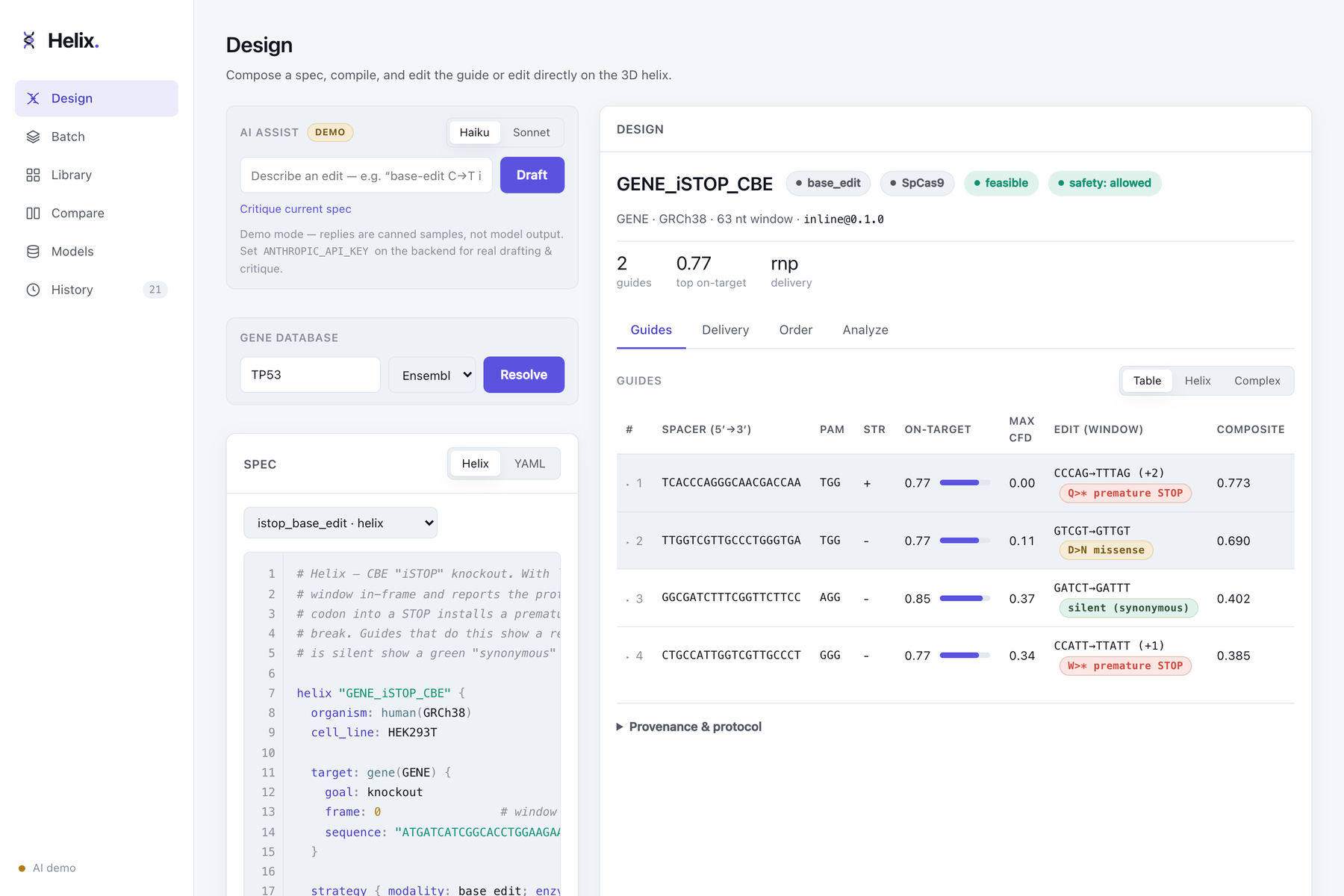
An interactive frontend (React + TypeScript, Vite) over a FastAPI backend — compile a spec and inspect ranked guides/pegRNAs, outcome metrics, feasibility, safety, provenance, and a delivery recommendation, in three views (Table · 3D helix · Cas9 complex). The helix is interactive: click a base to place an edit, drag to sweep it, and the compiler recompiles (a 3D → spec round-trip). Batch and Library modes, a design compare, a design-aware Models page, and a server-persisted run history round it out.
# One-command product: build the UI once, then serve UI + API on one origin.
cd frontend && npm install && npm run build && cd ..
pip install -e '.[web]' && helix serve       # full app on http://localhost:8000
Advanced — LLM agents · analysis loop · delivery · order export
- LLM agents (opt-in,
ANTHROPIC_API_KEY) —helix authorturns English into a.hxspec (validated by the real parser, self-repairing on error);--strategy llm|ragresolvesenzyme: auto(RAG cites a literature corpus);helix critiqueflags weaknesses and proposes IR-validated constraint edits;helix refineruns critique → recompile autonomously until convergence. The LLM sits behind an injectable client, fully tested offline with a fake. - Design → validate → analyse loop —
helix analyzeruns CRISPResso2 on amplicon reads and reconciles observed editing against the design's prediction. In the UI, an Analyze card does the same with a pure-Python caller (no install needed). - Order-ready oligos — every design exports guide cloning oligos (Golden Gate), pegRNA extensions, ssODN donors, and validation primers as a table + IDT CSV with a rough cost.
- Delivery-aware strategy — recommends RNP / plasmid / LNP / AAV from cargo size and context, honouring the single-AAV limit (an AAV knockout with
enzyme: autopicks the compact SaCas9). - Gene database — resolve a symbol to its edit window live from Ensembl / NCBI; the Models page lists every backend with a live ready / needs-setup status.
License
Release history Release notifications | RSS feed


Download files
Download the file for your platform. If you're not sure which to choose, learn more about installing packages.
Source Distribution
Built Distribution
Filter files by name, interpreter, ABI, and platform.
If you're not sure about the file name format, learn more about wheel file names.
Copy a direct link to the current filters
File details
Details for the file helix_dsl-0.1.1.tar.gz.
File metadata
- Download URL: helix_dsl-0.1.1.tar.gz
- Upload date:
- Size: 154.8 kB
- Tags: Source
- Uploaded using Trusted Publishing? No
- Uploaded via: twine/6.2.0 CPython/3.9.6
File hashes
| Algorithm | Hash digest | |
|---|---|---|
| SHA256 |
c777d64eb3d1f05970d39c26baddbe48bb15b8e2dd7e2a23ddf99af13461181d
|
|
| MD5 |
55cf77eed327b3dfd987608368398163
|
|
| BLAKE2b-256 |
3d95d7fa61fb7f7db71328087eab05477690dc1f025d9cbe69fc2ac85a9eee47
|
File details
Details for the file helix_dsl-0.1.1-py3-none-any.whl.
File metadata
- Download URL: helix_dsl-0.1.1-py3-none-any.whl
- Upload date:
- Size: 147.3 kB
- Tags: Python 3
- Uploaded using Trusted Publishing? No
- Uploaded via: twine/6.2.0 CPython/3.9.6
File hashes
| Algorithm | Hash digest | |
|---|---|---|
| SHA256 |
589aeac8dea03abba4ee6ceb9b95ad4f10d7e3205bf0898f3dec4b1eafd9d4fb
|
|
| MD5 |
400b499cf18bee5733a3a3df348ed8d3
|
|
| BLAKE2b-256 |
480308bdb181e4bd0d34b31557e25851c7d1fedb844c742c0920fb6d1a7ad3d9
|






