

Heretic
Training-free language model modification
Remove censorship, suppress slop, reduce sycophancy, and more.
All in an afternoon, on your gaming PC.


Modify any LLM that you can run on your hardware1
Heretic is a unique tool that lets you do what only corporations with access to massive computing power usually do: Modify, rather than merely run, language models. It does not perform expensive training; rather, it uses a collection of mathematical techniques to steer behavior based on contrasting example prompts and matching scorers.
Heretic can, depending on the configuration:
- Suppress refusals/remove censorship (this is the default action)
- Reduce slop (
config.noslop.toml) - Reduce humor (
config.nohumor.toml) - Reduce sycophancy (
config.nosyco.toml) - Alter emotional alignment (
config.emotions.toml)
and many, many other things.
‼️ Using Heretic does NOT require understanding how language models work internally ‼️
In fact, you can go from zero to removing censorship from your first model in a matter of seconds. Heretic supports most dense models, including many multimodal models, several different MoE architectures, and many modern hybrid models.
The community has created and published thousands of models with Heretic. Heretic models have been independently benchmarked using standard metrics like MMLU and GSM8K, and have been found to compare favorably against models produced with competing abliteration tools.23
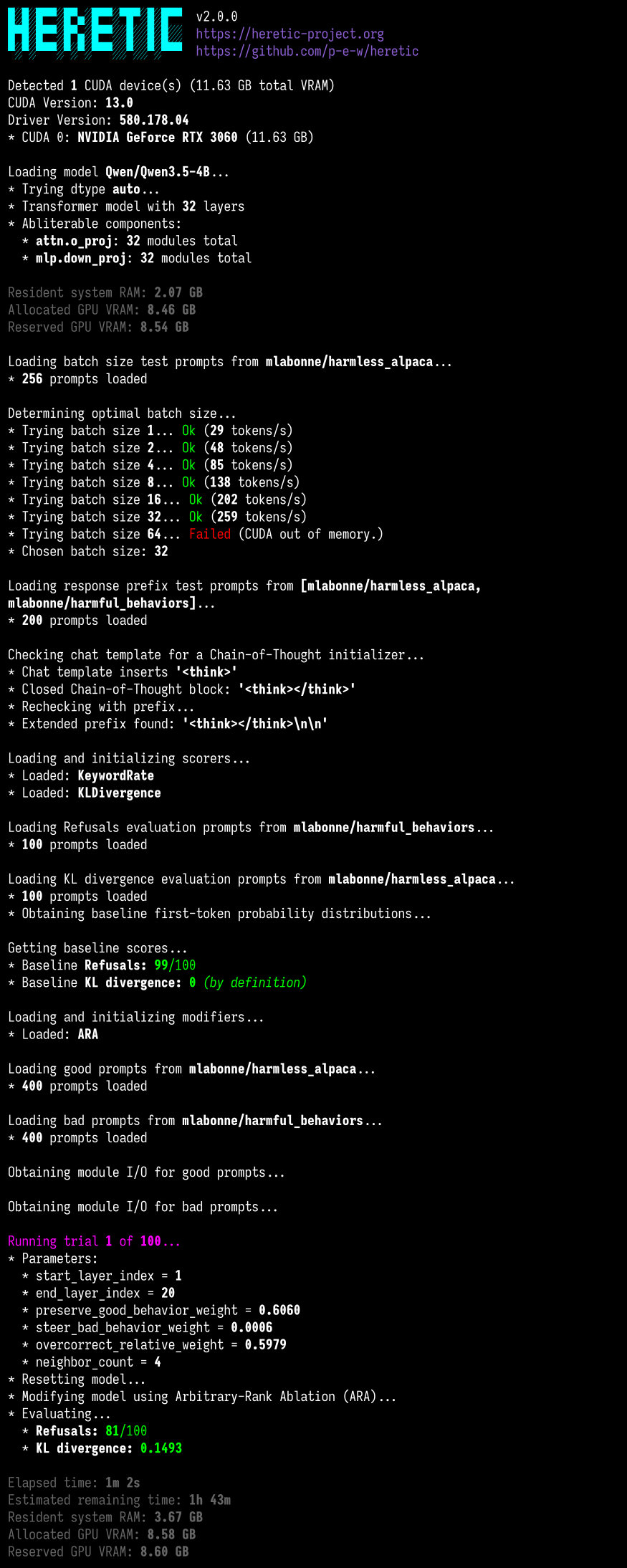
Usage
Prepare a Python 3.10+ environment with PyTorch 2.6+ installed as appropriate for your hardware. Then run:
pip install -U heretic-llm
heretic Qwen/Qwen3-4B-Instruct-2507
Replace Qwen/Qwen3-4B-Instruct-2507 with whatever model you want to process.
By default, Heretic performs censorship removal (refusal suppression).
If you want to do something else, choose one of the configuration files linked
above, or write your own. See config.default.toml
for available configuration options.
At the start of a program run, Heretic benchmarks the system to determine the optimal batch size to make the most of the available hardware. On an RTX 3090, with the default configuration, processing Qwen3-4B-Instruct-2507 takes about 30-40 minutes.
After Heretic has finished processing a model, you are given the choice to save the model, upload it to Hugging Face, chat with it to test how well it works, run standard benchmarks on it, or any combination of those actions.
Controlling what Heretic does using scorer plugins
Heretic steers model behavior by optimizing one or multiple scores. Scores are computed by scorer plugins. You can easily write your own scorers to get full control over what Heretic does to models.
The Scorer interface (abstract base class) your scorer needs to inherit from
is defined in scorer.py. The only required method
is get_score, but there is more machinery (such as settings management)
available when you need it.
By default, Heretic scores models by refusal rate (implemented in
keyword_rate.py) and KL divergence
(implemented in kl_divergence.py).
Additional scorers are available in the scorers directory.
These scorers can serve as examples for your own implementations, and can easily
be adapted to your needs.
Scorers are configured through the main configuration file.
Which scorer plugins are active is determined by the scorers setting, which
also controls whether a scorer's score should be minimized or maximized during
optimization. Any number of scorers can be used simultaneously, and their scores
will be co-optimized. Multiple instances of the same scorer can be configured
with different settings. See the configuration file for the full documentation
of this mechanism.
The path to a scorer plugin can be specified either as a fully qualified import
path (fully.qualified.module.MyScorerClass) or as a file path followed by
a class name (path/to/plugin.py:MyScorerClass). You do not have to modify
the Heretic package code in order to use your own plugins.
Heretic also has modifier plugins, which are described in the next section.
How Heretic works
Heretic combines a pluggable modifier (interface in
modifier.py) with a TPE-based hyperparameter optimizer
powered by Optuna. The optimizer finds a set of parameters that,
when passed to the modifier, minimize or maximize a set of configurable scores on the resulting model (see above).
Heretic ships with two modifiers:
-
Arbitrary-Rank Ablation (ARA)4: This is the default modifier, and was specifically developed for use in Heretic. You can find an overview of how ARA works in the original pull request, and see the precise implementation in
ara.py. -
Directional ablation aka "abliteration"5: The classic method for refusal suppression. Heretic's implementation uses a flexible ablation weight kernel over the layers, and supports both projected abliteration6 and norm preservation (MPOA)7. The complete code is in
abliteration.py.
You can use the modifiers setting to switch between modifier implementations.
Despite the name of the setting using a plural form, Heretic currently allows
only a single modifier for a given processing run. This may change in the future.
Reproducibility and the Heretic Grimoire
Heretic has the ability to create reproducible models whose repositories contain all information required to produce a byte-for-byte identical model on demand, provided that the environment is perfectly identical to the original one. PyTorch doesn't guarantee that operations return identical outputs unless hardware, drivers, operating system, and the entire software stack including all package versions are exactly the same.
Heretic manages all that complexity for you. When uploading a processed model to
Hugging Face, Heretic offers to include reproducibility information. This is entirely
optional, but if you choose to do so, the uploaded repository will contain a
reproduce folder with detailed instructions for recreating the model
(example).
This folder contains both human-readable instructions and a machine-readable manifest
file named reproduce.json, which includes all the information Heretic needs to
automatically reproduce the model.
Automatic reproduction can be performed with
heretic --reproduce path/to/reproduce.json
Heretic will guide you through the process, checking your environment against the one that was used to create the model, and pointing out potentially problematic mismatches. The multi-hour computations that were required to make the original model do not have to be re-done, and the entire process typically takes a few minutes. After you have exported the resulting model, Heretic will verify the hashes of the weight files against those stored in the reproduction manifest (they may or may not be identical, depending on how closely your system resembles the original one).
Many people have uploaded models with reproducibility information to Hugging Face. Since a reproduction manifest is only around 9 kilobytes in size, these manifests form a portable library of models that can be reproduced at will.
That library is called the Heretic Grimoire. You can view it here.
But you don't have to rely on an externally hosted web application to access the library of manifests: The Grimoire is fundamentally designed as a distributed system, and you can fetch your own local copies of publicly available manifests from Hugging Face whenever you want by running
heretic --collect-reproducibles path/to/target/folder/
You now have a local backup of all reproducible Heretic models, properly catalogued. To update this collection, simply run the command again. It functions as an append-only backup, never deleting files even if the corresponding model no longer exists on Hugging Face.
Heretic is made by humans!
Unlike lots of AI-related software today (and indeed lots of software in general), Heretic is not "vibe-coded".
All of my commits in this project so far were written 100% by hand, the way I have been doing programming for decades, and while some Heretic contributors use coding agents, I review every single line of code that I merge very carefully. There's no "LGTM" here!
Don't believe me? Check out this pull request, which accumulated almost 350 human-written comments over more than 7 months as we discussed the implementation. And here is another PR with more than 200 comments.
I am the opposite of a luddite and I have used agents for other projects, but I am proud of the code I write and so far can't quite bring myself to let a machine write it for me in a project I care so much about. As a result, Heretic has a lean, relatively simple codebase that in my opinion, and in that of some others, is a pleasure to work on.
If you like that, join us! Hop on the Discord and tell us about your ideas for improvements, or directly file an issue or open a PR.
Prior art
I'm aware of the following implementations of abliteration techniques that were publicly available when Heretic was first released (November 2025):
- AutoAbliteration
- abliterator.py
- wassname's Abliterator
- ErisForge
- Removing refusals with HF Transformers
- deccp
Note that Heretic was written from scratch, and does not reuse code from any of those projects.
Acknowledgments
The development of Heretic was informed by:
- The original abliteration paper (Arditi et al. 2024)
- Maxime Labonne's article on abliteration, as well as some details from the model cards of his own abliterated models, such as the use of non-constant ablation weights
- Jim Lai's articles describing "projected abliteration" and "norm-preserving biprojected abliteration"
- Thousands of interactions with members of the community
Citation
If you use Heretic for your research, please cite it using the following BibTeX entry:
@misc{heretic,
  author = {Weidmann, Philipp Emanuel},
  title = {Heretic: Training-free language model modification},
  year = {2025},
  publisher = {GitHub},
  journal = {GitHub repository},
  howpublished = {\url{https://github.com/p-e-w/heretic}}
}
License
Copyright © 2025-2026 Philipp Emanuel Weidmann (pew@worldwidemann.com) + contributors
This program is free software: you can redistribute it and/or modify it under the terms of the GNU Affero General Public License as published by the Free Software Foundation, either version 3 of the License, or (at your option) any later version.
This program is distributed in the hope that it will be useful, but WITHOUT ANY WARRANTY; without even the implied warranty of MERCHANTABILITY or FITNESS FOR A PARTICULAR PURPOSE. See the GNU Affero General Public License for more details.
You should have received a copy of the GNU Affero General Public License along with this program. If not, see https://www.gnu.org/licenses/.
By contributing to this project, you agree to release your contributions under the same license.
-
Heretic supports on-the-fly 4-bit model quantization with bitsandbytes, which can reduce the amount of VRAM required to process a model to the same amount that is used to run a typical quantized version of it, at a slight accuracy cost. Set the
quantizationoption tobnb_4bitto enable this. ↩ -
https://old.reddit.com/r/LocalLLaMA/comments/1sojjoc/abliterlitics_benchmark_and_tensor_analysis/ ↩
-
https://old.reddit.com/r/LocalLLaMA/comments/1sy18lx/abliterlitics_benchmarks_and_tensor_comparison/ ↩
-
Weidmann 2026. A preprint explaining the technique will be available soon. ↩
1 maintainer

Metadata
1 maintainer
Release files for heretic-llm 2.0.0
For a detailed explanation of source distributions (sdists) and built distributions (wheels), please see the package formats documentation.
Source distribution (sdist)
| File | Size | Uploaded | Provenance | Actions |
|---|---|---|---|---|
| heretic_llm-2.0.0.tar.gz | 73.5 kB | Without provenance | Details for heretic_llm-2.0.0.tar.gz |
Built distribution (wheel)
| File | Interpreter | ABI | Platform | Actions Reset |
|---|---|---|---|---|
| heretic_llm-2.0.0-py3-none-any.whl | Python 3 | none | any | Details for heretic_llm-2.0.0-py3-none-any.whl |
Total release size: 157.2 kB
Release files / heretic_llm-2.0.0.tar.gz
| Download URL | heretic_llm-2.0.0.tar.gz |
|---|---|
| Size | 73.5 kB |
| Tags | Source |
|
SHA-256 checksum How to use checksums |
c0ecdb1b6756b0bb910d865f5fad5c5513bc5a24923bb188c57dd5210f21a18e
|
|
BLAKE2b-256 checksum How to use checksums |
614b1af2484ee6864f4ab6dc4a47400bb0149892a517653eee5ffd34ea006a58
|
| Upload date | |
|
Uploaded using Trusted Publishing? What is trusted publishing? |
No |
| Uploaded via |
uv/0.13.6 {"installer":{"name":"uv","version":"0.13.6","subcommand":["publish"]},"python":null,"implementation":{"name":null,"version":null},"distro":{"name":"Fedora Linux","version":"44","id":"","libc":null},"system":{"name":null,"release":null},"cpu":null,"openssl_version":null,"setuptools_version":null,"rustc_version":null,"ci":null}
|
Release files / heretic_llm-2.0.0-py3-none-any.whl
| Download URL | heretic_llm-2.0.0-py3-none-any.whl |
|---|---|
| Size | 83.6 kB |
| Tags | Python 3 |
|
SHA-256 checksum How to use checksums |
d104be51a6b535b9cfc31ce8efa4442cebeeac9d009ccc27ff56c5b107ba12d0
|
|
BLAKE2b-256 checksum How to use checksums |
71d59c18d4036b5dd5d2ba6d392b1e0b830fd6b9cf07c8e17f94ecac5769acd5
|
| Upload date | |
|
Uploaded using Trusted Publishing? What is trusted publishing? |
No |
| Uploaded via |
uv/0.13.6 {"installer":{"name":"uv","version":"0.13.6","subcommand":["publish"]},"python":null,"implementation":{"name":null,"version":null},"distro":{"name":"Fedora Linux","version":"44","id":"","libc":null},"system":{"name":null,"release":null},"cpu":null,"openssl_version":null,"setuptools_version":null,"rustc_version":null,"ci":null}
|
Security for heretic-llm 2.0.0
Provenance
Provenance describes where a file came from. On PyPI, provenance is shared via attestations, which provide a verifiable record of the build or publishing details. View details, limitations and caveats.
No provenance found
None of the files in this release were uploaded with provenance metadata.
A note on package security
PyPI is a repository for distributing packages, not a service for auditing them. While third-party security researchers and our staff do their best to detect and remove malicious packages, PyPI cannot guarantee the quality, security or suitability of any given package.
To learn more about protecting yourself from malicious actors, visit our package security documentation.














