

Hebbian Robotics (YC S26)
HFlow
Open source SDK for building Physical AI data pipelines



HFlow provides reusable infrastructure for physical AI data pipelines. Add your existing Python transformations, quality checks, labels, and enrichments; HFlow handles the orchestration, storage, versioning, and curation around them.
HFlow stamps each processed episode with its provenance, renders the pipeline as a graph, and records metadata and quality evidence in a queryable catalog. You can trace how outputs were produced, monitor every stage, and investigate a corpus without loading the underlying recordings.
The design is an open source implementation of Dyna Robotics' "Training Dyna-2 at million-hour scale, repeatably" article, published August 2026. Dyna-2 was trained on more than one million hours of egocentric video data, and the post describes the reusable infrastructure that made processing and experimenting with that data repeatable. You can think of HFlow as an independent, open-source implementation of those public ideas, adapted for people who need the same foundation without Dyna's million-hour production stack. It is not Dyna's private source code or an undisclosed wire-compatible production system.
MCAP is HFlow's v1 input and output boundary because it efficiently stores and serves synchronized video, state, action, and other time-series streams. That format requirement does not define where the data comes from: human-worn cameras, teleoperated robots, autonomous policies, and other collection systems can all feed the pipeline once their data is represented as a supported MCAP episode.
Status: pre-v1, with the core lifecycle working end to end. HFlow is ready to try locally. See what is implemented and open issues for current details and remaining work.
Help advance open robotics and Physical AI. Contributors are welcome, and no robot hardware is required.
| HFlow's boundary | |
|---|---|
| Input | One multimodal episode per standard MCAP file |
| Processing | Your Python transforms, checks, labels, and enrichments |
| Execution | In-process for development; generated Airflow 3 DAGs for scheduled runs |
| Durable output | Canonical MCAP episodes, provenance, artifacts, and a Parquet catalog |
| Curation | DuckDB SQL that writes a version-pinned manifest |
What you get
Human and robot data move through the same four-stage lifecycle Dyna describes:
collection --> ingestion ---------------> curation ------> delivery
(landing       (transform -> QC gate ->  (SQL over        (curated MCAP +
 bucket)        enrich, as an             episode          manifest; convert
                Airflow DAG)              catalog)         for training)
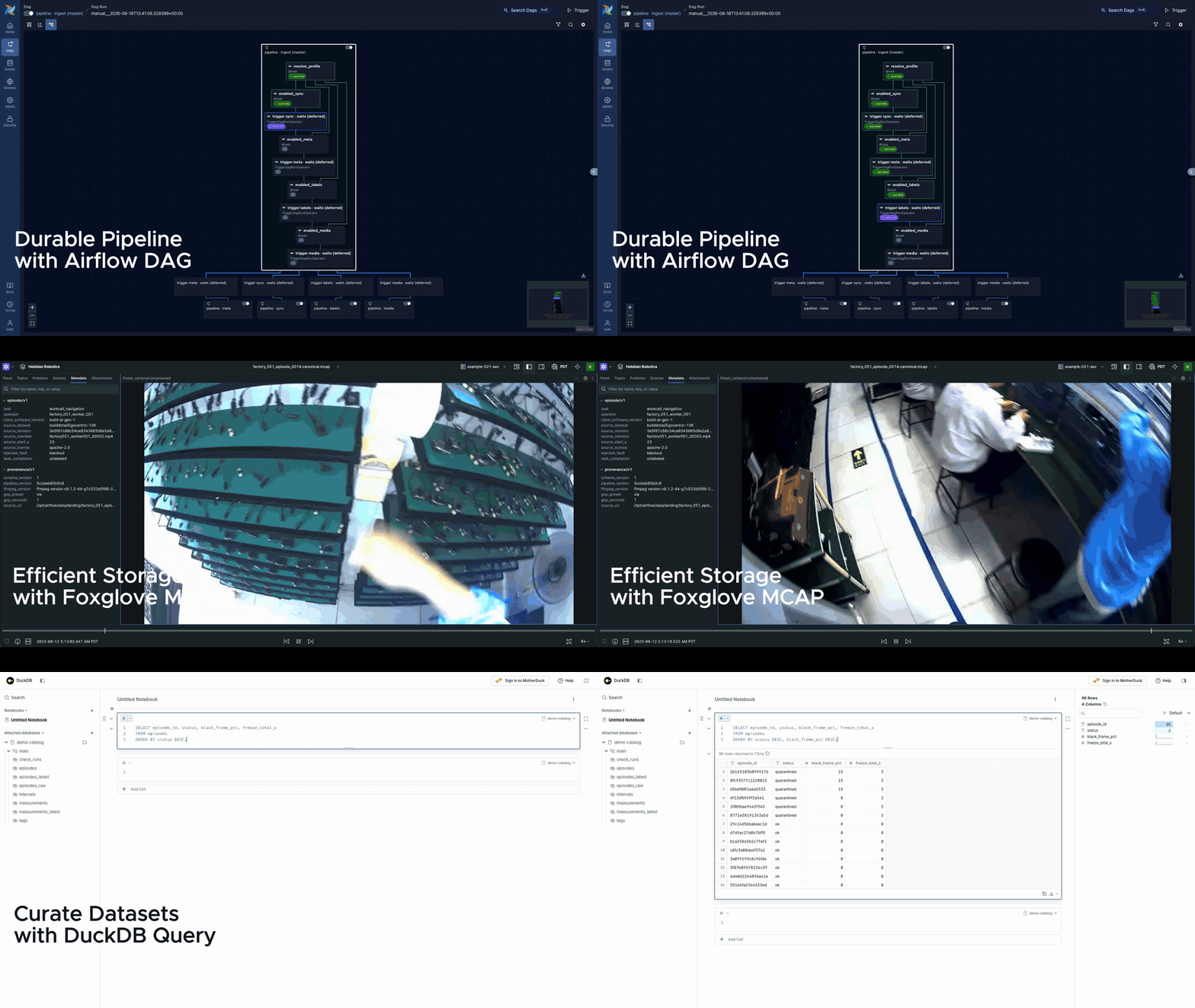
- Your processing code stays yours. Transformations, quality checks, labels, and enrichments are plain Python functions in your own environment. Existing code plugs in through small adapters instead of being rewritten for a proprietary framework.
- Episodes are MCAP, the container that ROS 2 records natively and Foxglove/Rerun open directly, written with the two tuning ideas from Dyna's post: in-band H.264 with GOP length matched to how the data is read, and topic-group chunking (camera streams and state streams never share a chunk, so a training sample costs one read per group instead of one per topic).
- Processed episodes carry their provenance. The file itself records the schema, pipeline, and tool versions that produced it, plus its source URI when available. Catalog records connect measurements and outcomes to step versions, making it easier to trace a bad result back to its origin.
- The pipeline is visible as a graph. HFlow renders Airflow DAGs so you can see how stages connect and monitor task status, logs, retries, and reruns.
- Quality checks produce reusable evidence. Accessors extract the inputs existing processing code expects (numpy arrays, MP4 paths, JPEG frames), and results land as queryable measurements rather than hardcoded verdicts. Different datasets can apply different thresholds without processing the media again.
- Query the corpus without loading the recordings. Metadata, quality measurements, tags, version stamps, and artifact locations live in the Parquet catalog. DuckDB can answer corpus-wide questions and build manifests without opening the underlying MCAP files.
Hosting and scale
The open-source deployment is built to be easy to own: run one single-tenant workspace with the included Docker Compose runtime, or deploy its generated DAG bundle into an Airflow 3 environment you already operate. It has no user accounts, RBAC, or multi-tenant control plane.
The data plane is kept separate from account and control-plane concerns so the same engine can be scaled as multiple isolated workspaces (for example, one per team or customer) behind an external control plane. That is the intended path to a future hosted version, but the hosted control plane is not implemented in this repository and is not a pre-v1 release commitment.
Community and hosted interest
- Hosted version interest: Google Form coming soon.
- Community Discord: join us for questions, feedback, and contribution discussion.
For reproducible bugs and scoped feature requests, use GitHub issues.
Install and try it
Install the SDK from PyPI with uv:
uv add hflow
The Hebbian Robotics project starts at version 0.2.0. Earlier 0.1.x releases under the same PyPI name belonged to an unrelated, inactive project before the name was transferred.
To run the repository's bundled quickstart:
git clone https://github.com/Hebbian-Robotics/hflow.git
cd hflow
uv sync --locked --all-extras
uv run python examples/quickstart.py
The quickstart synthesizes a small multimodal episode with camera and state
streams when no input file is given, runs the pipeline in-process, and writes
its outputs under the gitignored data/ directory. It needs no Docker or
Airflow. To use your own recording:
uv run python examples/quickstart.py path/to/episode.mcap
Use uv run hflow --help to see the CLI. When you are ready to schedule the
same pipeline, continue with the runtime guide. Developers
and contributors should start with CONTRIBUTING.md. Browse
the examples catalog for the egocentric-corpus and
OpenAI vision paths.
What it looks like
Get started in six lines of code. This fuller example uses a robot teleoperation episode, but the same step interface applies to egocentric video and other physical-AI recordings.
import hflow
from your_existing_qc import check_joint_smoothness  # use your existing checks

app = hflow.App("kitchen-pipeline", data_root="./data")


@app.check()
def joint_smoothness(ep: hflow.Episode) -> hflow.CheckResult:
    joints = ep.channel("/joint_states").to_numpy()  # our line: extract
    result = check_joint_smoothness(joints, rate_hz=100)  # your line: unchanged
    return hflow.CheckResult(measurements=result)  # our line: record


@app.check(critical=True)
def camera_blackout(ep: hflow.Episode) -> hflow.CheckResult:
    stats = hflow.ffmpeg.frame_stats(ep.video("wrist_cam"))  # one decode pass
    return hflow.CheckResult(
        measurements={"black_pct": stats.black_frame_pct},
        verdict=stats.black_frame_pct < 0.5,  # your threshold
    )


if __name__ == "__main__":
    app.test("episode_0001.mcap")  # whole pipeline, in-process, no infra
    # Or call app.run() here to start the Compose runtime, then use `hflow ingest`.
Curation comes afterwards, via hflow.curate(data_root / "catalog", sql, output="manifest.parquet")
or hflow curate "<sql>" on the command line, either way reporting coverage
denominators alongside the manifest:
SELECT episode_id, uri FROM episodes
WHERE task = 'fold_napkin'
  AND status != 'quarantined'
  AND black_pct < 1.0                      -- percent, user-owned threshold
  AND pipeline_version = 'a41c9f27b3d8'    -- pin one reprocessing generation
Design tenets
- Democratize the architecture, defer the optimizations. Preserve the useful workflow and standard interfaces at small scale, and label each production-scale mechanism honestly as implemented, simplified, deferred, or out of scope.
- Evidence, not verdicts. Checks record measurements with coverage; pass/fail policy belongs to the consumer, at curation time. Quality tags route episodes; they never delete data.
- Standard formats at every boundary. MCAP episodes, Parquet catalogs, Airflow DAGs. Our code exists only where the format forces bridging or a pitfall is genuinely non-obvious.
- Your code stays your code. Existing transforms, checks, and enrichments plug in through small adapters instead of being rewritten.
- Transparent provenance. The docs mark every design element as Dyna says (from the blog) or HFlow chooses (our engineering judgment, with the evidence behind it).
Non-goals
- Training. The pipeline ends at curated, quality-tagged, version-stamped episodes and a manifest. Many users filter data to deliver or sell it, not to train on it. (Converters to training formats such as LeRobot are planned as a separate, standalone package.)
- Maximum flexibility. Robotics/physical-AI data is the narrative and the constraint budget: one canonical episode format, coarse-grained steps, and opinionated defaults are features.
- Million-hour throughput. The benchmark report documents honestly what the simple version achieves and where it falls over.
Requirements
- Python ≥ 3.11
- Docker (for the pipeline runtime;
app.test()needs none), or bring your own Airflow deployment (Astronomer, MWAA, Cloud Composer, self-managed) - The first
hflow updownloads ~2 GB of container images and builds the task venv (one-time;app.test()needs none of this) - Native
s3://,gs://, and Azure data roots use the optional bucket backend (uv sync --extra bucket); local paths do not import it - On Linux x86_64/aarch64, the first video operation downloads a checksum-verified, pinned ffmpeg/ffprobe build into the user cache. Set
HFLOW_FFMPEGandHFLOW_FFPROBEto use binaries you manage instead. - Windows is supported via WSL2 (Airflow does not run natively on Windows)
Documentation
- Documentation home: start by task, then choose a tutorial, how-to guide, reference, or explanation
- Frequently asked questions: formats, infrastructure, scale, project scope, and current release status
- How HFlow fits the robotics data stack: MCAP, Airflow, Foxglove, Rerun, DuckDB, object storage, and training formats
- Runnable examples: exact commands, prerequisites, expected output, and links to the relevant guides
- Architecture and differences from Dyna: the implemented, simplified, deferred, and out-of-scope matrix
- Call OpenAI vision from a step: a focused guide linked to a complete executable pipeline
- Contributing: development setup, validation commands, test gates, and pull-request expectations
- Security policy: supported versions and private vulnerability reporting
References
Primary source:
- Dyna Robotics, Training Dyna-2 at million-hour scale, repeatably (Aug 2026)
Formats and tooling this project builds on:
- MCAP specification and Python libraries (Foxglove)
- foxglove.CompressedVideo schema: in-band H.264/H.265/VP9/AV1 video in MCAP
- Apache Airflow 3: ingestion DAG orchestration
- DuckDB: curation queries over the Parquet catalog
- Foxglove and Rerun: episode inspection
- FFmpeg: video processing and the deterministic frame instrument
Parts of the durability and measurement design draw on production experience from Pareto, Hebbian Robotics' robotics data curation platform.
License
1 maintainer

Download files
Download the file for your platform. If you're not sure which to choose, learn more about installing packages.
Source Distribution
Built Distribution
Filter files by name, interpreter, ABI, and platform.
If you're not sure about the file name format, learn more about wheel file names.
Copy a direct link to the current filters
File details
Details for the file hflow-0.2.0.tar.gz.
File metadata
- Download URL: hflow-0.2.0.tar.gz
- Upload date:
- Size: 140.8 kB
- Tags: Source
- Uploaded using Trusted Publishing? Yes
- Uploaded via:
twine/7.0.0 CPython/3.13.14
File hashes
| Algorithm | Hash digest | |
|---|---|---|
| SHA256 |
aded20dafddcae07cca4286e3d2f1d48b91ba4e6caed91ce94bf45411d53b56c
|
|
| MD5 |
1b5753205c3dd780d220c680d5c49d85
|
|
| BLAKE2b-256 |
4ee26bc45deebee3ead22a66ddc13278c66f7ae38a1fa0f7b149238911a8eca7
|
Provenance
The following attestation bundles were made for hflow-0.2.0.tar.gz:
Publisher:
publish.yml on Hebbian-Robotics/hflow
-
Statement:
-
Statement type:
https://in-toto.io/Statement/v1 -
Predicate type:
https://docs.pypi.org/attestations/publish/v1 -
Subject name:
hflow-0.2.0.tar.gz -
Subject digest:
aded20dafddcae07cca4286e3d2f1d48b91ba4e6caed91ce94bf45411d53b56c - Sigstore transparency entry: 2528087638
- Sigstore integration time:
-
Permalink:
Hebbian-Robotics/hflow@458cbd2c4f2c06ffbd9b48c6d1d7e22f2c1dfcd9 -
Branch / Tag:
refs/tags/v0.2.0 - Owner: https://github.com/Hebbian-Robotics
-
Access:
public
-
Token Issuer:
https://token.actions.githubusercontent.com -
Runner Environment:
github-hosted -
Publication workflow:
publish.yml@458cbd2c4f2c06ffbd9b48c6d1d7e22f2c1dfcd9 -
Trigger Event:
release
-
Statement type:
File details
Details for the file hflow-0.2.0-py3-none-any.whl.
File metadata
- Download URL: hflow-0.2.0-py3-none-any.whl
- Upload date:
- Size: 153.4 kB
- Tags: Python 3
- Uploaded using Trusted Publishing? Yes
- Uploaded via:
twine/7.0.0 CPython/3.13.14
File hashes
| Algorithm | Hash digest | |
|---|---|---|
| SHA256 |
886ec81fb85cca4dda0b4c87540b8800b898836bea63b51d1430febbfb32fe21
|
|
| MD5 |
79bb268606dc043fb8fe1837c699053e
|
|
| BLAKE2b-256 |
6e603b2c265f5abc512d37612174f97224f03b5049f2823493e91b1e2480bd59
|
Provenance
The following attestation bundles were made for hflow-0.2.0-py3-none-any.whl:
Publisher:
publish.yml on Hebbian-Robotics/hflow
-
Statement:
-
Statement type:
https://in-toto.io/Statement/v1 -
Predicate type:
https://docs.pypi.org/attestations/publish/v1 -
Subject name:
hflow-0.2.0-py3-none-any.whl -
Subject digest:
886ec81fb85cca4dda0b4c87540b8800b898836bea63b51d1430febbfb32fe21 - Sigstore transparency entry: 2528087770
- Sigstore integration time:
-
Permalink:
Hebbian-Robotics/hflow@458cbd2c4f2c06ffbd9b48c6d1d7e22f2c1dfcd9 -
Branch / Tag:
refs/tags/v0.2.0 - Owner: https://github.com/Hebbian-Robotics
-
Access:
public
-
Token Issuer:
https://token.actions.githubusercontent.com -
Runner Environment:
github-hosted -
Publication workflow:
publish.yml@458cbd2c4f2c06ffbd9b48c6d1d7e22f2c1dfcd9 -
Trigger Event:
release
-
Statement type:







