
hibira-approvals
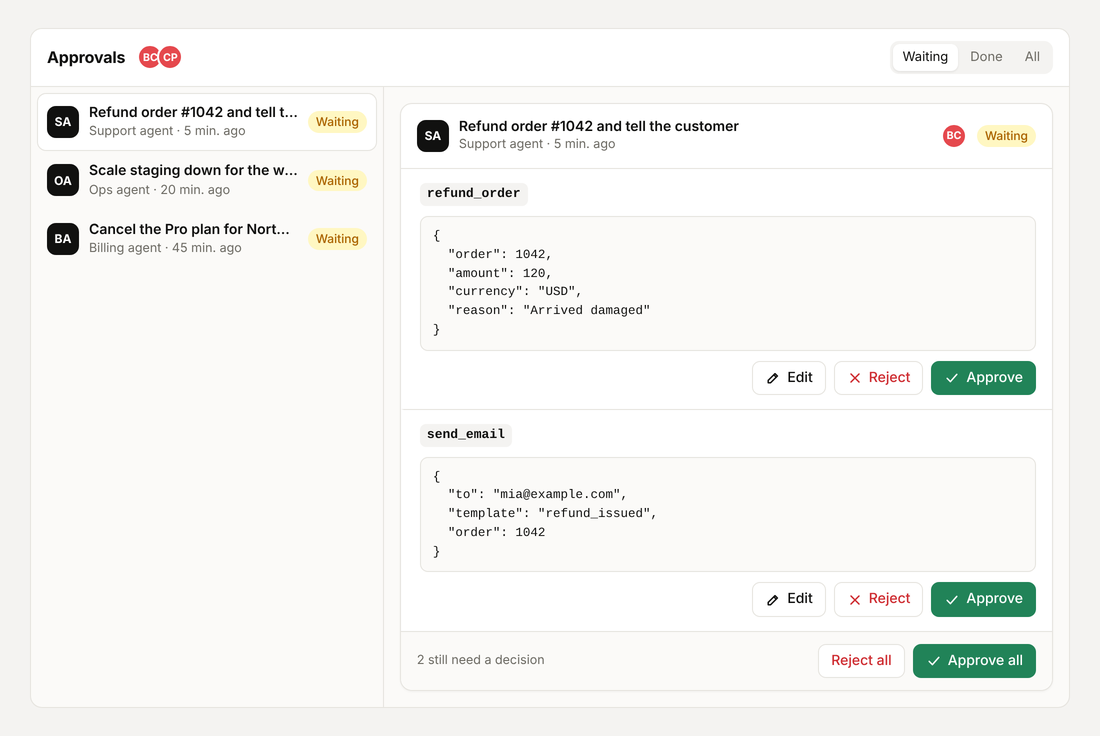
Human approvals for AI agents over Hibira realtime channels, for Python. When a LangGraph node needs a person's OK, the call waits in a live inbox; reviewers approve, edit or reject it, and the graph resumes with their answer.
It speaks the same protocol as the npm package
@hibira-io/approvals, so its
React and Vue inbox components work against a Python backend unchanged.
Install
pip install "hibira-approvals[pusher,fastapi]"
Use with LangGraph
import pusher
from langgraph.types import Command, interrupt

from hibira_approvals import Approvals
from hibira_approvals.langgraph import approval, approval_calls, resume_value

client = pusher.Pusher(app_id=..., key=..., secret=..., host="ws.hibira.io", ssl=True)


def refund_node(state):
    answer = interrupt(approval("refund_order", {"order": state["order"]}))
    if not answer["approved"]:
        return {"log": [f"skipped: {answer['reason']}"]}
    return {"log": [refund(answer["input"])]}  # the edited input when the reviewer changed it


async def resume(request):
    config = {"configurable": {"thread_id": request["metadata"]["thread_id"]}}
    await graph.ainvoke(Command(resume=resume_value(request)), config)


approvals = Approvals(client, scope="support", resume=resume)

paused = await graph.ainvoke({"order": 1042}, config)
calls, title = approval_calls(paused)  # parallel interrupts become one request
if calls:
    await approvals.request(calls, agent="Support agent", title=title, metadata={"thread_id": "t1"})
approvals.wait(id) polls until a request is decided, for workers that keep
the graph waiting in place.
Routes for the inbox components
from fastapi import FastAPI
from hibira_approvals.fastapi import approvals_router

app = FastAPI()
app.include_router(
    approvals_router(approvals, get_user=current_user, can_review=lambda user, request: user["role"] == "admin"),
    prefix="/api/approvals",
)
get_user(request) returns {"id", "name", "avatar"} or None. The router
also serves POST /auth for the Pusher channel authorization.
Requests live in memory by default; pass store= with async create,
get, list and an atomic update(id, fn) over your database.
License
MIT
1 maintainer

Metadata
1 maintainer
Release files for hibira-approvals 0.1.0
For a detailed explanation of source distributions (sdists) and built distributions (wheels), please see the package formats documentation.
Source distribution (sdist)
| File | Size | Uploaded | Provenance | Actions |
|---|---|---|---|---|
| hibira_approvals-0.1.0.tar.gz | 11.8 kB | With provenance | Details for hibira_approvals-0.1.0.tar.gz |
Built distribution (wheel)
| File | Interpreter | ABI | Platform | Actions Reset |
|---|---|---|---|---|
| hibira_approvals-0.1.0-py3-none-any.whl | Python 3 | none | any | Details for hibira_approvals-0.1.0-py3-none-any.whl |
Total release size: 22.9 kB
Release files / hibira_approvals-0.1.0.tar.gz
| Download URL | hibira_approvals-0.1.0.tar.gz |
|---|---|
| Size | 11.8 kB |
| Tags | Source |
|
SHA-256 checksum How to use checksums |
a60663caf2b6735c838a3e74c199394a4714bf00d6ccd221e4a690215782d560
|
|
BLAKE2b-256 checksum How to use checksums |
f5d3128193268826d97321d8046c1eb4b293e74ee7bb866417113a8a3703556b
|
| Upload date | |
|
Uploaded using Trusted Publishing? What is trusted publishing? |
Yes |
| Uploaded via |
twine/7.0.0 CPython/3.13.16
|
Provenance
Provenance describes where a file came from. On PyPI, provenance is shared via attestations, which provide a verifiable record of the build or publishing details. View details, limitations and caveats.


PyPI Publish Attestation
PyPI verified that this artifact, at this checksum, originated from the publisher listed below.
Signed by GitHub Actions, verified by PyPI on Oct 31, 2026.
Transparency logRelease files / hibira_approvals-0.1.0-py3-none-any.whl
| Download URL | hibira_approvals-0.1.0-py3-none-any.whl |
|---|---|
| Size | 11.2 kB |
| Tags | Python 3 |
|
SHA-256 checksum How to use checksums |
c49ec3fed3adfcba63dcb62cfccc424b6cd93f8b1ef720bd1372437c7f0a4ba0
|
|
BLAKE2b-256 checksum How to use checksums |
d80263b06b0b9f5105340c42e57e25b3d2d2358975126ddfbc032920df5e4ca4
|
| Upload date | |
|
Uploaded using Trusted Publishing? What is trusted publishing? |
Yes |
| Uploaded via |
twine/7.0.0 CPython/3.13.16
|
Provenance
Provenance describes where a file came from. On PyPI, provenance is shared via attestations, which provide a verifiable record of the build or publishing details. View details, limitations and caveats.
PyPI Publish Attestation
PyPI verified that this artifact, at this checksum, originated from the publisher listed below.
Signed by GitHub Actions, verified by PyPI on Oct 31, 2026.
Transparency logSecurity for hibira-approvals 0.1.0
Provenance
Provenance describes where a file came from. On PyPI, provenance is shared via attestations, which provide a verifiable record of the build or publishing details. View details, limitations and caveats.
Full provenance
All 2 files in this release have been uploaded with provenance metadata.
Attestation for hibira_approvals-0.1.0.tar.gz
PyPI Publish Attestation
PyPI verified that this artifact, at this checksum, originated from the publisher listed below.
Signed by GitHub Actions, verified by PyPI on Oct 31, 2026.
Transparency logA note on package security
PyPI is a repository for distributing packages, not a service for auditing them. While third-party security researchers and our staff do their best to detect and remove malicious packages, PyPI cannot guarantee the quality, security or suitability of any given package.
To learn more about protecting yourself from malicious actors, visit our package security documentation.













