
Higher Order Spectral Analysis Toolkit
This package provides a comprehensive set of tools for higher-order spectral analysis in Python. It includes functions for estimating bicoherence, bispectrum, and various orders of cumulants.
Installation
You can install the toolkit using pip:
pip install higher-spectrum
Contents
Higher-Order Spectral Analysis
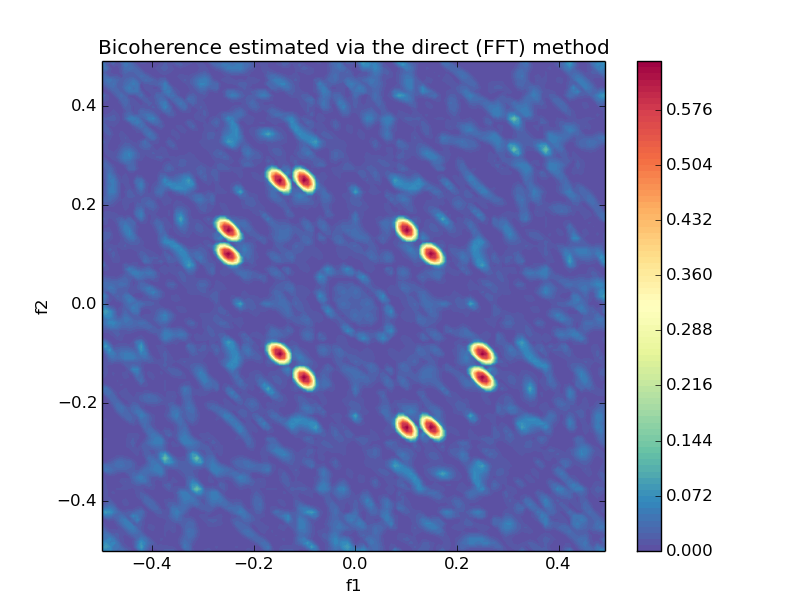
Bicoherence
from spectrum import bicoherence, plot_bicoherence

bic, waxis = bicoherence(y, nfft=None, window=None, nsamp=None, overlap=None)
plot_bicoherence(bic, waxis)
Cross Bicoherence
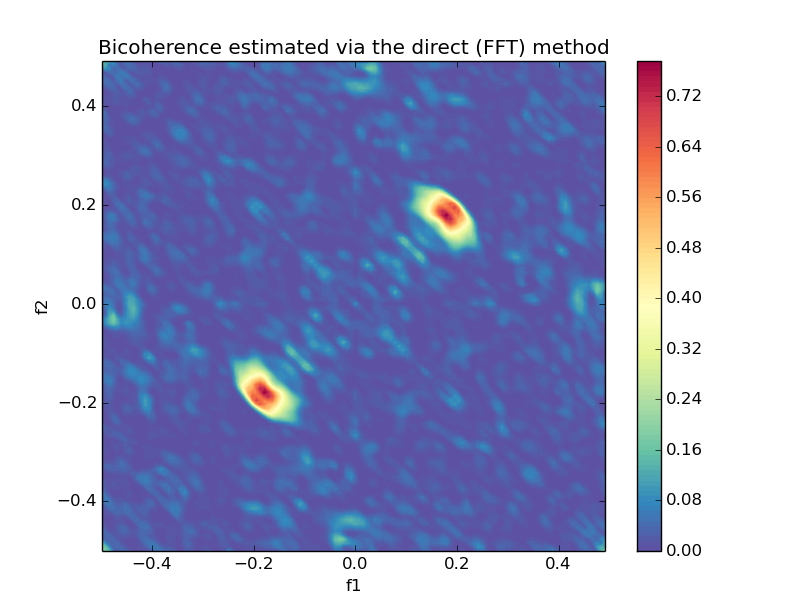
from spectrum import bicoherencex, plot_bicoherencex

bic, waxis = bicoherencex(w, x, y, nfft=None, window=None, nsamp=None, overlap=None)
plot_bicoherencex(bic, waxis)
Bispectrum Direct (using FFT)
from spectrum import bispectrumd, plot_bispectrumd

Bspec, waxis = bispectrumd(y, nfft=None, window=None, nsamp=None, overlap=None)
plot_bispectrumd(Bspec, waxis)

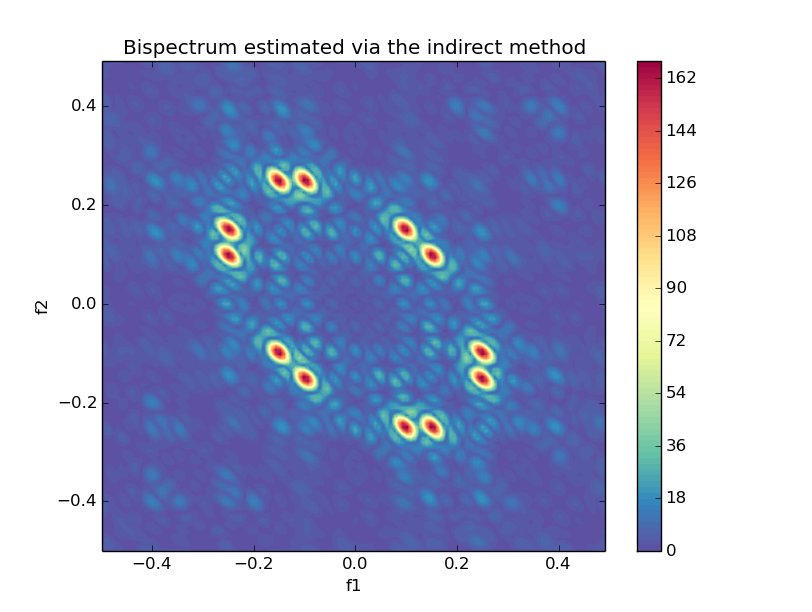
Bispectrum Indirect
from spectrum import bispectrumi, plot_bispectrumi

Bspec, waxis = bispectrumi(y, nlag=None, nsamp=None, overlap=None, flag='biased', nfft=None, wind='parzen')
plot_bispectrumi(Bspec, waxis)
Cross Bispectrum (Direct)
from spectrum import bispectrumdx, plot_bispectrumdx

Bspec, waxis = bispectrumdx(x, y, z, nfft=None, window=None, nsamp=None, overlap=None)
plot_bispectrumdx(Bspec, waxis)

Trispectrum and Tricoherence
from spectrum import trispectrum, tricoherence, plot_trispectrum, plot_tricoherence_summary

# Trispectrum (4th order spectrum)
Tspec, waxis = trispectrum(y, nfft=None, window=None, nsamp=None, overlap=None)
plot_trispectrum(Tspec, waxis, slice_type='magnitude')

# Tricoherence (normalized trispectrum)
tricoh, waxis = tricoherence(y, nfft=None, window=None, nsamp=None, overlap=None)
plot_tricoherence_summary(tricoh, waxis)
Cumulant Estimation
Cumulants (2nd, 3rd, and 4th order)
from spectrum import cumest

order = 2  # 2nd order
y_cum = cumest(y, norder=order, maxlag=20, nsamp=None, overlap=0, flag='biased', k1=0, k2=0)
Cross-Cumulants (2nd, 3rd, and 4th order)
from spectrum import cum2x, cum3x, cum4x

# 2nd order cross-cumulant
ccov = cum2x(x, y, maxlag=20, nsamp=None, overlap=0, flag='biased')

# 3rd order cross-cumulant
c3 = cum3x(x, y, z, maxlag=20, nsamp=None, overlap=0, flag='biased', k1=0)

# 4th order cross-cumulant
c4 = cum4x(w, x, y, z, maxlag=20, nsamp=None, overlap=0, flag='biased', k1=0, k2=0)
ARMA Modeling
ARMA Parameter Estimation
from spectrum import armafit, plot_arma_poles_zeros

# Estimate ARMA(p,q) parameters using cumulants
a, b, rho = armafit(y, p=2, q=1, maxlag=20)
plot_arma_poles_zeros(a, b, "ARMA Model Poles and Zeros")
ARMA Model Order Selection
from spectrum import armasel, plot_ic_surface, plot_ic_comparison

# Select optimal ARMA order using information criteria
p_opt, q_opt, ic_min, ic_matrix = armasel(y, pmax=5, qmax=3, criterion='aic')
plot_ic_surface(ic_matrix, criterion='AIC')
plot_ic_comparison(y, pmax=5, qmax=3, criteria=['aic', 'bic', 'hq'])
Signal Generation
Harmonic Signal Generation
from spectrum import harmgen, harmgen_complex, plot_harmonic_signal

# Real harmonics with noise
y = harmgen(N=1000, A=[1.0, 0.5], f=[0.1, 0.2], phi=[0, np.pi/4],
           sigma_n=0.1, sigma_m=0.05)
plot_harmonic_signal(y, fs=1.0, title="Harmonic Signal")

# Complex harmonics
y_complex = harmgen_complex(N=1000, A=1.0, f=0.1, sigma_n=0.1)
Nonlinear Time Series Generation
from spectrum import nlgen, plot_nonlinear_series, nonlinear_measures

# Bilinear model
y_bilinear = nlgen(N=1000, model_type='bilinear', a=[0.5], b=[1.0], c=[0.1])

# Threshold autoregressive model
y_tar = nlgen(N=1000, model_type='tar', a=[0.6], threshold=0.0, a2=[0.3])

# Hénon map
y_henon = nlgen(N=1000, model_type='henon', a=[1.4], b=[0.3], sigma=0.01)

# Logistic map
y_logistic = nlgen(N=1000, model_type='logistic', a=[3.8], sigma=0.01)

# Plot and analyze
plot_nonlinear_series(y_henon, model_type="Hénon Map")
measures = nonlinear_measures(y_henon)
Features
Higher-Order Spectral Analysis
- Bicoherence and cross-bicoherence estimation
- Direct and indirect methods for bispectrum estimation
- Cross-bispectrum estimation
- Trispectrum (4th order spectrum) estimation
- Tricoherence (normalized trispectrum) for quadratic coupling detection
Cumulant Estimation
- Cumulant estimation up to 4th order
- Cross-cumulant estimation up to 4th order
- Unified cumulant estimation interface
ARMA Modeling
- ARMA parameter estimation using higher-order statistics
- Model order selection with AIC, BIC, and Hannan-Quinn criteria
- Robust estimation in colored Gaussian noise
Signal Generation
- Harmonic signal generation with multiplicative and additive noise
- Complex harmonic generation
- Nonlinear time series generation (bilinear, TAR, Volterra, NARMA)
- Chaotic systems (Hénon map, logistic map)
Visualization and Analysis
- Comprehensive plotting functions for all methods
- Phase space reconstruction and analysis
- Nonlinearity measures and tests
- Information criterion surfaces for model selection
Requirements
- Python 3.6+
- NumPy
- SciPy
- Matplotlib
Acknowledgements
This toolkit is based on the Higher Order Spectral Analysis toolkit for MATLAB. We've adapted and extended it for Python users.
Backends
The estimators run on a native C extension when available and fall back to the pure-Python reference implementations otherwise.
import os
os.environ["SPECTRUM_BACKEND"] = "python"  # force the python reference
Build knobs: SPECTRUM_NO_OPENMP=1 builds without OpenMP, SPECTRUM_NATIVE=1
adds -march=native (not for distributed wheels). Benchmarks:
python tests/bench/bench_core.py (bispectrumd 4.9x, bicoherence 3.4x, trispec
5.4x on a 24-core machine).
Changelog
See CHANGELOG.md for the full 0.4.0 changes: HOSA semantic fixes, the C core,
and the new functions (cumtrue, trispec, wig2, wig2c, wig4, wig4c,
tfrwv, doa, armaqs, armarts).
1 maintainer

Metadata
1 maintainer
Release files for higher-spectrum 0.4.0
For a detailed explanation of source distributions (sdists) and built distributions (wheels), please see the package formats documentation.
Source distribution (sdist)
| File | Size | Uploaded | Provenance | Actions |
|---|---|---|---|---|
| higher_spectrum-0.4.0.tar.gz | 846.8 kB | Without provenance | Details for higher_spectrum-0.4.0.tar.gz |
Built distribution (wheel)
| File | Interpreter | ABI | Platform | Actions Reset |
|---|---|---|---|---|
| higher_spectrum-0.4.0-cp314-cp314-manylinux_2_38_x86_64.whl | CPython 3.14 | CPython 3.14 | Linux glibc 2.38+ x86-64 | Details for higher_spectrum-0.4.0-cp314-cp314-manylinux_2_38_x86_64.whl |
Total release size: 1.4 MB
Release files / higher_spectrum-0.4.0.tar.gz
| Download URL | higher_spectrum-0.4.0.tar.gz |
|---|---|
| Size | 846.8 kB |
| Tags | Source |
|
SHA-256 checksum How to use checksums |
9c6a30379baede3c34747c9ff95bed14fff65d7692e5b8eabcd122560f6decc0
|
|
BLAKE2b-256 checksum How to use checksums |
89c76f9b67251d7c4283a7df906180bdbf73b6fb0612f3c663f857452fdd80d3
|
| Upload date | |
|
Uploaded using Trusted Publishing? What is trusted publishing? |
No |
| Uploaded via |
twine/6.2.0 CPython/3.14.5
|
Release files / higher_spectrum-0.4.0-cp314-cp314-manylinux_2_38_x86_64.whl
| Download URL | higher_spectrum-0.4.0-cp314-cp314-manylinux_2_38_x86_64.whl |
|---|---|
| Size | 516.5 kB |
| Tags | CPython 3.14 Linux glibc 2.38+ x86-64 |
|
SHA-256 checksum How to use checksums |
f69b8fae7ab78665e3fa03cd24f4b3832404cc464e5debdf0628ebe94c74708f
|
|
BLAKE2b-256 checksum How to use checksums |
1bc147a88349dc3c8bfcb77250f867b112f171baca3d06f08eafe8196fed8cf5
|
| Upload date | |
|
Uploaded using Trusted Publishing? What is trusted publishing? |
No |
| Uploaded via |
twine/6.2.0 CPython/3.14.5
|
Security for higher-spectrum 0.4.0
Provenance
Provenance describes where a file came from. On PyPI, provenance is shared via attestations, which provide a verifiable record of the build or publishing details. View details, limitations and caveats.
No provenance found
None of the files in this release were uploaded with provenance metadata.
A note on package security
PyPI is a repository for distributing packages, not a service for auditing them. While third-party security researchers and our staff do their best to detect and remove malicious packages, PyPI cannot guarantee the quality, security or suitability of any given package.
To learn more about protecting yourself from malicious actors, visit our package security documentation.














