
hippocache 🦛
Smart, plug-and-play KV cache compression for Transformer inference, written in Rust.
hippocache provides drop-in KV cache implementations with multiple retention and compression strategies, designed to fit into LLM generation loops to reduce memory footprints without sacrificing model perplexity.
🚀 Features
- 🦀 Rust Engine: High-performance token merging and eviction operations implemented using
ndarrayand PyO3. - 🔌 Drop-in Integration: Fits seamlessly into standard LLM autoregressive generation loops.
- 📊 Smart Compression: Includes advanced strategies like cosine-similarity-based sequence merging (
mergeandhybrid). - 📈 Stats & Metrics: Built-in tracking for compression ratios, merges, and evictions.
📦 Installation
Install the pre-compiled package directly via pip:
pip install hippocache
⚡ Quickstart
Using hippocache is simple. Below is a realistic example demonstrating how to integrate KVCache into a token generation loop:
import random
from hippocache import KVCache

# 1. Initialize the KV Cache
# d_k and d_v represent the key and value head dimensions
cache = KVCache(
    d_k=64,
    d_v=64,
    strategy="hybrid",
    static_k=3,         # Retain the first 3 tokens (e.g., prompt context)
    threshold=0.90,     # Cosine similarity merge threshold
    merge_every=4       # Check and merge adjacent tokens every 4 steps
)

# 2. Simulate a generation loop
for step in range(20):
    # Mock key & value vectors for the new token
    new_k = [random.uniform(-1.0, 1.0) for _ in range(64)]
    new_v = [random.uniform(-1.0, 1.0) for _ in range(64)]

    # Append to cache (merges/evictions happen automatically in Rust)
    cache.append(new_k, new_v)

    # Query attention over the compressed cache
    q = [random.uniform(-1.0, 1.0) for _ in range(64)]
    attention_output = cache.attend(q)

    print(f"Step {step+1:02d} | Cache Size: {cache.current_len()} | Stats: {cache.stats()}")

# 3. Retrieve final stats
final_stats = cache.stats()
print("\nFinal Generation Stats:")
print(f"  Strategy:          {final_stats['strategy']}")
print(f"  Compression Ratio: {final_stats['compression_ratio']:.2f} (lower is better)")
print(f"  Total Appends:     {final_stats['total_appends']}")
print(f"  Total Merges:      {final_stats['total_merges']}")
🛠 Caching Strategies
| Strategy | Config Parameters | Description |
|---|---|---|
full |
None | Keeps all key-value states in memory (default). |
sliding |
window_size |
Retains only the last $N$ tokens, evicting older states. |
static |
static_k, recent_k |
Keeps the first $K$ prefix tokens forever + the last $R$ recent tokens. |
merge |
threshold, merge_every |
Compares adjacent key tensors using cosine similarity and merges them if similarity exceeds the threshold. |
hybrid |
static_k, threshold, merge_every |
Keeps the first $K$ prefix tokens forever and performs similarity merges on the rest of the sequence. |
📊 Benchmark Results
Evaluated on TinyLlama-1.1B (Layer 0, Head 0) across various compression strategies and parameters.
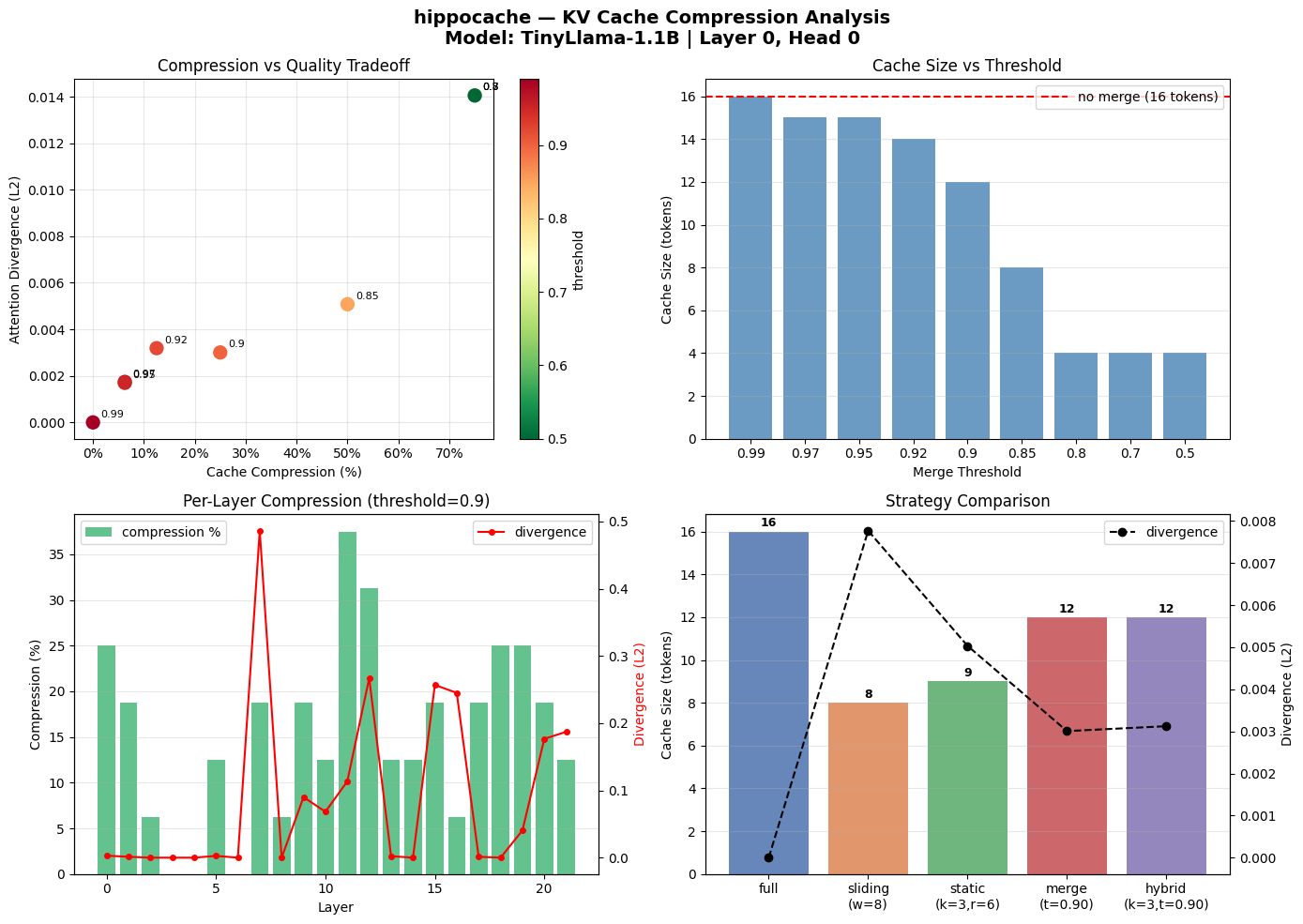
1. Strategy Comparison
Evaluating the tradeoff between cache size and quality loss (measured by KL Divergence / proxy perplexity and L2 attention divergence).
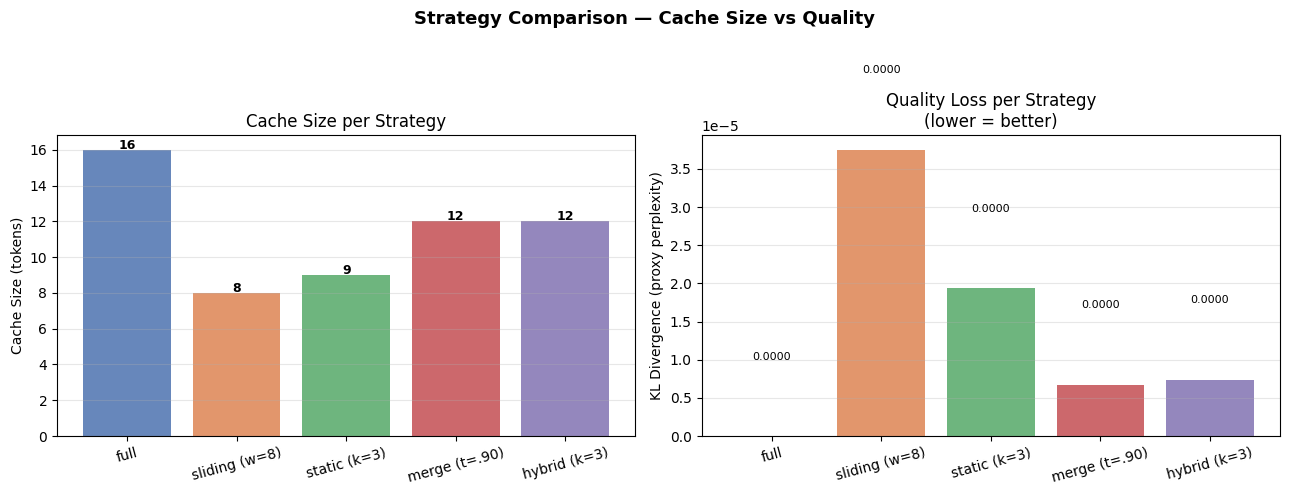
| Strategy | Config | Cache Size (Tokens) | Size Reduction (%) | L2 Attention Divergence | KL Divergence (Quality Loss) |
|---|---|---|---|---|---|
full |
(Default) | 16 | 0% | 0.0000 | 0.0000 |
merge |
threshold=0.90 |
12 | 25% | 0.0031 | 0.67 × 10⁻⁵ |
hybrid |
static_k=3, threshold=0.90 |
12 | 25% | 0.0032 | 0.74 × 10⁻⁵ |
static |
static_k=3, recent_k=6 |
9 | 43.8% | 0.0051 | 1.95 × 10⁻⁵ |
sliding |
window_size=8 |
8 | 50% | 0.0076 | 3.75 × 10⁻⁵ |
2. Compression vs. Quality (Merge Threshold Sweep)
Adjusting the cosine similarity threshold allows fine-grained control over the compression vs. attention quality tradeoff.
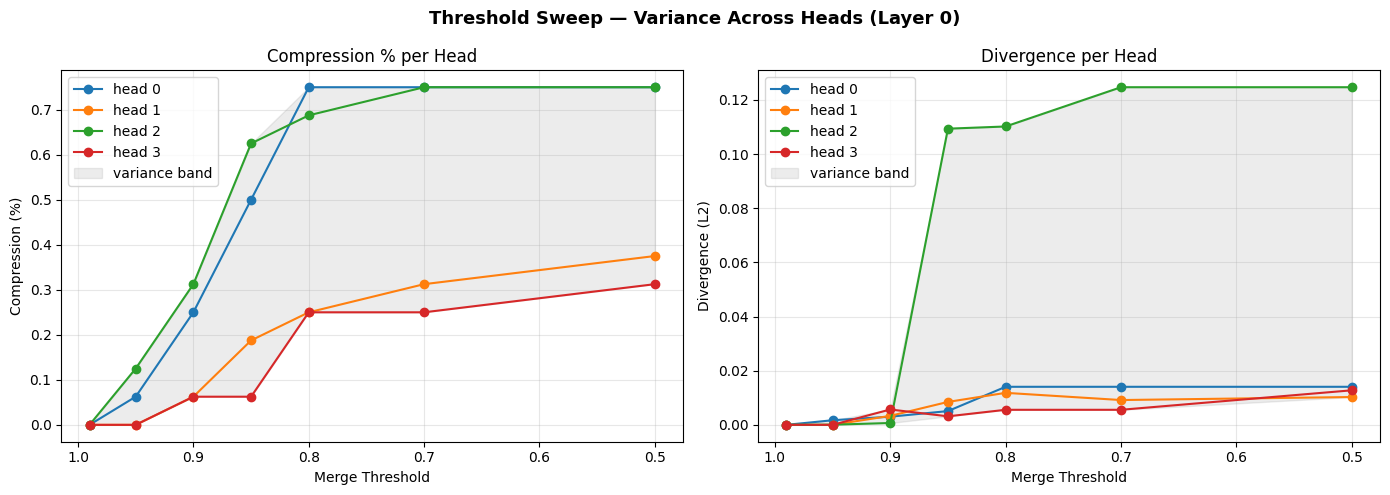
| Merge Threshold | Cache Size (Tokens) | Cache Compression | L2 Attention Divergence | Recommendation |
|---|---|---|---|---|
0.99 |
16 / 16 | 0% | 0.0000 | Lossless baseline |
0.97 |
15 / 16 | 6.2% | 0.0018 | Ultra-conservative |
0.95 |
15 / 16 | 6.2% | 0.0018 | Ultra-conservative |
0.92 |
14 / 16 | 12.5% | 0.0032 | Conservative |
0.90 |
12 / 16 | 25.0% | 0.0030 | Sweet spot (recommended) |
0.85 |
8 / 16 | 50.0% | 0.0051 | Moderate compression |
0.80 |
4 / 16 | 75.0% | 0.0140 | High compression, quality degradation |
📜 License
MIT License. See LICENSE for details.
1 maintainer

Metadata
1 maintainer
Release files for hippocache 0.1.2
For a detailed explanation of source distributions (sdists) and built distributions (wheels), please see the package formats documentation.
Built distribution (wheel)
| File | Interpreter | ABI | Platform | Actions Reset |
|---|---|---|---|---|
| hippocache-0.1.2-cp312-cp312-manylinux_2_34_x86_64.whl | CPython 3.12 | CPython 3.12 | Linux glibc 2.34+ x86-64 | Details for hippocache-0.1.2-cp312-cp312-manylinux_2_34_x86_64.whl |
Release files / hippocache-0.1.2-cp312-cp312-manylinux_2_34_x86_64.whl
| Download URL | hippocache-0.1.2-cp312-cp312-manylinux_2_34_x86_64.whl |
|---|---|
| Size | 279.1 kB |
| Tags | CPython 3.12 Linux glibc 2.34+ x86-64 |
|
SHA-256 checksum How to use checksums |
6c99b337821cc635a3c0d7160d7c1215ec17a28c5e49d207f343ed70ae3db69d
|
|
BLAKE2b-256 checksum How to use checksums |
40db4f69693492edf6481625ddebb0bf64131e068103bc0682ea2871f57ffa09
|
| Upload date | |
|
Uploaded using Trusted Publishing? What is trusted publishing? |
No |
| Uploaded via |
twine/6.2.0 CPython/3.12.3
|
Security for hippocache 0.1.2
Provenance
Provenance describes where a file came from. On PyPI, provenance is shared via attestations, which provide a verifiable record of the build or publishing details. View details, limitations and caveats.
No provenance found
None of the files in this release were uploaded with provenance metadata.
A note on package security
PyPI is a repository for distributing packages, not a service for auditing them. While third-party security researchers and our staff do their best to detect and remove malicious packages, PyPI cannot guarantee the quality, security or suitability of any given package.
To learn more about protecting yourself from malicious actors, visit our package security documentation.














