
hiscovid

Taiwan' data from the dataset was removed by the provider.
Takefuji Y. (2022) hiscovid for calculating time transition scores of policies against COVID-19 [Source Code]. https://doi.org/10.24433/CO.7364293.v1
Publications:
Takefuji Y. (2022). Sustainable policy: Don't get infected and don't infect others. Journal of Hazardous Materials Advances, 8, 100165. https://doi.org/10.1016/j.hazadv.2022.100165
Takefuji Y. (2022). COVID-19 policy analysis for 10 European countries. Zeitschrift fur Gesundheitswissenschaften = Journal of public health, 1–8. Advance online publication. https://doi.org/10.1007/s10389-022-01786-0
Takefuji Y. (2023). Policy analysis and data mining tools for controlling COVID-19 policies. Network modeling and analysis in health informatics and bioinformatics, 12(1), 4. https://doi.org/10.1007/s13721-022-00400-3
Takefuji Y. (2023). How to build disaster-resilient cities and societies for making people happy. Building and environment, 228, 109845. https://doi.org/10.1016/j.buildenv.2022.109845
hiscovid is a PyPI tool that calculates time transition scores for individual policies against COVID-19.
The goal of hiscovid is for policymakers to identify when they made mistakes. Policymakers must learn their mistakes for possible corrections in the future.
The time transition score is calculated by dividing the number of deaths in the time series due to COVID-19 by the population in millions.
Scores monotonically increase so that policymakers can only suppress them, but cannot improve them. Mistakes by policymakers cannot be corrected and are fatal forever.
The lower the score, the better the policy.
In other words, the score is equivalent to the accumulation of mistakes made by policymakers.
The perfect policy outcome means there are no covid-19 deaths. There is no perfect policy in the world, but mistakes by policymakers can be corrected for future better decisions.
hiscovid scrapes the latest data from the following site over the Internet:
https://covid.ourworldindata.org/data/owid-covid-data.csv
Data of Taiwan was removed from March 2023!
Mistakes can be observed in the calculated graph.
How to install hiscovid
$ pip install hiscovid
How to run hiscovid
$ hiscovid <country name(s)>
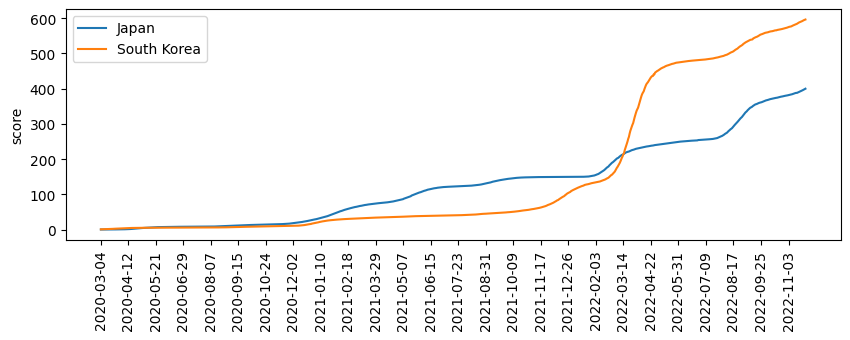
$ hiscovid Japan 'South Korea'
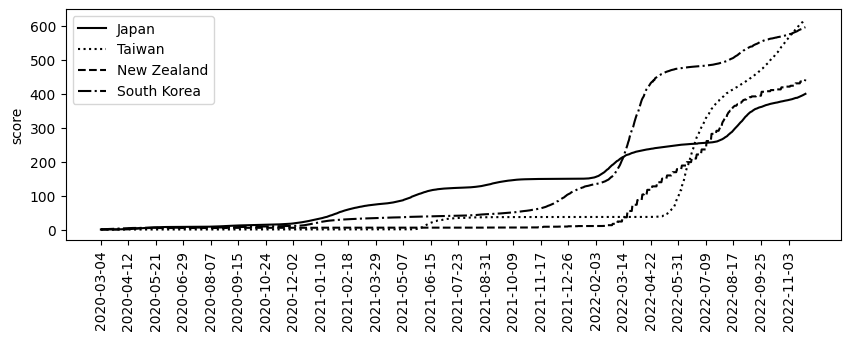
$ hiscovid Japan Taiwan
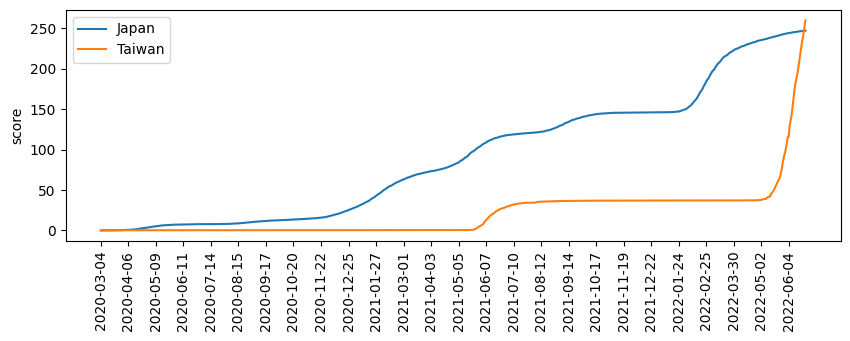
The vertical axis shows the overall result scores for policy, individual behavior, vaccination, and new COVID-19 variants. Score is the number of deaths due to COVID-19 per population in millions.
In the graph of South Korea, there are two points where the slope of the scoreline changed abruptly, including mid-November 2021 and mid-February 2022.
In the graph of Japan, there is a single abruptly changed point around mid-January 2022.
$ hiscovid Taiwan 'New Zealand'
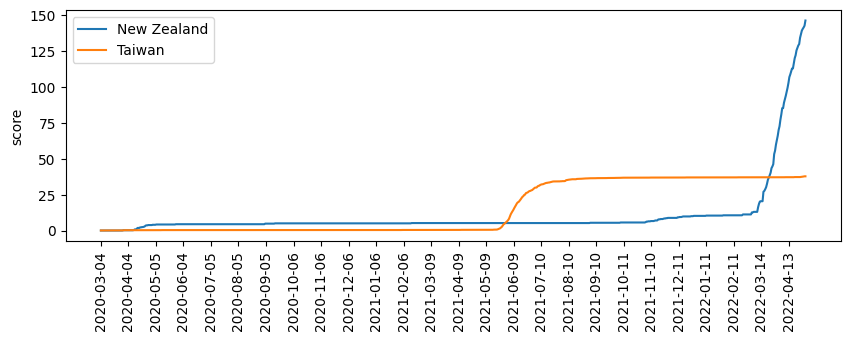
There is one point in the Taiwan graph that changes abruptly around mid-May 2021.
There is one point in the New Zealand graph that changes abruptly around the mid-February 2022.
$ hiscovid Taiwan 'United States' 'United Kingdom'
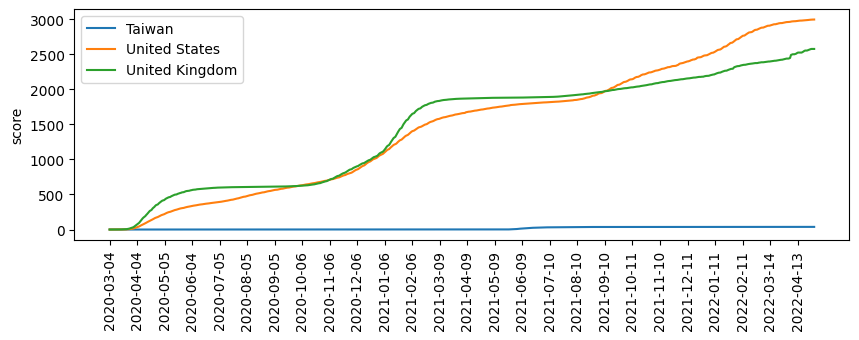
In the US graph, the scoreline is constantly bad, but a single point that changes abruptly around the mid-August 2021.
In the UK graph, there are two points where the slope of the scoreline changed abruptly, including the mid-March 2020 and the mid-October 2020.
Students exercises
question: Can you convert hiscovid into a program that produces black and white lines?
1 maintainer

Metadata
1 maintainer
Release files for hiscovid 0.0.5
For a detailed explanation of source distributions (sdists) and built distributions (wheels), please see the package formats documentation.
Source distribution (sdist)
| File | Size | Uploaded | Provenance | |
|---|---|---|---|---|
| hiscovid-0.0.5.tar.gz | 3.9 kB | Without provenance | Details |
Built distribution (wheel)
| File | Interpreter | ABI | Platform | Reset |
|---|---|---|---|---|
| hiscovid-0.0.5-py3-none-any.whl | Python 3 | none | any | Details |
Total release size: 7.9 kB
Release files / hiscovid-0.0.5.tar.gz
| Download URL | hiscovid-0.0.5.tar.gz |
|---|---|
| Size | 3.9 kB |
| Tags | Source |
|
SHA-256 checksum How to use checksums |
b76e828710d76576640155a1ec42e73112f1c72a9bf98660d23c3608261e03d0
|
|
BLAKE2b-256 checksum How to use checksums |
fb543807f6f6b28dc1e8d4028ed80bc4c8e6c0631fb4eb70ae7921022eb019aa
|
| Upload date | |
|
Uploaded using Trusted Publishing? What is trusted publishing? |
No |
| Uploaded via |
twine/5.0.0 CPython/3.8.12
|
Release files / hiscovid-0.0.5-py3-none-any.whl
| Download URL | hiscovid-0.0.5-py3-none-any.whl |
|---|---|
| Size | 4.1 kB |
| Tags | Python 3 |
|
SHA-256 checksum How to use checksums |
c3f2490b46b8086b3c163ecd0205e9fee2128507273aa4a1f0ca636483be32aa
|
|
BLAKE2b-256 checksum How to use checksums |
4ffe0acb95177f716efb4a57d03e789dcc267c27d0fe4701ac73d812c98d4ff4
|
| Upload date | |
|
Uploaded using Trusted Publishing? What is trusted publishing? |
No |
| Uploaded via |
twine/5.0.0 CPython/3.8.12
|
Security for hiscovid 0.0.5
Provenance
Provenance describes where a file came from. On PyPI, provenance is shared via attestations, which provide a verifiable record of the build or publishing details. View details, limitations and caveats.
No provenance found
None of the files in this release were uploaded with provenance metadata.
A note on package security
PyPI is a repository for distributing packages, not a service for auditing them. While third-party security researchers and our staff do their best to detect and remove malicious packages, PyPI cannot guarantee the quality, security or suitability of any given package.
To learn more about protecting yourself from malicious actors, visit our package security documentation.














