
HKEx Filing Scraper
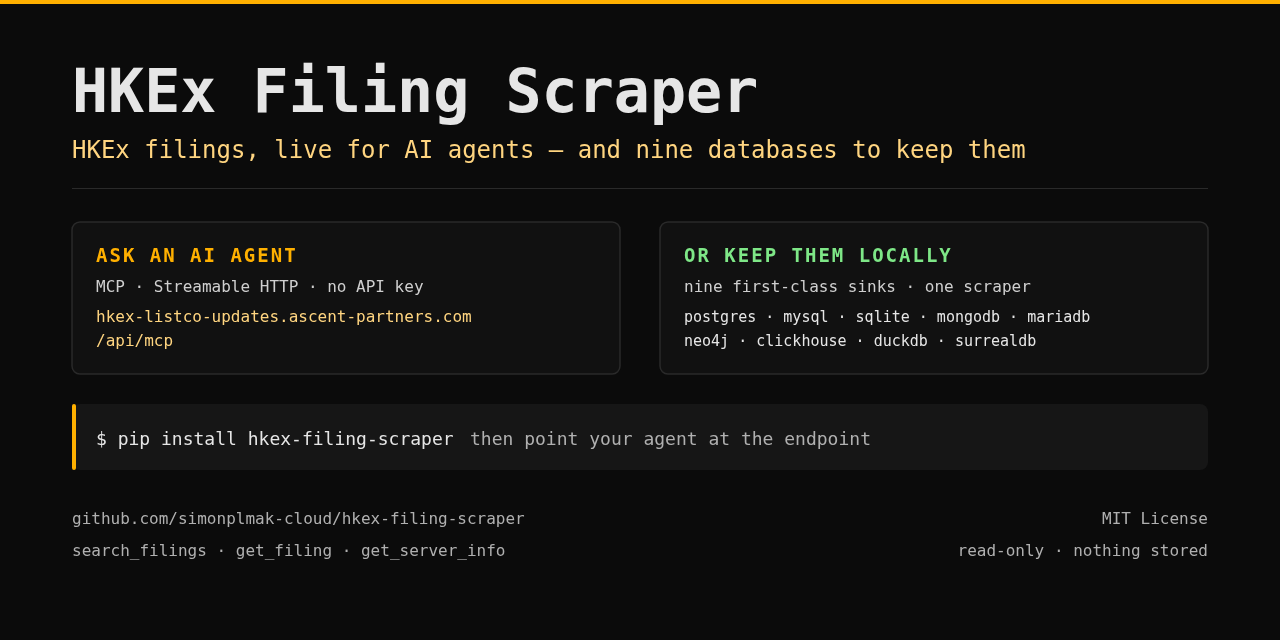





An open-source Python tool that scrapes 25+ years of Hong Kong Stock Exchange (HKEx) regulatory filings and ingests them into any combination of PostgreSQL, MySQL/MariaDB, SQLite, MongoDB, Neo4j, ClickHouse, DuckDB, and SurrealDB — with full-text extraction from PDF/HTML/Excel documents, structured tables, coverage tracking, and optional graph linking.
It uses the undocumented HKEx JSON API directly, which is significantly faster and more reliable than browser-based scraping.
Contents
- Database support
- Why this project
- How it works
- Features
- Installation
- Quick start
- Usage
- Configuration
- Database schema
- Documentation
- Development
- Contributing
- Roadmap
- License
Database support
Set DATABASE_TARGET to any ordered, comma-separated combination of these. Every sink is a
first-class destination — the order only decides which one serves reads. The full matrix
(licenses, capability differences, per-engine notes) is in
docs/sinks; rows are in the documented popularity order.
| Sink | Model | License | Extra | Idempotent upsert |
|---|---|---|---|---|
postgres |
relational | PostgreSQL License | postgres |
ON CONFLICT DO UPDATE |
mysql / mariadb |
relational | GPLv2 | mysql |
ON DUPLICATE KEY UPDATE |
sqlite |
relational | Public domain | — | ON CONFLICT DO UPDATE |
mongodb |
document | SSPL¹ | mongodb |
update_one(upsert=True) |
neo4j |
graph | GPLv3 (Community) | neo4j |
MERGE |
clickhouse |
columnar | Apache-2.0 | clickhouse |
ReplacingMergeTree + read-merge |
duckdb |
relational | MIT | duckdb |
ON CONFLICT DO UPDATE |
surrealdb |
graph + document | BSL 1.1¹ | — | UPSERT / RELATE |
¹ Source-available, not OSI-approved — labelled exceptions per ADR 0003.
Why this project
Regulatory filings are the raw substrate for research, compliance, and LLM/RAG systems, but getting a complete, faithful, provenance-preserving copy is tedious: you have to reverse-engineer the HKEx API, handle a JSF session and pagination, parse Chinese/English bilingual PDFs, extract tables, and survive payload limits and database quirks. This tool does all of that and hands you a clean corpus.
The multi-sink design means you don't have to adopt a new database to use it: keep whichever store your team already runs, mirror everything into a second one for SQL/BI/dbt tooling, stream documents into a document store, or load a columnar engine for analytics. Set one variable (DATABASE_TARGET) and the same run feeds one or several sinks.
How it works
The scraper runs in two phases, builds one canonical record per filing, and hands each record
to every sink listed in DATABASE_TARGET. Reads are served by the first configured sink
that supports them.
flowchart LR
    A[HKEx JSON API] --> B[Phase 1: metadata]
    B --> C[Canonical record]
    C --> D{DATABASE_TARGET}
    D --> E[(PostgreSQL)]
    D --> F[(MySQL / MariaDB)]
    D --> G[(SQLite)]
    D --> H[(MongoDB)]
    D --> I[(Neo4j)]
    D --> J[(ClickHouse)]
    D --> K[(DuckDB)]
    D --> L[(SurrealDB)]
    B --> M[Graph linking]
    M --> D
    B --> N[Phase 2: download and extract]
    N --> C
- Phase 1 scrapes filing metadata from the undocumented HKEx JSON API through a JSF
session, splitting the range into monthly chunks and deduplicating on a 16-character MD5
filingId. - Graph linking writes
has_filingandreferences_filingedges to every edge-capable sink whenCOMPANY_TABLEis set. - Phase 2 downloads each filing's PDF/HTML/Excel document, extracts text and tables to Markdown, and writes the payload to every sink.
- Failure isolation means one sink's failure is logged and counted but never blocks another; the run exits non-zero if any configured sink failed.
More detail: Architecture and ADR 0002.
Features
- Fast API scraping — direct HKEx JSON API, no browser/Selenium.
- Full history — every filing from April 1999 to today, with chunk-level coverage verification.
- Document processing — downloads PDF/HTML/Excel and extracts full text plus structured tables (Markdown).
- Multi-sink — write to any combination of the nine sinks via
DATABASE_TARGET(an ordered, comma-separated list). Each sink mirrors filings, documents, coverage, and edges with idempotent upserts, in its own native model. - Graph linking — optional
(company)-[has_filing]->(filing)and(filing)-[references_filing]->(company)edges on every edge-capable sink. - Parallel and resumable — batching, parallel downloads, stalled-job detection, and per-chunk coverage tracking.
- Failure isolation — a failure on one sink never blocks or rolls back another; per-sink counters are reported every run, and the run exits non-zero if any configured sink failed.
- Optional dependencies — core is
requests+beautifulsoup4; document extraction and every database driver (psycopg,PyMySQL,duckdb,pymongo,clickhouse-connect,neo4j) are extras with graceful fallback. SQLite needs no extra. - MCP server — an optional read-only Model Context Protocol server (
hkex-scraper-mcp) exposes the corpus to LLM clients over stdio. See docs/mcp.md.
Installation
The package is published on PyPI:
pip install hkex-filing-scraper              # core; SQLite works out of the box
pip install "hkex-filing-scraper[all]"       # Excel + dotenv + every database driver + the MCP server
pip install "hkex-filing-scraper[postgres]"  # add one sink driver at a time
pip install "hkex-filing-scraper[mysql]"     # MySQL and MariaDB
pip install "hkex-filing-scraper[duckdb]"    # or: mongodb, clickhouse, neo4j
pip install "hkex-filing-scraper[mcp]"       # read-only MCP server for LLM clients
To run the latest unreleased code, install straight from GitHub:
pip install "git+https://github.com/simonplmak-cloud/hkex-filing-scraper.git"
Optional extras: excel, postgres, mysql, duckdb, mongodb, clickhouse, neo4j,
mcp, all, dev. SQLite and SurrealDB need no extra.
For a fully locked development environment, uv.lock pins every dependency including extras:
uv sync --frozen --all-extras
Releases carry signed build provenance and a CycloneDX SBOM — see Verifying a release.
# PDF text + table extraction. AGPL-3.0 — see the license note below.
pip install "hkex-filing-scraper[pdf]"
License note. The
all, so the default install stays permissive. If you distribute or host a service that includes them, the AGPL's network clause applies to you. See docs/legal.md.
Quick start
cp .env.example .env
Set DATABASE_TARGET to any ordered, comma-separated list of sink ids, then add that sink's
connection settings. Every sink is written to; reads come from the first read-capable sink.
# PostgreSQL
DATABASE_TARGET=postgres
POSTGRES_DSN=postgresql://user:password@localhost:5432/hkex

# MySQL / MariaDB
DATABASE_TARGET=mysql
MYSQL_HOST=localhost  MYSQL_DATABASE=hkex  MYSQL_USER=hkex  MYSQL_PASSWORD=secret

# SQLite (no server)
DATABASE_TARGET=sqlite
SQLITE_PATH=hkex.db

# MongoDB
DATABASE_TARGET=mongodb
MONGODB_URI=mongodb://localhost:27017  MONGODB_DATABASE=hkex

# Neo4j
DATABASE_TARGET=neo4j
NEO4J_URI=bolt://localhost:7687  NEO4J_USER=neo4j  NEO4J_PASSWORD=secret

# ClickHouse
DATABASE_TARGET=clickhouse
CLICKHOUSE_HOST=localhost  CLICKHOUSE_DATABASE=hkex  CLICKHOUSE_USER=default

# DuckDB (no server)
DATABASE_TARGET=duckdb
DUCKDB_PATH=hkex.duckdb

# SurrealDB
DATABASE_TARGET=surrealdb
SURREAL_ENDPOINT=http://localhost:8000
SURREAL_PASSWORD=root
Then run:
hkex-scraper --metadata-only          # fast: metadata only
hkex-scraper                          # full: metadata + documents + graph
Several sinks at once
# Order sets read precedence.
DATABASE_TARGET=postgres,sqlite
POSTGRES_DSN=postgresql://user:password@localhost:5432/hkex
SQLITE_PATH=hkex.db
The schema is created automatically on startup — no manual DDL. See docs/sinks for the capability matrix. MongoDB (SSPL) and SurrealDB (BSL) are source-available, labelled exceptions.
Usage
# Last ~2 months (default)
hkex-scraper

# Full history from 1999
hkex-scraper --full-history

# Specific range
hkex-scraper --from-date 01/01/2024 --to-date 31/01/2024

# Metadata only / documents only / graphs only
hkex-scraper --metadata-only
hkex-scraper --backfill-docs
hkex-scraper --link-only

# Limit and dry-run
hkex-scraper --limit 500
hkex-scraper --dry-run

# Choose the sink(s) for this run (comma-separated, ordered)
hkex-scraper --database-target postgres
hkex-scraper --database-target sqlite
hkex-scraper --database-target postgres,sqlite

# Reporting
hkex-scraper --coverage-report
hkex-scraper --database-target postgres,sqlite --parity-report
hkex-scraper --database-target postgres,sqlite --verify
Command-line options
| Flag | Description |
|---|---|
--full-history |
Scrape all filings from April 1999 to today. |
--from-date DD/MM/YYYY |
Start date for scraping. |
--to-date DD/MM/YYYY |
End date for scraping. |
--limit N |
Limit processing to N filings (0 = unlimited). |
--metadata-only |
Phase 1 only: metadata, no downloads. |
--backfill-docs |
Phase 2 only: download documents for existing filings. |
--link-only |
Only create/refresh graph edges. |
--dry-run |
Fetch but do not write to any database. |
--database-target SINKS |
Override DATABASE_TARGET (comma-separated; valid: postgres, mysql, sqlite, mongodb, mariadb, neo4j, clickhouse, duckdb, surrealdb). |
--coverage-report |
Print chunk coverage from the read source, then exit. |
--parity-report |
Print filing counts per sink and the spread, then exit. |
--verify |
Compare sinks by filing id and document hash, then exit non-zero on any difference. |
--version |
Print the version and exit. |
Exit code is non-zero when any configured sink recorded write failures.
Configuration
Configuration is loaded from .env in the current working directory (not the project root). Full reference: docs/configuration.md.
| Variable | Default | Purpose |
|---|---|---|
DATABASE_TARGET |
required | Comma-separated, ordered sink list: postgres, mysql, sqlite, mongodb, mariadb, neo4j, clickhouse, duckdb, surrealdb. |
POSTGRES_DSN |
— | Full PostgreSQL DSN (preferred). |
POSTGRES_HOST / POSTGRES_PORT |
localhost / 5432 |
Discrete connection (used when POSTGRES_DSN is empty). |
POSTGRES_DATABASE / POSTGRES_USER / POSTGRES_PASSWORD |
— | Discrete connection. |
POSTGRES_SCHEMA |
public |
Schema for the mirrored tables. |
POSTGRES_MIN_POOL / POSTGRES_MAX_POOL |
1 / 15 |
Connection pool sizing. |
MYSQL_DSN |
— | Full MySQL DSN (preferred); MARIADB_DSN follows the same shape. |
MYSQL_HOST / MYSQL_PORT / MYSQL_DATABASE / MYSQL_USER / MYSQL_PASSWORD |
— / 3306 / — |
MySQL connection; MARIADB_* falls back to these. |
SQLITE_PATH |
— | SQLite file path, or :memory:. |
MONGODB_URI / MONGODB_DATABASE |
— | MongoDB connection URI and database. |
NEO4J_URI / NEO4J_USER / NEO4J_PASSWORD / NEO4J_DATABASE |
— | Neo4j Bolt connection. |
CLICKHOUSE_HOST / CLICKHOUSE_PORT / CLICKHOUSE_DATABASE / CLICKHOUSE_USER / CLICKHOUSE_PASSWORD |
— / 8123 / — |
ClickHouse connection. |
DUCKDB_PATH |
— | DuckDB file path, or :memory:. |
SURREAL_ENDPOINT |
— | SurrealDB HTTP endpoint (required when target includes surrealdb). |
SURREAL_NAMESPACE / SURREAL_DATABASE |
default |
SurrealDB NS/DB. |
SURREAL_USERNAME / SURREAL_PASSWORD |
root / — |
SurrealDB credentials. |
COMPANY_TABLE |
— | Company table; enables graph edges. |
COMPANY_ID_PATTERN |
{code}_{exchange} |
Ticker → company key pattern. |
MAX_DOWNLOAD_WORKERS |
15 |
Parallel document downloads. |
REQUEST_DELAY_SECONDS |
0 |
Minimum seconds between request starts (pacing). |
Database schema
Each sink stores the same four record families in its own native model. The schema is created
automatically with idempotent DDL, and filing_id (16-char MD5) is the shared join key across
all sinks.
| Record | Relational (postgres, mysql, mariadb, sqlite, duckdb) |
Key |
|---|---|---|
| Filing + document payload | exchange_filing |
filing_id |
| Chunk coverage | scrape_coverage |
(chunk_from, chunk_to, run_id) |
| Company → filing edges | has_filing |
(company_id, filing_id) |
| Filing → referenced-company edges | references_filing |
(filing_id, company_id) |
Column shapes differ by engine: document_tables is jsonb (PostgreSQL), json (MySQL/MariaDB),
JSON text (SQLite/DuckDB/ClickHouse), an embedded array (MongoDB), or a JSON string (Neo4j);
referenced_tickers is text[] (PostgreSQL), json (MySQL), JSON text (SQLite/DuckDB),
Array(String) (ClickHouse), an array (MongoDB), or a string array (Neo4j). SurrealDB uses
SCHEMAFULL tables of the same names.
Writes are parameterised upserts, so re-running is idempotent. Document payloads use a separate statement, so a metadata-only re-run never overwrites extracted text or tables.
-- PostgreSQL examples; each sink guide has engine-specific queries.
SELECT company_ticker, count(*) FROM exchange_filing GROUP BY 1 ORDER BY 2 DESC LIMIT 10;

SELECT filing_id, title
FROM exchange_filing
WHERE referenced_tickers && ARRAY['0700.HK'];

SELECT filing_id, tbl->>'markdown'
FROM exchange_filing, jsonb_array_elements(document_tables) AS tbl
WHERE filing_type = 'Annual Report';
Documentation
- Getting started
- Docs site: https://hkex-listco-updates.ascent-partners.com/
- Database sinks (support matrix)
- PostgreSQL sink guide
- MySQL/MariaDB sink guide
- SQLite sink guide
- MongoDB sink guide
- Neo4j sink guide
- ClickHouse sink guide
- DuckDB sink guide
- SurrealDB sink guide
- Try it locally (
examples/) - Configuration reference
- CLI reference
- MCP server
- Architecture
- Troubleshooting
- Testing
- De-risking register
- Legal & Terms of Use
- Upgrading
- Releasing
- Release automation reference
- Documentation style guide
- Changelog
Development
pip install -e ".[dev,all]"
ruff check          # lint (py310, line-length 100)
ruff format --check # formatting
pytest              # unit tests (no DB/network required)
Tests are pure unit tests. SQLite and DuckDB contract tests run in-process on every pytest;
integration tests that need a server are skipped unless that sink is configured.
Contributing
See CONTRIBUTING.md. Please report security issues per SECURITY.md. Ideas and questions are welcome in Discussions.
If this saves you time, a star helps others find it.
Roadmap
- Shipped — nine sinks on one contract: PostgreSQL, MySQL/MariaDB, SQLite, MongoDB, Neo4j, ClickHouse, DuckDB, SurrealDB.
- In progress — hardening: recorded HKEx API fixtures + canary, HTTP retry/backoff,
--verifycross-sink reconciliation, fault-injection tests, SBOM/provenance (see docs/de-risking.md). - Considered — OpenSearch, Cassandra, Valkey, TiDB (see ADR 0003).
Contributions that fit the roadmap, and good first issue items, are especially welcome.
License
MIT — see LICENSE. That covers this project's code only. Optional dependencies
carry their own licenses — notably the pdf extra, which is AGPL-3.0; see
docs/legal.md.
Data & Terms of Use: this is a research tool for the undocumented HKEx JSON API. Commercial redistribution of HKEx data may require a licensed HKEx feed; see docs/legal.md.
1 maintainer

Release files for hkex-filing-scraper 2.3.0
For a detailed explanation of source distributions (sdists) and built distributions (wheels), please see the package formats documentation.
Source distribution (sdist)
| File | Size | Uploaded | |
|---|---|---|---|
| hkex_filing_scraper-2.3.0.tar.gz | 671.9 kB | Details |
Built distribution (wheel)
| File | Interpreter | ABI | Platform | Reset |
|---|---|---|---|---|
| hkex_filing_scraper-2.3.0-py3-none-any.whl | Python 3 | none | any | Details |
Total release size: 784.9 kB
Release files / hkex_filing_scraper-2.3.0.tar.gz
| Download URL | hkex_filing_scraper-2.3.0.tar.gz |
|---|---|
| Size | 671.9 kB |
| Tags | Source |
|
SHA-256 checksum How to use checksums |
50677c813c4b8236c2c9699e706d2a2de87bd85af3a4dce87d2938c7c1acf250
|
|
BLAKE2b-256 checksum How to use checksums |
6f1128d328cdc74ee400679e69e126f6188b8eacbb8df5b695069272ad6f1ac1
|
| Upload date | |
|
Uploaded using Trusted Publishing? What is trusted publishing? |
Yes |
| Uploaded via |
twine/7.0.0 CPython/3.13.14
|
Provenance
Provenance describes where a file came from. On PyPI, provenance is shared via attestations, which provide a verifiable record of the build or publishing details. View details, limitations and caveats.


PyPI Publish Attestation
PyPI verified that this artifact, at this checksum, originated from the publisher listed below.
Signed by GitHub Actions, verified by PyPI on Sep 19, 2026.
Transparency logRelease files / hkex_filing_scraper-2.3.0-py3-none-any.whl
| Download URL | hkex_filing_scraper-2.3.0-py3-none-any.whl |
|---|---|
| Size | 113.0 kB |
| Tags | Python 3 |
|
SHA-256 checksum How to use checksums |
43daa123d6780eb30b71147b3617ab12936f78e69090e90aaa21f3d657d86837
|
|
BLAKE2b-256 checksum How to use checksums |
f1c16e1d7554c7e9e64b7f6c84194c06c84415e518bd83ff82c136e40321f3f9
|
| Upload date | |
|
Uploaded using Trusted Publishing? What is trusted publishing? |
Yes |
| Uploaded via |
twine/7.0.0 CPython/3.13.14
|
Provenance
Provenance describes where a file came from. On PyPI, provenance is shared via attestations, which provide a verifiable record of the build or publishing details. View details, limitations and caveats.
PyPI Publish Attestation
PyPI verified that this artifact, at this checksum, originated from the publisher listed below.
Signed by GitHub Actions, verified by PyPI on Sep 19, 2026.
Transparency log













