
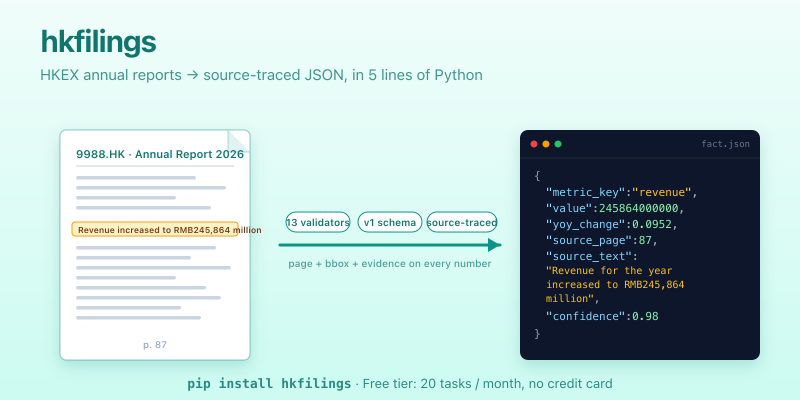
hkfilings · Python SDK for HKEX annual & interim reports
Stop hand-copying numbers from 300-page HKEX PDFs.
Get every fact — with its source page — in 5 lines of Python.





English · 中文
Install · Quickstart · Data shape · Cookbook · API · Plans · FAQ
Why this exists
If you've ever tried to extract revenue, segment breakdowns or capex guidance from a 300-page HKEX PDF, you know the failure modes: numbers without page references, OCR drift, units mixed between HKD and RMB, hallucinated year-over-year changes that don't reconcile, segment totals that don't sum to the consolidated figure.
This SDK is a client for an API that returns every fact with:
source_page+source_text— point at the exact location in the PDF (page-level bbox lands inextrawhen the parser can resolve it)- 13 deterministic validators — YoY recalc, accounting equation, segment reconciliation, currency / unit consistency, cashflow sign checks, EPS sign, free-cashflow definition, …
- Frozen v1 schema with forward-compat
extradict — new backend fields land inextra; your existing code never breaks on a release - Layer-2 signals — 11 enumerated signal types (margin driver, upstream cost pressure, downstream demand, inventory & orderbook, capex, …), each bound to evidence with anti-hallucination rules
- Supply-chain graph — suppliers, customers, competitors, regulators, substitutes, partners — with exposure share and direction
vs the alternatives
| Source-traced | Validated | HK coverage | Schema stability | Free tier | |
|---|---|---|---|---|---|
| Manual analyst | depends | manual | full | n/a | — |
| Wind / Bloomberg / CIQ | ✗ | proprietary | full | shifts each release | ✗ |
| Generic LLM on a PDF | hallucinates | ✗ | any | none | API costs |
| hkfilings | page + text | 13 validators | full HKEX | frozen v1 | ✓ |
Install
pip install hkfilings
Requires Python ≥ 3.10. The only runtime dependency is httpx. Works
great in Jupyter / Colab.
Quickstart
from hkfilings import HKFilingsClient

client = HKFilingsClient(api_key="ak_...")

task   = client.analyze(ticker="9988", year=2026)   # Alibaba 9988.HK
report = client.wait(task.task_id, timeout=600)

for fact in report.facts:
    print(f"{fact.metric_key:32}  {fact.value:>18,.0f}  p.{fact.source_page}")
Free tier: 20 tasks/month, no credit card required. → Get a key
What you get back
Every fact carries its provenance:
fact.metric_key       # "revenue"
fact.metric_label     # "Revenue"
fact.value            # 245_864_000_000.0
fact.comparable_value # 224_500_000_000.0    (prior period)
fact.yoy_change       # 0.0952
fact.source_page      # 87
fact.source_text      # "Revenue for the year increased to RMB245,864..."
fact.confidence       # 0.98
fact.extra            # forward-compat fields (e.g. bbox, unit) land here
Layer-2 signals come with direction + evidence:
signal.signal_type     # "margin_driver"
signal.direction       # "up" | "down" | "flat"
signal.summary         # "Cloud margin lifted on lower GPU procurement..."
signal.evidence        # [{"page": 42, "text": "..."}, ...]
signal.review_status   # "approved" | "auto_passed" | "pending"
Supply-chain nodes come with role + exposure share:
node.node_label             # "TSMC"
node.node_role              # "supplier" | "customer" | "competitor" | "regulator" | "substitute" | "partner"
node.exposure_share         # 0.18    (18% of revenue / cost tied to this node)
node.direction_to_company   # "inflow" | "outflow"
node.evidence_page          # 142
Cookbook
Tip: every snippet below runs as-is in a Jupyter notebook once you've exported
HKFILINGS_API_KEYin your shell.
Compare gross margin: BABA vs Tencent, last 3 fiscal years
from hkfilings import HKFilingsClient
import pandas as pd

client = HKFilingsClient(api_key="ak_...")
rows = []
for tk in ("9988", "0700"):
    m = client.company_matrix(tk, metrics=["revenue", "gross_profit"])
    rows.extend({"ticker": tk, **cell} for cell in m.cells)

df = pd.DataFrame(rows).pivot_table(
    index="period", columns=["ticker", "metric_key"], values="value"
)
print(df)
Read industry signals + evidence
sigs = client.task_signals(task.task_id, signal_type="margin_driver")
for s in sigs.signals:
    print(f"[{(s.direction or '-'):>4}] {s.summary}")
    for ev in s.evidence:
        text = (ev.get("text") or "")[:80]
        print(f"        p.{ev.get('page')} — {text}")

# [  up] Cloud Intelligence margin lifted 4.2pp YoY on lower GPU procurement...
#         p.42 — During the year, Cloud Intelligence Group recorded segment...
Render the supply-chain graph
import networkx as nx

graph = nx.DiGraph()
sc = client.company_supply_chain("9988")
for node in sc.nodes:
    graph.add_edge(
        "9988",
        node.node_label,
        role=node.node_role,
        exposure=node.exposure_share,
    )
print(graph)   # → "DiGraph with N nodes and M edges"  (networkx ≥ 3.0)
Export to CSV for Excel
with open("baba_2026_facts.csv", "wb") as fh:
    fh.write(client.facts_csv(task.task_id))
More runnable examples in examples/.
API reference
| Method | What it does |
|---|---|
analyze(ticker, year, …) |
Auto-discover and parse a report by ticker + year |
create_task(pdf_url, …) |
Parse a PDF by URL |
upload(file_path, …) |
Upload a local PDF |
task_status(task_id) |
Poll task progress |
wait(task_id, timeout=600) |
Block until the task reaches a terminal state |
result(task_id) |
Return the Layer-1 financial-facts envelope |
facts_csv(task_id) |
Same data, as CSV bytes |
company_matrix(ticker, metrics=…) |
Cross-period matrix for a ticker |
task_signals(task_id, …) |
Layer-2 signals for one report |
company_signals(ticker, …) |
Cross-period signal feed |
task_supply_chain(task_id) |
Supply-chain nodes for one report |
company_supply_chain(ticker, …) |
Cross-period supply-chain feed |
task_catalysts(task_id) |
Forward-looking catalysts (1–4Q horizon) |
company_catalysts(ticker, …) |
Cross-period catalyst feed |
intelligence_brief(task_id) |
Executive brief (rich nested) |
review_diff(task_id, …) |
Diff between review versions |
patch_fact(fact_id, **fields) |
Update a fact (review action) |
patch_signal(signal_id, **fields) |
Update a signal (review action) |
fact_comment(fact_id, body, …) |
Attach a review comment |
schema(name="financial_fact") |
Fetch a JSON Schema document |
Full docs: https://docs.hkfilings.app/python
Plans & limits
The SDK itself is free under MIT. The managed API runs on a usage-based plan with a free tier:
| Plan | Tasks / month | Layer-2 access | Export |
|---|---|---|---|
| Free | 20 | Limited | JSON / CSV (watermark) |
| Pro | 200 | Full | JSON / CSV |
| Team | 1,000 | Full + multi-seat | JSON / CSV / MD |
| Enterprise | Custom | Full + webhooks + SLA | Custom |
→ See current pricing & upgrade on hkfilings.app
You can also self-host the parsing service if you have your own LLM
budget — set base_url="https://your-host" when constructing the
client. Get in touch (sales@hkfilings.app) for on-prem deployments.
Schema contract
The v1 public schema is frozen. JSON Schema documents:
- https://hkfilings.app/v1/schema/financial_fact
- https://hkfilings.app/v1/schema/industry_signal
- https://hkfilings.app/v1/schema/supply_chain_node
- https://hkfilings.app/v1/schema/catalyst
New backend fields land in each dataclass's extra dict — you do not
need to upgrade the SDK to see them. We never remove or rename a
documented field within v1.
Configuration
| Setting | Constructor arg | Env var |
|---|---|---|
| API base URL | base_url= |
HKFILINGS_BASE_URL |
| API key | api_key= |
HKFILINGS_API_KEY |
| Request timeout (s) | timeout=60.0 |
— |
| User-Agent | user_agent= |
— |
The client honors HTTPS_PROXY / HTTP_PROXY via httpx — useful behind
corporate firewalls.
Roadmap
- v0.2 — Async client (
HKFilingsAsyncClient), retry with exponential backoff,client.facts_to_dataframe()helper. - v0.3 — Streaming task events (SSE wrapper), webhook signature
helpers, CLI (
hkfilings analyze 9988 2026). - v1.0 — Stable surface, deprecation warnings removed, TypeScript SDK companion.
Open issues for what you'd like prioritized.
FAQ
Q: Can I self-host the parsing engine? A: Yes for Enterprise customers — contact sales@hkfilings.app. The parsing service requires an LLM API key (DeepSeek, OpenAI, or Anthropic) and a Postgres database.
Q: How is this different from Wind / Bloomberg / Capital IQ? A: We focus on Hong Kong listings only and ship the entire evidence chain (source page + text) alongside every number. Our schema is public and frozen; theirs are proprietary and shift between releases. We're priced for individuals and small funds.
Q: A-shares? US listings? A: Not yet. We may add them once the HK coverage is rock-solid.
Q: Is the parsing logic open-source? A: This SDK is open-source under MIT. The parsing engine — LLM prompts, validators, anti-hallucination rules — is closed-source. We publish the JSON Schema contract as a stability commitment.
Q: How do I report a parsing bug for a specific report?
A: Open a GitHub issue with the task_id. We'll triage on the SaaS
side and either fix the engine or update the report.
Q: I got rate-limited. What now?
A: Free tier is 20 tasks/month. Upgrade or wait for the next monthly
reset. HKFilingsError will include status_code=429 and
payload["upgrade_url"].
License
MIT. See SECURITY.md for vulnerability reporting, CONTRIBUTING.md to help out.
⭐ If this saves you time, star the repo — it's the cheapest way to support the project.
Get a free key → hkfilings.app/signup
1 maintainer

Metadata
1 maintainer
Release files for hkfilings 0.1.2
For a detailed explanation of source distributions (sdists) and built distributions (wheels), please see the package formats documentation.
Source distribution (sdist)
| File | Size | Uploaded | Provenance | |
|---|---|---|---|---|
| hkfilings-0.1.2.tar.gz | 28.3 kB | With provenance | Details |
Built distribution (wheel)
| File | Interpreter | ABI | Platform | Reset |
|---|---|---|---|---|
| hkfilings-0.1.2-py3-none-any.whl | Python 3 | none | any | Details |
Total release size: 44.9 kB
Release files / hkfilings-0.1.2.tar.gz
| Download URL | hkfilings-0.1.2.tar.gz |
|---|---|
| Size | 28.3 kB |
| Tags | Source |
|
SHA-256 checksum How to use checksums |
80b5d350b49d24dd8c19035c5fcb9057a766aeb7b3bfa789efb2393723d00093
|
|
BLAKE2b-256 checksum How to use checksums |
ed7517c58fd05e03d3f4b876eaca0cda2dc9d16c90743f079f180b8d6ac82e92
|
| Upload date | |
|
Uploaded using Trusted Publishing? What is trusted publishing? |
Yes |
| Uploaded via |
twine/6.1.0 CPython/3.13.12
|
Provenance
Provenance describes where a file came from. On PyPI, provenance is shared via attestations, which provide a verifiable record of the build or publishing details. View details, limitations and caveats.


PyPI Publish Attestation
PyPI verified that this artifact, at this checksum, originated from the publisher listed below.
Signed by GitHub Actions, verified by PyPI on May 20, 2026.
Transparency logRelease files / hkfilings-0.1.2-py3-none-any.whl
| Download URL | hkfilings-0.1.2-py3-none-any.whl |
|---|---|
| Size | 16.5 kB |
| Tags | Python 3 |
|
SHA-256 checksum How to use checksums |
ba138b0999864f508d1ba3fb4e7678b797f7148c4085e5975603638a17c59bbb
|
|
BLAKE2b-256 checksum How to use checksums |
af693120a881b6d0f76f549232ecf142169932ac23d21e2364e2968ad03b89c9
|
| Upload date | |
|
Uploaded using Trusted Publishing? What is trusted publishing? |
Yes |
| Uploaded via |
twine/6.1.0 CPython/3.13.12
|
Provenance
Provenance describes where a file came from. On PyPI, provenance is shared via attestations, which provide a verifiable record of the build or publishing details. View details, limitations and caveats.
PyPI Publish Attestation
PyPI verified that this artifact, at this checksum, originated from the publisher listed below.
Signed by GitHub Actions, verified by PyPI on May 20, 2026.
Transparency logSecurity for hkfilings 0.1.2
Provenance
Provenance describes where a file came from. On PyPI, provenance is shared via attestations, which provide a verifiable record of the build or publishing details. View details, limitations and caveats.
Full provenance
All 2 files in this release have been uploaded with provenance metadata.
Attestation for hkfilings-0.1.2.tar.gz
PyPI Publish Attestation
PyPI verified that this artifact, at this checksum, originated from the publisher listed below.
Signed by GitHub Actions, verified by PyPI on May 20, 2026.
Transparency logA note on package security
PyPI is a repository for distributing packages, not a service for auditing them. While third-party security researchers and our staff do their best to detect and remove malicious packages, PyPI cannot guarantee the quality, security or suitability of any given package.
To learn more about protecting yourself from malicious actors, visit our package security documentation.














