

hlock
Make your agent harness pinnable, portable, and tunable.
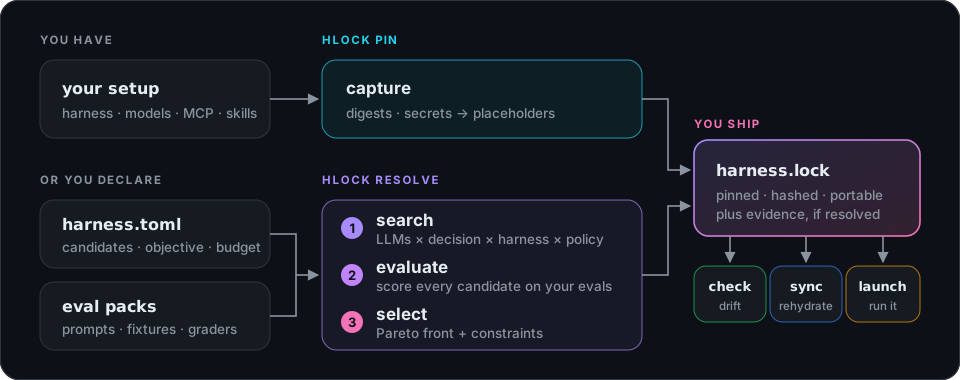
Tune your agent stack against your own tasks, then pin the winner in a harness.lock.






hlock treats an agent system the way a package manager treats dependencies. You
bring your domain tasks, the models you're allowed to use, and the harness you like.
hlock searches the stack, measures every candidate against your tasks, and writes a
harness.lock: a pinned, version-controlled, enforceable description of the agent that
actually works for your domain, along with the evidence for choosing it.
| You know this from package managers | In hlock |
|---|---|
📄 pyproject.toml |
harness.toml, the manifest: what the resolver may try, and what "best" means |
| 🧮 dependency resolver | the resolver: search over LLMs × decision models × harnesses × policies |
🔒 uv.lock / Cargo.lock |
harness.lock, the lockfile: what was chosen, pinned and hashed, plus the evidence |
✅ CI --locked check |
hlock check: fail when the manifest drifts from the lock |
Install
pip install hlock # or: uv add hlock · uvx hlock --help
Prebuilt wheels cover Linux (x86_64, aarch64), macOS (arm64, x86_64), and Windows (x64)
for CPython 3.9+. For Rust, use cargo add hlock.
Quickstart
No accounts or API keys needed. The built-in reference provider and harness are
deterministic and offline, so the whole loop runs on a laptop.
hlock init --name demo --pack ./tasks   # write a starter harness.toml
hlock resolve                           # tune the search space -> harness.lock
hlock check                             # fail if harness.toml drifted from the lock
hlock run "clean ./data/orders.csv"     # run the locked agent
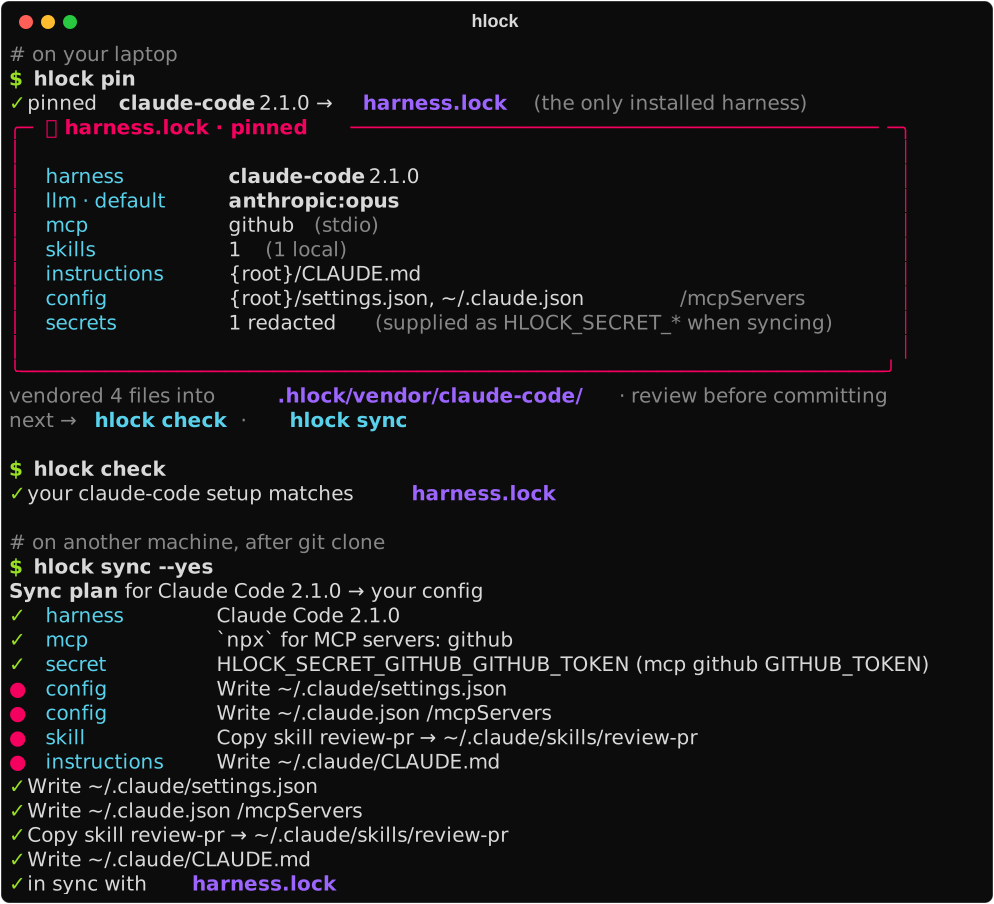
From there: hlock show prints the locked stack and its evidence, hlock tree prints the
component graph, hlock upgrade plans model upgrades, and hlock optimize tunes prompts,
hyperparameters, and small models into a harness.opt.lock.
Already have a harness set up?
Pin it. hlock pin captures your Claude Code, Codex, Pi, OpenCode, Hermes or Cursor setup
into harness.lock: the harness version, the models and local runtimes it uses, MCP
servers, skills, plugins, and config, with secrets replaced by placeholders.
hlock harness list      # the harnesses on this machine, and the one you're running inside
hlock pin               # lock your current setup into harness.lock
hlock check             # fail if your setup drifted from the pin
hlock sync              # on another machine: rehydrate it (also --prefix DIR, --docker)
hlock launch            # start a session that matches the lock (or: hlock launch opencode)
hlock localize          # an all-local equivalent: local harness + Ollama/LM Studio models
See Harnesses and Pinning your setup, Rehydrating with sync, and Launching a locked harness.
Python API
import json
import hlock
from hlock import SearchSpace, Objective, Budget

space = SearchSpace(
    llm={"planner": ["reference:qwen-7b", "reference:qwen-32b"]},
    decision=["none", "rules:default"],
    harness=["reference"],
    objective=Objective(select="min-cost", constraints={"success-rate": ">=0.5"}),
    budget=Budget(max_trials=50),
    tasks=json.dumps({"packs": ["./tasks"], "seeds": 2}),
)
lock = hlock.resolve(space, backend="local")   # writes ./harness.lock
print(lock.summary())

agent = hlock.load("harness.lock")
print(agent.run("clean ./data/orders.csv"))   # {"success": true, "model": "qwen-7b", ...}
How it works
Architecture
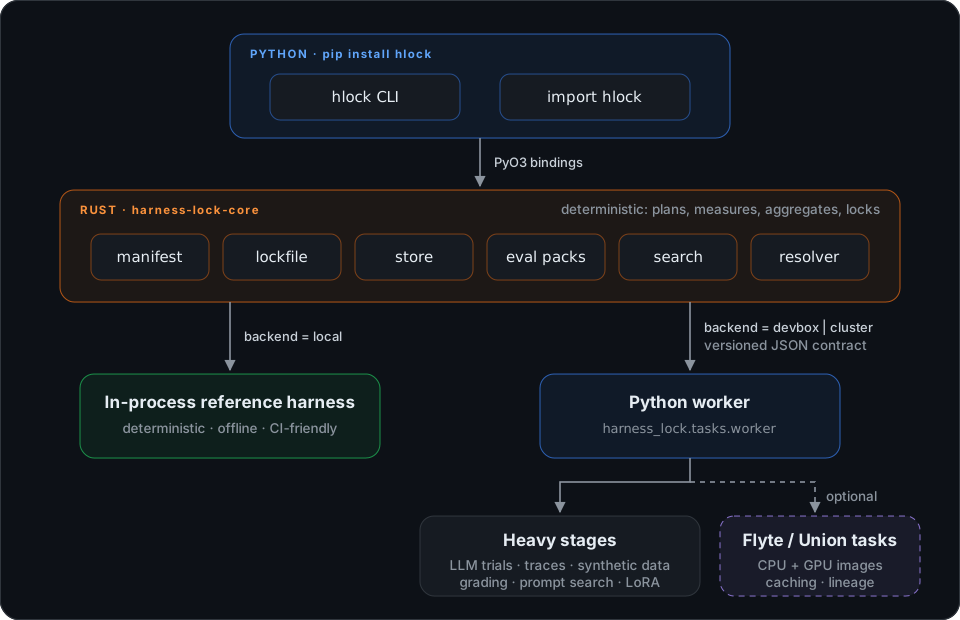
A Rust core does all the deterministic work. Anything that needs the Python ML ecosystem or a GPU runs in a Python worker, which can lift each piece of work to a Flyte task on a cluster.
| Path | What lives there |
|---|---|
crates/harness-lock-core |
The core library (pure Rust): manifests, lockfiles, search planning, trial bookkeeping, evidence, lock construction. It orchestrates and aggregates, and never does heavy compute itself. |
crates/harness-lock-py |
PyO3 bindings, compiled into harness_lock._harness_lock and shipped only inside the wheel. |
crates/hlock, crates/harness-lock |
Thin crates that re-export the core (harness-lock is the alias). |
harness_lock/ |
The Python package: the hlock CLI and the heavy-work worker (tasks/worker.py). |
hlock/ |
A shim that re-exports harness_lock, so import hlock works. |
packaging/harness-lock |
The harness-lock PyPI alias, which pins the matching hlock release. |
docs/ |
The documentation site (Zensical), published to GitHub Pages. |
Backends
| Backend | Where trials run | Use it for |
|---|---|---|
local (default) |
in-process Rust reference harness | trying it out, CI, deterministic tests |
devbox |
Python worker on this machine | real LLM calls, your own traces, flyte local |
cluster |
Python worker that lifts each stage to Flyte/Union | GPUs, fan-out, durable caching, shared results |
hlock optimize --backend devbox --depth probe --max-trials 10
# real LLM calls: export HL_LLM_BASE_URL=http://… HL_LLM_MODEL=qwen-32b [HL_LLM_API_KEY=…]
hlock optimize --backend cluster --depth ft --data user:./runs   # LoRA on a GPU worker
See Backends for setup and
the HL_* environment variables.
Development
Development uses uv and a Rust toolchain.
uv sync                            # create .venv, build the Rust extension, install dev tools
uv run pytest                      # Python bindings, CLI, worker
uv run ruff check harness_lock hlock tests
cargo test -p harness-lock-core    # Rust core + integration tests

uv run --group docs zensical serve # docs at http://localhost:8000
uv run rebuilds the extension automatically when Rust sources change.
Want to help? See the contributing guide. Releases are cut from tags. See RELEASING.md.
Status
hlock is at v0.1. What works today: manifest and lockfile schema v1, a
content-addressed store, task packs with graders, the reference provider and harness,
grid search with Pareto selection, upgrade (plan/apply/rollback), and optimize across
the local, devbox, and cluster backends. SPEC.md describes the full design,
much of which is still on the roadmap.
License
1 maintainer

Metadata
1 maintainer
Release files for hlock 0.2.0
For a detailed explanation of source distributions (sdists) and built distributions (wheels), please see the package formats documentation.
Source distribution (sdist)
| File | Size | Uploaded | |
|---|---|---|---|
| hlock-0.2.0.tar.gz | 157.0 kB | Details |
Built distributions (wheels)
| File | Reset | |||
|---|---|---|---|---|
| hlock-0.2.0-cp39-abi3-win_amd64.whl | CPython 3.9 | abi3 | Windows x86-64 | Details |
| hlock-0.2.0-cp39-abi3-manylinux_2_17_x86_64.manylinux2014_x86_64.whl | CPython 3.9 | abi3 | Linux glibc 2.17+ x86-64 | Details |
| hlock-0.2.0-cp39-abi3-manylinux_2_17_aarch64.manylinux2014_aarch64.whl | CPython 3.9 | abi3 | Linux glibc 2.17+ ARM64 | Details |
| hlock-0.2.0-cp39-abi3-macosx_11_0_arm64.whl | CPython 3.9 | abi3 | macOS 11.0+ ARM64 | Details |
| hlock-0.2.0-cp39-abi3-macosx_10_12_x86_64.whl | CPython 3.9 | abi3 | macOS 10.12+ x86-64 | Details |
Total release size: 9.6 MB
Release files / hlock-0.2.0.tar.gz
| Download URL | hlock-0.2.0.tar.gz |
|---|---|
| Size | 157.0 kB |
| Tags | Source |
|
SHA-256 checksum How to use checksums |
5acafcf05053f2c4bff7b838a4bb9a3093136f43c141dc9c6491bccca692f85d
|
|
BLAKE2b-256 checksum How to use checksums |
d7981d9994ec3f97be3832e6f5a9ee87332b625436964a8ed5a326c5d3490d06
|
| Upload date | |
|
Uploaded using Trusted Publishing? What is trusted publishing? |
Yes |
| Uploaded via |
twine/7.0.0 CPython/3.13.14
|
Provenance
Provenance describes where a file came from. On PyPI, provenance is shared via attestations, which provide a verifiable record of the build or publishing details. View details, limitations and caveats.


PyPI Publish Attestation
PyPI verified that this artifact, at this checksum, originated from the publisher listed below.
Signed by GitHub Actions, verified by PyPI on Oct 17, 2026.
Transparency logRelease files / hlock-0.2.0-cp39-abi3-win_amd64.whl
| Download URL | hlock-0.2.0-cp39-abi3-win_amd64.whl |
|---|---|
| Size | 1.9 MB |
| Tags | CPython 3.9 Windows x86-64 abi3 |
|
SHA-256 checksum How to use checksums |
517405d3c13b698a92cf6369d3ac7a4248b2210aba2ed6ce77e3505275063bd9
|
|
BLAKE2b-256 checksum How to use checksums |
57e3a68d2e8564032abea4460a04b074627c673cc1874aa24606efaae75b3037
|
| Upload date | |
|
Uploaded using Trusted Publishing? What is trusted publishing? |
Yes |
| Uploaded via |
twine/7.0.0 CPython/3.13.14
|
Provenance
Provenance describes where a file came from. On PyPI, provenance is shared via attestations, which provide a verifiable record of the build or publishing details. View details, limitations and caveats.
PyPI Publish Attestation
PyPI verified that this artifact, at this checksum, originated from the publisher listed below.
Signed by GitHub Actions, verified by PyPI on Oct 17, 2026.
Transparency logRelease files / hlock-0.2.0-cp39-abi3-manylinux_2_17_x86_64.manylinux2014_x86_64.whl
| Download URL | hlock-0.2.0-cp39-abi3-manylinux_2_17_x86_64.manylinux2014_x86_64.whl |
|---|---|
| Size | 2.0 MB |
| Tags | CPython 3.9 Linux glibc 2.17+ x86-64 abi3 |
|
SHA-256 checksum How to use checksums |
c5783e7b6541d14ca2a65542811e3667e98e79671a87f036f8a91f535b8ef93b
|
|
BLAKE2b-256 checksum How to use checksums |
6be78265da658e7524af6eb106df72248f0f17f57d50f47014bd9b338777a0f0
|
| Upload date | |
|
Uploaded using Trusted Publishing? What is trusted publishing? |
Yes |
| Uploaded via |
twine/7.0.0 CPython/3.13.14
|
Provenance
Provenance describes where a file came from. On PyPI, provenance is shared via attestations, which provide a verifiable record of the build or publishing details. View details, limitations and caveats.
PyPI Publish Attestation
PyPI verified that this artifact, at this checksum, originated from the publisher listed below.
Signed by GitHub Actions, verified by PyPI on Oct 17, 2026.
Transparency logRelease files / hlock-0.2.0-cp39-abi3-manylinux_2_17_aarch64.manylinux2014_aarch64.whl
| Download URL | hlock-0.2.0-cp39-abi3-manylinux_2_17_aarch64.manylinux2014_aarch64.whl |
|---|---|
| Size | 1.9 MB |
| Tags | CPython 3.9 Linux glibc 2.17+ ARM64 abi3 |
|
SHA-256 checksum How to use checksums |
a6e921d2f289aabd07c30eeb9b2044ca2a37c45f0b9ceef5b5703a71c3ba6a0c
|
|
BLAKE2b-256 checksum How to use checksums |
38df9d272ebe95cd8341ba49e362a7a81b2f789715c1afce0b5a13b7150c4fcf
|
| Upload date | |
|
Uploaded using Trusted Publishing? What is trusted publishing? |
Yes |
| Uploaded via |
twine/7.0.0 CPython/3.13.14
|
Provenance
Provenance describes where a file came from. On PyPI, provenance is shared via attestations, which provide a verifiable record of the build or publishing details. View details, limitations and caveats.
PyPI Publish Attestation
PyPI verified that this artifact, at this checksum, originated from the publisher listed below.
Signed by GitHub Actions, verified by PyPI on Oct 17, 2026.
Transparency logRelease files / hlock-0.2.0-cp39-abi3-macosx_11_0_arm64.whl
| Download URL | hlock-0.2.0-cp39-abi3-macosx_11_0_arm64.whl |
|---|---|
| Size | 1.8 MB |
| Tags | CPython 3.9 abi3 macOS 11.0+ ARM64 |
|
SHA-256 checksum How to use checksums |
3ccff69810777392cfdd2ea3754809c56346810398a215d8c2310edc95f81907
|
|
BLAKE2b-256 checksum How to use checksums |
123e07298bd629a2b603a4ea0a137de1f2aee8b994040b7512c398e68e0ddcc9
|
| Upload date | |
|
Uploaded using Trusted Publishing? What is trusted publishing? |
Yes |
| Uploaded via |
twine/7.0.0 CPython/3.13.14
|
Provenance
Provenance describes where a file came from. On PyPI, provenance is shared via attestations, which provide a verifiable record of the build or publishing details. View details, limitations and caveats.
PyPI Publish Attestation
PyPI verified that this artifact, at this checksum, originated from the publisher listed below.
Signed by GitHub Actions, verified by PyPI on Oct 17, 2026.
Transparency logRelease files / hlock-0.2.0-cp39-abi3-macosx_10_12_x86_64.whl
| Download URL | hlock-0.2.0-cp39-abi3-macosx_10_12_x86_64.whl |
|---|---|
| Size | 1.9 MB |
| Tags | CPython 3.9 abi3 macOS 10.12+ x86-64 |
|
SHA-256 checksum How to use checksums |
553dbb2ce00cb1331224a63cb929be78b92fbf66a85bb9259135d0df1f3edc23
|
|
BLAKE2b-256 checksum How to use checksums |
4d2c9d6b30987613c9057ba13a502c9ed435e8d9db9d7d731fdb32909f9e4daf
|
| Upload date | |
|
Uploaded using Trusted Publishing? What is trusted publishing? |
Yes |
| Uploaded via |
twine/7.0.0 CPython/3.13.14
|
Provenance
Provenance describes where a file came from. On PyPI, provenance is shared via attestations, which provide a verifiable record of the build or publishing details. View details, limitations and caveats.
PyPI Publish Attestation
PyPI verified that this artifact, at this checksum, originated from the publisher listed below.
Signed by GitHub Actions, verified by PyPI on Oct 17, 2026.
Transparency log













