
A lightweight, pure Python implementation of HNSW algorithm

Project description
HNSW-Lite



A lightweight, pure Python implementation of Hierarchical Navigable Small World (HNSW) algorithm for approximate nearest neighbor search.
Overview
HNSW-Lite provides an efficient solution for approximate nearest neighbor search in high-dimensional spaces. It's designed to be lightweight, easy to use, and suitable for a wide range of applications including:
- Similarity search in vector databases
- Recommendation systems
- Image similarity
- Document retrieval
- Feature matching
The implementation follows the algorithm described in "Efficient and robust approximate nearest neighbor search using Hierarchical Navigable Small World graphs" by Malkov & Yashunin (2016).
Key Features
- Pure Python Implementation: No C/C++ dependencies required
- Multiple Distance Metrics: Supports cosine and euclidean distance
- Simple API: Easy to integrate into your projects
- Metadata Support: Attach arbitrary metadata to vectors
- Flexible Configuration: Tune parameters for speed/accuracy tradeoffs
Installation
pip install hnsw-lite
Quick Start
import numpy as np
from hnsw.hnsw import HNSW

# Initialize HNSW index
hnsw = HNSW(space="cosine", M=16, ef_construction=200)

# Sample vectors to index
vectors = [
    [1.0, 0.0, 0.0],
    [0.0, 1.0, 0.0],
    [0.0, 0.0, 1.0],
    [0.5, 0.5, 0.0],
    [0.3, 0.3, 0.3]
]

# Add vectors to the index with optional metadata
for i, vector in enumerate(vectors):
    hnsw.insert(vector, {"id": i, "description": f"Vector {i}"})

# Create a query vector
from hnsw.node import Node
query_vector = [0.3, 0.3, 0.3]
query_node = Node(query_vector, 0)

# Search for nearest neighbors
k = 3  # Number of nearest neighbors to retrieve
results = hnsw.knn_search(query_node, k)

# Process results
for i, (distance, node) in enumerate(results):
    print(f"Neighbor {i+1}:")
    print(f"  Distance: {-distance}")  # Distances are negated in results
    print(f"  Vector: {node.vector}")
    print(f"  Metadata: {node.metadata}")
API Reference
HNSW Class
The main class for creating and searching the HNSW index.
HNSW(space="cosine", M=16, ef_construction=200)
Parameters
space(str): Distance metric to use. Options: "cosine", "euclidean". Default: "cosine"M(int): Maximum number of connections per node (except for layer 0). Default: 16ef_construction(int): Size of the dynamic list for the nearest neighbors during construction. Higher values lead to more accurate graphs but slower construction. Default: 200
Methods
insert(vector, metadata={}): Insert a vector into the index with optional metadataknn_search(query_node, top_n): Find k nearest neighbors for a query
Node Class
Used to represent vectors in the HNSW graph.
Node(vector, level, metadata=None)
Parameters
vector(List[float]): The vector to be stored in the nodelevel(int): The level of the node in the HNSW hierarchymetadata(Dict): Optional metadata to associate with the node
Performance Benchmarks
Effect of M Parameter on Recall and Performance
The M parameter (maximum number of connections per node) is crucial for balancing search accuracy and performance. Our benchmarks show:
Recall vs M Value
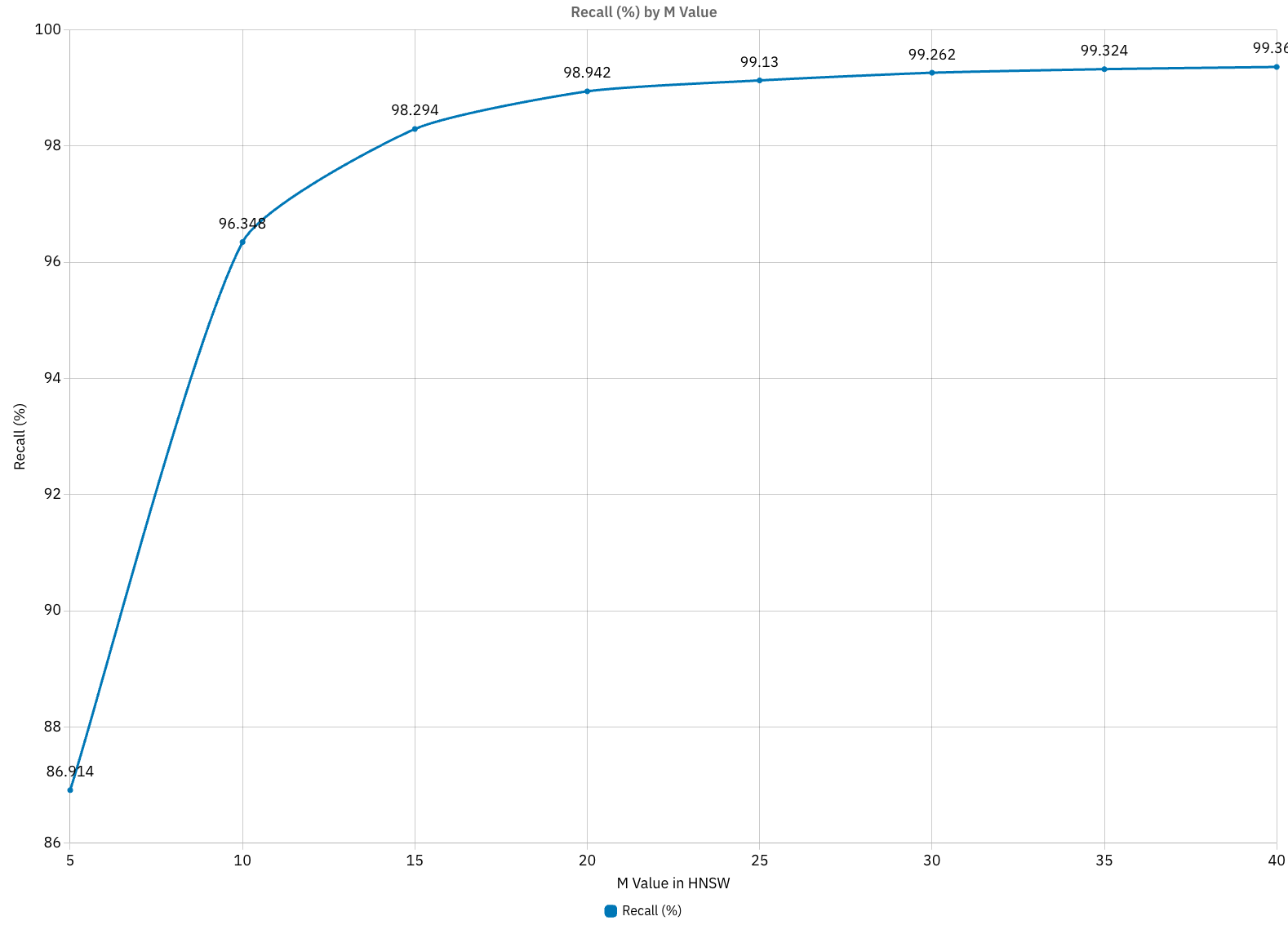
As shown in the graph:
- M=5: 86.91% recall
- M=10: 96.34% recall
- M=15: 98.29% recall
- M=20: 98.94% recall
- M=30: 99.26% recall
- M=40: 99.36% recall
The biggest improvements occur when increasing M from 5 to 15. After M=20, the recall gains diminish significantly while computational costs continue to increase.
Query Processing Time vs M Value
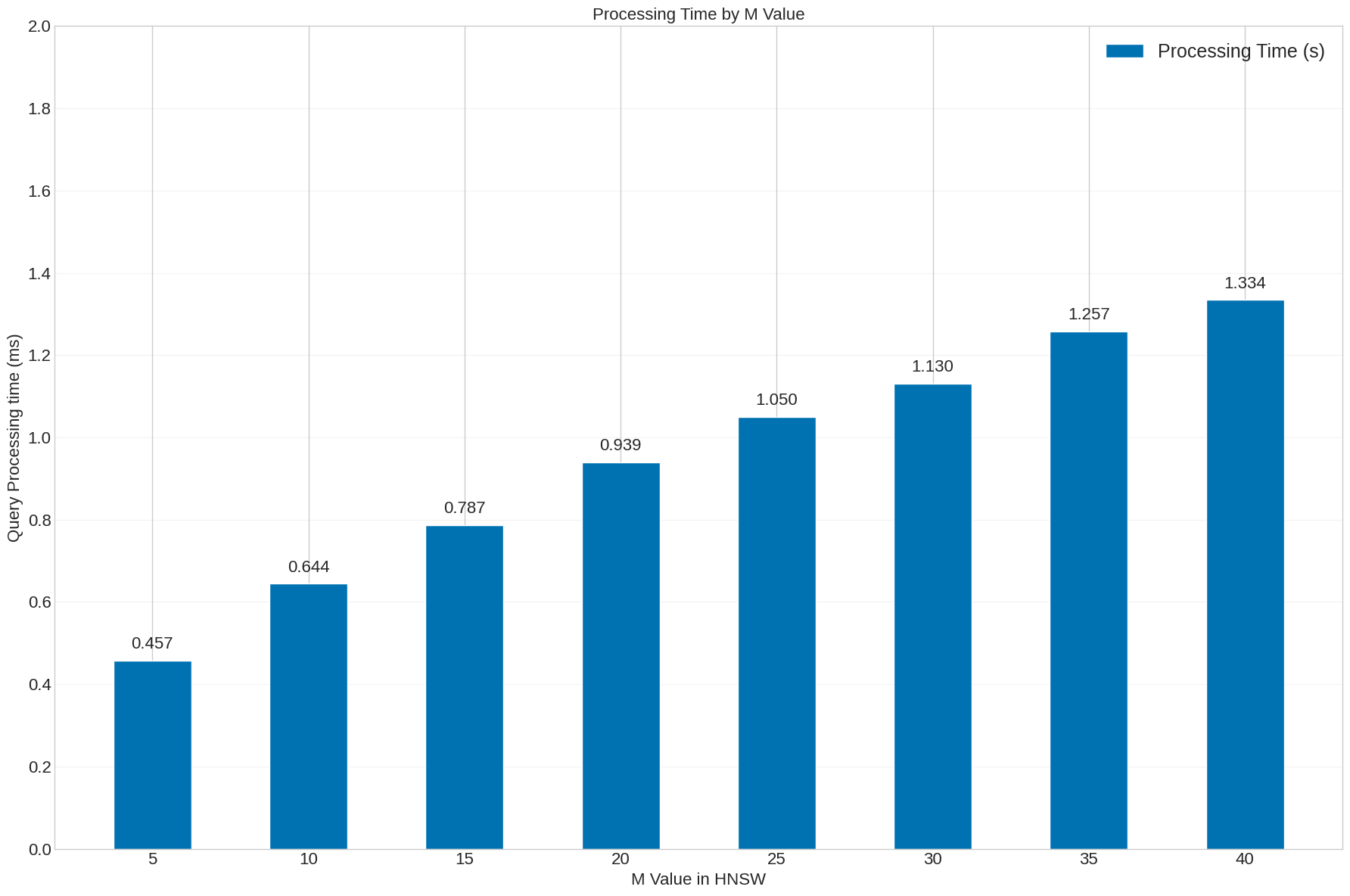
Processing time increases with higher M values:
- M=5: 0.457 ms
- M=10: 0.644 ms
- M=15: 0.787 ms
- M=20: 0.939 ms
- M=30: 1.130 ms
- M=40: 1.334 ms
Comparison with Other Algorithms
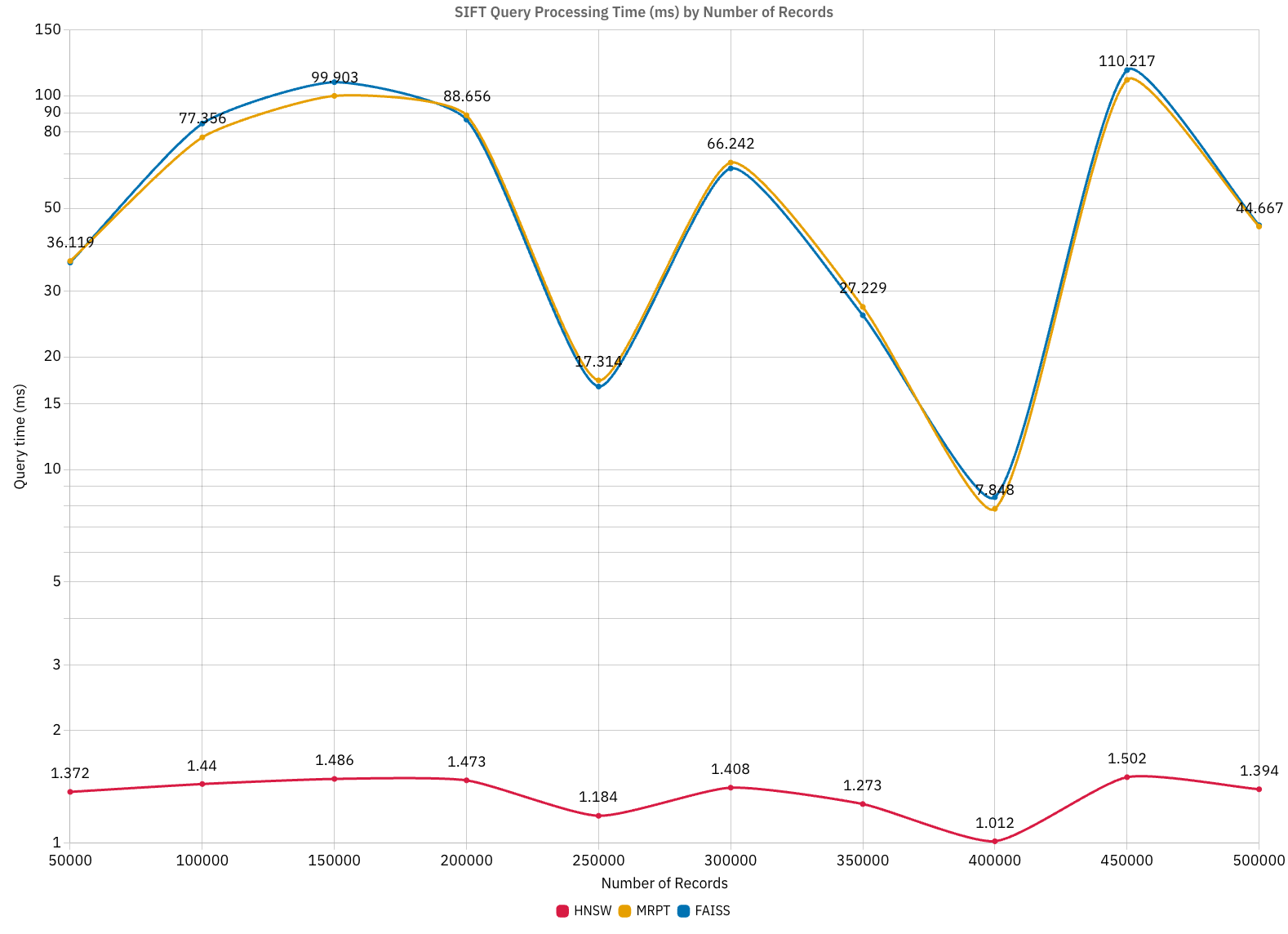
When comparing HNSW-Lite with other algorithms (FAISS, MRPT) on the SIFT dataset:
- HNSW consistently delivers sub-2ms query times regardless of dataset size
- HNSW shows faster query times compared to traditional methods
- Performance remains stable across different dataset sizes, from 50,000 to 500,000 records
Recommended M Values for Different Use Cases
| Use Case | Recommended M | Rationale |
|---|---|---|
| Ultra-fast search with acceptable recall | 8-12 | Good balance for speed-critical applications |
| Balanced performance | 15-20 | Best trade-off between recall and speed for most applications |
| High recall priority | 25-35 | When search quality is more important than speed |
| Maximum recall | 40+ | When search accuracy is critical, regardless of speed |
Parameter Tuning
Tuning the M Parameter
The HNSW algorithm's performance can be significantly impacted by the choice of M value:
-
Lower M values (5-12):
- ✅ Faster index construction
- ✅ Lower memory usage
- ✅ Faster queries
- ❌ Lower recall/accuracy
-
Higher M values (20-40):
- ✅ Better recall/accuracy (diminishing returns after M=20)
- ❌ Slower index construction
- ❌ Higher memory usage
- ❌ Slower queries
Suggested approach for tuning M:
- Start with M=10 (good default value)
- If search quality is insufficient, increase to M=20 or M=30
- If search is too slow, decrease to M=8 or M=6
- Run benchmarks with your specific dataset to find the optimal value
Tuning ef_construction
-
Lower ef_construction values (50-100):
- ✅ Faster index construction
- ❌ Potentially lower quality graph
-
Higher ef_construction values (200-500):
- ✅ Better graph quality
- ❌ Slower index construction
For most use cases, ef_construction=200 provides a good balance.
Performance Considerations
- Memory Usage: Each vector requires storage for its coordinates, connections, and metadata
- Construction Time: Scales roughly as O(n log n), where n is the number of vectors
- Search Time: Scales approximately logarithmically with the number of vectors
- Optimal M Value: The best M value depends on your specific use case, dataset dimensionality, and performance requirements
Limitations
- This is a pure Python implementation optimized for ease of use and understanding rather than maximum performance
- For extremely large datasets (millions of vectors), you might want to consider C++ implementations like hnswlib
Contributing
Contributions are welcome! Please feel free to submit a Pull Request.
License
This project is licensed under the MIT License - see the LICENSE file for details.
Citation
If you use HNSW-Lite in your research, please cite the original HNSW paper:
@article{malkov2016efficient,
  title={Efficient and robust approximate nearest neighbor search using hierarchical navigable small world graphs},
  author={Malkov, Yury A and Yashunin, Dmitry A},
  journal={IEEE transactions on pattern analysis and machine intelligence},
  volume={42},
  number={4},
  pages={824--836},
  year={2018},
  publisher={IEEE}
}


Download files
Download the file for your platform. If you're not sure which to choose, learn more about installing packages.
Source Distribution
Built Distribution
Filter files by name, interpreter, ABI, and platform.
If you're not sure about the file name format, learn more about wheel file names.
Copy a direct link to the current filters
File details
Details for the file hnsw_lite-0.1.2.tar.gz.
File metadata
- Download URL: hnsw_lite-0.1.2.tar.gz
- Upload date:
- Size: 10.9 kB
- Tags: Source
- Uploaded using Trusted Publishing? No
- Uploaded via: twine/6.1.0 CPython/3.12.10
File hashes
| Algorithm | Hash digest | |
|---|---|---|
| SHA256 |
c63dd65d50a743a1dec26005a1555b658b650984f116dcfc9707e95ca4d91463
|
|
| MD5 |
d06cee43d5b58033f96989c349575b8f
|
|
| BLAKE2b-256 |
d309b6606a159aa5401a0c4992dfec3e18dafbc8cf9f159908ebf818963b07fe
|
File details
Details for the file hnsw_lite-0.1.2-py3-none-any.whl.
File metadata
- Download URL: hnsw_lite-0.1.2-py3-none-any.whl
- Upload date:
- Size: 13.1 kB
- Tags: Python 3
- Uploaded using Trusted Publishing? No
- Uploaded via: twine/6.1.0 CPython/3.12.10
File hashes
| Algorithm | Hash digest | |
|---|---|---|
| SHA256 |
f63bdb5f50377d3e6301a0003cd6b18fd3c85d7e652fa2d4c625d7e0bc2832ca
|
|
| MD5 |
43f55b746f1fc71a97d662ba3bcf53f7
|
|
| BLAKE2b-256 |
61b7fc88e77f0c7e51c3dba68f5b755790f07135a612015e46a29583d045d88b
|






