Table of Contents
(Click me to see it.)
- What is
hoardy-web? - How to read this document
- Quickstart
- Supported input file formats
- Recipes
- Convert anything to
WRR - Find and filter things
- Merge multiple archive directories
- Build a file system tree of latest versions of all hoarded URLs
- Generate a local offline static website mirror, similar to
wget -mpk - Use
hoardy-web servefor archival and replay overHTTP - Generate previews for
WRRfiles, listen to them via TTS, open them withxdg-open, etc
- Convert anything to
- Usage
- Development:
./test-tool.sh [--help] [--wine] [--all|--subset NUM] [--long|--short NUM] PATH [PATH ...]
What is hoardy-web?
hoardy-web is a tool to inspect, search, organize, programmatically extract values and generate static website mirrors from, archive, view, and replay HTTP archives/dumps in WRR ("Web Request+Response", produced by the Hoardy-Web Web Extension browser add-on, also on GitHub) and mitmproxy (mitmdump) file formats.
How to read this document
The top part of this README file (from here to "Usage") is designed to be read in a linear fashion, not piece-meal.
The "Usage" section can be read and referenced to in arbitrary order.
Quickstart
Pre-installation
-
Install
Python 3:- On a Windows system: Download Python installer from the official website, run it, set
Add python.exe to PATHcheckbox, thenInstall(the default options are fine). - On a conventional POSIX system like most GNU/Linux distros and MacOS X: Install
python3via your package manager. Realistically, it probably is installed already.
- On a Windows system: Download Python installer from the official website, run it, set
Installation
-
On a Windows system:
Open
cmd.exe(pressWindows+R, entercmd.exe, pressEnter), install this withpython -m pip install hoardy-web
and run as
python -m hoardy_web --help
-
On a POSIX system or on a Windows system with Python's
/Scriptsadded toPATH:Open a terminal/
cmd.exe, install this withpip install hoardy-web
and run as
hoardy-web --help -
Alternatively, for light development (without development tools, for those see
nix-shellbelow):Open a terminal/
cmd.exe,cdinto this directory, then install withpython -m pip install -e . # or pip install -e .
and run as:
python -m hoardy_web --help
# or
hoardy-web --help
-
Alternatively, on a system with Nix package manager
nix-env -i -f ./default.nix
hoardy-web --help
Though, in this case, you'll probably want to do the first command from the parent directory, to install everything all at once.
-
Alternatively, to replicate my development environment:
nix-shell ./default.nix --arg developer true
Start archiving and replaying
python -m hoardy_web serve --implicit --archive-to C:\Users\Me\Documents\hoardy-web\raw
# or
hoardy-web serve --implicit --archive-to ~/hoardy-web/raw
Capture and archive some websites
See Hoardy-Web's "Quickstart" (also on GitHub).
In short:
- Install
Hoardy-Web's extension into your browser. - Switch it to
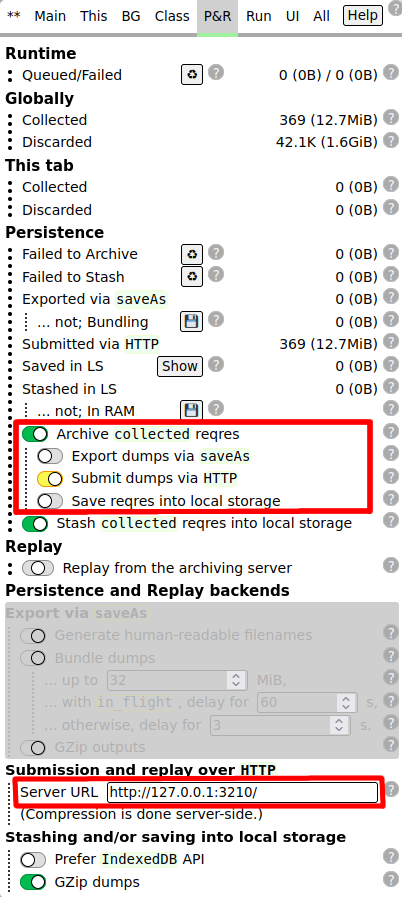
Submit dumps via 'HTTP'mode and ensure it points to the URL of the abovehoardy-web serveinstance (like this screenshot of theP&Rtab shows). - Browse some websites.
View/replay your archived data interactively over HTTP
You can then navigate to
- http://127.0.0.1:3210/web/*/* to see the list of all available URLs and their versions (visits), or to
- something like http://127.0.0.1:3210/web/2/https://archiveofourown.org/works/3733123 to view the latest archived version of that URL, or to
- something like http://127.0.0.1:3210/web/*/https://archiveofourown.org/works/3733123 to view the list of all visits to this URL,
- which also works with glob patterns http://127.0.0.1:3210/web/*/https://archiveofourown.org/works/[0-9]*.
This is very reminiscent of the Wayback Machine by design, yes.
Make a website mirror from your archived data
You can also use your archived data to generate a local offline static website mirror that can be opened in a web browser without accessing the Internet, similar to what wget -mpk does.
The precise invocation is slightly dependent on whether the archives were exported via saveAs by the Hoardy-Web extension itself, saved via the hoardy-web-sas simple archiving server, or via hoardy-web serve --archive-to (see below):
# for "Export via `saveAs`"
hoardy-web mirror --to ~/hoardy-web/mirror1 ~/Downloads/Hoardy-Web-export-*

# for `hoardy-web-sas` and/or `hoardy-web serve --archive-to`
hoardy-web mirror --to ~/hoardy-web/mirror1 ../simple_server/pwebarc-dump ~/hoardy-web/raw
You can then, e.g. rsync/syncthing/adb push/copy ~/hoardy-web/mirror1 to your phone/e-book reader before hopping on a plane or going on a deep-sea dive, and still be able to read all those pages.
The default settings should work for most simple websites, but a section below contains more info and more usage examples.
Supported input file formats
For definitions, see the "Data formats used by Hoardy-Web" page.
At the moment hoardy-web tool supports
WRRfiles (both compressed and not),WRRbundles (similarly),mitmproxydumps, andHAR(usingmitmproxy's parser).
WARC and built-in HAR support will be added soon-ish, PCAP support will be added eventually.
All sub-commands of hoardy-web except for
organizewhen run with--move,--hardlink, or--symlink(i.e. with anything other than--copy),get, andrun
can take all supported file formats as inputs. So, most examples described below will work fine with any mix of inputs as arguments.
You can, however, force hoardy-web to use a specific loader for all given inputs, e.g.:
hoardy-web mirror --to ~/hoardy-web/mirror1 \
  --load-mitmproxy mitmproxy.*.dump
This is slightly faster than the default --load-any and, for most loaders, produces more specific errors that explain exactly what failed to parse, instead of simply saying that all tried parsers failed to work.
Recipes
Convert anything to WRR
To use hoardy-web organize, get, and run sub-commands on data stored in file formats other than separate WRR files, you will have to import them first:
hoardy-web import bundle --to ~/hoardy-web/raw ~/Downloads/Hoardy-Web-export-*
hoardy-web import mitmproxy --to ~/hoardy-web/mitmproxy ~/mitmproxy/mitmproxy.*.dump
Note that .wrr files can be parsed as single-dump .wrrb files, so the first command above will work even when some of the exported dumps were exported as separate .wrr files by the Hoardy-Web extension (because you configured it to do that, because it exported a bucket with a single dump as a separate file, because it exported a dump that was larger than set maximum bundle size as a separate file, etc).
So, essentially, the first command above command is equivalent to
hoardy-web organize --copy --to ~/hoardy-web/raw ~/Downloads/Hoardy-Web-export-*.wrr
hoardy-web import bundle --to ~/hoardy-web/raw ~/Downloads/Hoardy-Web-export-*.wrrb
In fact, internally, hoardy-web import bundle is actually an alias for hoardy-web organize --copy --load-wrrb --defer-number 0.
Find and filter things
You can search your archive directory by using hoardy-web find sub-command, that prints paths to those of its inputs which match given conditions.
For example, to list reqres from ~/hoardy-web/raw that contain complete GET requests with 200 OK responses, you can run:
hoardy-web find --method GET --status-re .200C ~/hoardy-web/raw
To limit the above to responses containing text/html bodies with a (whole) word "Potter" in them:
hoardy-web find --method GET --method DOM --status-re .200C --response-mime text/html \
  --response-body-grep-re "\bPotter\b" ~/hoardy-web/raw
Most other sub-commands also accept the same filtering options. So, for instance, you can pretty-print or generate a static mirror from such files instead:
hoardy-web pprint --method GET --method DOM --status-re .200C --response-mime text/html \
  --response-body-grep-re "\bPotter\b" \
  ~/hoardy-web/raw

# we set `--index-all-inputs` to disable its default input filters
hoardy-web mirror --index-all-inputs \
  --method GET --method DOM --status-re .200C --response-mime text/html \
  --response-body-grep-re "\bPotter\b" \
  --to ~/hoardy-web/mirror-potter ~/hoardy-web/raw
Or, say, you want a list of all domains you ever visited that use CloudFlare:
hoardy-web stream --format=raw -ue hostname \
  --response-headers-grep-re '^server: cloudflare' \
  ~/hoardy-web/raw | sort | uniq
Or, say, you want to get all responses from a certain host with JSONs, except when they were fetched from CloudFlare and encoded with br, and then feed them to a script:
hoardy-web find -z --url-re 'https://example\.org/.*' --response-mime text/json \
  --not-response-headers-and-grep-re '^server: cloudflare' \
  --not-response-headers-and-grep-re '^content-encoding: br' \
  ~/hoardy-web/raw > found-paths
xargs -0 my-example-org-json-parser < found-paths
See the "Usage" section below for all possible filtering options.
In principle, the possibilities are limitless since hoardy-web has a tiny expression language which you can use to do things not directly supported by the command-line options:
hoardy-web find --and "response.body|eb|len|> 10240" ~/hoardy-web/raw
and, if you are a developer, you can easily add your own custom functions into there.
Merge multiple archive directories
To merge multiple input directories into one you can simply hoardy-web organize them --to a new directory.
hoardy-web will automatically deduplicate all the files in the generated result.
That is to say, for hoardy-web organize
--moveis de-duplicating when possible,- while
--copy,--hardlink, and--symlinkare non-duplicating when possible.
For example, if you duplicate an input directory via --copy or --hardlink:
hoardy-web organize --copy     --to ~/hoardy-web/copy1 ~/hoardy-web/original
hoardy-web organize --hardlink --to ~/hoardy-web/copy2 ~/hoardy-web/original
(In real-life use different copies usually end up on different backup drives or some such.)
Then, repeating the same command would a noop:
# noops
hoardy-web organize --copy     --to ~/hoardy-web/copy1 ~/hoardy-web/original
hoardy-web organize --hardlink --to ~/hoardy-web/copy2 ~/hoardy-web/original
And running the opposite command would also be a noop:
# noops
hoardy-web organize --hardlink --to ~/hoardy-web/copy1 ~/hoardy-web/original
hoardy-web organize --copy     --to ~/hoardy-web/copy2 ~/hoardy-web/original
And copying between copies is also a noop:
# noops
hoardy-web organize --hardlink --to ~/hoardy-web/copy2 ~/hoardy-web/copy1
hoardy-web organize --copy     --to ~/hoardy-web/copy2 ~/hoardy-web/copy1
But doing hoardy-web organize --move while supplying directories that have the same data will deduplicate the results:
hoardy-web organize --move --to ~/hoardy-web/all ~/hoardy-web/copy1 ~/hoardy-web/copy2
# `~/hoardy-web/all` will have each file only once
find ~/hoardy-web/copy1 ~/hoardy-web/copy2 -type f
# the output will be empty

hoardy-web organize --move --to ~/hoardy-web/original ~/hoardy-web/all
# `~/hoardy-web/original` will not change iff it is already organized using `--output default`
# otherwise, some files there will be duplicated
find ~/hoardy-web/all -type f
# the output will be empty
Similarly, hoardy-web organize --symlink resolves its input symlinks and deduplicates its output symlinks:
hoardy-web organize --symlink --output hupq_msn --to ~/hoardy-web/pointers ~/hoardy-web/original
hoardy-web organize --symlink --output shupq_msn --to ~/hoardy-web/schemed ~/hoardy-web/original

# noop
hoardy-web organize --symlink --output hupq_msn --to ~/hoardy-web/pointers ~/hoardy-web/original ~/hoardy-web/schemed
I.e. the above will produce ~/hoardy-web/pointers with unique symlinks pointing to each file in ~/hoardy-web/original only once.
Build a file system tree of latest versions of all hoarded URLs
Assuming you keep your WRR dumps in ~/hoardy-web/raw, the following commands will generate a file system hierarchy under ~/hoardy-web/latest organized in such a way that, for each URL from ~/hoardy-web/raw, it will contain a symlink from under ~/hoardy-web/latest to a file in ~/hoardy-web/raw pointing to the most recent WRR file containing 200 OK response for that URL:
# import exported extension outputs
hoardy-web import bundle --to ~/hoardy-web/raw ~/Downloads/Hoardy-Web-export-*
# and/or move and rename `hoardy-web-sas` outputs
hoardy-web organize --move --to ~/hoardy-web/raw ../simple_server/pwebarc-dump

# and then organize them
hoardy-web organize --symlink --latest --output hupq --to ~/hoardy-web/latest --status-re .200C ~/hoardy-web/raw
Personally, I prefer flat_mhs format (see the documentation of the --output below), as I dislike deep file hierarchies.
Using it also simplifies filtering in my ranger file browser, so I do this:
hoardy-web organize --symlink --latest --output flat_mhs --to ~/hoardy-web/latest --status-re .200C ~/hoardy-web/raw
Update the tree incrementally, in real time
The above commands rescan the whole contents of ~/hoardy-web/raw and so can take a while to complete.
If you have a lot of WRR files and you want to keep your symlink tree updated in near-real-time you will need to use a two-stage pipeline by giving the output of hoardy-web organize --zero-terminated to hoardy-web organize --stdin0 to perform complex updates.
E.g. the following will rename new WRR files from ../simple_server/pwebarc-dump to ~/hoardy-web/raw renaming them with --output default (the for loop is there to preserve buckets/profiles):
for arg in ../simple_server/pwebarc-dump/* ; do
  hoardy-web organize --zero-terminated --to ~/hoardy-web/raw/"$(basename "$arg")" "$arg"
done > changes
Then, you can reuse the paths saved in changes file to update the symlink tree, like in the above:
hoardy-web organize --symlink --latest --output flat_mhs --to ~/hoardy-web/latest --status-re .200C --stdin0 < changes
Then, optionally, you can reuse changes file again to symlink all new files from ~/hoardy-web/raw to ~/hoardy-web/all, showing all URL versions, by using --output hupq_msn format:
hoardy-web organize --symlink --output hupq_msn --to ~/hoardy-web/all --stdin0 < changes
Generate a local offline static website mirror, similar to wget -mpk
To render your archived data into a local offline static website mirror containing interlinked HTML files and their requisite resources similar to (but better than) what wget -mpk (wget --mirror --page-requisites --convert-links) does, you need to run something like this:
# separate `WRR` files
hoardy-web mirror --to ~/hoardy-web/mirror1 ~/hoardy-web/raw

# separate `WRR` files and/or `WRR` bundles
hoardy-web mirror --to ~/hoardy-web/mirror1 ~/Downloads/Hoardy-Web-export-*

# `mitmproxy` dumps
hoardy-web mirror --to ~/hoardy-web/mirror1 mitmproxy.*.dump

# any mix of these
hoardy-web mirror --to ~/hoardy-web/mirror1 \
  ~/hoardy-web/raw \
  ~/Downloads/Hoardy-Web-export-* \
  mitmproxy.*.dump
On completion, ~/hoardy-web/mirror1 will contain said newly generated interlinked HTML files, their resource requisites, and everything else available from given archive files.
The set of mirrored files can be limited with using several methods described below.
By default, the resulting HTML files will be stripped of all JavaScript and other stuff of various levels of evil.
The results should be completely self-contained (i.e., work inside a browser running in "Work offline" mode) and safe to view in a dumb unconfigured browser (i.e., the resulting web pages should not request any page requisites --- like images, media, CSS, fonts, etc --- from the Internet).
(In practice, though, hoardy-web mirror is not completely free of bugs and HTML5 spec is constantly evolving, with new things getting added there all the time.
So, it is entirely possible that the output of the above hoardy-web mirror invocation will not be completely self-contained.
Which is why the Hoardy-Web extension has its own per-tab Work offline mode which, by default, gets enabled for tabs with file: URLs.
That feature prevents the outputs of hoardy-web mirror from accessing the Internet regardless of any bugs or missing features in hoardy-web.
It also helps with debugging.)
If you are unhappy with the above and, for instance, want to keep JavaScript and produce human-readable HTMLs, you can run the following instead:
hoardy-web mirror \
  -e 'response.body|eb|scrub response &all_refs,+scripts,+pretty' \
  --to ~/hoardy-web/mirror2 ~/hoardy-web/raw
Or, say, you want to produce minimized outputs:
hoardy-web mirror \
  -e 'response.body|eb|scrub response &all_refs,-verbose,-whitespace,-optional_tags' \
  --to ~/hoardy-web/mirror2 ~/hoardy-web/raw
See the documentation for the --remap-* options of mirror sub-command and the options of the scrub function below for more info.
If you instead want a mirror made of raw files without any content censorship or link conversions, run:
# --raw-(re)s(ponse)body
hoardy-web mirror --raw-sbody --to ~/hoardy-web/mirror-raw ~/hoardy-web/raw
The later command will render your mirror rather quickly, but the other mirror commands use the scrub function, and that can be a bit slow, mostly because html5lib and tinycss2 that hoardy-web uses for paranoid HTML and CSS parsing and filtering are fairly slow.
Under CPython on my 2013-era laptop hoardy-web mirror manages to render, on average, 1-20 web pages per second, depending on the website.
Bunches of small pages reusing the same CSS files across them take less time, large pages, pages with a lot of complex HTML, or lots of inlined CSS take more.
Though, this is not very characteristic of the overall mirroring speed, since images and other media just get copied around at expected speeds of 300+ files per second.
Also, enabling +indent (or +pretty) in scrub will make HTML scrubbing slightly slower (since it will have to track more stuff) and CSS scrubbing a lot slower (since it will force complete structural parsing, not just tokenization).
Update your mirror incrementally
By default, hoardy-web mirror runs with an implied --remap-all option which remaps all links in mirrored HTML files to local files, even if source WRR files for those would-be mirrored files are missing.
This allows you to easily update your mirror directory incrementally by re-running hoardy-web mirror with the same --to argument on new inputs.
For instance:
# render everything archived in 2023
hoardy-web mirror --to ~/hoardy-web/mirror1 ~/hoardy-web/raw/*/2023

# now, add new stuff archived in 2024, keeping already exported files as-is
hoardy-web mirror --skip-existing --to ~/hoardy-web/mirror1 ~/hoardy-web/raw/*/2024

# same, but updating old files
hoardy-web mirror --overwrite-dangerously --to ~/hoardy-web/mirror1 ~/hoardy-web/raw/*/2024
After the first of the above commands, links from pages generated from WRR files of ~/hoardy-web/raw/*/2023 to URLs contained in files from ~/hoardy-web/raw/*/2024 but not contained in files from ~/hoardy-web/raw/*/2023 will point to non-existent, yet unmirrored, files on disk.
I.e. those links will be broken.
Running the second or the third command from the example above will then mirror additional files from ~/hoardy-web/raw/*/2024, thus fixing some or all of those links.
Treat missing links exactly like wget -mpk does
If you want to treat links pointing to not yet hoarded URLs exactly like wget -mpk does, i.e. you want to keep them pointing to their original URLs instead of remapping them to yet non-existent local files (like the default --remap-all does), you need to run mirror with --remap-open option:
hoardy-web mirror --remap-open --to ~/hoardy-web/mirror4 ~/hoardy-web/raw
In practice, however, you probably won't want the exact behaviour of wget -mpk, since opening pages generated that way is likely to make your web browser try to access the Internet to load missing page requisites.
To solve this problem, hoardy-web provides --remap-semi option, which does what --remap-open does, except it also remaps unavailable action links and page requisites into void links, fixing that problem:
hoardy-web mirror --remap-semi --to ~/hoardy-web/mirror4 ~/hoardy-web/raw
See the documentation for the --remap-* options below for more info.
Obviously, using --remap-open or --remap-semi will make incremental updates to your mirror impossible.
Mirror a subset of archived data
... by limiting inputs by using a symlink hierarchy
The simplest way to mirror a subset of your data is to run one of hoardy-web organize --symlink --latest commands described above, and then do something like this:
hoardy-web mirror --to ~/hoardy-web/mirror5 ~/hoardy-web/latest/archiveofourown.org
thus mirroring everything ever archived from https://archiveofourown.org.
... by limiting inputs with filters, --root-*, and --depth
As an alternative to (or in combination with) keeping a symlink hierarchy of latest versions, you can limit the set of files hoardy-web mirror will consider for mirroring by setting some input filters, e.g.:
hoardy-web mirror \
  --to ~/hoardy-web/mirror6 ~/hoardy-web/raw/*/2023 \
  --url-prefix 'https://archiveofourown.org/works/3733123' \
  --url-prefix 'https://archiveofourown.org/works/30186441'
Note, however, that doing this will prevent mirror from processing reqres not accepted by specified filters.
Which, in the above example, will prevent mirror from processing most of requisite resources of those pages.
When running with --remap-all, as the above does, this can be solved by running hoardy-web mirror repeatedly with different input filters, e.g., to mostly fix the above outputs you could then run:
hoardy-web mirror \
  --to ~/hoardy-web/mirror6 ~/hoardy-web/raw/*/2023 \
  --url-re 'https://archiveofourown\.org/.*\.css'
but this is quite inconvenient, and when running with something other than --remap-all, it will leave many output pages completely broken anyway.
Which is why hoardy-web can instead load (an index of) an assortment of WRR files into its memory but then only mirror a subset of those reqres with all requisite resources needed to properly render those pages.
This can be archived by specifying some --root-* filtering options, e.g.:
hoardy-web mirror \
  --to ~/hoardy-web/mirror6 ~/hoardy-web/raw/*/2023 \
  --root-url-prefix 'https://archiveofourown.org/works/3733123' \
  --root-url-prefix 'https://archiveofourown.org/works/30186441'
The --root-* options have exactly the same syntax and semantics as the normal input filtering options, except they start with --root- prefix, and instead of making hoardy-web accept reqres satisfying them as inputs, they make hoardy-web mirror queue such reqres for mirroring at the initial depth of 0.
An yes, there is also --depth option, which works similarly to wget's --level option in that it will follow all jump (a href) and action links accessible with no more than --depth browser navigations from recursion --root-*s and then mirror all those URLs and their requisites too.
When using --root-* options, --remap-open works exactly like wget's --convert-links in that it will only remap the URLs that are going to be mirrored and will keep the rest as-is.
Similarly, --remap-semi and --remap-closed will consider only the URLs reachable from the --root-*s in no more that --depth jumps as available.
Unlike most other sub-commands of hoardy-web which set no default filters, mirror runs with implied --ignore-some-inputs and --skip-some-indexed options which set some useful default input and root filters.
This can be disabled with --index-all-inputs and/or --queue-all-indexed, which can useful when using mirror to do weird things with custom --exprs, with the default --exprs, using these options is likely to produce a broken mirror, unless you add some specific filters manually.
See the documentation all of those options below for more info.
Also, note, that hoardy-web loads (indexes) WRR files pretty fast, so if you are running from an SSD, you can totally feed it years of WRR files and then only mirror a couple of URLs, and it will finish pretty quickly anyway.
Prioritize some files over others
By default, files are read, queued, and then mirrored in the order they are specified on the command line, in lexicographic file system walk order when an argument is a directory.
(See --paths-* and --walk-* options below if you want to change this.)
However, the above rule does not apply to page requisites, those are always (with or without --root-*, regardless of --paths-* and --walk-* options) get mirrored just after their parent HTML document gets parsed and before that document gets written to disk.
I.e., mirror will produce a new file containing an HTML document only after first producing all of its requisites.
I.e., when mirroring into an empty directory, if you see mirror generated an HTML document, you can be sure that all of its requisites loaded (indexed) by this mirror invocation are rendered too.
Meaning, you can go ahead and open it in your browser, even if mirror did not finish yet.
Moreover, unlike all other sub-commands mirror handles duplication in its input files in a special way: it remembers the files it has already seen and ignores them when they are given the second time.
(All other commands don't, they will just process the same file the second time, the third time, and so on.
This is by design, other commands are designed to handle potentially enormous file hierarchies in constant memory.)
The combination of all of the above means you can prioritize rendering of some documents over others by specifying them earlier on the command line and then, in a later argument, specifying their containing directory to allow mirror to also see their requisites and documents they link to.
For instance,
hoardy-web mirror \
  --to ~/hoardy-web/mirror7 \
  ~/hoardy-web/latest/archiveofourown.org/works__3733123*.wrr \
  ~/hoardy-web/latest/archiveofourown.org
will mirror all of ~/hoardy-web/latest/archiveofourown.org, but the web pages contained in files named ~/hoardy-web/latest/archiveofourown.org/works__3733123*.wrr and their requisites will be mirrored first.
This also works with --root-* options.
E.g., the following
hoardy-web mirror \
  --to ~/hoardy-web/mirror7 \
  ~/hoardy-web/latest/archiveofourown.org/works__3733123*.wrr \
  ~/hoardy-web/latest/archiveofourown.org \
  --root-url-prefix 'https://archiveofourown.org/works/'
will mirror all pages those URLs start with https://archiveofourown.org/works/ and all their requisites, but the pages contained in files named ~/hoardy-web/latest/archiveofourown.org/works__3733123*.wrr and their requisites will be mirrored first.
Finally, there is also the --boring option, which allows you to load some input PATHs without queuing them as roots, even when no --root-* options are specified or specified --root-* options say those reqres should be taken as roots.
E.g., the following
hoardy-web mirror \
  --to ~/hoardy-web/mirror8 \
  --boring ~/hoardy-web/latest/i.imgur.com \
  --boring ~/hoardy-web/latest/archiveofourown.org \
  ~/hoardy-web/latest/archiveofourown.org/works__[0-9]*.wrr
will load (an index of) everything under ~/hoardy-web/latest/i.imgur.com and ~/hoardy-web/latest/archiveofourown.org into memory but will only mirror the contents of ~/hoardy-web/latest/archiveofourown.org/works__[0-9]*.wrr files and their requisites.
Control which versions (visits) get mirrored
By default, hoardy-web mirror runs with the implied --latest option, which renders the latest available version (visit) to each URL.
Usually, this is fine, as most modern web-sites use versioned page requisites to improve caching.
But it can produce broken results sometimes.
For instance, when two different web pages share an unversioned CSS file and one those pages was recently revisited while the other was not, then, with the default --latest, only the latter version of the CSS file in question will be mirrored, making the older page broken.
To fix this, you can run mirror with --latest-hybrid option
hoardy-web mirror \
  --to ~/hoardy-web/mirror8 \
  --root-url-prefix 'https://en.wikipedia.org/wiki/'
  --latest-hybrid \
  ~/hoardy-web/raw
which will mirror each web page with its date-vise closest available resource requisites.
This takes quite a bit of memory, though, since mirror has to index and keep in memory references to all versions of all reqres to produce such hybrid results.
Similarly, you can also mirror the --oldest available version of each URL:
hoardy-web mirror \
  --to ~/hoardy-web/mirror9 \
  --root-url-prefix 'https://archiveofourown.org/works/'
  --oldest \
  ~/hoardy-web/raw
or a version closest to a certain date:
hoardy-web mirror \
  --to ~/hoardy-web/mirror9 \
  --root-url-prefix 'https://en.wikipedia.org/wiki/'
  --nearest 2020-10-31 \
  ~/hoardy-web/raw
both of which also have --*-hybrid variants.
There is also --all, which mirrors all available versions of all --root-*s and --depth-reachable URLs.
When using --all, you'll probably want to switch to a time-versioned output format, otherwise those default simply-numbered hupq_n outputs will be impossible to interpret:
hoardy-web mirror \
  --to ~/hoardy-web/mirror9 \
  --root-url-prefix 'https://en.wikipedia.org/wiki/'
  --all \
  --output hupq_tn \
  ~/hoardy-web/raw
Content-addressed outputs and de-duplication
Note that, by default, hoardy-web mirror runs with the implied --hardlink option, which makes it render and write each mirrored file to <--to>/_content/<hash/based/path>.<ext> and only then hardlink the result to <--to>/<output/format/based/path>.<ext> target destination.
The <hash/based/path> is derived from the sha256 hash of the generated file content.
This trick saves quite a bit of space in many cases.
E.g., when pages refer to the same resource requisites by slightly different URLs, same images and fonts get distributed via different CDN hosts, when you mirror --all visits to some URLs and many of those are absolutely identical, etc.
You can change the destination those hash-based paths get written to by specifying --content-to.
This allows you to easily share files between different mirrors:
hoardy-web mirror \
  --content-to ~/hoardy-web/shared \
  --to ~/hoardy-web/mirror10 \
  --root-url-prefix 'https://archiveofourown.org/works/'
  ~/hoardy-web/raw

hoardy-web mirror \
  --content-to ~/hoardy-web/shared \
  --to ~/hoardy-web/mirror11 \
  --root-url-prefix 'https://www.royalroad.com/'
  ~/hoardy-web/raw
You can also control the path of the generated files by setting --content-output, e.g.:
hoardy-web mirror \
  --content-output 'format:%(content_sha256|take_prefix 1|to_hex)s/%(content_sha256|take_prefix 2|take_suffix 1|to_hex)s/%(content_sha256|to_hex)s'
  --content-to ~/storage/sha256 \
  --to ~/hoardy-web/mirror12 \
  ~/hoardy-web/raw
hoardy-web mirror never overwrites any files under --content-to.
It does, however, check that any existing files it references from there have the contents it expects, and generates errors if they do not.
That is, you can set --content-output to anything and give any directory as --content-to, and hoardy-web will still ensure that the results are consistent, even when the --content-to cache is poisoned, or when different file contents compute to the same hash (produce a hash collision).
Also note that, by default, mirror treats jump-links (a href, etc) and links to resource requisites quite differently, remappings jump-links to normal --to destination paths, while remapping resource requisites to their hash-based --content-to paths instead.
This renders identical HTML and CSS files referencing identical resources into identical results, which also saves quite a bit of space.
Note, however, that all of the above does make mirror slightly slower, since it needs to compute a lot of hashes and check contents of many files on disk.
It also requires hardlink support on the target file system.
Also, pointing --content-to outside of --to stops the mirrored results in --to from being self-contained.
Which is why you can disable all of this by specifying --copy:
hoardy-web mirror \
  --to ~/hoardy-web/mirror10 \
  --copy \
  ~/hoardy-web/raw
Also, you can make it use --symlinks instead of hardlinks.
Though, enabling --symlink also enables the --absolute option by default because browsers treat file:// URLs pointing to symlinks as redirects.
Use hoardy-web serve for archival and replay over HTTP
hoardy-web comes with a builtin web server that can do
-
archival of
WRRcaptures produced by theHoardy-Webextension to disk; i.e., it can play a role of an archiving server forHoardy-Web, replacing thehoardy-web-sassimple archiving server; -
replay of
WRRand other supported file formats via Wayback Machine-esque URLs like http://127.0.0.1:3210/web/2/https://archiveofourown.org/works/3733123; -
do both at the same time, allowing newly archived URLs to be replayed immediately (after the
200 OKresponse to the archivingPOST).
In other words, hoardy-web serve is, essentially, a combination of hoardy-web-sas archiving server and an on-demand hoardy-web mirror which talks over HTTP instead of just dumping rendered documents to disk.
For interactive use, this is not only more convenient than hoardy-web mirror, it's also usually much faster since required URL rewrites are much cheaper and no recursive requisite resource rendering is required here.
That is, unlike mirror, serve is pretty snappy even on ancient hardware.
When invoking hoardy-web serve, the argument to the --archive-to option will be used by the archiving server parts, while the positional PATH arguments will used by the replay server parts.
That is,
hoardy-web serve \
  --archive-to ~/hoardy-web/raw \
  ~/hoardy-web/raw/*/2024 \
  ../simple_server/pwebarc-dump \
  ~/Downloads/Hoardy-Web-export-* \
  mitmproxy.*.dump
- will index and allow replay of all visits stored in files under
~/hoardy-web/raw/*/2024and../simple_server/pwebarc-dump, as well as all files named~/Downloads/Hoardy-Web-export-*(which are, usually,Hoardy-Webexports) and files namedmitmproxy.*.dump(which are probablymitmproxydumps); - while dumping new captures given by the extension to
~/hoardy-web/raw.
When the argument to --archive-to and the first PATH are the same, you can specify --implicit --- or -i --- to simplify it:
hoardy-web serve --implicit --archive-to ~/hoardy-web/raw
# which is equivalent to
hoardy-web serve --archive-to ~/hoardy-web/raw ~/hoardy-web/raw
# which can be shortened to
hoardy-web serve -i --to ~/hoardy-web/raw
# or even
hoardy-web serve -i -t ~/hoardy-web/raw
By default, hoardy-web serve runs with an implied --all option, which makes it keep the index of all given archives in memory, allowing arbitrary visits to be replayed.
If you dislike this behaviour, you can run it with the --latest, --oldest, or --nearest options instead
hoardy-web serve --latest -i -t ~/hoardy-web/raw
# or
hoardy-web serve --oldest -i -t ~/hoardy-web/raw
# or
hoardy-web serve --nearest 2024-06-01 -i -t ~/hoardy-web/raw
which, for each URL, will make hoardy-web serve keep and allow replay of the last, the first, or the one closest to the given timestamp, respectively.
This greatly improves resource consumption, but it also has the same caveats as hoardy-web mirror --latest, --oldest, and --nearest (see above).
When running with both --latest and archiving enabled, newly archived WRRs will elide older ones from the index, thus making that hoardy-web serve instance serve only the freshest archived version of each URL.
You can also disable indexing and replay completely by running it with --no-replay
hoardy-web serve --no-replay --to ~/hoardy-web/raw
which will make it essentially equivalent to hoardy-web-sas, except for serve having a customizable --output format.
The listening address and port can be controlled with --host and --port options, exactly the same as hoardy-web-sas:
hoardy-web serve --host 127.0.10.1 --port 4321 --archive-to ~/hoardy-web/raw
Currently enabled features can be queried programmatically from /hoardy-web/server-info endpoint
curl 'http://127.0.0.1:3210/hoardy-web/server-info'
which returns a JSON like
{"version": 1, "dump_wrr": "/pwebarc/dump", "index_ideal": null, "replay_oldest": "/web/-inf/{url}", "replay_latest": "/web/+inf/{url}", "replay_any": "/web/{timestamp}/{url}"}
Generate previews for WRR files, listen to them via TTS, open them with xdg-open, etc
See the script sub-directory for examples that show how to use pandoc and/or w3m to turn WRR files into previews and readable plain-text that can viewed or listened to via other tools, or dump them into temporary raw data files that can then be immediately fed to xdg-open for one-click viewing.
Usage
hoardy-web
Inspect, search, organize, programmatically extract values and generate static website mirrors from, archive, view, and replay HTTP archives/dumps in WRR ("Web Request+Response", produced by the Hoardy-Web Web Extension browser add-on) and mitmproxy (mitmdump) file formats.
Glossary: a reqres (Reqres when a type/class) is an instance of a structure representing HTTP request+response pair with some additional metadata.
-
options:
--version: show program's version number and exit-h, --help: show this help message and exit--markdown: show--helpformatted in Markdown
-
subcommands:
{pprint,print,inspect,get,run,spawn,stream,find,organize,import,mirror,serve}pprint (print, inspect): pretty-print given inputsget: print values produced by evaluating given expressions on a given inputrun (spawn): spawn a process with temporary files generated from given expressions evaluated on given inputsstream: stream lists containing values produced by evaluating given expressions on given inputs, a generalizedhoardy-web getfind: print paths of inputs matching specified criteriaorganize: programmatically copy/rename/move/hardlink/symlink given input files based on their metadata and/or contentsimport: convert otherHTTParchive formats intoWRRmirror: convert given inputs into a local offline static website mirror stored in interlinked files, a-lawget -mpkserve: run an archiving server and/or serve given input files for replay over HTTP
-
filtering options:
--ignore-case: when filtering with--*grep*, match case-insensitively--case-sensitive: when filtering with--*grep*, match case-sensitively--smart-case: when filtering with--*grep*, match case-insensitively if there are no uppercase letters in the corresponding*PATTERN*option argument and case-sensitively otherwise; default
-
input filters; if none are specified, then all reqres from input
PATHs will be taken; can be specified multiple times in arbitrary combinations; the resulting logical expression that will be checked isall_of(before) and all_of(not_before) and all_of(after) and all_of(not_after) and any_of(protocol) and not any_of(not_protcol) and any_of(request_method) and not any_of(not_request_method) ... and any_of(grep) and not any_of(not_grep) and all_of(and_grep) and not all_of(not_and_grep) and all_of(ands) and any_of(ors):--before DATE: accept reqres for processing when itsstimeis smaller than this; theDATEcan be specified either as a number of seconds since UNIX epoch using@<number>format where<number>can be a floating point, or using one of the following formats:YYYY-mm-DD HH:MM:SS[.NN*] (+|-)HHMM,YYYY-mm-DD HH:MM:SS[.NN*],YYYY-mm-DD HH:MM:SS,YYYY-mm-DD HH:MM,YYYY-mm-DD,YYYY-mm,YYYY; if no(+|-)HHMMpart is specified, theDATEis assumed to be in local time; if other parts are unspecified they are inherited from<year>-01-01 00:00:00.0--not-before DATE: accept reqres for processing when itsstimeis larger or equal than this; theDATEformat is the same as above--after DATE: accept reqres for processing when itsstimeis larger than this; theDATEformat is the same as above--not-after DATE: accept reqres for processing when itsstimeis smaller or equal than this; theDATEformat is the same as above--protocol PROTOCOL: accept reqres for processing when one of the givenPROTOCOLoption arguments is equal to itsprotocol(ofhoardy-web get --expr, which see); in short, this option defines a whitelisted element rule--protocol-prefix PROTOCOL_PREFIX: accept reqres for processing when one of the givenPROTOCOL_PREFIXoption arguments is a prefix of itsprotocol(ofhoardy-web get --expr, which see); in short, this option defines a whitelisted element rule--protocol-re PROTOCOL_RE: accept reqres for processing when one of the givenPROTOCOL_REregular expressions matches itsprotocol(ofhoardy-web get --expr, which see); this option matches the given regular expression against the whole input value; to match against any part of the input value, use.*<re>.*or^.*<re>.*$; in short, this option defines a whitelisted element rule--not-protocol NOT_PROTOCOL: accept reqres for processing when none of the givenNOT_PROTOCOLoption arguments are equal to itsprotocol(ofhoardy-web get --expr, which see); in short, this option defines a blacklisted element rule--not-protocol-prefix NOT_PROTOCOL_PREFIX: accept reqres for processing when none of the givenNOT_PROTOCOL_PREFIXoption arguments are a prefix of itsprotocol(ofhoardy-web get --expr, which see); in short, this option defines a blacklisted element rule--not-protocol-re NOT_PROTOCOL_RE: accept reqres for processing when none of the givenNOT_PROTOCOL_REregular expressions match itsprotocol(ofhoardy-web get --expr, which see); this option matches the given regular expression against the whole input value; to match against any part of the input value, use.*<re>.*or^.*<re>.*$; in short, this option defines a blacklisted element rule--request-method REQUEST_METHOD, --method REQUEST_METHOD: accept reqres for processing when one of the givenREQUEST_METHODoption arguments is equal to itsrequest.method(ofhoardy-web get --expr, which see); in short, this option defines a whitelisted element rule--request-method-prefix REQUEST_METHOD_PREFIX, --method-prefix REQUEST_METHOD_PREFIX: accept reqres for processing when one of the givenREQUEST_METHOD_PREFIXoption arguments is a prefix of itsrequest.method(ofhoardy-web get --expr, which see); in short, this option defines a whitelisted element rule--request-method-re REQUEST_METHOD_RE, --method-re REQUEST_METHOD_RE: accept reqres for processing when one of the givenREQUEST_METHOD_REregular expressions matches itsrequest.method(ofhoardy-web get --expr, which see); this option matches the given regular expression against the whole input value; to match against any part of the input value, use.*<re>.*or^.*<re>.*$; in short, this option defines a whitelisted element rule--not-request-method NOT_REQUEST_METHOD, --not-method NOT_REQUEST_METHOD: accept reqres for processing when none of the givenNOT_REQUEST_METHODoption arguments are equal to itsrequest.method(ofhoardy-web get --expr, which see); in short, this option defines a blacklisted element rule--not-request-method-prefix NOT_REQUEST_METHOD_PREFIX: accept reqres for processing when none of the givenNOT_REQUEST_METHOD_PREFIXoption arguments are a prefix of itsrequest.method(ofhoardy-web get --expr, which see); in short, this option defines a blacklisted element rule--not-request-method-re NOT_REQUEST_METHOD_RE: accept reqres for processing when none of the givenNOT_REQUEST_METHOD_REregular expressions match itsrequest.method(ofhoardy-web get --expr, which see); this option matches the given regular expression against the whole input value; to match against any part of the input value, use.*<re>.*or^.*<re>.*$; in short, this option defines a blacklisted element rule--status STATUS: accept reqres for processing when one of the givenSTATUSoption arguments is equal to itsstatus(ofhoardy-web get --expr, which see); in short, this option defines a whitelisted element rule--status-prefix STATUS_PREFIX: accept reqres for processing when one of the givenSTATUS_PREFIXoption arguments is a prefix of itsstatus(ofhoardy-web get --expr, which see); in short, this option defines a whitelisted element rule--status-re STATUS_RE: accept reqres for processing when one of the givenSTATUS_REregular expressions matches itsstatus(ofhoardy-web get --expr, which see); this option matches the given regular expression against the whole input value; to match against any part of the input value, use.*<re>.*or^.*<re>.*$; in short, this option defines a whitelisted element rule--not-status NOT_STATUS: accept reqres for processing when none of the givenNOT_STATUSoption arguments are equal to itsstatus(ofhoardy-web get --expr, which see); in short, this option defines a blacklisted element rule--not-status-prefix NOT_STATUS_PREFIX: accept reqres for processing when none of the givenNOT_STATUS_PREFIXoption arguments are a prefix of itsstatus(ofhoardy-web get --expr, which see); in short, this option defines a blacklisted element rule--not-status-re NOT_STATUS_RE: accept reqres for processing when none of the givenNOT_STATUS_REregular expressions match itsstatus(ofhoardy-web get --expr, which see); this option matches the given regular expression against the whole input value; to match against any part of the input value, use.*<re>.*or^.*<re>.*$; in short, this option defines a blacklisted element rule--url URL: accept reqres for processing when one of the givenURLoption arguments is equal to itsnet_url(ofhoardy-web get --expr, which see); Punycode UTS46 IDNAs, plain UNICODE IDNAs, percent-encoded URL components, and UNICODE URL components in arbitrary mixes and combinations are allowed; e.g.https://xn--hck7aa9d8fj9i.ですの.example.org/исп%D1%8B%D1%82%D0%B0%D0%BD%D0%B8%D0%B5/is/will be silently normalized into its Punycode UTS46 and percent-encoded version ofhttps://xn--hck7aa9d8fj9i.xn--88j1aw.example.org/%D0%B8%D1%81%D0%BF%D1%8B%D1%82%D0%B0%D0%BD%D0%B8%D0%B5/is/, which will then be matched against; in short, this option defines a whitelisted element rule--url-prefix URL_PREFIX: accept reqres for processing when one of the givenURL_PREFIXoption arguments is a prefix of itsnet_url(ofhoardy-web get --expr, which see); similarly to the previous option, arbitrary mixes of URL encodinds are allowed; in short, this option defines a whitelisted element rule--url-re URL_RE: accept reqres for processing when one of the givenURL_REregular expressions matches itsnet_urlorpretty_net_url(ofhoardy-web get --expr, which see); only Punycode UTS46 IDNAs with percent-encoded URL components or plain UNICODE IDNAs with UNICODE URL components are allowed; regular expressions that use mixes of differently encoded parts will fail to match properly; this option matches the given regular expression against the whole input value; to match against any part of the input value, use.*<re>.*or^.*<re>.*$; in short, this option defines a whitelisted element rule--not-url NOT_URL: accept reqres for processing when none of the givenNOT_URLoption arguments are equal to itsnet_url(ofhoardy-web get --expr, which see); option argument format and caveats are idential to thenot-less option above; in short, this option defines a blacklisted element rule--not-url-prefix NOT_URL_PREFIX: accept reqres for processing when none of the givenNOT_URL_PREFIXoption arguments are a prefix of itsnet_url(ofhoardy-web get --expr, which see); option argument format and caveats are idential to thenot-less option above; in short, this option defines a blacklisted element rule--not-url-re NOT_URL_RE: accept reqres for processing when none of the givenNOT_URL_REregular expressions match itsnet_urlorpretty_net_url(ofhoardy-web get --expr, which see); option argument format and caveats are idential to thenot-less option above; in short, this option defines a blacklisted element rule--request-headers-or-grep OR_PATTERN, --request-headers-grep OR_PATTERN: accept reqres for processing when at least one of the givenOR_PATTERNoption arguments is a substring of at least one of the elements of the list containing allrequest.headers(ofhoardy-web get --expr, which see); eachHTTPheader of*.headersis matched as a single<header_name>: <header_value>value; at the moment, binary values are matched against given option arguments by encoding the latter intoUTF-8first, which means that*.headersand*.bodyvalues that use encodings other thanUTF-8are not guaranteed to match properly; in short, this option defines a whitelisted element rule--request-headers-or-grep-re OR_PATTERN_RE, --request-headers-grep-re OR_PATTERN_RE: accept reqres for processing when at least one of the givenOR_PATTERN_REregular expressions matches a substring of at least one of the elements of the above list; matching caveats are the same as above; in short, this option defines a whitelisted element rule--not-request-headers-or-grep NOT_OR_PATTERN, --not-request-headers-grep NOT_OR_PATTERN: accept reqres for processing when none of the givenNOT_OR_PATTERNoption arguments are substrings of any of the elements of the above list; matching caveats are the same as above; in short, this option defines a blacklisted element rule--not-request-headers-or-grep-re NOT_OR_PATTERN_RE, --not-request-headers-grep-re NOT_OR_PATTERN_RE: accept reqres for processing when none of the givenNOT_OR_PATTERN_REregular expressions match any substrings of any of the elements of the above list; matching caveats are the same as above; in short, this option defines a blacklisted element rule--request-headers-and-grep AND_PATTERN: accept reqres for processing when each of the givenAND_PATTERNoption arguments is a substring of some element of the above list; matching caveats are the same as above--request-headers-and-grep-re AND_PATTERN_RE: accept reqres for processing when each of the givenAND_PATTERN_REregular expressions matches a substring of some element of the above list; matching caveats are the same as above--not-request-headers-and-grep NOT_AND_PATTERN: accept reqres for processing when one or more of the givenNOT_AND_PATTERNoption arguments is not a substring of the elements of the above list; matching caveats are the same as above--not-request-headers-and-grep-re NOT_AND_PATTERN_RE: accept reqres for processing when one or more of the givenNOT_AND_PATTERN_REregular expressions fails to match any substrings of the elements of the above list; matching caveats are the same as above--request-body-or-grep OR_PATTERN, --request-body-grep OR_PATTERN: accept reqres for processing when at least one of the givenOR_PATTERNoption arguments is a substring ofrequest.body(ofhoardy-web get --expr, which see); at the moment, binary values are matched against given option arguments by encoding the latter intoUTF-8first, which means that*.headersand*.bodyvalues that use encodings other thanUTF-8are not guaranteed to match properly; in short, this option defines a whitelisted element rule--request-body-or-grep-re OR_PATTERN_RE, --request-body-grep-re OR_PATTERN_RE: accept reqres for processing when at least one of the givenOR_PATTERN_REregular expressions matches a substring ofrequest.body; matching caveats are the same as above; in short, this option defines a whitelisted element rule--not-request-body-or-grep NOT_OR_PATTERN, --not-request-body-grep NOT_OR_PATTERN: accept reqres for processing when none of the givenNOT_OR_PATTERNoption arguments are substrings ofrequest.body; matching caveats are the same as above; in short, this option defines a blacklisted element rule--not-request-body-or-grep-re NOT_OR_PATTERN_RE, --not-request-body-grep-re NOT_OR_PATTERN_RE: accept reqres for processing when none of the givenNOT_OR_PATTERN_REregular expressions match any substrings ofrequest.body; matching caveats are the same as above; in short, this option defines a blacklisted element rule--request-body-and-grep AND_PATTERN: accept reqres for processing when each of the givenAND_PATTERNoption arguments is a substring ofrequest.body; matching caveats are the same as above--request-body-and-grep-re AND_PATTERN_RE: accept reqres for processing when each of the givenAND_PATTERN_REregular expressions matches a substring ofrequest.body; matching caveats are the same as above--not-request-body-and-grep NOT_AND_PATTERN: accept reqres for processing when one or more of the givenNOT_AND_PATTERNoption arguments is not a substring ofrequest.body; matching caveats are the same as above--not-request-body-and-grep-re NOT_AND_PATTERN_RE: accept reqres for processing when one or more of the givenNOT_AND_PATTERN_REregular expressions fails to match any substrings ofrequest.body; matching caveats are the same as above--request-mime REQUEST_MIME: accept reqres for processing when one of the givenREQUEST_MIMEoption arguments is equal to itsrequest_mime(ofhoardy-web get --expr, which see); both canonical and non-canonical MIME types are allowed; e.g., givingapplication/x-griporapplication/gzipwill produce the same predicate; in short, this option defines a whitelisted element rule--request-mime-prefix REQUEST_MIME_PREFIX: accept reqres for processing when one of the givenREQUEST_MIME_PREFIXoption arguments is a prefix of itsrequest_mime(ofhoardy-web get --expr, which see); given prefixes will only ever be matched against canonicalized MIME types; in short, this option defines a whitelisted element rule--request-mime-re REQUEST_MIME_RE: accept reqres for processing when one of the givenREQUEST_MIME_REregular expressions matches itsrequest_mime(ofhoardy-web get --expr, which see); given regular expressions will only ever be matched against canonicalized MIME types; this option matches the given regular expression against the whole input value; to match against any part of the input value, use.*<re>.*or^.*<re>.*$; in short, this option defines a whitelisted element rule--not-request-mime NOT_REQUEST_MIME: accept reqres for processing when none of the givenNOT_REQUEST_MIMEoption arguments are equal to itsrequest_mime(ofhoardy-web get --expr, which see); option argument format and caveats are idential to thenot-less option above; in short, this option defines a blacklisted element rule--not-request-mime-prefix NOT_REQUEST_MIME_PREFIX: accept reqres for processing when none of the givenNOT_REQUEST_MIME_PREFIXoption arguments are a prefix of itsrequest_mime(ofhoardy-web get --expr, which see); option argument format and caveats are idential to thenot-less option above; in short, this option defines a blacklisted element rule--not-request-mime-re NOT_REQUEST_MIME_RE: accept reqres for processing when none of the givenNOT_REQUEST_MIME_REregular expressions match itsrequest_mime(ofhoardy-web get --expr, which see); option argument format and caveats are idential to thenot-less option above; in short, this option defines a blacklisted element rule--response-headers-or-grep OR_PATTERN, --response-headers-grep OR_PATTERN: accept reqres for processing when at least one of the givenOR_PATTERNoption arguments is a substring of at least one of the elements of the list containing allresponse.headers(ofhoardy-web get --expr, which see); eachHTTPheader of*.headersis matched as a single<header_name>: <header_value>value; at the moment, binary values are matched against given option arguments by encoding the latter intoUTF-8first, which means that*.headersand*.bodyvalues that use encodings other thanUTF-8are not guaranteed to match properly; in short, this option defines a whitelisted element rule--response-headers-or-grep-re OR_PATTERN_RE, --response-headers-grep-re OR_PATTERN_RE: accept reqres for processing when at least one of the givenOR_PATTERN_REregular expressions matches a substring of at least one of the elements of the above list; matching caveats are the same as above; in short, this option defines a whitelisted element rule--not-response-headers-or-grep NOT_OR_PATTERN, --not-response-headers-grep NOT_OR_PATTERN: accept reqres for processing when none of the givenNOT_OR_PATTERNoption arguments are substrings of any of the elements of the above list; matching caveats are the same as above; in short, this option defines a blacklisted element rule--not-response-headers-or-grep-re NOT_OR_PATTERN_RE, --not-response-headers-grep-re NOT_OR_PATTERN_RE: accept reqres for processing when none of the givenNOT_OR_PATTERN_REregular expressions match any substrings of any of the elements of the above list; matching caveats are the same as above; in short, this option defines a blacklisted element rule--response-headers-and-grep AND_PATTERN: accept reqres for processing when each of the givenAND_PATTERNoption arguments is a substring of some element of the above list; matching caveats are the same as above--response-headers-and-grep-re AND_PATTERN_RE: accept reqres for processing when each of the givenAND_PATTERN_REregular expressions matches a substring of some element of the above list; matching caveats are the same as above--not-response-headers-and-grep NOT_AND_PATTERN: accept reqres for processing when one or more of the givenNOT_AND_PATTERNoption arguments is not a substring of the elements of the above list; matching caveats are the same as above--not-response-headers-and-grep-re NOT_AND_PATTERN_RE: accept reqres for processing when one or more of the givenNOT_AND_PATTERN_REregular expressions fails to match any substrings of the elements of the above list; matching caveats are the same as above--response-body-or-grep OR_PATTERN, --response-body-grep OR_PATTERN: accept reqres for processing when at least one of the givenOR_PATTERNoption arguments is a substring ofresponse.body(ofhoardy-web get --expr, which see); at the moment, binary values are matched against given option arguments by encoding the latter intoUTF-8first, which means that*.headersand*.bodyvalues that use encodings other thanUTF-8are not guaranteed to match properly; in short, this option defines a whitelisted element rule--response-body-or-grep-re OR_PATTERN_RE, --response-body-grep-re OR_PATTERN_RE: accept reqres for processing when at least one of the givenOR_PATTERN_REregular expressions matches a substring ofresponse.body; matching caveats are the same as above; in short, this option defines a whitelisted element rule--not-response-body-or-grep NOT_OR_PATTERN, --not-response-body-grep NOT_OR_PATTERN: accept reqres for processing when none of the givenNOT_OR_PATTERNoption arguments are substrings ofresponse.body; matching caveats are the same as above; in short, this option defines a blacklisted element rule--not-response-body-or-grep-re NOT_OR_PATTERN_RE, --not-response-body-grep-re NOT_OR_PATTERN_RE: accept reqres for processing when none of the givenNOT_OR_PATTERN_REregular expressions match any substrings ofresponse.body; matching caveats are the same as above; in short, this option defines a blacklisted element rule--response-body-and-grep AND_PATTERN: accept reqres for processing when each of the givenAND_PATTERNoption arguments is a substring ofresponse.body; matching caveats are the same as above--response-body-and-grep-re AND_PATTERN_RE: accept reqres for processing when each of the givenAND_PATTERN_REregular expressions matches a substring ofresponse.body; matching caveats are the same as above--not-response-body-and-grep NOT_AND_PATTERN: accept reqres for processing when one or more of the givenNOT_AND_PATTERNoption arguments is not a substring ofresponse.body; matching caveats are the same as above--not-response-body-and-grep-re NOT_AND_PATTERN_RE: accept reqres for processing when one or more of the givenNOT_AND_PATTERN_REregular expressions fails to match any substrings ofresponse.body; matching caveats are the same as above--response-mime RESPONSE_MIME: accept reqres for processing when one of the givenRESPONSE_MIMEoption arguments is equal to itsresponse_mime(ofhoardy-web get --expr, which see); both canonical and non-canonical MIME types are allowed; e.g., givingapplication/x-griporapplication/gzipwill produce the same predicate; in short, this option defines a whitelisted element rule--response-mime-prefix RESPONSE_MIME_PREFIX: accept reqres for processing when one of the givenRESPONSE_MIME_PREFIXoption arguments is a prefix of itsresponse_mime(ofhoardy-web get --expr, which see); given prefixes will only ever be matched against canonicalized MIME types; in short, this option defines a whitelisted element rule--response-mime-re RESPONSE_MIME_RE: accept reqres for processing when one of the givenRESPONSE_MIME_REregular expressions matches itsresponse_mime(ofhoardy-web get --expr, which see); given regular expressions will only ever be matched against canonicalized MIME types; this option matches the given regular expression against the whole input value; to match against any part of the input value, use.*<re>.*or^.*<re>.*$; in short, this option defines a whitelisted element rule--not-response-mime NOT_RESPONSE_MIME: accept reqres for processing when none of the givenNOT_RESPONSE_MIMEoption arguments are equal to itsresponse_mime(ofhoardy-web get --expr, which see); option argument format and caveats are idential to thenot-less option above; in short, this option defines a blacklisted element rule--not-response-mime-prefix NOT_RESPONSE_MIME_PREFIX: accept reqres for processing when none of the givenNOT_RESPONSE_MIME_PREFIXoption arguments are a prefix of itsresponse_mime(ofhoardy-web get --expr, which see); option argument format and caveats are idential to thenot-less option above; in short, this option defines a blacklisted element rule--not-response-mime-re NOT_RESPONSE_MIME_RE: accept reqres for processing when none of the givenNOT_RESPONSE_MIME_REregular expressions match itsresponse_mime(ofhoardy-web get --expr, which see); option argument format and caveats are idential to thenot-less option above; in short, this option defines a blacklisted element rule--or-grep OR_PATTERN, --grep OR_PATTERN: accept reqres for processing when at least one of the givenOR_PATTERNoption arguments is a substring of at least one of the elements of the list containingraw_url,url,pretty_url, allrequest.headers,request.body, allresponse.headers, andresponse.body(ofhoardy-web get --expr, which see); eachHTTPheader of*.headersis matched as a single<header_name>: <header_value>value; at the moment, binary values are matched against given option arguments by encoding the latter intoUTF-8first, which means that*.headersand*.bodyvalues that use encodings other thanUTF-8are not guaranteed to match properly; in short, this option defines a whitelisted element rule--or-grep-re OR_PATTERN_RE, --grep-re OR_PATTERN_RE: accept reqres for processing when at least one of the givenOR_PATTERN_REregular expressions matches a substring of at least one of the elements of the above list; matching caveats are the same as above; in short, this option defines a whitelisted element rule--not-or-grep NOT_OR_PATTERN, --not-grep NOT_OR_PATTERN: accept reqres for processing when none of the givenNOT_OR_PATTERNoption arguments are substrings of any of the elements of the above list; matching caveats are the same as above; in short, this option defines a blacklisted element rule--not-or-grep-re NOT_OR_PATTERN_RE, --not-grep-re NOT_OR_PATTERN_RE: accept reqres for processing when none of the givenNOT_OR_PATTERN_REregular expressions match any substrings of any of the elements of the above list; matching caveats are the same as above; in short, this option defines a blacklisted element rule--and-grep AND_PATTERN: accept reqres for processing when each of the givenAND_PATTERNoption arguments is a substring of some element of the above list; matching caveats are the same as above--and-grep-re AND_PATTERN_RE: accept reqres for processing when each of the givenAND_PATTERN_REregular expressions matches a substring of some element of the above list; matching caveats are the same as above--not-and-grep NOT_AND_PATTERN: accept reqres for processing when one or more of the givenNOT_AND_PATTERNoption arguments is not a substring of the elements of the above list; matching caveats are the same as above--not-and-grep-re NOT_AND_PATTERN_RE: accept reqres for processing when one or more of the givenNOT_AND_PATTERN_REregular expressions fails to match any substrings of the elements of the above list; matching caveats are the same as above--and EXPR: accept reqres for processing when all of the given expressions of the same format ashoardy-web get --expr(which see) evaluate totrue--or EXPR: accept reqres for processing when some of the given expressions of the same format ashoardy-web get --expr(which see) evaluate totrue
hoardy-web pprint
Pretty-print given inputs to stdout.
-
options:
-h, --help: show this help message and exit--markdown: show--helpformatted in Markdown-q, --quiet: don't print end-of-filtering warnings to stderr-u, --unabridged: print all data in full--abridged: shorten long strings for brevity, useful when you want to visually scan through batch data dumps; default
-
error handling:
--errors {fail,skip,ignore}: when an error occurs:fail: report failure and stop the execution; defaultskip: report failure but skip the reqres that produced it from the output and continueignore:skip, but don't report the failure
-
path ordering:
--paths-given-order:argvand--stdin0PATHs are processed in the order they are given; default--paths-sorted:argvand--stdin0PATHs are processed in lexicographic order--paths-reversed:argvand--stdin0PATHs are processed in reverse lexicographic order--walk-fs-order: recursive file system walk is done in the orderreaddir(2)gives results--walk-sorted: recursive file system walk is done in lexicographic order; default--walk-reversed: recursive file system walk is done in reverse lexicographic order
-
input loading:
--load-any: for each given inputPATH, decide which loader to use based on its file extension; default--load-wrr: load all inputs using the single-WRRper-file loader--load-wrrb: load all inputs using theWRRbundle loader, this will load separateWRRfiles as single-WRRbundles too--load-mitmproxy: load inputs using themitmproxydump loader--stdin0: read zero-terminatedPATHs from stdin, these will be processed after allPATHs specified as command-line argumentsPATH: inputs, can be a mix of files and directories (which will be traversed recursively)
-
MIMEtype sniffing; this controls the use of themimesniffalgorithm; for this sub-command this simply populates thepotentiallylists in the output in various ways:--sniff-default: runmimesniffwhen the spec says it should be run; i.e. trustContent-TypeHTTPheaders most of the time; default--sniff-force: runmimesniffregardless of whatContent-TypeandX-Content-Type-OptionsHTTPheaders say; i.e. for each reqres, runmimesniffalgorithm on theContent-TypeHTTPheader and the actual contents of(request|response).body(depending on the first argument ofscrub) to determine what the body actually contains, then interpret the data as intersection of whatContent-Typeandmimesniffclaim it to be; e.g. ifContent-Typesaystext/plainbutmimesniffsaystext/plain or text/javascript, interpret it astext/plain--sniff-paranoid: do what--sniff-forcedoes, but interpret the results in the most paranoid way possible; e.g. ifContent-Typesaystext/plainbutmimesniffsaystext/plain or text/javascript, interpret it astext/plain or text/javascript; which, for instance, will then makescrubwith-scriptscensor it out, since it can be interpreted as a script
hoardy-web get
Print results produced by evaluating given EXPRessions on a given input to stdout.
Algorithm:
- Load input
PATH; - evaluate all
EXPRexpressions on the resulting reqres; - print all the results to stdout, terminating each value as specified.
The end.
-
positional arguments:
PATH: inputWRRfile path
-
options:
-h, --help: show this help message and exit--markdown: show--helpformatted in Markdown
-
MIMEtype sniffing; this controls the use of themimesniffalgorithm; for this sub-command higher values make thescrubfunction (which see) censor out more things when-unknown,-styles, or-scriptsoptions are set; in particular, at the moment, with--sniff-paranoidand-scriptsmost plain text files will be censored out as potentialJavaScript:--sniff-default: runmimesniffwhen the spec says it should be run; i.e. trustContent-TypeHTTPheaders most of the time; default--sniff-force: runmimesniffregardless of whatContent-TypeandX-Content-Type-OptionsHTTPheaders say; i.e. for each reqres, runmimesniffalgorithm on theContent-TypeHTTPheader and the actual contents of(request|response).body(depending on the first argument ofscrub) to determine what the body actually contains, then interpret the data as intersection of whatContent-Typeandmimesniffclaim it to be; e.g. ifContent-Typesaystext/plainbutmimesniffsaystext/plain or text/javascript, interpret it astext/plain--sniff-paranoid: do what--sniff-forcedoes, but interpret the results in the most paranoid way possible; e.g. ifContent-Typesaystext/plainbutmimesniffsaystext/plain or text/javascript, interpret it astext/plain or text/javascript; which, for instance, will then makescrubwith-scriptscensor it out, since it can be interpreted as a script
-
expression evaluation:
-
--expr-fd INT: file descriptor to which the results of evaluations of the following--exprs computations should be written; can be specified multiple times, thus separating different--exprs into different output streams; default:1, i.e.stdout -
-e EXPR, --expr EXPR: an expression to compute; can be specified multiple times in which case computed outputs will be printed sequentially (see also "printing" options below); the default depends on options below; eachEXPRdescribes a state-transformer (pipeline) which starts from valueNoneand evaluates a script built from the following:-
constants and functions:
es: replaceNonevalue with an empty string""eb: replaceNonevalue with an empty byte stringb""false: replaceNonevalue withFalsetrue: replaceNonevalue withTruemissing:Trueif the value isNone0: replaceNonevalue with01: replaceNonevalue with1not: apply logicalnotto valuelen: applylento valuestr: cast value tostror failbytes: cast value tobytesor failbool: cast value toboolor failint: cast value tointor failfloat: cast value tofloator failecho: replace the value with the given stringquote: URL-percent-encoding quote valuequote_plus: URL-percent-encoding quote value and replace spaces with+symbolsunquote: URL-percent-encoding unquote valueunquote_plus: URL-percent-encoding unquote value and replace+symbols with spacesto_ascii: encodestrvalue intobyteswith "ascii" codec, do nothing if the value is alreadybytesto_utf8: encodestrvalue intobyteswith "utf-8" codec, do nothing if the value is alreadybytesto_hex: replacebytesvalue with its hexadecimalstrrepresentationfrom_hex: replace hexadecimalstrvalue with its decodedbytesvaluesha256: replacebytesvalue with itssha256hash digest~=: check if the current value matches the regular exprissionarg==: apply== arg,argis cast to the same type as the current value!=: apply!= arg, similarly<: apply< arg, similarly<=: apply<= arg, similarly>: apply> arg, similarly>=: apply>= arg, similarlyadd_prefix: add prefix to the current valueadd_suffix: add suffix to the current valuetake_prefix: take firstargcharacters or list elements from the current valuetake_suffix: take lastargcharacters or list elements from the current valueabbrev: leave the current value as-is if if its length is less or equal thanargcharacters, otherwise take firstarg/2followed by lastarg/2charactersabbrev_each:abbrev argeach element in a valuelistreplace: replace all occurences of the first argument in the current value with the second argument, casts arguments to the same type as the current valueparse_path: parse a URL path componentstrintopath_partslistunparse_path: encodepath_partslistinto a URL path componentstrparse_query: parse a URL query componentstrintoquery_partslistunparse_query: encodequery_partslistinto a URL query componentstrpp_to_path: encode*path_partslistinto a POSIX path, quoting as little as neededqsl_to_path: encodequery_partslistinto a POSIX path, quoting as little as neededscrub: scrub the value by optionally rewriting links and/or removing dynamic content from it; what gets done depends on theMIMEtype of the value itself and the scrubbing options described below; this function takes two arguments: - the first must be either ofrequest|response, it controls whichHTTPheadersscrubshould inspect to help it detect theMIMEtype; - the second is eitherdefaultsor ","-separated string of tokens which control the scrubbing behaviour: -(+|-|*|/|&)jumpscontrols how jump-links (a href,area href, and similarHTMLtag attributes) should be remapped or censored out: -+rewrites their values into full URLs, e.g.<a href="/path?query">-><a href="https://example.org/path?query">; --"voids" all of them, i.e. rewrites them tojavascript:void(0)and emptydata:URLs; -*rewrites links in an "open"-ended way, i.e. points them to locally mirrored versions of their URLs when available and leaves them pointing to their original URL otherwise; this is only supported whenscrubis used withmirrorsub-command; under other sub-commands this is equivalent to+; -/rewrites links in a "close"-ended way, i.e. points them to locally mirrored versions of their URLs when available and voids them otherwise; this is only supported whenscrubis used withmirrorsub-command; under other sub-commands this is equivalent to-; -&rewrites links in a "close"-ended way like/does, except this option uses fallbacks to remap unavailable URLs whenever possible; this is only supported whenscrubis used withmirrorsub-command; under other sub-commands this is equivalent to-; see the documentation of the--remap-alloption for more info; -(+|-|*|/|&)actionscontrols how action-links (a ping,form action, and similarHTMLtag attributes) should be remapped or censored out; same rewrite options as above; -(+|-|*|/|&)reqscontrols how references to page requisites (img src,iframe src, and similarHTMLtag attributes, as well aslink srcattributes which haverelattribute of theirHTMLtag set tostylesheetoricon,CSSurlreferences, etc) should be remapped or censored out; same rewrite options as above; -(+|-|*|/|&)all_refsis equivalent to setting all ofjumps,actions, andreqssimultaneously; -(+|-)stylescontrols whetherCSSstylesheets (both separate files andHTMLtags and attributes) should be kept in or censored out; -(+|-)scriptscontrols whetherJavaScript(both separate files andHTMLtags and attributes) should be kept in or censored out; -(+|-)iepragmascontrols whether Internet Explorer'sHTMLpragmas should be kept in or censored out; -(+|-)iframescontrols whether<iframe>HTMLtags should be kept in or censored out; -(+|-)prefetchescontrols whetherHTMLcontent prefetchlinktags should be kept in or censored out; -(+|-)trackingcontrols whether other trackingHTMLtags and attributes (likea ping) should be kept in or censored out; -(+|-)navigationscontrols whether automatic navigations (RefreshHTTPheaders and<meta http-equiv>HTMLtags) should be kept in or censored out; -(+|-)all_dynsis equivalent to setting all ofstyles,scripts,iepragmas,iframes,prefetches,tracking, andnavigationssimultaneously; -(+|-)inline_headerscontrols whether certainHTTPheaders (Content-Security-Policy,Default-Style,Link,Refresh, andX-UA-Compatible) should be inlined as<meta http-equiv=*>HTMLtags;scrubwill then interpret the contents of and process those tags as usual, as if they were present in the document to begin with; -(+|-)inline_fallback_iconcontrols whether<link rel="icon" href="/favicon.ico">HTMLtag browsers use as a fallback when a page does not declare any icons should be made explicit and inlined into the result; that URL will then get remapped like a normal page requisite usingreqsand the tag will not be added if that/favicon.icoURL gets remapped into void; -(+|-)interpret_noscriptcontrols whether the contents ofnoscripttags should be inlined when-scriptsis set; -(+|-)unknowncontrols if the data with unknown content types should passed to the output unchanged or censored out (respectively); -(+|-)verbosecontrols whether tag censoring controlled by the above options is to be reported in the output (as comments) or stuff should be wiped from existence without evidence instead; -(+|-)whitespacecontrols whetherHTMLandCSSrenderers should keep the original whitespace as-is or collapse it away; -(+|-)optional_tagscontrols whetherHTMLrenderer should put optionalHTMLtags into the output or skip them; -(+|-)indentcontrols whetherHTMLandCSSrenderers should indent their outputs (where whitespace placement in the original markup allows for it) or not; -+prettyis an alias for-whitespace,+indentwhich produces the prettiest possible human-readable output that keeps the original whitespace semantics; --prettyis an alias for+whitespace,-indentwhich produces the approximation of the original markup with censoring applied; -+debugis a variant of+prettythat also uses a much more aggressive version ofindentthat ignores the semantics of original whitespace placement, i.e. it indents<p>not<em>sep</em>arated</p>as if there was whitespace before and afterp,em,/em, and/ptags; this is useful for debugging; --debugis a noop; - thedefaultsare: -*jumps,&actions,&reqs, because these produce a self-contained result that can be fed into another tool --- be it a web browser orpandoc--- without that tool trying to access the Internet; --prefetches,-tracking,-navigations, because these ensure the result will not try to prefetch or track anything, or re-navigate elsewhere, when loaded in a web browser; -+styles,+iframes, because these are arescrubbed properly; --scripts, becausescrubbing ofJavaScript(code whitelisting) is not supported yet; --iepragmas, because censoring of contents of such pragmas is not supported yet; -+inline_headers, because otherwise the result won't be self-contained; -+inline_fallback_iconwhenreqsis/or&,-interpret_faviconotherwise; i.e., by default,scrubinlines fallback favicons if they remap to something non-void and keep the result self-contained; -+interpret_noscript, because this usually helps; -+verbose, because this allows you to inspect the generated output and see whathoardy-webdid to it, i.e., this minimizes surprises; -+whitespace,-indent, to keep the output as close to the original as possible; -+optional_tags, because many tools fail to parse minimizedHTMLproperly; -+unknownwhich keeps data of unknown contentMIMEtypes as-is; - note however, that most--remap-*options set different defaults;
-
reqres fields, these work the same way as constants above, i.e. they replace current value of
Nonewith field's value, if reqres is missing the field in question, which could happen forresponse*fields, the result isNone:version: WEBREQRES format version; intagent:+-separated list of applications that produced this reqres; strprotocol: protocol; e.g."HTTP/1.1","HTTP/2.0"; strrequest.started_at: request start time in seconds since 1970-01-01 00:00; Timestamprequest.method: requestHTTPmethod; e.g."GET","POST", etc; strrequest.url: request URL, including thefragment/hash part; strrequest.headers: request headers; list[tuple[str, bytes]]request.complete: is request body complete?; boolrequest.body: request body; bytesresponse.started_at: response start time in seconds since 1970-01-01 00:00; Timestampresponse.code:HTTPresponse code; e.g.200,404, etc; intresponse.reason:HTTPresponse reason; e.g."OK","Not Found", etc; usually empty for Chromium and filled for Firefox; strresponse.headers: response headers; list[tuple[str, bytes]]response.complete: is response body complete?; boolresponse.body: response body; Firefox gives raw bytes, Chromium gives UTF-8 encoded strings; bytes | strfinished_at: request completion time in seconds since 1970-01-01 00:00; Timestampwebsocket: a list of WebSocket frames
-
derived attributes:
fs_path: file system path for the WRR file containing this reqres; str | bytes | Noneraw_url: aliast forrequest.url; strmethod: aliast forrequest.method; strqtime: aliast forrequest.started_at; mnemonic: "reQuest TIME"; seconds since UNIX epoch; Timestampqtime_ms:qtimein milliseconds rounded down to nearest integer; milliseconds since UNIX epoch; intqtime_msq: three least significant digits ofqtime_ms; intqyear: year number ofgmtime(qtime)(UTC year number ofqtime); intqmonth: month number ofgmtime(qtime); intqday: day of the month ofgmtime(qtime); intqhour: hour ofgmtime(qtime)in 24h format; intqminute: minute ofgmtime(qtime); intqsecond: second ofgmtime(qtime); intstime:response.started_atif there was a response,finished_atotherwise; mnemonic: "reSponse TIME"; seconds since UNIX epoch; Timestampstime_ms:stimein milliseconds rounded down to nearest integer; milliseconds since UNIX epoch; intstime_msq: three least significant digits ofstime_ms; intsyear: similar toqyear, but forstime; intsmonth: similar toqmonth, but forstime; intsday: similar toqday, but forstime; intshour: similar toqhour, but forstime; intsminute: similar toqminute, but forstime; intssecond: similar toqsecond, but forstime; intftime: aliast forfinished_at; seconds since UNIX epoch; Timestampftime_ms:ftimein milliseconds rounded down to nearest integer; milliseconds since UNIX epoch; intftime_msq: three least significant digits offtime_ms; intfyear: similar toqyear, but forftime; intfmonth: similar toqmonth, but forftime; intfday: similar toqday, but forftime; intfhour: similar toqhour, but forftime; intfminute: similar toqminute, but forftime; intfsecond: similar toqsecond, but forftime; intnet_url: a variant ofraw_urlthat uses Punycode UTS46 IDNA encodednet_hostname, has all unsafe characters ofraw_pathandraw_queryquoted, and comes without thefragment/hash part; this is the URL that actually gets sent to anHTTPserver when you requestraw_url; strurl:net_urlwithfragment/hash part appended; strpretty_net_url: a variant ofraw_urlthat uses UNICODE IDNAhostnamewithout Punycode, minimally quotedmq_pathandmq_query, and comes without thefragment/hash part; this is a human-readable version ofnet_url; strpretty_url:pretty_net_urlwithfragment/hash part appended; strpretty_net_nurl: a variant ofpretty_net_urlthat usesmq_npathinstead ofmq_pathandmq_nqueryinstead ofmq_query; i.e. this ispretty_net_urlwith normalized path and query; strpretty_nurl:pretty_net_nurlwithfragment/hash part appended; strscheme: scheme part ofraw_url; e.g.http,https, etc; strraw_hostname: hostname part ofraw_urlas it is recorded in the reqres; strnet_hostname: hostname part ofraw_url, encoded as Punycode UTS46 IDNA; this is what actually gets sent to the server; ASCII strhostname:net_hostnamedecoded back into UNICODE; this is the canonical hostname representation for which IDNA-encoding and decoding are bijective; UNICODE strrhostname:hostnamewith the order of its parts reversed; e.g."www.example.org"->"com.example.www"; strport: port part ofraw_url; strnetloc: netloc part ofraw_url; i.e., in the most general case,<username>:<password>@<hostname>:<port>; strraw_path: raw path part ofraw_urlas it is recorded is the reqres; e.g."https://www.example.org"->"","https://www.example.org/"->"/","https://www.example.org/index.html"->"/index.html"; strpath_parts: component-wise unquoted "/"-splitraw_path; list[str]path:path_partsturned back into a quoted string, i.e.raw_pathnormalized like browsers do it; strnpath_parts:path_partswith empty components removed and dots and double dots interpreted away; e.g."https://www.example.org"->[],"https://www.example.org/"->[],"https://www.example.org/index.html"->["index.html"],"https://www.example.org/skipped/.//../used/"->["used"]; list[str]mq_path:path_partsturned back into a minimally-quoted string; strmq_npath:npath_partsturned back into a minimally-quoted string; strraw_query: query part ofraw_url, i.e. everything after the?character and before the#character; strquery_parts: parsed and component-wise unquotedraw_query; list[tuple[str, str | None]]query:query_partsturned back into a quoted string, i.e.raw_querynormalized like browsers do it; strquery_nparts:query_partswith empty query parameters removed; list[tuple[str, str]]mq_query:query_partsturned back into a minimally-quoted string appropriate for use in filenames; strmq_nquery:query_ne_partsturned back into a minimally-quoted string appropriate for use in filenames; stroqm: optional query mark:?character ifqueryis non-empty, an empty string otherwise; strfragment: fragment (hash) part of the url; strofm: optional fragment mark:#character iffragmentis non-empty, an empty string otherwise; strstatus:"I"or"C"forrequest.complete(Iforfalse,Cfortrue) followed by either"N"whenresponse is None, orstr(response.code)followed by"I"or"C"forresponse.complete; e.g.C200C(all "OK"),CN(request was sent, but it got no response),I200C(partial request with complete "OK" response),C200I(complete request with incomplete response, e.g. if download was interrupted),C404C(complete request with complete "Not Found" response), etc; strrequest_mime:request.bodyMIMEtype, note the underscore, this is not a field ofrequest, this is a derived value that depends onrequestContent-Typeheader and--sniff*settings; str or Noneresponse_mime:response.bodyMIMEtype, note the underscore, this is not a field ofresponse, this is a derived value that depends onresponseContent-Typeheader and--sniff*settings; str or Nonefilepath_parts:npath_partstransformed into components usable as an exportable file name; i.e.npath_partswith an optional additional"index"appended, depending onraw_urlandresponse_mime; extension will be stored separately infilepath_ext; e.g. forHTMLdocuments"https://www.example.org/"->["index"],"https://www.example.org/test.html"->["test"],"https://www.example.org/test"->["test", "index"],"https://www.example.org/test.json"->["test.json", "index"], but if it has aJSONMIMEtype then"https://www.example.org/test.json"->["test"](andfilepath_extwill be set to".json"); this is similar to whatwget -mpkdoes, but a bit smarter; list[str]filepath_ext: extension of the last component offilepath_partsfor recognizedMIMEtypes,".data"otherwise; str
-
a compound expression built by piping (
|) the above, for example:response.body|eb(the default forgetandrun) will print rawresponse.bodyor an empty byte string, if there was no response;response.body|eb|scrub response defaultswill take the above value,scrubit using default content scrubbing settings which will censor out all actions and references to page requisites;response.completewill print the value ofresponse.completeorNone, if there was no response;response.complete|falsewill printresponse.completeorFalse;net_url|to_ascii|sha256|to_hexwill print a hexadecimal representation of thesha256hash of the URL that was actually sent over the network;net_url|to_ascii|sha256|take_prefix 2|to_hexwill print the first 2 bytes (4 characters) of the above;path_parts|take_prefix 3|pp_to_pathwill print first 3 path components of the URL, minimally quoted to be used as a path;query_ne_parts|take_prefix 3|qsl_to_path|abbrev 128will print first 3 non-empty query parameters of the URL, abbreviated to 128 characters or less, minimally quoted to be used as a path;
Example URL mappings:
raw_url:https://example.org->https://example.orghttps://example.org/->https://example.org/https://example.org/index.html->https://example.org/index.htmlhttps://example.org/media->https://example.org/mediahttps://example.org/media/->https://example.org/media/https://example.org/view?one=1&two=2&three=&three=3#fragment->https://example.org/view?one=1&two=2&three=&three=3#fragmenthttps://königsgäßchen.example.org/index.html->https://königsgäßchen.example.org/index.htmlhttps://ジャジェメント.ですの.example.org/испытание/is/->https://ジャジェメント.ですの.example.org/испытание/is/https://xn--hck7aa9d8fj9i.xn--88j1aw.example.org/%D0%B8%D1%81%D0%BF%D1%8B%D1%82%D0%B0%D0%BD%D0%B8%D0%B5/is/->https://xn--hck7aa9d8fj9i.xn--88j1aw.example.org/%D0%B8%D1%81%D0%BF%D1%8B%D1%82%D0%B0%D0%BD%D0%B8%D0%B5/is/https://xn--hck7aa9d8fj9i.ですの.example.org/исп%D1%8B%D1%82%D0%B0%D0%BD%D0%B8%D0%B5/is/->https://xn--hck7aa9d8fj9i.ですの.example.org/исп%D1%8B%D1%82%D0%B0%D0%BD%D0%B8%D0%B5/is/
net_url:https://example.org,https://example.org/->https://example.org/https://example.org/index.html->https://example.org/index.htmlhttps://example.org/media->https://example.org/mediahttps://example.org/media/->https://example.org/media/https://example.org/view?one=1&two=2&three=&three=3#fragment->https://example.org/view?one=1&two=2&three=&three=3https://königsgäßchen.example.org/index.html->https://xn--knigsgchen-b4a3dun.example.org/index.htmlhttps://ジャジェメント.ですの.example.org/испытание/is/,https://xn--hck7aa9d8fj9i.xn--88j1aw.example.org/%D0%B8%D1%81%D0%BF%D1%8B%D1%82%D0%B0%D0%BD%D0%B8%D0%B5/is/,https://xn--hck7aa9d8fj9i.ですの.example.org/исп%D1%8B%D1%82%D0%B0%D0%BD%D0%B8%D0%B5/is/->https://xn--hck7aa9d8fj9i.xn--88j1aw.example.org/%D0%B8%D1%81%D0%BF%D1%8B%D1%82%D0%B0%D0%BD%D0%B8%D0%B5/is/
pretty_url:https://example.org,https://example.org/->https://example.org/https://example.org/index.html->https://example.org/index.htmlhttps://example.org/media->https://example.org/mediahttps://example.org/media/->https://example.org/media/https://example.org/view?one=1&two=2&three=&three=3#fragment->https://example.org/view?one=1&two=2&three=&three=3#fragmenthttps://königsgäßchen.example.org/index.html->https://königsgäßchen.example.org/index.htmlhttps://ジャジェメント.ですの.example.org/испытание/is/,https://xn--hck7aa9d8fj9i.xn--88j1aw.example.org/%D0%B8%D1%81%D0%BF%D1%8B%D1%82%D0%B0%D0%BD%D0%B8%D0%B5/is/,https://xn--hck7aa9d8fj9i.ですの.example.org/исп%D1%8B%D1%82%D0%B0%D0%BD%D0%B8%D0%B5/is/->https://ジャジェメント.ですの.example.org/испытание/is/
pretty_nurl:https://example.org,https://example.org/->https://example.org/https://example.org/index.html->https://example.org/index.htmlhttps://example.org/media->https://example.org/mediahttps://example.org/media/->https://example.org/media/https://example.org/view?one=1&two=2&three=&three=3#fragment->https://example.org/view?one=1&two=2&three=3#fragmenthttps://königsgäßchen.example.org/index.html->https://königsgäßchen.example.org/index.htmlhttps://ジャジェメント.ですの.example.org/испытание/is/,https://xn--hck7aa9d8fj9i.xn--88j1aw.example.org/%D0%B8%D1%81%D0%BF%D1%8B%D1%82%D0%B0%D0%BD%D0%B8%D0%B5/is/,https://xn--hck7aa9d8fj9i.ですの.example.org/исп%D1%8B%D1%82%D0%B0%D0%BD%D0%B8%D0%B5/is/->https://ジャジェメント.ですの.example.org/испытание/is/
-
-
-
printing of
--exprvalues:--not-separated: print--exprvalues without separating them with anything, just concatenate them-l, --lf-separated: print--exprvalues separated with\n(LF) newline characters; default-z, --zero-separated: print--exprvalues separated with\0(NUL) bytes
-
default value of
--expr:--raw-qbody: set the default value of--exprtorequest.body|eb; i.e. produce the raw request body--raw-sbody, --no-remap: set the default value of--exprtoresponse.body|eb; i.e. produce the raw response body; default--remap-id: set the default value of--exprtoresponse.body|eb|scrub response +all_refs; i.e.scrubresponse body as follows: remap all URLs with an identity function (which, as a whole, is NOT an identity function, it will transform all relative URLs into absolute ones), censor out all dynamic content (e.g.JavaScript); results will NOT be self-contained--remap-void: set the default value of--exprtoresponse.body|eb|scrub response -all_refs; i.e.scrubresponse body as follows: remap all URLs intojavascript:void(0)and emptydata:URLs, censor out all dynamic content; results will be self-contained
hoardy-web run
Spawn COMMAND with given static ARGuments and NUM additional arguments generated by evaluating given EXPRessions on given PATHs into temporary files.
Algorithm:
- Load
NUMgivenPATHs (--num-argsdecides the point at whichargvget split intoARGs andPATHs); - for each of
NUMresulting reqres:- evaluate
EXPRexpressions; - write the results into a newly generated temporary file, terminating each value as specified;
- evaluate
- spawn given
COMMANDwith givenARGarguments andNUMadditional arguments that are paths of the files generated in the previous step, - wait for it to finish,
- delete the temporary files,
- exit with the return code of the spawned process.
The end.
Essentially, this is {__prog__} get into a temporary file for each given PATH, followed by spawning of COMMAND, followed by cleanup when it finishes.
-
positional arguments:
COMMAND: command to spawnARG: static arguments to give to theCOMMANDPATH: inputWRRfile paths to be mapped into new temporary files
-
options:
-h, --help: show this help message and exit--markdown: show--helpformatted in Markdown-n NUM, --num-args NUM: number ofPATHs; default:1
-
MIMEtype sniffing; this controls the use of themimesniffalgorithm; for this sub-command higher values make thescrubfunction (which see) censor out more things when-unknown,-styles, or-scriptsoptions are set; in particular, at the moment, with--sniff-paranoidand-scriptsmost plain text files will be censored out as potentialJavaScript:--sniff-default: runmimesniffwhen the spec says it should be run; i.e. trustContent-TypeHTTPheaders most of the time; default--sniff-force: runmimesniffregardless of whatContent-TypeandX-Content-Type-OptionsHTTPheaders say; i.e. for each reqres, runmimesniffalgorithm on theContent-TypeHTTPheader and the actual contents of(request|response).body(depending on the first argument ofscrub) to determine what the body actually contains, then interpret the data as intersection of whatContent-Typeandmimesniffclaim it to be; e.g. ifContent-Typesaystext/plainbutmimesniffsaystext/plain or text/javascript, interpret it astext/plain--sniff-paranoid: do what--sniff-forcedoes, but interpret the results in the most paranoid way possible; e.g. ifContent-Typesaystext/plainbutmimesniffsaystext/plain or text/javascript, interpret it astext/plain or text/javascript; which, for instance, will then makescrubwith-scriptscensor it out, since it can be interpreted as a script
-
expression evaluation:
-e EXPR, --expr EXPR: an expression to compute, same expression format and semantics ashoardy-web get --expr(which see); can be specified multiple times; the default depends on--remap-*options below
-
printing of
--exprvalues:--not-separated: print--exprvalues without separating them with anything, just concatenate them-l, --lf-separated: print--exprvalues separated with\n(LF) newline characters; default-z, --zero-separated: print--exprvalues separated with\0(NUL) bytes
-
default value of
--expr:--raw-qbody: set the default value of--exprtorequest.body|eb; i.e. produce the raw request body--raw-sbody, --no-remap: set the default value of--exprtoresponse.body|eb; i.e. produce the raw response body; default--remap-id: set the default value of--exprtoresponse.body|eb|scrub response +all_refs; i.e.scrubresponse body as follows: remap all URLs with an identity function (which, as a whole, is NOT an identity function, it will transform all relative URLs into absolute ones), censor out all dynamic content (e.g.JavaScript); results will NOT be self-contained--remap-void: set the default value of--exprtoresponse.body|eb|scrub response -all_refs; i.e.scrubresponse body as follows: remap all URLs intojavascript:void(0)and emptydata:URLs, censor out all dynamic content; results will be self-contained
hoardy-web stream
Stream lists of results produced by evaluating given EXPRessions on given inputs to stdout.
Algorithm:
- For each input
PATH:- load it;
- evaluate all
EXPRexpressions on the resulting reqres; - encode the resulting list into a requested
FORMAT; - print it to stdout.
The end.
Esentially, this is a generalized {__prog__} get.
-
options:
-h, --help: show this help message and exit--markdown: show--helpformatted in Markdown-q, --quiet: don't print end-of-filtering warnings to stderr-u, --unabridged: print all data in full--abridged: shorten long strings for brevity, useful when you want to visually scan through batch data dumps; default--format FORMAT: generate output in:- py: Pythonic Object Representation aka
repr; default - cbor: Concise Binary Object Representation aka
CBOR(RFC8949) - json: JavaScript Object Notation aka
JSON; binary data can't be represented, UNICODE replacement characters will be used - raw: concatenate raw values; termination is controlled by
*-terminatedoptions
- py: Pythonic Object Representation aka
-
error handling:
--errors {fail,skip,ignore}: when an error occurs:fail: report failure and stop the execution; defaultskip: report failure but skip the reqres that produced it from the output and continueignore:skip, but don't report the failure
-
path ordering:
--paths-given-order:argvand--stdin0PATHs are processed in the order they are given; default--paths-sorted:argvand--stdin0PATHs are processed in lexicographic order--paths-reversed:argvand--stdin0PATHs are processed in reverse lexicographic order--walk-fs-order: recursive file system walk is done in the orderreaddir(2)gives results--walk-sorted: recursive file system walk is done in lexicographic order; default--walk-reversed: recursive file system walk is done in reverse lexicographic order
-
input loading:
--load-any: for each given inputPATH, decide which loader to use based on its file extension; default--load-wrr: load all inputs using the single-WRRper-file loader--load-wrrb: load all inputs using theWRRbundle loader, this will load separateWRRfiles as single-WRRbundles too--load-mitmproxy: load inputs using themitmproxydump loader--stdin0: read zero-terminatedPATHs from stdin, these will be processed after allPATHs specified as command-line argumentsPATH: inputs, can be a mix of files and directories (which will be traversed recursively)
-
MIMEtype sniffing; this controls the use of themimesniffalgorithm; for this sub-command higher values make thescrubfunction (which see) censor out more things when-unknown,-styles, or-scriptsoptions are set; in particular, at the moment, with--sniff-paranoidand-scriptsmost plain text files will be censored out as potentialJavaScript:--sniff-default: runmimesniffwhen the spec says it should be run; i.e. trustContent-TypeHTTPheaders most of the time; default--sniff-force: runmimesniffregardless of whatContent-TypeandX-Content-Type-OptionsHTTPheaders say; i.e. for each reqres, runmimesniffalgorithm on theContent-TypeHTTPheader and the actual contents of(request|response).body(depending on the first argument ofscrub) to determine what the body actually contains, then interpret the data as intersection of whatContent-Typeandmimesniffclaim it to be; e.g. ifContent-Typesaystext/plainbutmimesniffsaystext/plain or text/javascript, interpret it astext/plain--sniff-paranoid: do what--sniff-forcedoes, but interpret the results in the most paranoid way possible; e.g. ifContent-Typesaystext/plainbutmimesniffsaystext/plain or text/javascript, interpret it astext/plain or text/javascript; which, for instance, will then makescrubwith-scriptscensor it out, since it can be interpreted as a script
-
expression evaluation:
-e EXPR, --expr EXPR: an expression to compute, same expression format and semantics ashoardy-web get --expr(which see); can be specified multiple times; the default depends on--remap-*options below
-
--format=raw--exprprinting:--not-terminated: print--format=raw--exproutput values without terminating them with anything, just concatenate them-l, --lf-terminated: print--format=raw--exproutput values terminated with\n(LF) newline characters; default-z, --zero-terminated: print--format=raw--exproutput values terminated with\0(NUL) bytes
-
default value of
--expr:--structure: set the default value of--exprto.; i.e. dump the whole structure; default--raw-qbody: set the default value of--exprtorequest.body|eb; i.e. produce the raw request body--raw-sbody, --no-remap: set the default value of--exprtoresponse.body|eb; i.e. produce the raw response body--remap-id: set the default value of--exprtoresponse.body|eb|scrub response +all_refs; i.e.scrubresponse body as follows: remap all URLs with an identity function (which, as a whole, is NOT an identity function, it will transform all relative URLs into absolute ones), censor out all dynamic content (e.g.JavaScript); results will NOT be self-contained--remap-void: set the default value of--exprtoresponse.body|eb|scrub response -all_refs; i.e.scrubresponse body as follows: remap all URLs intojavascript:void(0)and emptydata:URLs, censor out all dynamic content; results will be self-contained
hoardy-web find
Print paths of inputs matching specified criteria.
Algorithm:
- For each input
PATH:- load it;
- check this reqres satisfies given filters and skip it if it does not,
- print its path to stdout.
The end.
-
options:
-h, --help: show this help message and exit--markdown: show--helpformatted in Markdown-q, --quiet: don't print end-of-filtering warnings to stderr
-
error handling:
--errors {fail,skip,ignore}: when an error occurs:fail: report failure and stop the execution; defaultskip: report failure but skip the reqres that produced it from the output and continueignore:skip, but don't report the failure
-
path ordering:
--paths-given-order:argvand--stdin0PATHs are processed in the order they are given; default--paths-sorted:argvand--stdin0PATHs are processed in lexicographic order--paths-reversed:argvand--stdin0PATHs are processed in reverse lexicographic order--walk-fs-order: recursive file system walk is done in the orderreaddir(2)gives results--walk-sorted: recursive file system walk is done in lexicographic order; default--walk-reversed: recursive file system walk is done in reverse lexicographic order
-
input loading:
--load-any: for each given inputPATH, decide which loader to use based on its file extension; default--load-wrr: load all inputs using the single-WRRper-file loader--load-wrrb: load all inputs using theWRRbundle loader, this will load separateWRRfiles as single-WRRbundles too--load-mitmproxy: load inputs using themitmproxydump loader--stdin0: read zero-terminatedPATHs from stdin, these will be processed after allPATHs specified as command-line argumentsPATH: inputs, can be a mix of files and directories (which will be traversed recursively)
-
MIMEtype sniffing; this controls the use of themimesniffalgorithm; for this sub-command higher values make thescrubfunction (which see) censor out more things when-unknown,-styles, or-scriptsoptions are set; in particular, at the moment, with--sniff-paranoidand-scriptsmost plain text files will be censored out as potentialJavaScript:--sniff-default: runmimesniffwhen the spec says it should be run; i.e. trustContent-TypeHTTPheaders most of the time; default--sniff-force: runmimesniffregardless of whatContent-TypeandX-Content-Type-OptionsHTTPheaders say; i.e. for each reqres, runmimesniffalgorithm on theContent-TypeHTTPheader and the actual contents of(request|response).body(depending on the first argument ofscrub) to determine what the body actually contains, then interpret the data as intersection of whatContent-Typeandmimesniffclaim it to be; e.g. ifContent-Typesaystext/plainbutmimesniffsaystext/plain or text/javascript, interpret it astext/plain--sniff-paranoid: do what--sniff-forcedoes, but interpret the results in the most paranoid way possible; e.g. ifContent-Typesaystext/plainbutmimesniffsaystext/plain or text/javascript, interpret it astext/plain or text/javascript; which, for instance, will then makescrubwith-scriptscensor it out, since it can be interpreted as a script
-
found files printing:
-l, --lf-terminated: print absolute paths of matchingWRRfiles terminated with\n(LF) newline characters; default-z, --zero-terminated: print absolute paths of matchingWRRfiles terminated with\0(NUL) bytes
hoardy-web organize
Programmatically copy/rename/move/hardlink/symlink given input files based on their metadata and/or contents.
Algorithm:
- For each input
PATH:- load it;
- check this reqres satisfies given filters and skip it if it does not,
- copy/rename/move/hardlink/symlink each file to
OUTPUT_DESTINATIONwith the new path derived from each reqres' metadata.
The end.
Operations that could lead to accidental data loss are not permitted.
E.g. hoardy-web organize --move will not overwrite any files, which is why the default --output contains %(num)d.
-
options:
-h, --help: show this help message and exit--markdown: show--helpformatted in Markdown--dry-run: perform a trial run without actually performing any changes-q, --quiet: don't log computed updates and don't print end-of-filtering warnings to stderr
-
caching, deferring, and batching:
--seen-number INT: track at most this many distinct generated--outputvalues; default:16384; making this larger improves disk performance at the cost of increased memory consumption; setting it to zero will force forcehoardy-webto constantly re-check existence of--outputfiles and forcehoardy-webto execute all IO actions immediately, disregarding--defer-numbersetting--cache-number INT: cachestat(2)information about this many files in memory; default:8192; making this larger improves performance at the cost of increased memory consumption; setting this to a too small number will likely forcehoardy-webinto repeatedly performing lots ofstat(2)system calls on the same files; setting this to a value smaller than--defer-numberwill not improve memory consumption very much since deferred IO actions also cache information about their own files--defer-number INT: defer at most this many IO actions; default:1024; making this larger improves performance at the cost of increased memory consumption; setting it to zero will force all IO actions to be applied immediately--batch-number INT: queue at most this many deferred IO actions to be applied together in a batch; this queue will only be used if all other resource constraints are met; default:128--max-memory INT: the caches, the deferred actions queue, and the batch queue, all taken together, must not take more than this much memory in MiB; default:1024; making this larger improves performance; the actual maximum whole-program memory consumption isO(<size of the largest reqres> + <--seen-number> + <sum of lengths of the last --seen-number generated --output paths> + <--cache-number> + <--defer-number> + <--batch-number> + <--max-memory>)--lazy: sets all of the above options to positive infinity; most useful when doinghoardy-web organize --symlink --latest --output flator similar, where the number of distinct generated--outputvalues and the amount of other datahoardy-webneeds to keep in memory is small, in which case it will forcehoardy-webto compute the desired file system state first and then perform all disk writes in a single batch
-
error handling:
--errors {fail,skip,ignore}: when an error occurs:fail: report failure and stop the execution; defaultskip: report failure but skip the reqres that produced it from the output and continueignore:skip, but don't report the failure
-
path ordering:
--paths-given-order:argvand--stdin0PATHs are processed in the order they are given; default when--no-overwrite--paths-sorted:argvand--stdin0PATHs are processed in lexicographic order--paths-reversed:argvand--stdin0PATHs are processed in reverse lexicographic order; default when--latest--walk-fs-order: recursive file system walk is done in the orderreaddir(2)gives results--walk-sorted: recursive file system walk is done in lexicographic order; default when--no-overwrite--walk-reversed: recursive file system walk is done in reverse lexicographic order; default when--latest
-
input loading:
--load-any: for each given inputPATH, decide which loader to use based on its file extension; default--load-wrr: load all inputs using the single-WRRper-file loader--load-wrrb: load all inputs using theWRRbundle loader, this will load separateWRRfiles as single-WRRbundles too--load-mitmproxy: load inputs using themitmproxydump loader--stdin0: read zero-terminatedPATHs from stdin, these will be processed after allPATHs specified as command-line argumentsPATH: inputs, can be a mix of files and directories (which will be traversed recursively)
-
MIMEtype sniffing; this controls the use of themimesniffalgorithm; for this sub-command this influeences generated file names becausefilepath_partsandfilepath_extofhoardy-web get --expr(which see) depend on both the original file extension present in the URL and the detectedMIMEtype of its content:--sniff-default: runmimesniffwhen the spec says it should be run; i.e. trustContent-TypeHTTPheaders most of the time; default--sniff-force: runmimesniffregardless of whatContent-TypeandX-Content-Type-OptionsHTTPheaders say; i.e. for each reqres, runmimesniffalgorithm on theContent-TypeHTTPheader and the actual contents of(request|response).body(depending on the first argument ofscrub) to determine what the body actually contains, then interpret the data as intersection of whatContent-Typeandmimesniffclaim it to be; e.g. ifContent-Typesaystext/plainbutmimesniffsaystext/plain or text/javascript, interpret it astext/plain--sniff-paranoid: do what--sniff-forcedoes, but interpret the results in the most paranoid way possible; e.g. ifContent-Typesaystext/plainbutmimesniffsaystext/plain or text/javascript, interpret it astext/plain or text/javascript; which, for instance, will then makescrubwith-scriptscensor it out, since it can be interpreted as a script
-
action:
--move: move source files underOUTPUT_DESTINATION; default--copy: copy source files to files underOUTPUT_DESTINATION--hardlink: create hardlinks from source files to paths underOUTPUT_DESTINATION--symlink: create symlinks from source files to paths underOUTPUT_DESTINATION
-
file outputs:
-t OUTPUT_DESTINATION, --to OUTPUT_DESTINATION, --organize-to OUTPUT_DESTINATION: destination directory; when unset each sourcePATHmust be a directory which will be treated as its ownOUTPUT_DESTINATION-o OUTPUT_FORMAT, --output OUTPUT_FORMAT: format describing generated output paths, an alias name or "format:" followed by a custom pythonic %-substitution string:- available aliases and corresponding %-substitutions:
default:%(syear)d/%(smonth)02d/%(sday)02d/%(shour)02d%(sminute)02d%(ssecond)02d%(stime_msq)03d_%(qtime_ms)s_%(method)s_%(net_url|to_ascii|sha256|take_prefix 2|to_hex)s_%(status)s_%(hostname)s_%(num)d; the default -https://example.org,https://example.org/->1970/01/01/001640000_0_GET_8198_C200C_example.org_0-https://example.org/index.html->1970/01/01/001640000_0_GET_f0dc_C200C_example.org_0-https://example.org/media->1970/01/01/001640000_0_GET_086d_C200C_example.org_0-https://example.org/media/->1970/01/01/001640000_0_GET_3fbb_C200C_example.org_0-https://example.org/view?one=1&two=2&three=&three=3#fragment->1970/01/01/001640000_0_GET_5658_C200C_example.org_0-https://königsgäßchen.example.org/index.html->1970/01/01/001640000_0_GET_4f11_C200C_königsgäßchen.example.org_0-https://ジャジェメント.ですの.example.org/испытание/is/,https://xn--hck7aa9d8fj9i.xn--88j1aw.example.org/%D0%B8%D1%81%D0%BF%D1%8B%D1%82%D0%B0%D0%BD%D0%B8%D0%B5/is/,https://xn--hck7aa9d8fj9i.ですの.example.org/исп%D1%8B%D1%82%D0%B0%D0%BD%D0%B8%D0%B5/is/->1970/01/01/001640000_0_GET_c4ae_C200C_ジャジェメント.ですの.example.org_0short:%(syear)d/%(smonth)02d/%(sday)02d/%(stime_ms)d_%(qtime_ms)s_%(num)d-https://example.org,https://example.org/,https://example.org/index.html,https://example.org/media,https://example.org/media/,https://example.org/view?one=1&two=2&three=&three=3#fragment,https://königsgäßchen.example.org/index.html,https://ジャジェメント.ですの.example.org/испытание/is/,https://xn--hck7aa9d8fj9i.xn--88j1aw.example.org/%D0%B8%D1%81%D0%BF%D1%8B%D1%82%D0%B0%D0%BD%D0%B8%D0%B5/is/,https://xn--hck7aa9d8fj9i.ですの.example.org/исп%D1%8B%D1%82%D0%B0%D0%BD%D0%B8%D0%B5/is/->1970/01/01/1000000_0_0surl:%(scheme)s/%(netloc)s/%(mq_npath)s%(oqm)s%(mq_query)s-https://example.org,https://example.org/->https/example.org/-https://example.org/index.html->https/example.org/index.html-https://example.org/media,https://example.org/media/->https/example.org/media-https://example.org/view?one=1&two=2&three=&three=3#fragment->https/example.org/view?one=1&two=2&three=&three=3-https://königsgäßchen.example.org/index.html->https/königsgäßchen.example.org/index.html-https://ジャジェメント.ですの.example.org/испытание/is/,https://xn--hck7aa9d8fj9i.xn--88j1aw.example.org/%D0%B8%D1%81%D0%BF%D1%8B%D1%82%D0%B0%D0%BD%D0%B8%D0%B5/is/,https://xn--hck7aa9d8fj9i.ですの.example.org/исп%D1%8B%D1%82%D0%B0%D0%BD%D0%B8%D0%B5/is/->https/ジャジェメント.ですの.example.org/испытание/issurl_msn:%(scheme)s/%(netloc)s/%(mq_npath)s%(oqm)s%(mq_query)s__%(method)s_%(status)s_%(num)d-https://example.org,https://example.org/->https/example.org/__GET_C200C_0-https://example.org/index.html->https/example.org/index.html__GET_C200C_0-https://example.org/media,https://example.org/media/->https/example.org/media__GET_C200C_0-https://example.org/view?one=1&two=2&three=&three=3#fragment->https/example.org/view?one=1&two=2&three=&three=3__GET_C200C_0-https://königsgäßchen.example.org/index.html->https/königsgäßchen.example.org/index.html__GET_C200C_0-https://ジャジェメント.ですの.example.org/испытание/is/,https://xn--hck7aa9d8fj9i.xn--88j1aw.example.org/%D0%B8%D1%81%D0%BF%D1%8B%D1%82%D0%B0%D0%BD%D0%B8%D0%B5/is/,https://xn--hck7aa9d8fj9i.ですの.example.org/исп%D1%8B%D1%82%D0%B0%D0%BD%D0%B8%D0%B5/is/->https/ジャジェメント.ですの.example.org/испытание/is__GET_C200C_0surl_mstn:%(scheme)s/%(netloc)s/%(mq_npath)s%(oqm)s%(mq_query)s__%(method)s_%(status)s_%(syear)d-%(smonth)02d-%(sday)02d_%(shour)02d%(sminute)02d%(ssecond)02d%(stime_msq)03d_%(num)d-https://example.org,https://example.org/->https/example.org/__GET_C200C_1970-01-01_001640000_0-https://example.org/index.html->https/example.org/index.html__GET_C200C_1970-01-01_001640000_0-https://example.org/media,https://example.org/media/->https/example.org/media__GET_C200C_1970-01-01_001640000_0-https://example.org/view?one=1&two=2&three=&three=3#fragment->https/example.org/view?one=1&two=2&three=&three=3__GET_C200C_1970-01-01_001640000_0-https://königsgäßchen.example.org/index.html->https/königsgäßchen.example.org/index.html__GET_C200C_1970-01-01_001640000_0-https://ジャジェメント.ですの.example.org/испытание/is/,https://xn--hck7aa9d8fj9i.xn--88j1aw.example.org/%D0%B8%D1%81%D0%BF%D1%8B%D1%82%D0%B0%D0%BD%D0%B8%D0%B5/is/,https://xn--hck7aa9d8fj9i.ですの.example.org/исп%D1%8B%D1%82%D0%B0%D0%BD%D0%B8%D0%B5/is/->https/ジャジェメント.ですの.example.org/испытание/is__GET_C200C_1970-01-01_001640000_0shupq:%(scheme)s/%(hostname)s/%(filepath_parts|abbrev_each 120|pp_to_path)s%(oqm)s%(mq_query|abbrev 120)s%(filepath_ext)s-https://example.org,https://example.org/->https/example.org/index.htm-https://example.org/index.html->https/example.org/index.html-https://example.org/media,https://example.org/media/->https/example.org/media/index.htm-https://example.org/view?one=1&two=2&three=&three=3#fragment->https/example.org/view/index?one=1&two=2&three=&three=3.htm-https://königsgäßchen.example.org/index.html->https/königsgäßchen.example.org/index.html-https://ジャジェメント.ですの.example.org/испытание/is/,https://xn--hck7aa9d8fj9i.xn--88j1aw.example.org/%D0%B8%D1%81%D0%BF%D1%8B%D1%82%D0%B0%D0%BD%D0%B8%D0%B5/is/,https://xn--hck7aa9d8fj9i.ですの.example.org/исп%D1%8B%D1%82%D0%B0%D0%BD%D0%B8%D0%B5/is/->https/ジャジェメント.ですの.example.org/испытание/is/index.htmshupq_n:%(scheme)s/%(hostname)s/%(filepath_parts|abbrev_each 120|pp_to_path)s%(oqm)s%(mq_query|abbrev 120)s.%(num)d%(filepath_ext)s-https://example.org,https://example.org/->https/example.org/index.0.htm-https://example.org/index.html->https/example.org/index.0.html-https://example.org/media,https://example.org/media/->https/example.org/media/index.0.htm-https://example.org/view?one=1&two=2&three=&three=3#fragment->https/example.org/view/index?one=1&two=2&three=&three=3.0.htm-https://königsgäßchen.example.org/index.html->https/königsgäßchen.example.org/index.0.html-https://ジャジェメント.ですの.example.org/испытание/is/,https://xn--hck7aa9d8fj9i.xn--88j1aw.example.org/%D0%B8%D1%81%D0%BF%D1%8B%D1%82%D0%B0%D0%BD%D0%B8%D0%B5/is/,https://xn--hck7aa9d8fj9i.ですの.example.org/исп%D1%8B%D1%82%D0%B0%D0%BD%D0%B8%D0%B5/is/->https/ジャジェメント.ですの.example.org/испытание/is/index.0.htmshupq_tn:%(scheme)s/%(hostname)s/%(filepath_parts|abbrev_each 120|pp_to_path)s%(oqm)s%(mq_query|abbrev 120)s.%(syear)d-%(smonth)02d-%(sday)02d_%(shour)02d%(sminute)02d%(ssecond)02d%(stime_msq)03d_%(num)d%(filepath_ext)s-https://example.org,https://example.org/->https/example.org/index.1970-01-01_001640000_0.htm-https://example.org/index.html->https/example.org/index.1970-01-01_001640000_0.html-https://example.org/media,https://example.org/media/->https/example.org/media/index.1970-01-01_001640000_0.htm-https://example.org/view?one=1&two=2&three=&three=3#fragment->https/example.org/view/index?one=1&two=2&three=&three=3.1970-01-01_001640000_0.htm-https://königsgäßchen.example.org/index.html->https/königsgäßchen.example.org/index.1970-01-01_001640000_0.html-https://ジャジェメント.ですの.example.org/испытание/is/,https://xn--hck7aa9d8fj9i.xn--88j1aw.example.org/%D0%B8%D1%81%D0%BF%D1%8B%D1%82%D0%B0%D0%BD%D0%B8%D0%B5/is/,https://xn--hck7aa9d8fj9i.ですの.example.org/исп%D1%8B%D1%82%D0%B0%D0%BD%D0%B8%D0%B5/is/->https/ジャジェメント.ですの.example.org/испытание/is/index.1970-01-01_001640000_0.htmshupq_msn:%(scheme)s/%(hostname)s/%(filepath_parts|abbrev_each 120|pp_to_path)s%(oqm)s%(mq_query|abbrev 100)s.%(method)s_%(status)s_%(num)d%(filepath_ext)s-https://example.org,https://example.org/->https/example.org/index.GET_C200C_0.htm-https://example.org/index.html->https/example.org/index.GET_C200C_0.html-https://example.org/media,https://example.org/media/->https/example.org/media/index.GET_C200C_0.htm-https://example.org/view?one=1&two=2&three=&three=3#fragment->https/example.org/view/index?one=1&two=2&three=&three=3.GET_C200C_0.htm-https://königsgäßchen.example.org/index.html->https/königsgäßchen.example.org/index.GET_C200C_0.html-https://ジャジェメント.ですの.example.org/испытание/is/,https://xn--hck7aa9d8fj9i.xn--88j1aw.example.org/%D0%B8%D1%81%D0%BF%D1%8B%D1%82%D0%B0%D0%BD%D0%B8%D0%B5/is/,https://xn--hck7aa9d8fj9i.ですの.example.org/исп%D1%8B%D1%82%D0%B0%D0%BD%D0%B8%D0%B5/is/->https/ジャジェメント.ですの.example.org/испытание/is/index.GET_C200C_0.htmshupq_mstn:%(scheme)s/%(hostname)s/%(filepath_parts|abbrev_each 120|pp_to_path)s%(oqm)s%(mq_query|abbrev 100)s.%(method)s_%(status)s_%(syear)d-%(smonth)02d-%(sday)02d_%(shour)02d%(sminute)02d%(ssecond)02d%(stime_msq)03d_%(num)d%(filepath_ext)s-https://example.org,https://example.org/->https/example.org/index.GET_C200C_1970-01-01_001640000_0.htm-https://example.org/index.html->https/example.org/index.GET_C200C_1970-01-01_001640000_0.html-https://example.org/media,https://example.org/media/->https/example.org/media/index.GET_C200C_1970-01-01_001640000_0.htm-https://example.org/view?one=1&two=2&three=&three=3#fragment->https/example.org/view/index?one=1&two=2&three=&three=3.GET_C200C_1970-01-01_001640000_0.htm-https://königsgäßchen.example.org/index.html->https/königsgäßchen.example.org/index.GET_C200C_1970-01-01_001640000_0.html-https://ジャジェメント.ですの.example.org/испытание/is/,https://xn--hck7aa9d8fj9i.xn--88j1aw.example.org/%D0%B8%D1%81%D0%BF%D1%8B%D1%82%D0%B0%D0%BD%D0%B8%D0%B5/is/,https://xn--hck7aa9d8fj9i.ですの.example.org/исп%D1%8B%D1%82%D0%B0%D0%BD%D0%B8%D0%B5/is/->https/ジャジェメント.ですの.example.org/испытание/is/index.GET_C200C_1970-01-01_001640000_0.htmshupnq:%(scheme)s/%(hostname)s/%(filepath_parts|abbrev_each 120|pp_to_path)s%(oqm)s%(mq_nquery|abbrev 120)s%(filepath_ext)s-https://example.org,https://example.org/->https/example.org/index.htm-https://example.org/index.html->https/example.org/index.html-https://example.org/media,https://example.org/media/->https/example.org/media/index.htm-https://example.org/view?one=1&two=2&three=&three=3#fragment->https/example.org/view/index?one=1&two=2&three=3.htm-https://königsgäßchen.example.org/index.html->https/königsgäßchen.example.org/index.html-https://ジャジェメント.ですの.example.org/испытание/is/,https://xn--hck7aa9d8fj9i.xn--88j1aw.example.org/%D0%B8%D1%81%D0%BF%D1%8B%D1%82%D0%B0%D0%BD%D0%B8%D0%B5/is/,https://xn--hck7aa9d8fj9i.ですの.example.org/исп%D1%8B%D1%82%D0%B0%D0%BD%D0%B8%D0%B5/is/->https/ジャジェメント.ですの.example.org/испытание/is/index.htmshupnq_n:%(scheme)s/%(hostname)s/%(filepath_parts|abbrev_each 120|pp_to_path)s%(oqm)s%(mq_nquery|abbrev 120)s.%(num)d%(filepath_ext)s-https://example.org,https://example.org/->https/example.org/index.0.htm-https://example.org/index.html->https/example.org/index.0.html-https://example.org/media,https://example.org/media/->https/example.org/media/index.0.htm-https://example.org/view?one=1&two=2&three=&three=3#fragment->https/example.org/view/index?one=1&two=2&three=3.0.htm-https://königsgäßchen.example.org/index.html->https/königsgäßchen.example.org/index.0.html-https://ジャジェメント.ですの.example.org/испытание/is/,https://xn--hck7aa9d8fj9i.xn--88j1aw.example.org/%D0%B8%D1%81%D0%BF%D1%8B%D1%82%D0%B0%D0%BD%D0%B8%D0%B5/is/,https://xn--hck7aa9d8fj9i.ですの.example.org/исп%D1%8B%D1%82%D0%B0%D0%BD%D0%B8%D0%B5/is/->https/ジャジェメント.ですの.example.org/испытание/is/index.0.htmshupnq_tn:%(scheme)s/%(hostname)s/%(filepath_parts|abbrev_each 120|pp_to_path)s%(oqm)s%(mq_nquery|abbrev 120)s.%(syear)d-%(smonth)02d-%(sday)02d_%(shour)02d%(sminute)02d%(ssecond)02d%(stime_msq)03d_%(num)d%(filepath_ext)s-https://example.org,https://example.org/->https/example.org/index.1970-01-01_001640000_0.htm-https://example.org/index.html->https/example.org/index.1970-01-01_001640000_0.html-https://example.org/media,https://example.org/media/->https/example.org/media/index.1970-01-01_001640000_0.htm-https://example.org/view?one=1&two=2&three=&three=3#fragment->https/example.org/view/index?one=1&two=2&three=3.1970-01-01_001640000_0.htm-https://königsgäßchen.example.org/index.html->https/königsgäßchen.example.org/index.1970-01-01_001640000_0.html-https://ジャジェメント.ですの.example.org/испытание/is/,https://xn--hck7aa9d8fj9i.xn--88j1aw.example.org/%D0%B8%D1%81%D0%BF%D1%8B%D1%82%D0%B0%D0%BD%D0%B8%D0%B5/is/,https://xn--hck7aa9d8fj9i.ですの.example.org/исп%D1%8B%D1%82%D0%B0%D0%BD%D0%B8%D0%B5/is/->https/ジャジェメント.ですの.example.org/испытание/is/index.1970-01-01_001640000_0.htmshupnq_msn:%(scheme)s/%(hostname)s/%(filepath_parts|abbrev_each 120|pp_to_path)s%(oqm)s%(mq_nquery|abbrev 100)s.%(method)s_%(status)s_%(num)d%(filepath_ext)s-https://example.org,https://example.org/->https/example.org/index.GET_C200C_0.htm-https://example.org/index.html->https/example.org/index.GET_C200C_0.html-https://example.org/media,https://example.org/media/->https/example.org/media/index.GET_C200C_0.htm-https://example.org/view?one=1&two=2&three=&three=3#fragment->https/example.org/view/index?one=1&two=2&three=3.GET_C200C_0.htm-https://königsgäßchen.example.org/index.html->https/königsgäßchen.example.org/index.GET_C200C_0.html-https://ジャジェメント.ですの.example.org/испытание/is/,https://xn--hck7aa9d8fj9i.xn--88j1aw.example.org/%D0%B8%D1%81%D0%BF%D1%8B%D1%82%D0%B0%D0%BD%D0%B8%D0%B5/is/,https://xn--hck7aa9d8fj9i.ですの.example.org/исп%D1%8B%D1%82%D0%B0%D0%BD%D0%B8%D0%B5/is/->https/ジャジェメント.ですの.example.org/испытание/is/index.GET_C200C_0.htmshupnq_mstn:%(scheme)s/%(hostname)s/%(filepath_parts|abbrev_each 120|pp_to_path)s%(oqm)s%(mq_nquery|abbrev 100)s.%(method)s_%(status)s_%(syear)d-%(smonth)02d-%(sday)02d_%(shour)02d%(sminute)02d%(ssecond)02d%(stime_msq)03d_%(num)d%(filepath_ext)s-https://example.org,https://example.org/->https/example.org/index.GET_C200C_1970-01-01_001640000_0.htm-https://example.org/index.html->https/example.org/index.GET_C200C_1970-01-01_001640000_0.html-https://example.org/media,https://example.org/media/->https/example.org/media/index.GET_C200C_1970-01-01_001640000_0.htm-https://example.org/view?one=1&two=2&three=&three=3#fragment->https/example.org/view/index?one=1&two=2&three=3.GET_C200C_1970-01-01_001640000_0.htm-https://königsgäßchen.example.org/index.html->https/königsgäßchen.example.org/index.GET_C200C_1970-01-01_001640000_0.html-https://ジャジェメント.ですの.example.org/испытание/is/,https://xn--hck7aa9d8fj9i.xn--88j1aw.example.org/%D0%B8%D1%81%D0%BF%D1%8B%D1%82%D0%B0%D0%BD%D0%B8%D0%B5/is/,https://xn--hck7aa9d8fj9i.ですの.example.org/исп%D1%8B%D1%82%D0%B0%D0%BD%D0%B8%D0%B5/is/->https/ジャジェメント.ですの.example.org/испытание/is/index.GET_C200C_1970-01-01_001640000_0.htmshupnq_mhs:%(scheme)s/%(hostname)s/%(filepath_parts|abbrev_each 120|pp_to_path)s%(oqm)s%(mq_nquery|abbrev 120)s.%(method)s_%(net_url|to_ascii|sha256|take_prefix 2|to_hex)s_%(status)s%(filepath_ext)s-https://example.org,https://example.org/->https/example.org/index.GET_8198_C200C.htm-https://example.org/index.html->https/example.org/index.GET_f0dc_C200C.html-https://example.org/media->https/example.org/media/index.GET_086d_C200C.htm-https://example.org/media/->https/example.org/media/index.GET_3fbb_C200C.htm-https://example.org/view?one=1&two=2&three=&three=3#fragment->https/example.org/view/index?one=1&two=2&three=3.GET_5658_C200C.htm-https://königsgäßchen.example.org/index.html->https/königsgäßchen.example.org/index.GET_4f11_C200C.html-https://ジャジェメント.ですの.example.org/испытание/is/,https://xn--hck7aa9d8fj9i.xn--88j1aw.example.org/%D0%B8%D1%81%D0%BF%D1%8B%D1%82%D0%B0%D0%BD%D0%B8%D0%B5/is/,https://xn--hck7aa9d8fj9i.ですの.example.org/исп%D1%8B%D1%82%D0%B0%D0%BD%D0%B8%D0%B5/is/->https/ジャジェメント.ですの.example.org/испытание/is/index.GET_c4ae_C200C.htmshupnq_mhsn:%(scheme)s/%(hostname)s/%(filepath_parts|abbrev_each 120|pp_to_path)s%(oqm)s%(mq_nquery|abbrev 100)s.%(method)s_%(net_url|to_ascii|sha256|take_prefix 2|to_hex)s_%(status)s_%(num)d%(filepath_ext)s-https://example.org,https://example.org/->https/example.org/index.GET_8198_C200C_0.htm-https://example.org/index.html->https/example.org/index.GET_f0dc_C200C_0.html-https://example.org/media->https/example.org/media/index.GET_086d_C200C_0.htm-https://example.org/media/->https/example.org/media/index.GET_3fbb_C200C_0.htm-https://example.org/view?one=1&two=2&three=&three=3#fragment->https/example.org/view/index?one=1&two=2&three=3.GET_5658_C200C_0.htm-https://königsgäßchen.example.org/index.html->https/königsgäßchen.example.org/index.GET_4f11_C200C_0.html-https://ジャジェメント.ですの.example.org/испытание/is/,https://xn--hck7aa9d8fj9i.xn--88j1aw.example.org/%D0%B8%D1%81%D0%BF%D1%8B%D1%82%D0%B0%D0%BD%D0%B8%D0%B5/is/,https://xn--hck7aa9d8fj9i.ですの.example.org/исп%D1%8B%D1%82%D0%B0%D0%BD%D0%B8%D0%B5/is/->https/ジャジェメント.ですの.example.org/испытание/is/index.GET_c4ae_C200C_0.htmshupnq_mhstn:%(scheme)s/%(hostname)s/%(filepath_parts|abbrev_each 120|pp_to_path)s%(oqm)s%(mq_nquery|abbrev 100)s.%(method)s_%(net_url|to_ascii|sha256|take_prefix 2|to_hex)s_%(status)s_%(syear)d-%(smonth)02d-%(sday)02d_%(shour)02d%(sminute)02d%(ssecond)02d%(stime_msq)03d_%(num)d%(filepath_ext)s-https://example.org,https://example.org/->https/example.org/index.GET_8198_C200C_1970-01-01_001640000_0.htm-https://example.org/index.html->https/example.org/index.GET_f0dc_C200C_1970-01-01_001640000_0.html-https://example.org/media->https/example.org/media/index.GET_086d_C200C_1970-01-01_001640000_0.htm-https://example.org/media/->https/example.org/media/index.GET_3fbb_C200C_1970-01-01_001640000_0.htm-https://example.org/view?one=1&two=2&three=&three=3#fragment->https/example.org/view/index?one=1&two=2&three=3.GET_5658_C200C_1970-01-01_001640000_0.htm-https://königsgäßchen.example.org/index.html->https/königsgäßchen.example.org/index.GET_4f11_C200C_1970-01-01_001640000_0.html-https://ジャジェメント.ですの.example.org/испытание/is/,https://xn--hck7aa9d8fj9i.xn--88j1aw.example.org/%D0%B8%D1%81%D0%BF%D1%8B%D1%82%D0%B0%D0%BD%D0%B8%D0%B5/is/,https://xn--hck7aa9d8fj9i.ですの.example.org/исп%D1%8B%D1%82%D0%B0%D0%BD%D0%B8%D0%B5/is/->https/ジャジェメント.ですの.example.org/испытание/is/index.GET_c4ae_C200C_1970-01-01_001640000_0.htmsrhupq:%(scheme)s/%(rhostname)s/%(filepath_parts|abbrev_each 120|pp_to_path)s%(oqm)s%(mq_query|abbrev 120)s%(filepath_ext)s-https://example.org,https://example.org/->https/org.example/index.htm-https://example.org/index.html->https/org.example/index.html-https://example.org/media,https://example.org/media/->https/org.example/media/index.htm-https://example.org/view?one=1&two=2&three=&three=3#fragment->https/org.example/view/index?one=1&two=2&three=&three=3.htm-https://königsgäßchen.example.org/index.html->https/org.example.königsgäßchen/index.html-https://ジャジェメント.ですの.example.org/испытание/is/,https://xn--hck7aa9d8fj9i.xn--88j1aw.example.org/%D0%B8%D1%81%D0%BF%D1%8B%D1%82%D0%B0%D0%BD%D0%B8%D0%B5/is/,https://xn--hck7aa9d8fj9i.ですの.example.org/исп%D1%8B%D1%82%D0%B0%D0%BD%D0%B8%D0%B5/is/->https/org.example.ですの.ジャジェメント/испытание/is/index.htmsrhupq_n:%(scheme)s/%(rhostname)s/%(filepath_parts|abbrev_each 120|pp_to_path)s%(oqm)s%(mq_query|abbrev 120)s.%(num)d%(filepath_ext)s-https://example.org,https://example.org/->https/org.example/index.0.htm-https://example.org/index.html->https/org.example/index.0.html-https://example.org/media,https://example.org/media/->https/org.example/media/index.0.htm-https://example.org/view?one=1&two=2&three=&three=3#fragment->https/org.example/view/index?one=1&two=2&three=&three=3.0.htm-https://königsgäßchen.example.org/index.html->https/org.example.königsgäßchen/index.0.html-https://ジャジェメント.ですの.example.org/испытание/is/,https://xn--hck7aa9d8fj9i.xn--88j1aw.example.org/%D0%B8%D1%81%D0%BF%D1%8B%D1%82%D0%B0%D0%BD%D0%B8%D0%B5/is/,https://xn--hck7aa9d8fj9i.ですの.example.org/исп%D1%8B%D1%82%D0%B0%D0%BD%D0%B8%D0%B5/is/->https/org.example.ですの.ジャジェメント/испытание/is/index.0.htmsrhupq_tn:%(scheme)s/%(rhostname)s/%(filepath_parts|abbrev_each 120|pp_to_path)s%(oqm)s%(mq_query|abbrev 120)s.%(syear)d-%(smonth)02d-%(sday)02d_%(shour)02d%(sminute)02d%(ssecond)02d%(stime_msq)03d_%(num)d%(filepath_ext)s-https://example.org,https://example.org/->https/org.example/index.1970-01-01_001640000_0.htm-https://example.org/index.html->https/org.example/index.1970-01-01_001640000_0.html-https://example.org/media,https://example.org/media/->https/org.example/media/index.1970-01-01_001640000_0.htm-https://example.org/view?one=1&two=2&three=&three=3#fragment->https/org.example/view/index?one=1&two=2&three=&three=3.1970-01-01_001640000_0.htm-https://königsgäßchen.example.org/index.html->https/org.example.königsgäßchen/index.1970-01-01_001640000_0.html-https://ジャジェメント.ですの.example.org/испытание/is/,https://xn--hck7aa9d8fj9i.xn--88j1aw.example.org/%D0%B8%D1%81%D0%BF%D1%8B%D1%82%D0%B0%D0%BD%D0%B8%D0%B5/is/,https://xn--hck7aa9d8fj9i.ですの.example.org/исп%D1%8B%D1%82%D0%B0%D0%BD%D0%B8%D0%B5/is/->https/org.example.ですの.ジャジェメント/испытание/is/index.1970-01-01_001640000_0.htmsrhupq_msn:%(scheme)s/%(rhostname)s/%(filepath_parts|abbrev_each 120|pp_to_path)s%(oqm)s%(mq_query|abbrev 100)s.%(method)s_%(status)s_%(num)d%(filepath_ext)s-https://example.org,https://example.org/->https/org.example/index.GET_C200C_0.htm-https://example.org/index.html->https/org.example/index.GET_C200C_0.html-https://example.org/media,https://example.org/media/->https/org.example/media/index.GET_C200C_0.htm-https://example.org/view?one=1&two=2&three=&three=3#fragment->https/org.example/view/index?one=1&two=2&three=&three=3.GET_C200C_0.htm-https://königsgäßchen.example.org/index.html->https/org.example.königsgäßchen/index.GET_C200C_0.html-https://ジャジェメント.ですの.example.org/испытание/is/,https://xn--hck7aa9d8fj9i.xn--88j1aw.example.org/%D0%B8%D1%81%D0%BF%D1%8B%D1%82%D0%B0%D0%BD%D0%B8%D0%B5/is/,https://xn--hck7aa9d8fj9i.ですの.example.org/исп%D1%8B%D1%82%D0%B0%D0%BD%D0%B8%D0%B5/is/->https/org.example.ですの.ジャジェメント/испытание/is/index.GET_C200C_0.htmsrhupq_mstn:%(scheme)s/%(rhostname)s/%(filepath_parts|abbrev_each 120|pp_to_path)s%(oqm)s%(mq_query|abbrev 100)s.%(method)s_%(status)s_%(syear)d-%(smonth)02d-%(sday)02d_%(shour)02d%(sminute)02d%(ssecond)02d%(stime_msq)03d_%(num)d%(filepath_ext)s-https://example.org,https://example.org/->https/org.example/index.GET_C200C_1970-01-01_001640000_0.htm-https://example.org/index.html->https/org.example/index.GET_C200C_1970-01-01_001640000_0.html-https://example.org/media,https://example.org/media/->https/org.example/media/index.GET_C200C_1970-01-01_001640000_0.htm-https://example.org/view?one=1&two=2&three=&three=3#fragment->https/org.example/view/index?one=1&two=2&three=&three=3.GET_C200C_1970-01-01_001640000_0.htm-https://königsgäßchen.example.org/index.html->https/org.example.königsgäßchen/index.GET_C200C_1970-01-01_001640000_0.html-https://ジャジェメント.ですの.example.org/испытание/is/,https://xn--hck7aa9d8fj9i.xn--88j1aw.example.org/%D0%B8%D1%81%D0%BF%D1%8B%D1%82%D0%B0%D0%BD%D0%B8%D0%B5/is/,https://xn--hck7aa9d8fj9i.ですの.example.org/исп%D1%8B%D1%82%D0%B0%D0%BD%D0%B8%D0%B5/is/->https/org.example.ですの.ジャジェメント/испытание/is/index.GET_C200C_1970-01-01_001640000_0.htmsrhupnq:%(scheme)s/%(rhostname)s/%(filepath_parts|abbrev_each 120|pp_to_path)s%(oqm)s%(mq_nquery|abbrev 120)s%(filepath_ext)s-https://example.org,https://example.org/->https/org.example/index.htm-https://example.org/index.html->https/org.example/index.html-https://example.org/media,https://example.org/media/->https/org.example/media/index.htm-https://example.org/view?one=1&two=2&three=&three=3#fragment->https/org.example/view/index?one=1&two=2&three=3.htm-https://königsgäßchen.example.org/index.html->https/org.example.königsgäßchen/index.html-https://ジャジェメント.ですの.example.org/испытание/is/,https://xn--hck7aa9d8fj9i.xn--88j1aw.example.org/%D0%B8%D1%81%D0%BF%D1%8B%D1%82%D0%B0%D0%BD%D0%B8%D0%B5/is/,https://xn--hck7aa9d8fj9i.ですの.example.org/исп%D1%8B%D1%82%D0%B0%D0%BD%D0%B8%D0%B5/is/->https/org.example.ですの.ジャジェメント/испытание/is/index.htmsrhupnq_n:%(scheme)s/%(rhostname)s/%(filepath_parts|abbrev_each 120|pp_to_path)s%(oqm)s%(mq_nquery|abbrev 120)s.%(num)d%(filepath_ext)s-https://example.org,https://example.org/->https/org.example/index.0.htm-https://example.org/index.html->https/org.example/index.0.html-https://example.org/media,https://example.org/media/->https/org.example/media/index.0.htm-https://example.org/view?one=1&two=2&three=&three=3#fragment->https/org.example/view/index?one=1&two=2&three=3.0.htm-https://königsgäßchen.example.org/index.html->https/org.example.königsgäßchen/index.0.html-https://ジャジェメント.ですの.example.org/испытание/is/,https://xn--hck7aa9d8fj9i.xn--88j1aw.example.org/%D0%B8%D1%81%D0%BF%D1%8B%D1%82%D0%B0%D0%BD%D0%B8%D0%B5/is/,https://xn--hck7aa9d8fj9i.ですの.example.org/исп%D1%8B%D1%82%D0%B0%D0%BD%D0%B8%D0%B5/is/->https/org.example.ですの.ジャジェメント/испытание/is/index.0.htmsrhupnq_tn:%(scheme)s/%(rhostname)s/%(filepath_parts|abbrev_each 120|pp_to_path)s%(oqm)s%(mq_nquery|abbrev 120)s.%(syear)d-%(smonth)02d-%(sday)02d_%(shour)02d%(sminute)02d%(ssecond)02d%(stime_msq)03d_%(num)d%(filepath_ext)s-https://example.org,https://example.org/->https/org.example/index.1970-01-01_001640000_0.htm-https://example.org/index.html->https/org.example/index.1970-01-01_001640000_0.html-https://example.org/media,https://example.org/media/->https/org.example/media/index.1970-01-01_001640000_0.htm-https://example.org/view?one=1&two=2&three=&three=3#fragment->https/org.example/view/index?one=1&two=2&three=3.1970-01-01_001640000_0.htm-https://königsgäßchen.example.org/index.html->https/org.example.königsgäßchen/index.1970-01-01_001640000_0.html-https://ジャジェメント.ですの.example.org/испытание/is/,https://xn--hck7aa9d8fj9i.xn--88j1aw.example.org/%D0%B8%D1%81%D0%BF%D1%8B%D1%82%D0%B0%D0%BD%D0%B8%D0%B5/is/,https://xn--hck7aa9d8fj9i.ですの.example.org/исп%D1%8B%D1%82%D0%B0%D0%BD%D0%B8%D0%B5/is/->https/org.example.ですの.ジャジェメント/испытание/is/index.1970-01-01_001640000_0.htmsrhupnq_msn:%(scheme)s/%(rhostname)s/%(filepath_parts|abbrev_each 120|pp_to_path)s%(oqm)s%(mq_nquery|abbrev 100)s.%(method)s_%(status)s_%(num)d%(filepath_ext)s-https://example.org,https://example.org/->https/org.example/index.GET_C200C_0.htm-https://example.org/index.html->https/org.example/index.GET_C200C_0.html-https://example.org/media,https://example.org/media/->https/org.example/media/index.GET_C200C_0.htm-https://example.org/view?one=1&two=2&three=&three=3#fragment->https/org.example/view/index?one=1&two=2&three=3.GET_C200C_0.htm-https://königsgäßchen.example.org/index.html->https/org.example.königsgäßchen/index.GET_C200C_0.html-https://ジャジェメント.ですの.example.org/испытание/is/,https://xn--hck7aa9d8fj9i.xn--88j1aw.example.org/%D0%B8%D1%81%D0%BF%D1%8B%D1%82%D0%B0%D0%BD%D0%B8%D0%B5/is/,https://xn--hck7aa9d8fj9i.ですの.example.org/исп%D1%8B%D1%82%D0%B0%D0%BD%D0%B8%D0%B5/is/->https/org.example.ですの.ジャジェメント/испытание/is/index.GET_C200C_0.htmsrhupnq_mstn:%(scheme)s/%(rhostname)s/%(filepath_parts|abbrev_each 120|pp_to_path)s%(oqm)s%(mq_nquery|abbrev 100)s.%(method)s_%(status)s_%(syear)d-%(smonth)02d-%(sday)02d_%(shour)02d%(sminute)02d%(ssecond)02d%(stime_msq)03d_%(num)d%(filepath_ext)s-https://example.org,https://example.org/->https/org.example/index.GET_C200C_1970-01-01_001640000_0.htm-https://example.org/index.html->https/org.example/index.GET_C200C_1970-01-01_001640000_0.html-https://example.org/media,https://example.org/media/->https/org.example/media/index.GET_C200C_1970-01-01_001640000_0.htm-https://example.org/view?one=1&two=2&three=&three=3#fragment->https/org.example/view/index?one=1&two=2&three=3.GET_C200C_1970-01-01_001640000_0.htm-https://königsgäßchen.example.org/index.html->https/org.example.königsgäßchen/index.GET_C200C_1970-01-01_001640000_0.html-https://ジャジェメント.ですの.example.org/испытание/is/,https://xn--hck7aa9d8fj9i.xn--88j1aw.example.org/%D0%B8%D1%81%D0%BF%D1%8B%D1%82%D0%B0%D0%BD%D0%B8%D0%B5/is/,https://xn--hck7aa9d8fj9i.ですの.example.org/исп%D1%8B%D1%82%D0%B0%D0%BD%D0%B8%D0%B5/is/->https/org.example.ですの.ジャジェメント/испытание/is/index.GET_C200C_1970-01-01_001640000_0.htmsrhupnq_mhs:%(scheme)s/%(rhostname)s/%(filepath_parts|abbrev_each 120|pp_to_path)s%(oqm)s%(mq_nquery|abbrev 120)s.%(method)s_%(net_url|to_ascii|sha256|take_prefix 2|to_hex)s_%(status)s%(filepath_ext)s-https://example.org,https://example.org/->https/org.example/index.GET_8198_C200C.htm-https://example.org/index.html->https/org.example/index.GET_f0dc_C200C.html-https://example.org/media->https/org.example/media/index.GET_086d_C200C.htm-https://example.org/media/->https/org.example/media/index.GET_3fbb_C200C.htm-https://example.org/view?one=1&two=2&three=&three=3#fragment->https/org.example/view/index?one=1&two=2&three=3.GET_5658_C200C.htm-https://königsgäßchen.example.org/index.html->https/org.example.königsgäßchen/index.GET_4f11_C200C.html-https://ジャジェメント.ですの.example.org/испытание/is/,https://xn--hck7aa9d8fj9i.xn--88j1aw.example.org/%D0%B8%D1%81%D0%BF%D1%8B%D1%82%D0%B0%D0%BD%D0%B8%D0%B5/is/,https://xn--hck7aa9d8fj9i.ですの.example.org/исп%D1%8B%D1%82%D0%B0%D0%BD%D0%B8%D0%B5/is/->https/org.example.ですの.ジャジェメント/испытание/is/index.GET_c4ae_C200C.htmsrhupnq_mhsn:%(scheme)s/%(rhostname)s/%(filepath_parts|abbrev_each 120|pp_to_path)s%(oqm)s%(mq_nquery|abbrev 100)s.%(method)s_%(net_url|to_ascii|sha256|take_prefix 2|to_hex)s_%(status)s_%(num)d%(filepath_ext)s-https://example.org,https://example.org/->https/org.example/index.GET_8198_C200C_0.htm-https://example.org/index.html->https/org.example/index.GET_f0dc_C200C_0.html-https://example.org/media->https/org.example/media/index.GET_086d_C200C_0.htm-https://example.org/media/->https/org.example/media/index.GET_3fbb_C200C_0.htm-https://example.org/view?one=1&two=2&three=&three=3#fragment->https/org.example/view/index?one=1&two=2&three=3.GET_5658_C200C_0.htm-https://königsgäßchen.example.org/index.html->https/org.example.königsgäßchen/index.GET_4f11_C200C_0.html-https://ジャジェメント.ですの.example.org/испытание/is/,https://xn--hck7aa9d8fj9i.xn--88j1aw.example.org/%D0%B8%D1%81%D0%BF%D1%8B%D1%82%D0%B0%D0%BD%D0%B8%D0%B5/is/,https://xn--hck7aa9d8fj9i.ですの.example.org/исп%D1%8B%D1%82%D0%B0%D0%BD%D0%B8%D0%B5/is/->https/org.example.ですの.ジャジェメント/испытание/is/index.GET_c4ae_C200C_0.htmsrhupnq_mhstn:%(scheme)s/%(rhostname)s/%(filepath_parts|abbrev_each 120|pp_to_path)s%(oqm)s%(mq_nquery|abbrev 100)s.%(method)s_%(net_url|to_ascii|sha256|take_prefix 2|to_hex)s_%(status)s_%(syear)d-%(smonth)02d-%(sday)02d_%(shour)02d%(sminute)02d%(ssecond)02d%(stime_msq)03d_%(num)d%(filepath_ext)s-https://example.org,https://example.org/->https/org.example/index.GET_8198_C200C_1970-01-01_001640000_0.htm-https://example.org/index.html->https/org.example/index.GET_f0dc_C200C_1970-01-01_001640000_0.html-https://example.org/media->https/org.example/media/index.GET_086d_C200C_1970-01-01_001640000_0.htm-https://example.org/media/->https/org.example/media/index.GET_3fbb_C200C_1970-01-01_001640000_0.htm-https://example.org/view?one=1&two=2&three=&three=3#fragment->https/org.example/view/index?one=1&two=2&three=3.GET_5658_C200C_1970-01-01_001640000_0.htm-https://königsgäßchen.example.org/index.html->https/org.example.königsgäßchen/index.GET_4f11_C200C_1970-01-01_001640000_0.html-https://ジャジェメント.ですの.example.org/испытание/is/,https://xn--hck7aa9d8fj9i.xn--88j1aw.example.org/%D0%B8%D1%81%D0%BF%D1%8B%D1%82%D0%B0%D0%BD%D0%B8%D0%B5/is/,https://xn--hck7aa9d8fj9i.ですの.example.org/исп%D1%8B%D1%82%D0%B0%D0%BD%D0%B8%D0%B5/is/->https/org.example.ですの.ジャジェメント/испытание/is/index.GET_c4ae_C200C_1970-01-01_001640000_0.htmurl:%(netloc)s/%(mq_npath)s%(oqm)s%(mq_query)s-https://example.org,https://example.org/->example.org/-https://example.org/index.html->example.org/index.html-https://example.org/media,https://example.org/media/->example.org/media-https://example.org/view?one=1&two=2&three=&three=3#fragment->example.org/view?one=1&two=2&three=&three=3-https://königsgäßchen.example.org/index.html->königsgäßchen.example.org/index.html-https://ジャジェメント.ですの.example.org/испытание/is/,https://xn--hck7aa9d8fj9i.xn--88j1aw.example.org/%D0%B8%D1%81%D0%BF%D1%8B%D1%82%D0%B0%D0%BD%D0%B8%D0%B5/is/,https://xn--hck7aa9d8fj9i.ですの.example.org/исп%D1%8B%D1%82%D0%B0%D0%BD%D0%B8%D0%B5/is/->ジャジェメント.ですの.example.org/испытание/isurl_msn:%(netloc)s/%(mq_npath)s%(oqm)s%(mq_query)s__%(method)s_%(status)s_%(num)d-https://example.org,https://example.org/->example.org/__GET_C200C_0-https://example.org/index.html->example.org/index.html__GET_C200C_0-https://example.org/media,https://example.org/media/->example.org/media__GET_C200C_0-https://example.org/view?one=1&two=2&three=&three=3#fragment->example.org/view?one=1&two=2&three=&three=3__GET_C200C_0-https://königsgäßchen.example.org/index.html->königsgäßchen.example.org/index.html__GET_C200C_0-https://ジャジェメント.ですの.example.org/испытание/is/,https://xn--hck7aa9d8fj9i.xn--88j1aw.example.org/%D0%B8%D1%81%D0%BF%D1%8B%D1%82%D0%B0%D0%BD%D0%B8%D0%B5/is/,https://xn--hck7aa9d8fj9i.ですの.example.org/исп%D1%8B%D1%82%D0%B0%D0%BD%D0%B8%D0%B5/is/->ジャジェメント.ですの.example.org/испытание/is__GET_C200C_0url_mstn:%(netloc)s/%(mq_npath)s%(oqm)s%(mq_query)s__%(method)s_%(status)s_%(syear)d-%(smonth)02d-%(sday)02d_%(shour)02d%(sminute)02d%(ssecond)02d%(stime_msq)03d_%(num)d-https://example.org,https://example.org/->example.org/__GET_C200C_1970-01-01_001640000_0-https://example.org/index.html->example.org/index.html__GET_C200C_1970-01-01_001640000_0-https://example.org/media,https://example.org/media/->example.org/media__GET_C200C_1970-01-01_001640000_0-https://example.org/view?one=1&two=2&three=&three=3#fragment->example.org/view?one=1&two=2&three=&three=3__GET_C200C_1970-01-01_001640000_0-https://königsgäßchen.example.org/index.html->königsgäßchen.example.org/index.html__GET_C200C_1970-01-01_001640000_0-https://ジャジェメント.ですの.example.org/испытание/is/,https://xn--hck7aa9d8fj9i.xn--88j1aw.example.org/%D0%B8%D1%81%D0%BF%D1%8B%D1%82%D0%B0%D0%BD%D0%B8%D0%B5/is/,https://xn--hck7aa9d8fj9i.ですの.example.org/исп%D1%8B%D1%82%D0%B0%D0%BD%D0%B8%D0%B5/is/->ジャジェメント.ですの.example.org/испытание/is__GET_C200C_1970-01-01_001640000_0hupq:%(hostname)s/%(filepath_parts|abbrev_each 120|pp_to_path)s%(oqm)s%(mq_query|abbrev 120)s%(filepath_ext)s-https://example.org,https://example.org/->example.org/index.htm-https://example.org/index.html->example.org/index.html-https://example.org/media,https://example.org/media/->example.org/media/index.htm-https://example.org/view?one=1&two=2&three=&three=3#fragment->example.org/view/index?one=1&two=2&three=&three=3.htm-https://königsgäßchen.example.org/index.html->königsgäßchen.example.org/index.html-https://ジャジェメント.ですの.example.org/испытание/is/,https://xn--hck7aa9d8fj9i.xn--88j1aw.example.org/%D0%B8%D1%81%D0%BF%D1%8B%D1%82%D0%B0%D0%BD%D0%B8%D0%B5/is/,https://xn--hck7aa9d8fj9i.ですの.example.org/исп%D1%8B%D1%82%D0%B0%D0%BD%D0%B8%D0%B5/is/->ジャジェメント.ですの.example.org/испытание/is/index.htmhupq_n:%(hostname)s/%(filepath_parts|abbrev_each 120|pp_to_path)s%(oqm)s%(mq_query|abbrev 120)s.%(num)d%(filepath_ext)s-https://example.org,https://example.org/->example.org/index.0.htm-https://example.org/index.html->example.org/index.0.html-https://example.org/media,https://example.org/media/->example.org/media/index.0.htm-https://example.org/view?one=1&two=2&three=&three=3#fragment->example.org/view/index?one=1&two=2&three=&three=3.0.htm-https://königsgäßchen.example.org/index.html->königsgäßchen.example.org/index.0.html-https://ジャジェメント.ですの.example.org/испытание/is/,https://xn--hck7aa9d8fj9i.xn--88j1aw.example.org/%D0%B8%D1%81%D0%BF%D1%8B%D1%82%D0%B0%D0%BD%D0%B8%D0%B5/is/,https://xn--hck7aa9d8fj9i.ですの.example.org/исп%D1%8B%D1%82%D0%B0%D0%BD%D0%B8%D0%B5/is/->ジャジェメント.ですの.example.org/испытание/is/index.0.htmhupq_tn:%(hostname)s/%(filepath_parts|abbrev_each 120|pp_to_path)s%(oqm)s%(mq_query|abbrev 120)s.%(syear)d-%(smonth)02d-%(sday)02d_%(shour)02d%(sminute)02d%(ssecond)02d%(stime_msq)03d_%(num)d%(filepath_ext)s-https://example.org,https://example.org/->example.org/index.1970-01-01_001640000_0.htm-https://example.org/index.html->example.org/index.1970-01-01_001640000_0.html-https://example.org/media,https://example.org/media/->example.org/media/index.1970-01-01_001640000_0.htm-https://example.org/view?one=1&two=2&three=&three=3#fragment->example.org/view/index?one=1&two=2&three=&three=3.1970-01-01_001640000_0.htm-https://königsgäßchen.example.org/index.html->königsgäßchen.example.org/index.1970-01-01_001640000_0.html-https://ジャジェメント.ですの.example.org/испытание/is/,https://xn--hck7aa9d8fj9i.xn--88j1aw.example.org/%D0%B8%D1%81%D0%BF%D1%8B%D1%82%D0%B0%D0%BD%D0%B8%D0%B5/is/,https://xn--hck7aa9d8fj9i.ですの.example.org/исп%D1%8B%D1%82%D0%B0%D0%BD%D0%B8%D0%B5/is/->ジャジェメント.ですの.example.org/испытание/is/index.1970-01-01_001640000_0.htmhupq_msn:%(hostname)s/%(filepath_parts|abbrev_each 120|pp_to_path)s%(oqm)s%(mq_query|abbrev 100)s.%(method)s_%(status)s_%(num)d%(filepath_ext)s-https://example.org,https://example.org/->example.org/index.GET_C200C_0.htm-https://example.org/index.html->example.org/index.GET_C200C_0.html-https://example.org/media,https://example.org/media/->example.org/media/index.GET_C200C_0.htm-https://example.org/view?one=1&two=2&three=&three=3#fragment->example.org/view/index?one=1&two=2&three=&three=3.GET_C200C_0.htm-https://königsgäßchen.example.org/index.html->königsgäßchen.example.org/index.GET_C200C_0.html-https://ジャジェメント.ですの.example.org/испытание/is/,https://xn--hck7aa9d8fj9i.xn--88j1aw.example.org/%D0%B8%D1%81%D0%BF%D1%8B%D1%82%D0%B0%D0%BD%D0%B8%D0%B5/is/,https://xn--hck7aa9d8fj9i.ですの.example.org/исп%D1%8B%D1%82%D0%B0%D0%BD%D0%B8%D0%B5/is/->ジャジェメント.ですの.example.org/испытание/is/index.GET_C200C_0.htmhupq_mstn:%(hostname)s/%(filepath_parts|abbrev_each 120|pp_to_path)s%(oqm)s%(mq_query|abbrev 100)s.%(method)s_%(status)s_%(syear)d-%(smonth)02d-%(sday)02d_%(shour)02d%(sminute)02d%(ssecond)02d%(stime_msq)03d_%(num)d%(filepath_ext)s-https://example.org,https://example.org/->example.org/index.GET_C200C_1970-01-01_001640000_0.htm-https://example.org/index.html->example.org/index.GET_C200C_1970-01-01_001640000_0.html-https://example.org/media,https://example.org/media/->example.org/media/index.GET_C200C_1970-01-01_001640000_0.htm-https://example.org/view?one=1&two=2&three=&three=3#fragment->example.org/view/index?one=1&two=2&three=&three=3.GET_C200C_1970-01-01_001640000_0.htm-https://königsgäßchen.example.org/index.html->königsgäßchen.example.org/index.GET_C200C_1970-01-01_001640000_0.html-https://ジャジェメント.ですの.example.org/испытание/is/,https://xn--hck7aa9d8fj9i.xn--88j1aw.example.org/%D0%B8%D1%81%D0%BF%D1%8B%D1%82%D0%B0%D0%BD%D0%B8%D0%B5/is/,https://xn--hck7aa9d8fj9i.ですの.example.org/исп%D1%8B%D1%82%D0%B0%D0%BD%D0%B8%D0%B5/is/->ジャジェメント.ですの.example.org/испытание/is/index.GET_C200C_1970-01-01_001640000_0.htmhupnq:%(hostname)s/%(filepath_parts|abbrev_each 120|pp_to_path)s%(oqm)s%(mq_nquery|abbrev 120)s%(filepath_ext)s-https://example.org,https://example.org/->example.org/index.htm-https://example.org/index.html->example.org/index.html-https://example.org/media,https://example.org/media/->example.org/media/index.htm-https://example.org/view?one=1&two=2&three=&three=3#fragment->example.org/view/index?one=1&two=2&three=3.htm-https://königsgäßchen.example.org/index.html->königsgäßchen.example.org/index.html-https://ジャジェメント.ですの.example.org/испытание/is/,https://xn--hck7aa9d8fj9i.xn--88j1aw.example.org/%D0%B8%D1%81%D0%BF%D1%8B%D1%82%D0%B0%D0%BD%D0%B8%D0%B5/is/,https://xn--hck7aa9d8fj9i.ですの.example.org/исп%D1%8B%D1%82%D0%B0%D0%BD%D0%B8%D0%B5/is/->ジャジェメント.ですの.example.org/испытание/is/index.htmhupnq_n:%(hostname)s/%(filepath_parts|abbrev_each 120|pp_to_path)s%(oqm)s%(mq_nquery|abbrev 120)s.%(num)d%(filepath_ext)s-https://example.org,https://example.org/->example.org/index.0.htm-https://example.org/index.html->example.org/index.0.html-https://example.org/media,https://example.org/media/->example.org/media/index.0.htm-https://example.org/view?one=1&two=2&three=&three=3#fragment->example.org/view/index?one=1&two=2&three=3.0.htm-https://königsgäßchen.example.org/index.html->königsgäßchen.example.org/index.0.html-https://ジャジェメント.ですの.example.org/испытание/is/,https://xn--hck7aa9d8fj9i.xn--88j1aw.example.org/%D0%B8%D1%81%D0%BF%D1%8B%D1%82%D0%B0%D0%BD%D0%B8%D0%B5/is/,https://xn--hck7aa9d8fj9i.ですの.example.org/исп%D1%8B%D1%82%D0%B0%D0%BD%D0%B8%D0%B5/is/->ジャジェメント.ですの.example.org/испытание/is/index.0.htmhupnq_tn:%(hostname)s/%(filepath_parts|abbrev_each 120|pp_to_path)s%(oqm)s%(mq_nquery|abbrev 120)s.%(syear)d-%(smonth)02d-%(sday)02d_%(shour)02d%(sminute)02d%(ssecond)02d%(stime_msq)03d_%(num)d%(filepath_ext)s-https://example.org,https://example.org/->example.org/index.1970-01-01_001640000_0.htm-https://example.org/index.html->example.org/index.1970-01-01_001640000_0.html-https://example.org/media,https://example.org/media/->example.org/media/index.1970-01-01_001640000_0.htm-https://example.org/view?one=1&two=2&three=&three=3#fragment->example.org/view/index?one=1&two=2&three=3.1970-01-01_001640000_0.htm-https://königsgäßchen.example.org/index.html->königsgäßchen.example.org/index.1970-01-01_001640000_0.html-https://ジャジェメント.ですの.example.org/испытание/is/,https://xn--hck7aa9d8fj9i.xn--88j1aw.example.org/%D0%B8%D1%81%D0%BF%D1%8B%D1%82%D0%B0%D0%BD%D0%B8%D0%B5/is/,https://xn--hck7aa9d8fj9i.ですの.example.org/исп%D1%8B%D1%82%D0%B0%D0%BD%D0%B8%D0%B5/is/->ジャジェメント.ですの.example.org/испытание/is/index.1970-01-01_001640000_0.htmhupnq_msn:%(hostname)s/%(filepath_parts|abbrev_each 120|pp_to_path)s%(oqm)s%(mq_nquery|abbrev 100)s.%(method)s_%(status)s_%(num)d%(filepath_ext)s-https://example.org,https://example.org/->example.org/index.GET_C200C_0.htm-https://example.org/index.html->example.org/index.GET_C200C_0.html-https://example.org/media,https://example.org/media/->example.org/media/index.GET_C200C_0.htm-https://example.org/view?one=1&two=2&three=&three=3#fragment->example.org/view/index?one=1&two=2&three=3.GET_C200C_0.htm-https://königsgäßchen.example.org/index.html->königsgäßchen.example.org/index.GET_C200C_0.html-https://ジャジェメント.ですの.example.org/испытание/is/,https://xn--hck7aa9d8fj9i.xn--88j1aw.example.org/%D0%B8%D1%81%D0%BF%D1%8B%D1%82%D0%B0%D0%BD%D0%B8%D0%B5/is/,https://xn--hck7aa9d8fj9i.ですの.example.org/исп%D1%8B%D1%82%D0%B0%D0%BD%D0%B8%D0%B5/is/->ジャジェメント.ですの.example.org/испытание/is/index.GET_C200C_0.htmhupnq_mstn:%(hostname)s/%(filepath_parts|abbrev_each 120|pp_to_path)s%(oqm)s%(mq_nquery|abbrev 100)s.%(method)s_%(status)s_%(syear)d-%(smonth)02d-%(sday)02d_%(shour)02d%(sminute)02d%(ssecond)02d%(stime_msq)03d_%(num)d%(filepath_ext)s-https://example.org,https://example.org/->example.org/index.GET_C200C_1970-01-01_001640000_0.htm-https://example.org/index.html->example.org/index.GET_C200C_1970-01-01_001640000_0.html-https://example.org/media,https://example.org/media/->example.org/media/index.GET_C200C_1970-01-01_001640000_0.htm-https://example.org/view?one=1&two=2&three=&three=3#fragment->example.org/view/index?one=1&two=2&three=3.GET_C200C_1970-01-01_001640000_0.htm-https://königsgäßchen.example.org/index.html->königsgäßchen.example.org/index.GET_C200C_1970-01-01_001640000_0.html-https://ジャジェメント.ですの.example.org/испытание/is/,https://xn--hck7aa9d8fj9i.xn--88j1aw.example.org/%D0%B8%D1%81%D0%BF%D1%8B%D1%82%D0%B0%D0%BD%D0%B8%D0%B5/is/,https://xn--hck7aa9d8fj9i.ですの.example.org/исп%D1%8B%D1%82%D0%B0%D0%BD%D0%B8%D0%B5/is/->ジャジェメント.ですの.example.org/испытание/is/index.GET_C200C_1970-01-01_001640000_0.htmhupnq_mhs:%(hostname)s/%(filepath_parts|abbrev_each 120|pp_to_path)s%(oqm)s%(mq_nquery|abbrev 120)s.%(method)s_%(net_url|to_ascii|sha256|take_prefix 2|to_hex)s_%(status)s%(filepath_ext)s-https://example.org,https://example.org/->example.org/index.GET_8198_C200C.htm-https://example.org/index.html->example.org/index.GET_f0dc_C200C.html-https://example.org/media->example.org/media/index.GET_086d_C200C.htm-https://example.org/media/->example.org/media/index.GET_3fbb_C200C.htm-https://example.org/view?one=1&two=2&three=&three=3#fragment->example.org/view/index?one=1&two=2&three=3.GET_5658_C200C.htm-https://königsgäßchen.example.org/index.html->königsgäßchen.example.org/index.GET_4f11_C200C.html-https://ジャジェメント.ですの.example.org/испытание/is/,https://xn--hck7aa9d8fj9i.xn--88j1aw.example.org/%D0%B8%D1%81%D0%BF%D1%8B%D1%82%D0%B0%D0%BD%D0%B8%D0%B5/is/,https://xn--hck7aa9d8fj9i.ですの.example.org/исп%D1%8B%D1%82%D0%B0%D0%BD%D0%B8%D0%B5/is/->ジャジェメント.ですの.example.org/испытание/is/index.GET_c4ae_C200C.htmhupnq_mhsn:%(hostname)s/%(filepath_parts|abbrev_each 120|pp_to_path)s%(oqm)s%(mq_nquery|abbrev 100)s.%(method)s_%(net_url|to_ascii|sha256|take_prefix 2|to_hex)s_%(status)s_%(num)d%(filepath_ext)s-https://example.org,https://example.org/->example.org/index.GET_8198_C200C_0.htm-https://example.org/index.html->example.org/index.GET_f0dc_C200C_0.html-https://example.org/media->example.org/media/index.GET_086d_C200C_0.htm-https://example.org/media/->example.org/media/index.GET_3fbb_C200C_0.htm-https://example.org/view?one=1&two=2&three=&three=3#fragment->example.org/view/index?one=1&two=2&three=3.GET_5658_C200C_0.htm-https://königsgäßchen.example.org/index.html->königsgäßchen.example.org/index.GET_4f11_C200C_0.html-https://ジャジェメント.ですの.example.org/испытание/is/,https://xn--hck7aa9d8fj9i.xn--88j1aw.example.org/%D0%B8%D1%81%D0%BF%D1%8B%D1%82%D0%B0%D0%BD%D0%B8%D0%B5/is/,https://xn--hck7aa9d8fj9i.ですの.example.org/исп%D1%8B%D1%82%D0%B0%D0%BD%D0%B8%D0%B5/is/->ジャジェメント.ですの.example.org/испытание/is/index.GET_c4ae_C200C_0.htmhupnq_mhstn:%(hostname)s/%(filepath_parts|abbrev_each 120|pp_to_path)s%(oqm)s%(mq_nquery|abbrev 100)s.%(method)s_%(net_url|to_ascii|sha256|take_prefix 2|to_hex)s_%(status)s_%(syear)d-%(smonth)02d-%(sday)02d_%(shour)02d%(sminute)02d%(ssecond)02d%(stime_msq)03d_%(num)d%(filepath_ext)s-https://example.org,https://example.org/->example.org/index.GET_8198_C200C_1970-01-01_001640000_0.htm-https://example.org/index.html->example.org/index.GET_f0dc_C200C_1970-01-01_001640000_0.html-https://example.org/media->example.org/media/index.GET_086d_C200C_1970-01-01_001640000_0.htm-https://example.org/media/->example.org/media/index.GET_3fbb_C200C_1970-01-01_001640000_0.htm-https://example.org/view?one=1&two=2&three=&three=3#fragment->example.org/view/index?one=1&two=2&three=3.GET_5658_C200C_1970-01-01_001640000_0.htm-https://königsgäßchen.example.org/index.html->königsgäßchen.example.org/index.GET_4f11_C200C_1970-01-01_001640000_0.html-https://ジャジェメント.ですの.example.org/испытание/is/,https://xn--hck7aa9d8fj9i.xn--88j1aw.example.org/%D0%B8%D1%81%D0%BF%D1%8B%D1%82%D0%B0%D0%BD%D0%B8%D0%B5/is/,https://xn--hck7aa9d8fj9i.ですの.example.org/исп%D1%8B%D1%82%D0%B0%D0%BD%D0%B8%D0%B5/is/->ジャジェメント.ですの.example.org/испытание/is/index.GET_c4ae_C200C_1970-01-01_001640000_0.htmrhupq:%(rhostname)s/%(filepath_parts|abbrev_each 120|pp_to_path)s%(oqm)s%(mq_query|abbrev 120)s%(filepath_ext)s-https://example.org,https://example.org/->org.example/index.htm-https://example.org/index.html->org.example/index.html-https://example.org/media,https://example.org/media/->org.example/media/index.htm-https://example.org/view?one=1&two=2&three=&three=3#fragment->org.example/view/index?one=1&two=2&three=&three=3.htm-https://königsgäßchen.example.org/index.html->org.example.königsgäßchen/index.html-https://ジャジェメント.ですの.example.org/испытание/is/,https://xn--hck7aa9d8fj9i.xn--88j1aw.example.org/%D0%B8%D1%81%D0%BF%D1%8B%D1%82%D0%B0%D0%BD%D0%B8%D0%B5/is/,https://xn--hck7aa9d8fj9i.ですの.example.org/исп%D1%8B%D1%82%D0%B0%D0%BD%D0%B8%D0%B5/is/->org.example.ですの.ジャジェメント/испытание/is/index.htmrhupq_n:%(rhostname)s/%(filepath_parts|abbrev_each 120|pp_to_path)s%(oqm)s%(mq_query|abbrev 120)s.%(num)d%(filepath_ext)s-https://example.org,https://example.org/->org.example/index.0.htm-https://example.org/index.html->org.example/index.0.html-https://example.org/media,https://example.org/media/->org.example/media/index.0.htm-https://example.org/view?one=1&two=2&three=&three=3#fragment->org.example/view/index?one=1&two=2&three=&three=3.0.htm-https://königsgäßchen.example.org/index.html->org.example.königsgäßchen/index.0.html-https://ジャジェメント.ですの.example.org/испытание/is/,https://xn--hck7aa9d8fj9i.xn--88j1aw.example.org/%D0%B8%D1%81%D0%BF%D1%8B%D1%82%D0%B0%D0%BD%D0%B8%D0%B5/is/,https://xn--hck7aa9d8fj9i.ですの.example.org/исп%D1%8B%D1%82%D0%B0%D0%BD%D0%B8%D0%B5/is/->org.example.ですの.ジャジェメント/испытание/is/index.0.htmrhupq_tn:%(rhostname)s/%(filepath_parts|abbrev_each 120|pp_to_path)s%(oqm)s%(mq_query|abbrev 120)s.%(syear)d-%(smonth)02d-%(sday)02d_%(shour)02d%(sminute)02d%(ssecond)02d%(stime_msq)03d_%(num)d%(filepath_ext)s-https://example.org,https://example.org/->org.example/index.1970-01-01_001640000_0.htm-https://example.org/index.html->org.example/index.1970-01-01_001640000_0.html-https://example.org/media,https://example.org/media/->org.example/media/index.1970-01-01_001640000_0.htm-https://example.org/view?one=1&two=2&three=&three=3#fragment->org.example/view/index?one=1&two=2&three=&three=3.1970-01-01_001640000_0.htm-https://königsgäßchen.example.org/index.html->org.example.königsgäßchen/index.1970-01-01_001640000_0.html-https://ジャジェメント.ですの.example.org/испытание/is/,https://xn--hck7aa9d8fj9i.xn--88j1aw.example.org/%D0%B8%D1%81%D0%BF%D1%8B%D1%82%D0%B0%D0%BD%D0%B8%D0%B5/is/,https://xn--hck7aa9d8fj9i.ですの.example.org/исп%D1%8B%D1%82%D0%B0%D0%BD%D0%B8%D0%B5/is/->org.example.ですの.ジャジェメント/испытание/is/index.1970-01-01_001640000_0.htmrhupq_msn:%(rhostname)s/%(filepath_parts|abbrev_each 120|pp_to_path)s%(oqm)s%(mq_query|abbrev 100)s.%(method)s_%(status)s_%(num)d%(filepath_ext)s-https://example.org,https://example.org/->org.example/index.GET_C200C_0.htm-https://example.org/index.html->org.example/index.GET_C200C_0.html-https://example.org/media,https://example.org/media/->org.example/media/index.GET_C200C_0.htm-https://example.org/view?one=1&two=2&three=&three=3#fragment->org.example/view/index?one=1&two=2&three=&three=3.GET_C200C_0.htm-https://königsgäßchen.example.org/index.html->org.example.königsgäßchen/index.GET_C200C_0.html-https://ジャジェメント.ですの.example.org/испытание/is/,https://xn--hck7aa9d8fj9i.xn--88j1aw.example.org/%D0%B8%D1%81%D0%BF%D1%8B%D1%82%D0%B0%D0%BD%D0%B8%D0%B5/is/,https://xn--hck7aa9d8fj9i.ですの.example.org/исп%D1%8B%D1%82%D0%B0%D0%BD%D0%B8%D0%B5/is/->org.example.ですの.ジャジェメント/испытание/is/index.GET_C200C_0.htmrhupq_mstn:%(rhostname)s/%(filepath_parts|abbrev_each 120|pp_to_path)s%(oqm)s%(mq_query|abbrev 100)s.%(method)s_%(status)s_%(syear)d-%(smonth)02d-%(sday)02d_%(shour)02d%(sminute)02d%(ssecond)02d%(stime_msq)03d_%(num)d%(filepath_ext)s-https://example.org,https://example.org/->org.example/index.GET_C200C_1970-01-01_001640000_0.htm-https://example.org/index.html->org.example/index.GET_C200C_1970-01-01_001640000_0.html-https://example.org/media,https://example.org/media/->org.example/media/index.GET_C200C_1970-01-01_001640000_0.htm-https://example.org/view?one=1&two=2&three=&three=3#fragment->org.example/view/index?one=1&two=2&three=&three=3.GET_C200C_1970-01-01_001640000_0.htm-https://königsgäßchen.example.org/index.html->org.example.königsgäßchen/index.GET_C200C_1970-01-01_001640000_0.html-https://ジャジェメント.ですの.example.org/испытание/is/,https://xn--hck7aa9d8fj9i.xn--88j1aw.example.org/%D0%B8%D1%81%D0%BF%D1%8B%D1%82%D0%B0%D0%BD%D0%B8%D0%B5/is/,https://xn--hck7aa9d8fj9i.ですの.example.org/исп%D1%8B%D1%82%D0%B0%D0%BD%D0%B8%D0%B5/is/->org.example.ですの.ジャジェメント/испытание/is/index.GET_C200C_1970-01-01_001640000_0.htmrhupnq:%(rhostname)s/%(filepath_parts|abbrev_each 120|pp_to_path)s%(oqm)s%(mq_nquery|abbrev 120)s%(filepath_ext)s-https://example.org,https://example.org/->org.example/index.htm-https://example.org/index.html->org.example/index.html-https://example.org/media,https://example.org/media/->org.example/media/index.htm-https://example.org/view?one=1&two=2&three=&three=3#fragment->org.example/view/index?one=1&two=2&three=3.htm-https://königsgäßchen.example.org/index.html->org.example.königsgäßchen/index.html-https://ジャジェメント.ですの.example.org/испытание/is/,https://xn--hck7aa9d8fj9i.xn--88j1aw.example.org/%D0%B8%D1%81%D0%BF%D1%8B%D1%82%D0%B0%D0%BD%D0%B8%D0%B5/is/,https://xn--hck7aa9d8fj9i.ですの.example.org/исп%D1%8B%D1%82%D0%B0%D0%BD%D0%B8%D0%B5/is/->org.example.ですの.ジャジェメント/испытание/is/index.htmrhupnq_n:%(rhostname)s/%(filepath_parts|abbrev_each 120|pp_to_path)s%(oqm)s%(mq_nquery|abbrev 120)s.%(num)d%(filepath_ext)s-https://example.org,https://example.org/->org.example/index.0.htm-https://example.org/index.html->org.example/index.0.html-https://example.org/media,https://example.org/media/->org.example/media/index.0.htm-https://example.org/view?one=1&two=2&three=&three=3#fragment->org.example/view/index?one=1&two=2&three=3.0.htm-https://königsgäßchen.example.org/index.html->org.example.königsgäßchen/index.0.html-https://ジャジェメント.ですの.example.org/испытание/is/,https://xn--hck7aa9d8fj9i.xn--88j1aw.example.org/%D0%B8%D1%81%D0%BF%D1%8B%D1%82%D0%B0%D0%BD%D0%B8%D0%B5/is/,https://xn--hck7aa9d8fj9i.ですの.example.org/исп%D1%8B%D1%82%D0%B0%D0%BD%D0%B8%D0%B5/is/->org.example.ですの.ジャジェメント/испытание/is/index.0.htmrhupnq_tn:%(rhostname)s/%(filepath_parts|abbrev_each 120|pp_to_path)s%(oqm)s%(mq_nquery|abbrev 120)s.%(syear)d-%(smonth)02d-%(sday)02d_%(shour)02d%(sminute)02d%(ssecond)02d%(stime_msq)03d_%(num)d%(filepath_ext)s-https://example.org,https://example.org/->org.example/index.1970-01-01_001640000_0.htm-https://example.org/index.html->org.example/index.1970-01-01_001640000_0.html-https://example.org/media,https://example.org/media/->org.example/media/index.1970-01-01_001640000_0.htm-https://example.org/view?one=1&two=2&three=&three=3#fragment->org.example/view/index?one=1&two=2&three=3.1970-01-01_001640000_0.htm-https://königsgäßchen.example.org/index.html->org.example.königsgäßchen/index.1970-01-01_001640000_0.html-https://ジャジェメント.ですの.example.org/испытание/is/,https://xn--hck7aa9d8fj9i.xn--88j1aw.example.org/%D0%B8%D1%81%D0%BF%D1%8B%D1%82%D0%B0%D0%BD%D0%B8%D0%B5/is/,https://xn--hck7aa9d8fj9i.ですの.example.org/исп%D1%8B%D1%82%D0%B0%D0%BD%D0%B8%D0%B5/is/->org.example.ですの.ジャジェメント/испытание/is/index.1970-01-01_001640000_0.htmrhupnq_msn:%(rhostname)s/%(filepath_parts|abbrev_each 120|pp_to_path)s%(oqm)s%(mq_nquery|abbrev 100)s.%(method)s_%(status)s_%(num)d%(filepath_ext)s-https://example.org,https://example.org/->org.example/index.GET_C200C_0.htm-https://example.org/index.html->org.example/index.GET_C200C_0.html-https://example.org/media,https://example.org/media/->org.example/media/index.GET_C200C_0.htm-https://example.org/view?one=1&two=2&three=&three=3#fragment->org.example/view/index?one=1&two=2&three=3.GET_C200C_0.htm-https://königsgäßchen.example.org/index.html->org.example.königsgäßchen/index.GET_C200C_0.html-https://ジャジェメント.ですの.example.org/испытание/is/,https://xn--hck7aa9d8fj9i.xn--88j1aw.example.org/%D0%B8%D1%81%D0%BF%D1%8B%D1%82%D0%B0%D0%BD%D0%B8%D0%B5/is/,https://xn--hck7aa9d8fj9i.ですの.example.org/исп%D1%8B%D1%82%D0%B0%D0%BD%D0%B8%D0%B5/is/->org.example.ですの.ジャジェメント/испытание/is/index.GET_C200C_0.htmrhupnq_mstn:%(rhostname)s/%(filepath_parts|abbrev_each 120|pp_to_path)s%(oqm)s%(mq_nquery|abbrev 100)s.%(method)s_%(status)s_%(syear)d-%(smonth)02d-%(sday)02d_%(shour)02d%(sminute)02d%(ssecond)02d%(stime_msq)03d_%(num)d%(filepath_ext)s-https://example.org,https://example.org/->org.example/index.GET_C200C_1970-01-01_001640000_0.htm-https://example.org/index.html->org.example/index.GET_C200C_1970-01-01_001640000_0.html-https://example.org/media,https://example.org/media/->org.example/media/index.GET_C200C_1970-01-01_001640000_0.htm-https://example.org/view?one=1&two=2&three=&three=3#fragment->org.example/view/index?one=1&two=2&three=3.GET_C200C_1970-01-01_001640000_0.htm-https://königsgäßchen.example.org/index.html->org.example.königsgäßchen/index.GET_C200C_1970-01-01_001640000_0.html-https://ジャジェメント.ですの.example.org/испытание/is/,https://xn--hck7aa9d8fj9i.xn--88j1aw.example.org/%D0%B8%D1%81%D0%BF%D1%8B%D1%82%D0%B0%D0%BD%D0%B8%D0%B5/is/,https://xn--hck7aa9d8fj9i.ですの.example.org/исп%D1%8B%D1%82%D0%B0%D0%BD%D0%B8%D0%B5/is/->org.example.ですの.ジャジェメント/испытание/is/index.GET_C200C_1970-01-01_001640000_0.htmrhupnq_mhs:%(rhostname)s/%(filepath_parts|abbrev_each 120|pp_to_path)s%(oqm)s%(mq_nquery|abbrev 120)s.%(method)s_%(net_url|to_ascii|sha256|take_prefix 2|to_hex)s_%(status)s%(filepath_ext)s-https://example.org,https://example.org/->org.example/index.GET_8198_C200C.htm-https://example.org/index.html->org.example/index.GET_f0dc_C200C.html-https://example.org/media->org.example/media/index.GET_086d_C200C.htm-https://example.org/media/->org.example/media/index.GET_3fbb_C200C.htm-https://example.org/view?one=1&two=2&three=&three=3#fragment->org.example/view/index?one=1&two=2&three=3.GET_5658_C200C.htm-https://königsgäßchen.example.org/index.html->org.example.königsgäßchen/index.GET_4f11_C200C.html-https://ジャジェメント.ですの.example.org/испытание/is/,https://xn--hck7aa9d8fj9i.xn--88j1aw.example.org/%D0%B8%D1%81%D0%BF%D1%8B%D1%82%D0%B0%D0%BD%D0%B8%D0%B5/is/,https://xn--hck7aa9d8fj9i.ですの.example.org/исп%D1%8B%D1%82%D0%B0%D0%BD%D0%B8%D0%B5/is/->org.example.ですの.ジャジェメント/испытание/is/index.GET_c4ae_C200C.htmrhupnq_mhsn:%(rhostname)s/%(filepath_parts|abbrev_each 120|pp_to_path)s%(oqm)s%(mq_nquery|abbrev 100)s.%(method)s_%(net_url|to_ascii|sha256|take_prefix 2|to_hex)s_%(status)s_%(num)d%(filepath_ext)s-https://example.org,https://example.org/->org.example/index.GET_8198_C200C_0.htm-https://example.org/index.html->org.example/index.GET_f0dc_C200C_0.html-https://example.org/media->org.example/media/index.GET_086d_C200C_0.htm-https://example.org/media/->org.example/media/index.GET_3fbb_C200C_0.htm-https://example.org/view?one=1&two=2&three=&three=3#fragment->org.example/view/index?one=1&two=2&three=3.GET_5658_C200C_0.htm-https://königsgäßchen.example.org/index.html->org.example.königsgäßchen/index.GET_4f11_C200C_0.html-https://ジャジェメント.ですの.example.org/испытание/is/,https://xn--hck7aa9d8fj9i.xn--88j1aw.example.org/%D0%B8%D1%81%D0%BF%D1%8B%D1%82%D0%B0%D0%BD%D0%B8%D0%B5/is/,https://xn--hck7aa9d8fj9i.ですの.example.org/исп%D1%8B%D1%82%D0%B0%D0%BD%D0%B8%D0%B5/is/->org.example.ですの.ジャジェメント/испытание/is/index.GET_c4ae_C200C_0.htmrhupnq_mhstn:%(rhostname)s/%(filepath_parts|abbrev_each 120|pp_to_path)s%(oqm)s%(mq_nquery|abbrev 100)s.%(method)s_%(net_url|to_ascii|sha256|take_prefix 2|to_hex)s_%(status)s_%(syear)d-%(smonth)02d-%(sday)02d_%(shour)02d%(sminute)02d%(ssecond)02d%(stime_msq)03d_%(num)d%(filepath_ext)s-https://example.org,https://example.org/->org.example/index.GET_8198_C200C_1970-01-01_001640000_0.htm-https://example.org/index.html->org.example/index.GET_f0dc_C200C_1970-01-01_001640000_0.html-https://example.org/media->org.example/media/index.GET_086d_C200C_1970-01-01_001640000_0.htm-https://example.org/media/->org.example/media/index.GET_3fbb_C200C_1970-01-01_001640000_0.htm-https://example.org/view?one=1&two=2&three=&three=3#fragment->org.example/view/index?one=1&two=2&three=3.GET_5658_C200C_1970-01-01_001640000_0.htm-https://königsgäßchen.example.org/index.html->org.example.königsgäßchen/index.GET_4f11_C200C_1970-01-01_001640000_0.html-https://ジャジェメント.ですの.example.org/испытание/is/,https://xn--hck7aa9d8fj9i.xn--88j1aw.example.org/%D0%B8%D1%81%D0%BF%D1%8B%D1%82%D0%B0%D0%BD%D0%B8%D0%B5/is/,https://xn--hck7aa9d8fj9i.ですの.example.org/исп%D1%8B%D1%82%D0%B0%D0%BD%D0%B8%D0%B5/is/->org.example.ですの.ジャジェメント/испытание/is/index.GET_c4ae_C200C_1970-01-01_001640000_0.htmflat:%(hostname)s/%(filepath_parts|abbrev_each 120|pp_to_path|replace / __|abbrev 120)s%(oqm)s%(mq_nquery|abbrev 100)s%(filepath_ext)s-https://example.org,https://example.org/->example.org/index.htm-https://example.org/index.html->example.org/index.html-https://example.org/media,https://example.org/media/->example.org/media__index.htm-https://example.org/view?one=1&two=2&three=&three=3#fragment->example.org/view__index?one=1&two=2&three=3.htm-https://königsgäßchen.example.org/index.html->königsgäßchen.example.org/index.html-https://ジャジェメント.ですの.example.org/испытание/is/,https://xn--hck7aa9d8fj9i.xn--88j1aw.example.org/%D0%B8%D1%81%D0%BF%D1%8B%D1%82%D0%B0%D0%BD%D0%B8%D0%B5/is/,https://xn--hck7aa9d8fj9i.ですの.example.org/исп%D1%8B%D1%82%D0%B0%D0%BD%D0%B8%D0%B5/is/->ジャジェメント.ですの.example.org/испытание__is__index.htmflat_n:%(hostname)s/%(filepath_parts|abbrev_each 120|pp_to_path|replace / __|abbrev 120)s%(oqm)s%(mq_nquery|abbrev 100)s.%(num)d%(filepath_ext)s-https://example.org,https://example.org/->example.org/index.0.htm-https://example.org/index.html->example.org/index.0.html-https://example.org/media,https://example.org/media/->example.org/media__index.0.htm-https://example.org/view?one=1&two=2&three=&three=3#fragment->example.org/view__index?one=1&two=2&three=3.0.htm-https://königsgäßchen.example.org/index.html->königsgäßchen.example.org/index.0.html-https://ジャジェメント.ですの.example.org/испытание/is/,https://xn--hck7aa9d8fj9i.xn--88j1aw.example.org/%D0%B8%D1%81%D0%BF%D1%8B%D1%82%D0%B0%D0%BD%D0%B8%D0%B5/is/,https://xn--hck7aa9d8fj9i.ですの.example.org/исп%D1%8B%D1%82%D0%B0%D0%BD%D0%B8%D0%B5/is/->ジャジェメント.ですの.example.org/испытание__is__index.0.htmflat_tn:%(hostname)s/%(filepath_parts|abbrev_each 120|pp_to_path|replace / __|abbrev 120)s%(oqm)s%(mq_nquery|abbrev 100)s.%(syear)d-%(smonth)02d-%(sday)02d_%(shour)02d%(sminute)02d%(ssecond)02d%(stime_msq)03d_%(num)d%(filepath_ext)s-https://example.org,https://example.org/->example.org/index.1970-01-01_001640000_0.htm-https://example.org/index.html->example.org/index.1970-01-01_001640000_0.html-https://example.org/media,https://example.org/media/->example.org/media__index.1970-01-01_001640000_0.htm-https://example.org/view?one=1&two=2&three=&three=3#fragment->example.org/view__index?one=1&two=2&three=3.1970-01-01_001640000_0.htm-https://königsgäßchen.example.org/index.html->königsgäßchen.example.org/index.1970-01-01_001640000_0.html-https://ジャジェメント.ですの.example.org/испытание/is/,https://xn--hck7aa9d8fj9i.xn--88j1aw.example.org/%D0%B8%D1%81%D0%BF%D1%8B%D1%82%D0%B0%D0%BD%D0%B8%D0%B5/is/,https://xn--hck7aa9d8fj9i.ですの.example.org/исп%D1%8B%D1%82%D0%B0%D0%BD%D0%B8%D0%B5/is/->ジャジェメント.ですの.example.org/испытание__is__index.1970-01-01_001640000_0.htmflat_ms:%(hostname)s/%(filepath_parts|abbrev_each 120|pp_to_path|replace / __|abbrev 120)s%(oqm)s%(mq_nquery|abbrev 100)s.%(method)s_%(status)s%(filepath_ext)s-https://example.org,https://example.org/->example.org/index.GET_C200C.htm-https://example.org/index.html->example.org/index.GET_C200C.html-https://example.org/media,https://example.org/media/->example.org/media__index.GET_C200C.htm-https://example.org/view?one=1&two=2&three=&three=3#fragment->example.org/view__index?one=1&two=2&three=3.GET_C200C.htm-https://königsgäßchen.example.org/index.html->königsgäßchen.example.org/index.GET_C200C.html-https://ジャジェメント.ですの.example.org/испытание/is/,https://xn--hck7aa9d8fj9i.xn--88j1aw.example.org/%D0%B8%D1%81%D0%BF%D1%8B%D1%82%D0%B0%D0%BD%D0%B8%D0%B5/is/,https://xn--hck7aa9d8fj9i.ですの.example.org/исп%D1%8B%D1%82%D0%B0%D0%BD%D0%B8%D0%B5/is/->ジャジェメント.ですの.example.org/испытание__is__index.GET_C200C.htmflat_msn:%(hostname)s/%(filepath_parts|abbrev_each 120|pp_to_path|replace / __|abbrev 120)s%(oqm)s%(mq_nquery|abbrev 100)s.%(method)s_%(status)s_%(num)d%(filepath_ext)s-https://example.org,https://example.org/->example.org/index.GET_C200C_0.htm-https://example.org/index.html->example.org/index.GET_C200C_0.html-https://example.org/media,https://example.org/media/->example.org/media__index.GET_C200C_0.htm-https://example.org/view?one=1&two=2&three=&three=3#fragment->example.org/view__index?one=1&two=2&three=3.GET_C200C_0.htm-https://königsgäßchen.example.org/index.html->königsgäßchen.example.org/index.GET_C200C_0.html-https://ジャジェメント.ですの.example.org/испытание/is/,https://xn--hck7aa9d8fj9i.xn--88j1aw.example.org/%D0%B8%D1%81%D0%BF%D1%8B%D1%82%D0%B0%D0%BD%D0%B8%D0%B5/is/,https://xn--hck7aa9d8fj9i.ですの.example.org/исп%D1%8B%D1%82%D0%B0%D0%BD%D0%B8%D0%B5/is/->ジャジェメント.ですの.example.org/испытание__is__index.GET_C200C_0.htmflat_mstn:%(hostname)s/%(filepath_parts|abbrev_each 120|pp_to_path|replace / __|abbrev 120)s%(oqm)s%(mq_nquery|abbrev 100)s.%(method)s_%(status)s_%(syear)d-%(smonth)02d-%(sday)02d_%(shour)02d%(sminute)02d%(ssecond)02d%(stime_msq)03d_%(num)d%(filepath_ext)s-https://example.org,https://example.org/->example.org/index.GET_C200C_1970-01-01_001640000_0.htm-https://example.org/index.html->example.org/index.GET_C200C_1970-01-01_001640000_0.html-https://example.org/media,https://example.org/media/->example.org/media__index.GET_C200C_1970-01-01_001640000_0.htm-https://example.org/view?one=1&two=2&three=&three=3#fragment->example.org/view__index?one=1&two=2&three=3.GET_C200C_1970-01-01_001640000_0.htm-https://königsgäßchen.example.org/index.html->königsgäßchen.example.org/index.GET_C200C_1970-01-01_001640000_0.html-https://ジャジェメント.ですの.example.org/испытание/is/,https://xn--hck7aa9d8fj9i.xn--88j1aw.example.org/%D0%B8%D1%81%D0%BF%D1%8B%D1%82%D0%B0%D0%BD%D0%B8%D0%B5/is/,https://xn--hck7aa9d8fj9i.ですの.example.org/исп%D1%8B%D1%82%D0%B0%D0%BD%D0%B8%D0%B5/is/->ジャジェメント.ですの.example.org/испытание__is__index.GET_C200C_1970-01-01_001640000_0.htmflat_mhs:%(hostname)s/%(filepath_parts|abbrev_each 120|pp_to_path|replace / __|abbrev 120)s%(oqm)s%(mq_nquery|abbrev 100)s.%(method)s_%(net_url|to_ascii|sha256|take_prefix 2|to_hex)s_%(status)s%(filepath_ext)s-https://example.org,https://example.org/->example.org/index.GET_8198_C200C.htm-https://example.org/index.html->example.org/index.GET_f0dc_C200C.html-https://example.org/media->example.org/media__index.GET_086d_C200C.htm-https://example.org/media/->example.org/media__index.GET_3fbb_C200C.htm-https://example.org/view?one=1&two=2&three=&three=3#fragment->example.org/view__index?one=1&two=2&three=3.GET_5658_C200C.htm-https://königsgäßchen.example.org/index.html->königsgäßchen.example.org/index.GET_4f11_C200C.html-https://ジャジェメント.ですの.example.org/испытание/is/,https://xn--hck7aa9d8fj9i.xn--88j1aw.example.org/%D0%B8%D1%81%D0%BF%D1%8B%D1%82%D0%B0%D0%BD%D0%B8%D0%B5/is/,https://xn--hck7aa9d8fj9i.ですの.example.org/исп%D1%8B%D1%82%D0%B0%D0%BD%D0%B8%D0%B5/is/->ジャジェメント.ですの.example.org/испытание__is__index.GET_c4ae_C200C.htmflat_mhsn:%(hostname)s/%(filepath_parts|abbrev_each 120|pp_to_path|replace / __|abbrev 120)s%(oqm)s%(mq_nquery|abbrev 100)s.%(method)s_%(net_url|to_ascii|sha256|take_prefix 2|to_hex)s_%(status)s_%(num)d%(filepath_ext)s-https://example.org,https://example.org/->example.org/index.GET_8198_C200C_0.htm-https://example.org/index.html->example.org/index.GET_f0dc_C200C_0.html-https://example.org/media->example.org/media__index.GET_086d_C200C_0.htm-https://example.org/media/->example.org/media__index.GET_3fbb_C200C_0.htm-https://example.org/view?one=1&two=2&three=&three=3#fragment->example.org/view__index?one=1&two=2&three=3.GET_5658_C200C_0.htm-https://königsgäßchen.example.org/index.html->königsgäßchen.example.org/index.GET_4f11_C200C_0.html-https://ジャジェメント.ですの.example.org/испытание/is/,https://xn--hck7aa9d8fj9i.xn--88j1aw.example.org/%D0%B8%D1%81%D0%BF%D1%8B%D1%82%D0%B0%D0%BD%D0%B8%D0%B5/is/,https://xn--hck7aa9d8fj9i.ですの.example.org/исп%D1%8B%D1%82%D0%B0%D0%BD%D0%B8%D0%B5/is/->ジャジェメント.ですの.example.org/испытание__is__index.GET_c4ae_C200C_0.htmflat_mhstn:%(hostname)s/%(filepath_parts|abbrev_each 120|pp_to_path|replace / __|abbrev 120)s%(oqm)s%(mq_nquery|abbrev 100)s.%(method)s_%(net_url|to_ascii|sha256|take_prefix 2|to_hex)s_%(status)s_%(syear)d-%(smonth)02d-%(sday)02d_%(shour)02d%(sminute)02d%(ssecond)02d%(stime_msq)03d_%(num)d%(filepath_ext)s-https://example.org,https://example.org/->example.org/index.GET_8198_C200C_1970-01-01_001640000_0.htm-https://example.org/index.html->example.org/index.GET_f0dc_C200C_1970-01-01_001640000_0.html-https://example.org/media->example.org/media__index.GET_086d_C200C_1970-01-01_001640000_0.htm-https://example.org/media/->example.org/media__index.GET_3fbb_C200C_1970-01-01_001640000_0.htm-https://example.org/view?one=1&two=2&three=&three=3#fragment->example.org/view__index?one=1&two=2&three=3.GET_5658_C200C_1970-01-01_001640000_0.htm-https://königsgäßchen.example.org/index.html->königsgäßchen.example.org/index.GET_4f11_C200C_1970-01-01_001640000_0.html-https://ジャジェメント.ですの.example.org/испытание/is/,https://xn--hck7aa9d8fj9i.xn--88j1aw.example.org/%D0%B8%D1%81%D0%BF%D1%8B%D1%82%D0%B0%D0%BD%D0%B8%D0%B5/is/,https://xn--hck7aa9d8fj9i.ですの.example.org/исп%D1%8B%D1%82%D0%B0%D0%BD%D0%B8%D0%B5/is/->ジャジェメント.ですの.example.org/испытание__is__index.GET_c4ae_C200C_1970-01-01_001640000_0.htm
- available substitutions:
- all expressions of
hoardy-web get --expr(which see); num: number of times the resulting output path was encountered before; adding this parameter to your--outputformat will ensure all generated file names will be unique
- all expressions of
- available aliases and corresponding %-substitutions:
-
new
--outputs printing:--no-print: don't print anything; default-l, --lf-terminated: print absolute paths of newly produced or replaced files terminated with\n(LF) newline characters-z, --zero-terminated: print absolute paths of newly produced or replaced files terminated with\0(NUL) bytes
-
updates to
--outputs:--no-overwrite: disallow overwrites and replacements of any existing files underOUTPUT_DESTINATION, i.e. only ever create new files underOUTPUT_DESTINATION, producing errors instead of attempting any other updates; default;--outputtargets that are broken symlinks will be considered to be non-existent and will be replaced; when the operation's source is binary-eqivalent to the--outputtarget, the operation will be permitted, but the disk write will be reduced to a noop, i.e. the results will be deduplicated; thedirnameof a source file and the--totarget directories can be the same, in that case the source file will be renamed to use new--outputname, though renames that attempt to swap files will still fail--latest: replace files underOUTPUT_DESTINATIONwith their latest version; this is only allowed in combination with--symlinkat the moment; for each sourcePATHfile, the destination--outputfile will be replaced with a symlink to the source if and only ifstime_msof the source reqres is newer thanstime_msof the reqres stored at the destination file
hoardy-web import
Use specified parser to parse data in each INPUT PATH into (a sequence of) reqres and then generate and place their WRR dumps into separate WRR files under OUTPUT_DESTINATION with paths derived from their metadata.
In short, this is hoardy-web organize --copy for INPUT files that use different files formats.
-
options:
-h, --help: show this help message and exit--markdown: show--helpformatted in Markdown
-
file formats:
{wrrb,bundle,mitmproxy,mitmdump}wrrb (bundle): convertWRRbundles into separateWRRfilesmitmproxy (mitmdump): convertmitmproxystream dumps (files produced bymitmdump) intoWRRfiles
hoardy-web import wrrb
Parse each INPUT PATH as a WRR bundle (an optionally compressed sequence of WRR dumps) and then generate and place their WRR dumps into separate WRR files under OUTPUT_DESTINATION with paths derived from their metadata.
-
options:
-h, --help: show this help message and exit--markdown: show--helpformatted in Markdown--dry-run: perform a trial run without actually performing any changes-q, --quiet: don't log computed updates and don't print end-of-filtering warnings to stderr
-
caching, deferring, and batching:
--seen-number INT: track at most this many distinct generated--outputvalues; default:16384; making this larger improves disk performance at the cost of increased memory consumption; setting it to zero will force forcehoardy-webto constantly re-check existence of--outputfiles and forcehoardy-webto execute all IO actions immediately, disregarding--defer-numbersetting--cache-number INT: cachestat(2)information about this many files in memory; default:8192; making this larger improves performance at the cost of increased memory consumption; setting this to a too small number will likely forcehoardy-webinto repeatedly performing lots ofstat(2)system calls on the same files; setting this to a value smaller than--defer-numberwill not improve memory consumption very much since deferred IO actions also cache information about their own files--defer-number INT: defer at most this many IO actions; default:0; making this larger improves performance at the cost of increased memory consumption; setting it to zero will force all IO actions to be applied immediately--batch-number INT: queue at most this many deferred IO actions to be applied together in a batch; this queue will only be used if all other resource constraints are met; default:1024--max-memory INT: the caches, the deferred actions queue, and the batch queue, all taken together, must not take more than this much memory in MiB; default:1024; making this larger improves performance; the actual maximum whole-program memory consumption isO(<size of the largest reqres> + <--seen-number> + <sum of lengths of the last --seen-number generated --output paths> + <--cache-number> + <--defer-number> + <--batch-number> + <--max-memory>)--lazy: sets all of the above options to positive infinity; most useful when doinghoardy-web organize --symlink --latest --output flator similar, where the number of distinct generated--outputvalues and the amount of other datahoardy-webneeds to keep in memory is small, in which case it will forcehoardy-webto compute the desired file system state first and then perform all disk writes in a single batch
-
error handling:
--errors {fail,skip,ignore}: when an error occurs:fail: report failure and stop the execution; defaultskip: report failure but skip the reqres that produced it from the output and continueignore:skip, but don't report the failure
-
path ordering:
--paths-given-order:argvand--stdin0PATHs are processed in the order they are given; default--paths-sorted:argvand--stdin0PATHs are processed in lexicographic order--paths-reversed:argvand--stdin0PATHs are processed in reverse lexicographic order--walk-fs-order: recursive file system walk is done in the orderreaddir(2)gives results--walk-sorted: recursive file system walk is done in lexicographic order; default--walk-reversed: recursive file system walk is done in reverse lexicographic order
-
input loading:
--load-any: for each given inputPATH, decide which loader to use based on its file extension; default--load-wrr: load all inputs using the single-WRRper-file loader--load-wrrb: load all inputs using theWRRbundle loader, this will load separateWRRfiles as single-WRRbundles too--load-mitmproxy: load inputs using themitmproxydump loader--stdin0: read zero-terminatedPATHs from stdin, these will be processed after allPATHs specified as command-line argumentsPATH: inputs, can be a mix of files and directories (which will be traversed recursively)
-
MIMEtype sniffing; this controls the use of themimesniffalgorithm; for this sub-command this influeences generated file names becausefilepath_partsandfilepath_extofhoardy-web get --expr(which see) depend on both the original file extension present in the URL and the detectedMIMEtype of its content:--sniff-default: runmimesniffwhen the spec says it should be run; i.e. trustContent-TypeHTTPheaders most of the time; default--sniff-force: runmimesniffregardless of whatContent-TypeandX-Content-Type-OptionsHTTPheaders say; i.e. for each reqres, runmimesniffalgorithm on theContent-TypeHTTPheader and the actual contents of(request|response).body(depending on the first argument ofscrub) to determine what the body actually contains, then interpret the data as intersection of whatContent-Typeandmimesniffclaim it to be; e.g. ifContent-Typesaystext/plainbutmimesniffsaystext/plain or text/javascript, interpret it astext/plain--sniff-paranoid: do what--sniff-forcedoes, but interpret the results in the most paranoid way possible; e.g. ifContent-Typesaystext/plainbutmimesniffsaystext/plain or text/javascript, interpret it astext/plain or text/javascript; which, for instance, will then makescrubwith-scriptscensor it out, since it can be interpreted as a script
-
file outputs:
-t OUTPUT_DESTINATION, --to OUTPUT_DESTINATION, --import-to OUTPUT_DESTINATION: destination directory; required-o OUTPUT_FORMAT, --output OUTPUT_FORMAT: format describing generated output paths, an alias name or "format:" followed by a custom pythonic %-substitution string; same expression format ashoardy-web organize --output(which see); default:default
-
new
--outputs printing:--no-print: don't print anything; default-l, --lf-terminated: print absolute paths of newly produced or replaced files terminated with\n(LF) newline characters-z, --zero-terminated: print absolute paths of newly produced or replaced files terminated with\0(NUL) bytes
-
updates to
--outputs:--no-overwrite: disallow overwrites and replacements of any existing files underOUTPUT_DESTINATION, i.e. only ever create new files underOUTPUT_DESTINATION, producing errors instead of attempting any other updates; default--overwrite-dangerously: permit overwrites to files underOUTPUT_DESTINATION; DANGEROUS! not recommended, importing to a newOUTPUT_DESTINATIONwith the default--no-overwriteand thenrsyncing some of the files over to the oldOUTPUT_DESTINATIONis a safer way to do this
hoardy-web import mitmproxy
Parse each INPUT PATH as mitmproxy stream dump (by using mitmproxy's own parser) into a sequence of reqres and then generate and place their WRR dumps into separate WRR files under OUTPUT_DESTINATION with paths derived from their metadata.
-
options:
-h, --help: show this help message and exit--markdown: show--helpformatted in Markdown--dry-run: perform a trial run without actually performing any changes-q, --quiet: don't log computed updates and don't print end-of-filtering warnings to stderr
-
caching, deferring, and batching:
--seen-number INT: track at most this many distinct generated--outputvalues; default:16384; making this larger improves disk performance at the cost of increased memory consumption; setting it to zero will force forcehoardy-webto constantly re-check existence of--outputfiles and forcehoardy-webto execute all IO actions immediately, disregarding--defer-numbersetting--cache-number INT: cachestat(2)information about this many files in memory; default:8192; making this larger improves performance at the cost of increased memory consumption; setting this to a too small number will likely forcehoardy-webinto repeatedly performing lots ofstat(2)system calls on the same files; setting this to a value smaller than--defer-numberwill not improve memory consumption very much since deferred IO actions also cache information about their own files--defer-number INT: defer at most this many IO actions; default:0; making this larger improves performance at the cost of increased memory consumption; setting it to zero will force all IO actions to be applied immediately--batch-number INT: queue at most this many deferred IO actions to be applied together in a batch; this queue will only be used if all other resource constraints are met; default:1024--max-memory INT: the caches, the deferred actions queue, and the batch queue, all taken together, must not take more than this much memory in MiB; default:1024; making this larger improves performance; the actual maximum whole-program memory consumption isO(<size of the largest reqres> + <--seen-number> + <sum of lengths of the last --seen-number generated --output paths> + <--cache-number> + <--defer-number> + <--batch-number> + <--max-memory>)--lazy: sets all of the above options to positive infinity; most useful when doinghoardy-web organize --symlink --latest --output flator similar, where the number of distinct generated--outputvalues and the amount of other datahoardy-webneeds to keep in memory is small, in which case it will forcehoardy-webto compute the desired file system state first and then perform all disk writes in a single batch
-
error handling:
--errors {fail,skip,ignore}: when an error occurs:fail: report failure and stop the execution; defaultskip: report failure but skip the reqres that produced it from the output and continueignore:skip, but don't report the failure
-
path ordering:
--paths-given-order:argvand--stdin0PATHs are processed in the order they are given; default--paths-sorted:argvand--stdin0PATHs are processed in lexicographic order--paths-reversed:argvand--stdin0PATHs are processed in reverse lexicographic order--walk-fs-order: recursive file system walk is done in the orderreaddir(2)gives results--walk-sorted: recursive file system walk is done in lexicographic order; default--walk-reversed: recursive file system walk is done in reverse lexicographic order
-
input loading:
--load-any: for each given inputPATH, decide which loader to use based on its file extension; default--load-wrr: load all inputs using the single-WRRper-file loader--load-wrrb: load all inputs using theWRRbundle loader, this will load separateWRRfiles as single-WRRbundles too--load-mitmproxy: load inputs using themitmproxydump loader--stdin0: read zero-terminatedPATHs from stdin, these will be processed after allPATHs specified as command-line argumentsPATH: inputs, can be a mix of files and directories (which will be traversed recursively)
-
MIMEtype sniffing; this controls the use of themimesniffalgorithm; for this sub-command this influeences generated file names becausefilepath_partsandfilepath_extofhoardy-web get --expr(which see) depend on both the original file extension present in the URL and the detectedMIMEtype of its content:--sniff-default: runmimesniffwhen the spec says it should be run; i.e. trustContent-TypeHTTPheaders most of the time; default--sniff-force: runmimesniffregardless of whatContent-TypeandX-Content-Type-OptionsHTTPheaders say; i.e. for each reqres, runmimesniffalgorithm on theContent-TypeHTTPheader and the actual contents of(request|response).body(depending on the first argument ofscrub) to determine what the body actually contains, then interpret the data as intersection of whatContent-Typeandmimesniffclaim it to be; e.g. ifContent-Typesaystext/plainbutmimesniffsaystext/plain or text/javascript, interpret it astext/plain--sniff-paranoid: do what--sniff-forcedoes, but interpret the results in the most paranoid way possible; e.g. ifContent-Typesaystext/plainbutmimesniffsaystext/plain or text/javascript, interpret it astext/plain or text/javascript; which, for instance, will then makescrubwith-scriptscensor it out, since it can be interpreted as a script
-
file outputs:
-t OUTPUT_DESTINATION, --to OUTPUT_DESTINATION, --import-to OUTPUT_DESTINATION: destination directory; required-o OUTPUT_FORMAT, --output OUTPUT_FORMAT: format describing generated output paths, an alias name or "format:" followed by a custom pythonic %-substitution string; same expression format ashoardy-web organize --output(which see); default:default
-
new
--outputs printing:--no-print: don't print anything; default-l, --lf-terminated: print absolute paths of newly produced or replaced files terminated with\n(LF) newline characters-z, --zero-terminated: print absolute paths of newly produced or replaced files terminated with\0(NUL) bytes
-
updates to
--outputs:--no-overwrite: disallow overwrites and replacements of any existing files underOUTPUT_DESTINATION, i.e. only ever create new files underOUTPUT_DESTINATION, producing errors instead of attempting any other updates; default--overwrite-dangerously: permit overwrites to files underOUTPUT_DESTINATION; DANGEROUS! not recommended, importing to a newOUTPUT_DESTINATIONwith the default--no-overwriteand thenrsyncing some of the files over to the oldOUTPUT_DESTINATIONis a safer way to do this
hoardy-web mirror
Generate a local offline static website mirror from given intuts, producing results similar to those of wget -mpk.
Algorithm:
- index all given inputs, for each input
PATH:- load it;
- check this reqres satisfies given filters and skip it if it does not,
- if there are no root filters set or if it satisfies given root filters, queue it for mirroring;
- either remember its location (or, for some types of files, its contents) for future use or forget about it (e.g., if running with
--latestand this input is older than the already indexed one);
- then, for each reqres in the queue, mirror it:
- evaluate all
EXPRexpressions on the reqres (which, by default, takes its response body and rewrites all links to point to locally mirrored files); - if the document being mirrored has resource requisites, mirror them recursively,
- if the document being mirrored references other documents and the current depth is smaller than
DEPTH, queue those documents for mirroring too, - write the result of evaluating
EXPRs into a separate file underOUTPUT_DESTINATIONwith its path derived from reqres' metadata.
- evaluate all
The end.
Essentially, this is a combination of hoardy-web organize --copy followed by in-place hoardy-web get which has the advanced URL remapping capabilities of (*|/|&)(jumps|actions|reqs) options available in its scrub function.
-
options:
-h, --help: show this help message and exit--markdown: show--helpformatted in Markdown--dry-run: perform a trial run without actually performing any changes-q, --quiet: don't log computed updates and don't print end-of-filtering warnings to stderr
-
caching:
--max-memory INT: the caches, all taken together, must not take more than this much memory in MiB; default:1024; making this larger improves performance; the actual maximum whole-program memory consumption isO(<size of the largest reqres> + <numer of indexed files> + <sum of lengths of all their --output paths> + <--max-memory>)
-
error handling:
--errors {fail,skip,ignore}: when an error occurs:fail: report failure and stop the execution; defaultskip: report failure but skip the reqres that produced it from the output and continueignore:skip, but don't report the failure
-
path ordering:
--paths-given-order:argvand--stdin0PATHs are processed in the order they are given; default--paths-sorted:argvand--stdin0PATHs are processed in lexicographic order--paths-reversed:argvand--stdin0PATHs are processed in reverse lexicographic order--walk-fs-order: recursive file system walk is done in the orderreaddir(2)gives results--walk-sorted: recursive file system walk is done in lexicographic order; default--walk-reversed: recursive file system walk is done in reverse lexicographic order
-
input loading:
--load-any: for each given inputPATH, decide which loader to use based on its file extension; default--load-wrr: load all inputs using the single-WRRper-file loader--load-wrrb: load all inputs using theWRRbundle loader, this will load separateWRRfiles as single-WRRbundles too--load-mitmproxy: load inputs using themitmproxydump loader--stdin0: read zero-terminatedPATHs from stdin, these will be processed after allPATHs specified as command-line arguments--boring PATH: low-priority inputPATH; boringPATHs will be processed after allPATHs specified as positional command-line arguments and those given via--stdin0and will not be queued as roots even when no--root-*options are specifiedPATH: inputs, can be a mix of files and directories (which will be traversed recursively)
-
MIMEtype sniffing; this controls the use of themimesniffalgorithm; for this sub-command this influeences generated file names becausefilepath_partsandfilepath_extofhoardy-web get --expr(which see) depend on both the original file extension present in the URL and the detectedMIMEtype of its content; also, higher values make thescrubfunction (which see) censor out more things when-unknown,-styles, or-scriptsoptions are set; in particular, at the moment, with--sniff-paranoidand-scriptsmost plain text files will be censored out as potentialJavaScript:--sniff-default: runmimesniffwhen the spec says it should be run; i.e. trustContent-TypeHTTPheaders most of the time; default--sniff-force: runmimesniffregardless of whatContent-TypeandX-Content-Type-OptionsHTTPheaders say; i.e. for each reqres, runmimesniffalgorithm on theContent-TypeHTTPheader and the actual contents of(request|response).body(depending on the first argument ofscrub) to determine what the body actually contains, then interpret the data as intersection of whatContent-Typeandmimesniffclaim it to be; e.g. ifContent-Typesaystext/plainbutmimesniffsaystext/plain or text/javascript, interpret it astext/plain--sniff-paranoid: do what--sniff-forcedoes, but interpret the results in the most paranoid way possible; e.g. ifContent-Typesaystext/plainbutmimesniffsaystext/plain or text/javascript, interpret it astext/plain or text/javascript; which, for instance, will then makescrubwith-scriptscensor it out, since it can be interpreted as a script
-
default input filters:
--ignore-some-inputs: initialize input filters to--status-re ".(200|30[012378])C"; this matches complete200 OKand300 Multiple Choicesresponses and various redirects; default--index-all-inputs: do not set any input filters by default; if you set this option, you should also probably set at least--status-re ".*C" --not-status-re ".206.", unless you wanthoardy-web mirrorprocessing partially downloaded data
-
default root filters:
--skip-some-indexed: initialize root filters to--root-status-re ".[23]00C"; this matches complete200 OKand300 Multiple Choicesresponses; default--queue-all-indexed: do not set any root filters by default;hoardy-web mirrorwill follow redirects when remapping links, but, at the moment, attempting to render redirects produces empty files; thus, if you set this option, you should also set--not-status-re ".30[12378]."or similar
-
expression evaluation:
-e EXPR, --expr EXPR: an expression to compute, same expression format and semantics ashoardy-web get --expr(which see); can be specified multiple times; the default depends on--remap-*options below
-
rendering of
--exprvalues:--not-separated: render--exprvalues into outputs without separating them with anything, just concatenate them--lf-separated: render--exprvalues into outputs separated with\n(LF) newline characters; default--zero-separated: render--exprvalues into outputs separated with\0(NUL) bytes
-
default value of
--expr:-
--raw-qbody: set the default value of--exprtorequest.body|eb; i.e. produce the raw request body -
--raw-sbody, --no-remap: set the default value of--exprtoresponse.body|eb; i.e. produce the raw response body -
--remap-id: set the default value of--exprtoresponse.body|eb|scrub response +all_refs; i.e.scrubresponse body as follows: remap all URLs with an identity function (which, as a whole, is NOT an identity function, it will transform all relative URLs into absolute ones), censor out all dynamic content (e.g.JavaScript); results will NOT be self-contained -
--remap-void: set the default value of--exprtoresponse.body|eb|scrub response -all_refs; i.e.scrubresponse body as follows: remap all URLs intojavascript:void(0)and emptydata:URLs, censor out all dynamic content; results will be self-contained -
--remap-open, -k, --convert-links: set the default value of--exprtoresponse.body|eb|scrub response *all_refs; i.e.scrubresponse body as follows: remap all URLs present in inputPATHs and reachable from--root-*s in no more that--depthsteps to their corresponding--outputpaths, remap all other URLs like--remap-iddoes, censor out all dynamic content; results almost certainly will NOT be self-contained -
--remap-closed: set the default value of--exprtoresponse.body|eb|scrub response /all_refs; i.e.scrubresponse body as follows: remap all URLs present in inputPATHs and reachable from--root-*s in no more that--depthsteps to their corresponding--outputpaths, remap all other URLs like--remap-voiddoes, censor out all dynamic content; results will be self-contained -
--remap-semi: set the default value of--exprtoresponse.body|eb|scrub response *jumps,/actions,/reqs; i.e.scrubresponse body as follows: remap all jump links like--remap-opendoes, remap action links and references to page requisites like--remap-closeddoes, censor out all dynamic content; this is a better version of--remap-openwhich keeps themirrors self-contained with respect to page requisites, i.e. generated pages can be opened in a web browser without it trying to access the Internet, but all navigations to missing and unreachable URLs will still point to the original URLs; results will be semi-self-contained -
--remap-all: set the default value of--exprtoresponse.body|eb|scrub response &all_refs; i.e.scrubresponse body as follows: remap all links and references like--remap-closeddoes, except, instead of voiding missing and unreachable URLs, replace them with fallback URLs whenever possble, censor out all dynamic content; results will be self-contained; defaulthoardy-web mirroruses--outputpaths of trivialGET <URL> -> 200 OKas fallbacks for&(jumps|actions|reqs)options ofscrub. This will remap links pointing to missing and unreachable URLs to missing files. However, for simple--outputformats (like the defaulthupq), those files can later be generated by runninghoardy-web mirrorwithWRRfiles containing those missing or unreachable URLs as inputs. I.e. this behaviour allows you to add new data to an already existing mirror without regenerating old files that reference newly added URLs. I.e. this allowshoardy-web mirrorto be used incrementally.Note however, that using fallbacks when the
--outputformat depends on anything but the URL itself (e.g. if it mentions timestamps) will produce a mirror with unrecoverably broken links.
-
-
link conversions:
--relative: when remapping URLs to local files, produce links and references with relative URLs (relative to the--outputfiles underOUTPUT_DESTINATION); default when--copyor--hardlink--absolute: when remapping URLs to local files, produce links and references with absolute URLs; default when--symlink
-
mirror what:
--oldest: for each URL, mirror its oldest available version--oldest-hybrid: for each URL, mirror its oldest available version, except, for each URL that is a requisite resource, mirror a version that is time-closest to the referencing document; i.e., this will make each mirrored page refer to requisites (images, media,CSS, fonts, etc) that were archived around the time the page itself was archived, even if those requisite resources changed in time; this produces results that are as close to the original web page as possible at the cost of much more memory tomirror--nearest INTERVAL_DATE: for each URL, mirror an available version that is closest to the givenINTERVAL_DATEvalue; theINTERVAL_DATEis parsed as a time interval the middle point of which is taken as target value; e.g.,2024becomes2024-07-02 00:00:00(which is the exact middle point of that year),2024-12-31becomes2024-12-31 12:00:00,2024-12-31 12->2024-12-31 12:30:00,2024-12-31 12:00->2024-12-31 12:00:30,2024-12-31 12:00:01->2024-12-31 12:00:01.5, etc--nearest-hybrid INTERVAL_DATE: for each URL, mirror an available version that is closest to the givenINTERVAL_DATEvalue; theINTERVAL_DATEformat and semantics is the same as above, except, for each URL that is a requisite resource, mirror a version that is time-closest to the referencing document; see--oldest-hybridabove for more info--latest: for each URL, mirror its latest available version; default--latest-hybrid: for each URL, mirror its latest available version, except, for each URL that is a requisite resource, mirror a version that is time-closest to the referencing document; see--oldest-hybridabove for more info--all: mirror all available versions of all available URLs; this is likely to take a lot of time and eat a lot of memory!
-
file outputs:
-t OUTPUT_DESTINATION, --to OUTPUT_DESTINATION, --mirror-to OUTPUT_DESTINATION: destination directory; required-o OUTPUT_FORMAT, --output OUTPUT_FORMAT: format describing generated output paths, an alias name or "format:" followed by a custom pythonic %-substitution string; same expression format ashoardy-web organize --output(which see); default:hupq_n
-
new
--outputs printing:--no-print: don't print anything; default-l, --lf-terminated: print absolute paths of newly produced or replaced files terminated with\n(LF) newline characters-z, --zero-terminated: print absolute paths of newly produced or replaced files terminated with\0(NUL) bytes
-
updates to
--outputs:--no-overwrite: disallow overwrites and replacements of any existing files underOUTPUT_DESTINATION, i.e. only ever create new files underOUTPUT_DESTINATION, producing errors instead of attempting any other updates; default; repeatedmirrors of the same targets with the same parameters (which, therefore, will produce the same--outputdata) are allowed and will be reduced to noops; however, trying to overwrite existing files underOUTPUT_DESTINATIONwith any new data will produce errors; this allows reusing theOUTPUT_DESTINATIONbetween unrelatedmirrors and betweenmirrors that produce the same data on disk in their common parts--skip-existing, --partial: skip rendering of targets which have a corresponding file underOUTPUT_DESTINATION, use the contents of such files instead; using this together with--depthis likely to produce a partially broken result, since skipping of a document will also skip all of the things it references; on the other hand, this is quite useful when growing a partial mirror generated with--remap-all--overwrite-dangerously: mirror all targets while permitting overwriting of old--outputfiles underOUTPUT_DESTINATION; DANGEROUS! not recommended, mirroring to a newOUTPUT_DESTINATIONwith the default--no-overwriteand thenrsyncing some of the files over to the oldOUTPUT_DESTINATIONis a safer way to do this
-
content-addressed file output mode:
--copy: do not use content-addressed outputs, simply write rendered output data to files underOUTPUT_DESTINATION--hardlink: write rendered output data to files underCONTENT_DESTINATION, then hardlink them to paths underOUTPUT_DESTINATION; default--symlink: write rendered output data to files underCONTENT_DESTINATION, then symlink them to paths underOUTPUT_DESTINATION
-
content-addressed file output settings:
--content-to CONTENT_DESTINATION: content-addressed destination directory; if not specified, reusesOUTPUT_DESTINATION--content-output CONTENT_FORMAT: format describing generated content-addressed output paths, an alias name or "format:" followed by a custom pythonic %-substitution string:- available aliases and corresponding %-substitutions:
default:_content/sha256/%(content_sha256|take_prefix 1|to_hex)s/%(content_sha256|to_hex)s%(filepath_ext)s; the default
- available substitutions:
- all expressions of
hoardy-web get --expr(which see); content: rendered contentcontent_sha256: alias forcontent|sha256
- all expressions of
- available aliases and corresponding %-substitutions:
-
recursion root filters; if none are specified, then all URLs available from input
PATHs will be treated as roots (except for those given via--boring); can be specified multiple times in arbitrary combinations; the resulting logical expression that will be checked isall_of(before) and all_of(not_before) and all_of(after) and all_of(not_after) and any_of(protocol) and not any_of(not_protcol) and any_of(request_method) and not any_of(not_request_method) ... and any_of(grep) and not any_of(not_grep) and all_of(and_grep) and not all_of(not_and_grep) and all_of(ands) and any_of(ors):--root-before DATE: take reqres as a root when itsstimeis smaller than this; theDATEcan be specified either as a number of seconds since UNIX epoch using@<number>format where<number>can be a floating point, or using one of the following formats:YYYY-mm-DD HH:MM:SS[.NN*] (+|-)HHMM,YYYY-mm-DD HH:MM:SS[.NN*],YYYY-mm-DD HH:MM:SS,YYYY-mm-DD HH:MM,YYYY-mm-DD,YYYY-mm,YYYY; if no(+|-)HHMMpart is specified, theDATEis assumed to be in local time; if other parts are unspecified they are inherited from<year>-01-01 00:00:00.0--root-not-before DATE: take reqres as a root when itsstimeis larger or equal than this; theDATEformat is the same as above--root-after DATE: take reqres as a root when itsstimeis larger than this; theDATEformat is the same as above--root-not-after DATE: take reqres as a root when itsstimeis smaller or equal than this; theDATEformat is the same as above--root-protocol PROTOCOL: take reqres as a root when one of the givenPROTOCOLoption arguments is equal to itsprotocol(ofhoardy-web get --expr, which see); in short, this option defines a whitelisted element rule--root-protocol-prefix PROTOCOL_PREFIX: take reqres as a root when one of the givenPROTOCOL_PREFIXoption arguments is a prefix of itsprotocol(ofhoardy-web get --expr, which see); in short, this option defines a whitelisted element rule--root-protocol-re PROTOCOL_RE: take reqres as a root when one of the givenPROTOCOL_REregular expressions matches itsprotocol(ofhoardy-web get --expr, which see); this option matches the given regular expression against the whole input value; to match against any part of the input value, use.*<re>.*or^.*<re>.*$; in short, this option defines a whitelisted element rule--root-not-protocol NOT_PROTOCOL: take reqres as a root when none of the givenNOT_PROTOCOLoption arguments are equal to itsprotocol(ofhoardy-web get --expr, which see); in short, this option defines a blacklisted element rule--root-not-protocol-prefix NOT_PROTOCOL_PREFIX: take reqres as a root when none of the givenNOT_PROTOCOL_PREFIXoption arguments are a prefix of itsprotocol(ofhoardy-web get --expr, which see); in short, this option defines a blacklisted element rule--root-not-protocol-re NOT_PROTOCOL_RE: take reqres as a root when none of the givenNOT_PROTOCOL_REregular expressions match itsprotocol(ofhoardy-web get --expr, which see); this option matches the given regular expression against the whole input value; to match against any part of the input value, use.*<re>.*or^.*<re>.*$; in short, this option defines a blacklisted element rule--root-request-method REQUEST_METHOD, --root-method REQUEST_METHOD: take reqres as a root when one of the givenREQUEST_METHODoption arguments is equal to itsrequest.method(ofhoardy-web get --expr, which see); in short, this option defines a whitelisted element rule--root-request-method-prefix REQUEST_METHOD_PREFIX, --root-method-prefix REQUEST_METHOD_PREFIX: take reqres as a root when one of the givenREQUEST_METHOD_PREFIXoption arguments is a prefix of itsrequest.method(ofhoardy-web get --expr, which see); in short, this option defines a whitelisted element rule--root-request-method-re REQUEST_METHOD_RE, --root-method-re REQUEST_METHOD_RE: take reqres as a root when one of the givenREQUEST_METHOD_REregular expressions matches itsrequest.method(ofhoardy-web get --expr, which see); this option matches the given regular expression against the whole input value; to match against any part of the input value, use.*<re>.*or^.*<re>.*$; in short, this option defines a whitelisted element rule--root-not-request-method NOT_REQUEST_METHOD, --root-not-method NOT_REQUEST_METHOD: take reqres as a root when none of the givenNOT_REQUEST_METHODoption arguments are equal to itsrequest.method(ofhoardy-web get --expr, which see); in short, this option defines a blacklisted element rule--root-not-request-method-prefix NOT_REQUEST_METHOD_PREFIX: take reqres as a root when none of the givenNOT_REQUEST_METHOD_PREFIXoption arguments are a prefix of itsrequest.method(ofhoardy-web get --expr, which see); in short, this option defines a blacklisted element rule--root-not-request-method-re NOT_REQUEST_METHOD_RE: take reqres as a root when none of the givenNOT_REQUEST_METHOD_REregular expressions match itsrequest.method(ofhoardy-web get --expr, which see); this option matches the given regular expression against the whole input value; to match against any part of the input value, use.*<re>.*or^.*<re>.*$; in short, this option defines a blacklisted element rule--root-status STATUS: take reqres as a root when one of the givenSTATUSoption arguments is equal to itsstatus(ofhoardy-web get --expr, which see); in short, this option defines a whitelisted element rule--root-status-prefix STATUS_PREFIX: take reqres as a root when one of the givenSTATUS_PREFIXoption arguments is a prefix of itsstatus(ofhoardy-web get --expr, which see); in short, this option defines a whitelisted element rule--root-status-re STATUS_RE: take reqres as a root when one of the givenSTATUS_REregular expressions matches itsstatus(ofhoardy-web get --expr, which see); this option matches the given regular expression against the whole input value; to match against any part of the input value, use.*<re>.*or^.*<re>.*$; in short, this option defines a whitelisted element rule--root-not-status NOT_STATUS: take reqres as a root when none of the givenNOT_STATUSoption arguments are equal to itsstatus(ofhoardy-web get --expr, which see); in short, this option defines a blacklisted element rule--root-not-status-prefix NOT_STATUS_PREFIX: take reqres as a root when none of the givenNOT_STATUS_PREFIXoption arguments are a prefix of itsstatus(ofhoardy-web get --expr, which see); in short, this option defines a blacklisted element rule--root-not-status-re NOT_STATUS_RE: take reqres as a root when none of the givenNOT_STATUS_REregular expressions match itsstatus(ofhoardy-web get --expr, which see); this option matches the given regular expression against the whole input value; to match against any part of the input value, use.*<re>.*or^.*<re>.*$; in short, this option defines a blacklisted element rule--root-url URL: take reqres as a root when one of the givenURLoption arguments is equal to itsnet_url(ofhoardy-web get --expr, which see); Punycode UTS46 IDNAs, plain UNICODE IDNAs, percent-encoded URL components, and UNICODE URL components in arbitrary mixes and combinations are allowed; e.g.https://xn--hck7aa9d8fj9i.ですの.example.org/исп%D1%8B%D1%82%D0%B0%D0%BD%D0%B8%D0%B5/is/will be silently normalized into its Punycode UTS46 and percent-encoded version ofhttps://xn--hck7aa9d8fj9i.xn--88j1aw.example.org/%D0%B8%D1%81%D0%BF%D1%8B%D1%82%D0%B0%D0%BD%D0%B8%D0%B5/is/, which will then be matched against; in short, this option defines a whitelisted element rule--root-url-prefix URL_PREFIX, --root URL_PREFIX, -r URL_PREFIX: take reqres as a root when one of the givenURL_PREFIXoption arguments is a prefix of itsnet_url(ofhoardy-web get --expr, which see); similarly to the previous option, arbitrary mixes of URL encodinds are allowed; in short, this option defines a whitelisted element rule--root-url-re URL_RE: take reqres as a root when one of the givenURL_REregular expressions matches itsnet_urlorpretty_net_url(ofhoardy-web get --expr, which see); only Punycode UTS46 IDNAs with percent-encoded URL components or plain UNICODE IDNAs with UNICODE URL components are allowed; regular expressions that use mixes of differently encoded parts will fail to match properly; this option matches the given regular expression against the whole input value; to match against any part of the input value, use.*<re>.*or^.*<re>.*$; in short, this option defines a whitelisted element rule--root-not-url NOT_URL: take reqres as a root when none of the givenNOT_URLoption arguments are equal to itsnet_url(ofhoardy-web get --expr, which see); option argument format and caveats are idential to thenot-less option above; in short, this option defines a blacklisted element rule--root-not-url-prefix NOT_URL_PREFIX: take reqres as a root when none of the givenNOT_URL_PREFIXoption arguments are a prefix of itsnet_url(ofhoardy-web get --expr, which see); option argument format and caveats are idential to thenot-less option above; in short, this option defines a blacklisted element rule--root-not-url-re NOT_URL_RE: take reqres as a root when none of the givenNOT_URL_REregular expressions match itsnet_urlorpretty_net_url(ofhoardy-web get --expr, which see); option argument format and caveats are idential to thenot-less option above; in short, this option defines a blacklisted element rule--root-request-headers-or-grep OR_PATTERN, --root-request-headers-grep OR_PATTERN: take reqres as a root when at least one of the givenOR_PATTERNoption arguments is a substring of at least one of the elements of the list containing allrequest.headers(ofhoardy-web get --expr, which see); eachHTTPheader of*.headersis matched as a single<header_name>: <header_value>value; at the moment, binary values are matched against given option arguments by encoding the latter intoUTF-8first, which means that*.headersand*.bodyvalues that use encodings other thanUTF-8are not guaranteed to match properly; in short, this option defines a whitelisted element rule--root-request-headers-or-grep-re OR_PATTERN_RE, --root-request-headers-grep-re OR_PATTERN_RE: take reqres as a root when at least one of the givenOR_PATTERN_REregular expressions matches a substring of at least one of the elements of the above list; matching caveats are the same as above; in short, this option defines a whitelisted element rule--root-not-request-headers-or-grep NOT_OR_PATTERN, --root-not-request-headers-grep NOT_OR_PATTERN: take reqres as a root when none of the givenNOT_OR_PATTERNoption arguments are substrings of any of the elements of the above list; matching caveats are the same as above; in short, this option defines a blacklisted element rule--root-not-request-headers-or-grep-re NOT_OR_PATTERN_RE, --root-not-request-headers-grep-re NOT_OR_PATTERN_RE: take reqres as a root when none of the givenNOT_OR_PATTERN_REregular expressions match any substrings of any of the elements of the above list; matching caveats are the same as above; in short, this option defines a blacklisted element rule--root-request-headers-and-grep AND_PATTERN: take reqres as a root when each of the givenAND_PATTERNoption arguments is a substring of some element of the above list; matching caveats are the same as above--root-request-headers-and-grep-re AND_PATTERN_RE: take reqres as a root when each of the givenAND_PATTERN_REregular expressions matches a substring of some element of the above list; matching caveats are the same as above--root-not-request-headers-and-grep NOT_AND_PATTERN: take reqres as a root when one or more of the givenNOT_AND_PATTERNoption arguments is not a substring of the elements of the above list; matching caveats are the same as above--root-not-request-headers-and-grep-re NOT_AND_PATTERN_RE: take reqres as a root when one or more of the givenNOT_AND_PATTERN_REregular expressions fails to match any substrings of the elements of the above list; matching caveats are the same as above--root-request-body-or-grep OR_PATTERN, --root-request-body-grep OR_PATTERN: take reqres as a root when at least one of the givenOR_PATTERNoption arguments is a substring ofrequest.body(ofhoardy-web get --expr, which see); at the moment, binary values are matched against given option arguments by encoding the latter intoUTF-8first, which means that*.headersand*.bodyvalues that use encodings other thanUTF-8are not guaranteed to match properly; in short, this option defines a whitelisted element rule--root-request-body-or-grep-re OR_PATTERN_RE, --root-request-body-grep-re OR_PATTERN_RE: take reqres as a root when at least one of the givenOR_PATTERN_REregular expressions matches a substring ofrequest.body; matching caveats are the same as above; in short, this option defines a whitelisted element rule--root-not-request-body-or-grep NOT_OR_PATTERN, --root-not-request-body-grep NOT_OR_PATTERN: take reqres as a root when none of the givenNOT_OR_PATTERNoption arguments are substrings ofrequest.body; matching caveats are the same as above; in short, this option defines a blacklisted element rule--root-not-request-body-or-grep-re NOT_OR_PATTERN_RE, --root-not-request-body-grep-re NOT_OR_PATTERN_RE: take reqres as a root when none of the givenNOT_OR_PATTERN_REregular expressions match any substrings ofrequest.body; matching caveats are the same as above; in short, this option defines a blacklisted element rule--root-request-body-and-grep AND_PATTERN: take reqres as a root when each of the givenAND_PATTERNoption arguments is a substring ofrequest.body; matching caveats are the same as above--root-request-body-and-grep-re AND_PATTERN_RE: take reqres as a root when each of the givenAND_PATTERN_REregular expressions matches a substring ofrequest.body; matching caveats are the same as above--root-not-request-body-and-grep NOT_AND_PATTERN: take reqres as a root when one or more of the givenNOT_AND_PATTERNoption arguments is not a substring ofrequest.body; matching caveats are the same as above--root-not-request-body-and-grep-re NOT_AND_PATTERN_RE: take reqres as a root when one or more of the givenNOT_AND_PATTERN_REregular expressions fails to match any substrings ofrequest.body; matching caveats are the same as above--root-request-mime REQUEST_MIME: take reqres as a root when one of the givenREQUEST_MIMEoption arguments is equal to itsrequest_mime(ofhoardy-web get --expr, which see); both canonical and non-canonical MIME types are allowed; e.g., givingapplication/x-griporapplication/gzipwill produce the same predicate; in short, this option defines a whitelisted element rule--root-request-mime-prefix REQUEST_MIME_PREFIX: take reqres as a root when one of the givenREQUEST_MIME_PREFIXoption arguments is a prefix of itsrequest_mime(ofhoardy-web get --expr, which see); given prefixes will only ever be matched against canonicalized MIME types; in short, this option defines a whitelisted element rule--root-request-mime-re REQUEST_MIME_RE: take reqres as a root when one of the givenREQUEST_MIME_REregular expressions matches itsrequest_mime(ofhoardy-web get --expr, which see); given regular expressions will only ever be matched against canonicalized MIME types; this option matches the given regular expression against the whole input value; to match against any part of the input value, use.*<re>.*or^.*<re>.*$; in short, this option defines a whitelisted element rule--root-not-request-mime NOT_REQUEST_MIME: take reqres as a root when none of the givenNOT_REQUEST_MIMEoption arguments are equal to itsrequest_mime(ofhoardy-web get --expr, which see); option argument format and caveats are idential to thenot-less option above; in short, this option defines a blacklisted element rule--root-not-request-mime-prefix NOT_REQUEST_MIME_PREFIX: take reqres as a root when none of the givenNOT_REQUEST_MIME_PREFIXoption arguments are a prefix of itsrequest_mime(ofhoardy-web get --expr, which see); option argument format and caveats are idential to thenot-less option above; in short, this option defines a blacklisted element rule--root-not-request-mime-re NOT_REQUEST_MIME_RE: take reqres as a root when none of the givenNOT_REQUEST_MIME_REregular expressions match itsrequest_mime(ofhoardy-web get --expr, which see); option argument format and caveats are idential to thenot-less option above; in short, this option defines a blacklisted element rule--root-response-headers-or-grep OR_PATTERN, --root-response-headers-grep OR_PATTERN: take reqres as a root when at least one of the givenOR_PATTERNoption arguments is a substring of at least one of the elements of the list containing allresponse.headers(ofhoardy-web get --expr, which see); eachHTTPheader of*.headersis matched as a single<header_name>: <header_value>value; at the moment, binary values are matched against given option arguments by encoding the latter intoUTF-8first, which means that*.headersand*.bodyvalues that use encodings other thanUTF-8are not guaranteed to match properly; in short, this option defines a whitelisted element rule--root-response-headers-or-grep-re OR_PATTERN_RE, --root-response-headers-grep-re OR_PATTERN_RE: take reqres as a root when at least one of the givenOR_PATTERN_REregular expressions matches a substring of at least one of the elements of the above list; matching caveats are the same as above; in short, this option defines a whitelisted element rule--root-not-response-headers-or-grep NOT_OR_PATTERN, --root-not-response-headers-grep NOT_OR_PATTERN: take reqres as a root when none of the givenNOT_OR_PATTERNoption arguments are substrings of any of the elements of the above list; matching caveats are the same as above; in short, this option defines a blacklisted element rule--root-not-response-headers-or-grep-re NOT_OR_PATTERN_RE, --root-not-response-headers-grep-re NOT_OR_PATTERN_RE: take reqres as a root when none of the givenNOT_OR_PATTERN_REregular expressions match any substrings of any of the elements of the above list; matching caveats are the same as above; in short, this option defines a blacklisted element rule--root-response-headers-and-grep AND_PATTERN: take reqres as a root when each of the givenAND_PATTERNoption arguments is a substring of some element of the above list; matching caveats are the same as above--root-response-headers-and-grep-re AND_PATTERN_RE: take reqres as a root when each of the givenAND_PATTERN_REregular expressions matches a substring of some element of the above list; matching caveats are the same as above--root-not-response-headers-and-grep NOT_AND_PATTERN: take reqres as a root when one or more of the givenNOT_AND_PATTERNoption arguments is not a substring of the elements of the above list; matching caveats are the same as above--root-not-response-headers-and-grep-re NOT_AND_PATTERN_RE: take reqres as a root when one or more of the givenNOT_AND_PATTERN_REregular expressions fails to match any substrings of the elements of the above list; matching caveats are the same as above--root-response-body-or-grep OR_PATTERN, --root-response-body-grep OR_PATTERN: take reqres as a root when at least one of the givenOR_PATTERNoption arguments is a substring ofresponse.body(ofhoardy-web get --expr, which see); at the moment, binary values are matched against given option arguments by encoding the latter intoUTF-8first, which means that*.headersand*.bodyvalues that use encodings other thanUTF-8are not guaranteed to match properly; in short, this option defines a whitelisted element rule--root-response-body-or-grep-re OR_PATTERN_RE, --root-response-body-grep-re OR_PATTERN_RE: take reqres as a root when at least one of the givenOR_PATTERN_REregular expressions matches a substring ofresponse.body; matching caveats are the same as above; in short, this option defines a whitelisted element rule--root-not-response-body-or-grep NOT_OR_PATTERN, --root-not-response-body-grep NOT_OR_PATTERN: take reqres as a root when none of the givenNOT_OR_PATTERNoption arguments are substrings ofresponse.body; matching caveats are the same as above; in short, this option defines a blacklisted element rule--root-not-response-body-or-grep-re NOT_OR_PATTERN_RE, --root-not-response-body-grep-re NOT_OR_PATTERN_RE: take reqres as a root when none of the givenNOT_OR_PATTERN_REregular expressions match any substrings ofresponse.body; matching caveats are the same as above; in short, this option defines a blacklisted element rule--root-response-body-and-grep AND_PATTERN: take reqres as a root when each of the givenAND_PATTERNoption arguments is a substring ofresponse.body; matching caveats are the same as above--root-response-body-and-grep-re AND_PATTERN_RE: take reqres as a root when each of the givenAND_PATTERN_REregular expressions matches a substring ofresponse.body; matching caveats are the same as above--root-not-response-body-and-grep NOT_AND_PATTERN: take reqres as a root when one or more of the givenNOT_AND_PATTERNoption arguments is not a substring ofresponse.body; matching caveats are the same as above--root-not-response-body-and-grep-re NOT_AND_PATTERN_RE: take reqres as a root when one or more of the givenNOT_AND_PATTERN_REregular expressions fails to match any substrings ofresponse.body; matching caveats are the same as above--root-response-mime RESPONSE_MIME: take reqres as a root when one of the givenRESPONSE_MIMEoption arguments is equal to itsresponse_mime(ofhoardy-web get --expr, which see); both canonical and non-canonical MIME types are allowed; e.g., givingapplication/x-griporapplication/gzipwill produce the same predicate; in short, this option defines a whitelisted element rule--root-response-mime-prefix RESPONSE_MIME_PREFIX: take reqres as a root when one of the givenRESPONSE_MIME_PREFIXoption arguments is a prefix of itsresponse_mime(ofhoardy-web get --expr, which see); given prefixes will only ever be matched against canonicalized MIME types; in short, this option defines a whitelisted element rule--root-response-mime-re RESPONSE_MIME_RE: take reqres as a root when one of the givenRESPONSE_MIME_REregular expressions matches itsresponse_mime(ofhoardy-web get --expr, which see); given regular expressions will only ever be matched against canonicalized MIME types; this option matches the given regular expression against the whole input value; to match against any part of the input value, use.*<re>.*or^.*<re>.*$; in short, this option defines a whitelisted element rule--root-not-response-mime NOT_RESPONSE_MIME: take reqres as a root when none of the givenNOT_RESPONSE_MIMEoption arguments are equal to itsresponse_mime(ofhoardy-web get --expr, which see); option argument format and caveats are idential to thenot-less option above; in short, this option defines a blacklisted element rule--root-not-response-mime-prefix NOT_RESPONSE_MIME_PREFIX: take reqres as a root when none of the givenNOT_RESPONSE_MIME_PREFIXoption arguments are a prefix of itsresponse_mime(ofhoardy-web get --expr, which see); option argument format and caveats are idential to thenot-less option above; in short, this option defines a blacklisted element rule--root-not-response-mime-re NOT_RESPONSE_MIME_RE: take reqres as a root when none of the givenNOT_RESPONSE_MIME_REregular expressions match itsresponse_mime(ofhoardy-web get --expr, which see); option argument format and caveats are idential to thenot-less option above; in short, this option defines a blacklisted element rule--root-or-grep OR_PATTERN, --root-grep OR_PATTERN: take reqres as a root when at least one of the givenOR_PATTERNoption arguments is a substring of at least one of the elements of the list containingraw_url,url,pretty_url, allrequest.headers,request.body, allresponse.headers, andresponse.body(ofhoardy-web get --expr, which see); eachHTTPheader of*.headersis matched as a single<header_name>: <header_value>value; at the moment, binary values are matched against given option arguments by encoding the latter intoUTF-8first, which means that*.headersand*.bodyvalues that use encodings other thanUTF-8are not guaranteed to match properly; in short, this option defines a whitelisted element rule--root-or-grep-re OR_PATTERN_RE, --root-grep-re OR_PATTERN_RE: take reqres as a root when at least one of the givenOR_PATTERN_REregular expressions matches a substring of at least one of the elements of the above list; matching caveats are the same as above; in short, this option defines a whitelisted element rule--root-not-or-grep NOT_OR_PATTERN, --root-not-grep NOT_OR_PATTERN: take reqres as a root when none of the givenNOT_OR_PATTERNoption arguments are substrings of any of the elements of the above list; matching caveats are the same as above; in short, this option defines a blacklisted element rule--root-not-or-grep-re NOT_OR_PATTERN_RE, --root-not-grep-re NOT_OR_PATTERN_RE: take reqres as a root when none of the givenNOT_OR_PATTERN_REregular expressions match any substrings of any of the elements of the above list; matching caveats are the same as above; in short, this option defines a blacklisted element rule--root-and-grep AND_PATTERN: take reqres as a root when each of the givenAND_PATTERNoption arguments is a substring of some element of the above list; matching caveats are the same as above--root-and-grep-re AND_PATTERN_RE: take reqres as a root when each of the givenAND_PATTERN_REregular expressions matches a substring of some element of the above list; matching caveats are the same as above--root-not-and-grep NOT_AND_PATTERN: take reqres as a root when one or more of the givenNOT_AND_PATTERNoption arguments is not a substring of the elements of the above list; matching caveats are the same as above--root-not-and-grep-re NOT_AND_PATTERN_RE: take reqres as a root when one or more of the givenNOT_AND_PATTERN_REregular expressions fails to match any substrings of the elements of the above list; matching caveats are the same as above--root-and EXPR: take reqres as a root when all of the given expressions of the same format ashoardy-web get --expr(which see) evaluate totrue--root-or EXPR: take reqres as a root when some of the given expressions of the same format ashoardy-web get --expr(which see) evaluate totrue
-
recursion depth:
-d DEPTH, --depth DEPTH: maximum recursion depth level; the default is0, which means "--root-*documents and their requisite resources only"; setting this to1will also mirror one level of documents referenced via jump and action links, if those are being remapped to local files with--remap-*; higher values will mean even more recursion
hoardy-web serve
Run an archiving server and/or serve given input files for replay over HTTP.
Algorithm:
- index all given inputs, for each input
PATH:- load it;
- check this reqres satisfies given filters and skip it if it does not,
- remember its location (or, for some types of files, its contents) for future use;
- start listering on given host and port for:
- replay requests on
GET /web/<selector>/<url>;
- replay requests on
- for each replay request:
- if
selectorends with*:- interpret
selectoras a time interval; - interpret
urlas glob pattern; - show a page with all indexed visits to URLs matching the pattern in the interval;
- interpret
- otherwise:
- if
urlhas indexed visits, respond with data most closely matching the givenselector; - otherwise:
- if
urlcontains*, interpret it as a glob pattern; - otherwise, generate a glob pattern by chopping away less important parts of the current
url; - show a
Not Foundpage with a list of similar URLs and visits matching the pattern.
- if
- if
- if
The end.
-
options:
-h, --help: show this help message and exit--markdown: show--helpformatted in Markdown-q, --quiet: don't don't print end-of-filtering warnings, don't print optional informational messages, and don't log HTTP requests to stderr
-
caching:
--max-memory INT: the caches, all taken together, must not take more than this much memory in MiB; default:1024; making this larger improves performance; the actual maximum whole-program memory consumption isO(<size of the largest reqres> + <numer of indexed files> + <sum of lengths of all their --output paths> + <--max-memory>)
-
error handling:
--errors {fail,skip,ignore}: when an error occurs:fail: report failure and stop the execution; defaultskip: report failure but skip the reqres that produced it from the output and continueignore:skip, but don't report the failure
-
path ordering:
--paths-given-order:argvand--stdin0PATHs are processed in the order they are given; default--paths-sorted:argvand--stdin0PATHs are processed in lexicographic order--paths-reversed:argvand--stdin0PATHs are processed in reverse lexicographic order--walk-fs-order: recursive file system walk is done in the orderreaddir(2)gives results--walk-sorted: recursive file system walk is done in lexicographic order; default--walk-reversed: recursive file system walk is done in reverse lexicographic order
-
input loading:
--load-any: for each given inputPATH, decide which loader to use based on its file extension; default--load-wrr: load all inputs using the single-WRRper-file loader--load-wrrb: load all inputs using theWRRbundle loader, this will load separateWRRfiles as single-WRRbundles too--load-mitmproxy: load inputs using themitmproxydump loader--stdin0: read zero-terminatedPATHs from stdin, these will be processed after allPATHs specified as command-line argumentsPATH: inputs, can be a mix of files and directories (which will be traversed recursively)
-
MIMEtype sniffing; this controls the use of themimesniffalgorithm; for this sub-command higher values make thescrubfunction (which see) censor out more things when-unknown,-styles, or-scriptsoptions are set; in particular, at the moment, with--sniff-paranoidand-scriptsmost plain text files will be censored out as potentialJavaScript:--sniff-default: runmimesniffwhen the spec says it should be run; i.e. trustContent-TypeHTTPheaders most of the time; default--sniff-force: runmimesniffregardless of whatContent-TypeandX-Content-Type-OptionsHTTPheaders say; i.e. for each reqres, runmimesniffalgorithm on theContent-TypeHTTPheader and the actual contents of(request|response).body(depending on the first argument ofscrub) to determine what the body actually contains, then interpret the data as intersection of whatContent-Typeandmimesniffclaim it to be; e.g. ifContent-Typesaystext/plainbutmimesniffsaystext/plain or text/javascript, interpret it astext/plain--sniff-paranoid: do what--sniff-forcedoes, but interpret the results in the most paranoid way possible; e.g. ifContent-Typesaystext/plainbutmimesniffsaystext/plain or text/javascript, interpret it astext/plain or text/javascript; which, for instance, will then makescrubwith-scriptscensor it out, since it can be interpreted as a script
-
default input filters:
--ignore-some-inputs: initialize input filters to--status-re ".(200|30[012378])C"; this matches complete200 OKand300 Multiple Choicesresponses and various redirects; default--index-all-inputs: do not set any input filters by default; if you set this option, you should also probably set at least--status-re ".*C" --not-status-re ".206.", unless you wanthoardy-web mirrorprocessing partially downloaded data
-
HTTPserver options:--host HOST: listen on what host/IP; default:127.0.0.1--port PORT: listen on what port; default:3210--debug-bottle: run withbottle's debugging enabled
-
expression evaluation:
-e EXPR, --expr EXPR: an expression to compute, same expression format and semantics ashoardy-web get --expr(which see); can be specified multiple times; the default depends on--remap-*options below
-
rendering of
--exprvalues:--not-separated: render--exprvalues into outputs without separating them with anything, just concatenate them--lf-separated: render--exprvalues into outputs separated with\n(LF) newline characters; default--zero-separated: render--exprvalues into outputs separated with\0(NUL) bytes
-
default value of
--expr:--raw-qbody: set the default value of--exprtorequest.body|eb; i.e. produce the raw request body--raw-sbody, --no-remap: set the default value of--exprtoresponse.body|eb; i.e. produce the raw response body--remap-id: set the default value of--exprtoresponse.body|eb|scrub response +all_refs,-inline_headers; i.e.scrubresponse body as follows: remap all URLs with an identity function (which, as a whole, is NOT an identity function, it will transform all relative URLs into absolute ones), censor out all dynamic content (e.g.JavaScript); results will NOT be self-contained--remap-void: set the default value of--exprtoresponse.body|eb|scrub response -all_refs,-inline_headers; i.e.scrubresponse body as follows: remap all URLs intojavascript:void(0)and emptydata:URLs, censor out all dynamic content; results will be self-contained--remap-semi: set the default value of--exprtoresponse.body|eb|scrub response *jumps,/actions,/reqs,-inline_headers; i.e.scrubresponse body as follows: keeps all jump links pointing to unarchived URLs as-is, remap all other links and references to their replay URLs, censor out all dynamic content; results will be self-contained--remap-all: set the default value of--exprtoresponse.body|eb|scrub response &all_refs,-inline_headers; i.e.scrubresponse body as follows: remap all links and references to their replay URLs, even when they are not available in the index, censor out all dynamic content; results will be self-contained; default
-
buckets:
--default-bucket NAME, --default-profile NAME: default bucket name to use when a client does not specify any; default:default--ignore-buckets, --ignore-profiles: ignore bucket names specified by clients and always use--default-bucketinstead
-
file output options:
--compress: compress new archivals before dumping them to disk; default--no-compress, --uncompressed: dump new archivals to disk without compression
-
file outputs:
-t ARCHIVE_DESTINATION, --to ARCHIVE_DESTINATION, --archive-to ARCHIVE_DESTINATION: archiving destination directory; if left unset, which is the default, then archiving server support will be disabled-i, --implicit: prependARCHIVE_DESTINATIONto the list of inputPATHs-o OUTPUT_FORMAT, --output OUTPUT_FORMAT: format describing generated output paths, an alias name or "format:" followed by a custom pythonic %-substitution string; same expression format ashoardy-web organize --output(which see); default:default
-
new
--outputs printing:--no-print: don't print anything; default-l, --lf-terminated: print absolute paths of newly produced or replaced files terminated with\n(LF) newline characters-z, --zero-terminated: print absolute paths of newly produced or replaced files terminated with\0(NUL) bytes
-
replay what:
--no-replay: disable replay functionality, makes this into an archive-only server, likehoardy-web-sasis--oldest: for each URL, index and replay only the oldest visit; if--tois set, archiving a new visit for a URL will keep the indexed and replayable version as-is--nearest INTERVAL_DATE: for each URL, index and replay only the visit closest to the givenINTERVAL_DATEvalue; if--tois set, archiving a new visit for a URL will replace the indexed and replayable version ifINTERVAL_DATEis in the future and keep it as-is otherwise; theINTERVAL_DATEis parsed as a time interval the middle point of which is taken as target value; e.g.,2024becomes2024-07-02 00:00:00(which is the exact middle point of that year),2024-12-31becomes2024-12-31 12:00:00,2024-12-31 12->2024-12-31 12:30:00,2024-12-31 12:00->2024-12-31 12:00:30,2024-12-31 12:00:01->2024-12-31 12:00:01.5, etc--latest: {fiar} the latest visit; if--tois set, archiving a new visit for a URL will replace the indexed and replayable version with a new one--all: index and replay all visits to all available URLs; if--tois given, archiving a new visit for a URL will update the index and make the new visit available for replay; default
-
replay how:
--web: replayHTTPresponses as close as possible to their original captures; default--mirror: replayHTTPresponses likehoardy-web mirrordoes; setting this option will disable replay of allHTTPheaders except forLocationand enableinline_headersoption inscrubcalls used in defaultEXPRs, similar tohoardy-web mirror; i.e., enabling this option will, essentially, turn this sub-command into an on-demandhoardy-web mirrorwhich you can query withcurlor some such
Examples
-
Pretty-print all reqres in
../simple_server/pwebarc-dumpusing an abridged (for ease of reading and rendering) verbose textual representation:hoardy-web pprint ../simple_server/pwebarc-dump -
Pipe raw response body from a given
WRRfile to stdout:hoardy-web get ../simple_server/pwebarc-dump/path/to/file.wrr -
Pipe response body scrubbed of dynamic content from a given
WRRfile to stdout:hoardy-web get -e "response.body|eb|scrub response defaults" ../simple_server/pwebarc-dump/path/to/file.wrr -
Get first 2 bytes (4 characters) of a hex digest of sha256 hash computed on the URL without the fragment/hash part:
hoardy-web get -e "net_url|to_ascii|sha256|take_prefix 2|to_hex" ../simple_server/pwebarc-dump/path/to/file.wrr -
Pipe response body from a given
WRRfile to stdout, but less efficiently, by generating a temporary file and giving it tocat:hoardy-web run cat ../simple_server/pwebarc-dump/path/to/file.wrrThus
hoardy-web runcan be used to do almost anything you want, e.g.hoardy-web run less ../simple_server/pwebarc-dump/path/to/file.wrrhoardy-web run -- sort -R ../simple_server/pwebarc-dump/path/to/file.wrrhoardy-web run -n 2 -- diff -u ../simple_server/pwebarc-dump/path/to/file-v1.wrr ../simple_server/pwebarc-dump/path/to/file-v2.wrr -
List paths of all
WRRfiles from../simple_server/pwebarc-dumpthat contain complete200 OKresponses withtext/htmlbodies larger than 1K:hoardy-web find --status-re .200C --response-mime text/html --and "response.body|len|> 1024" ../simple_server/pwebarc-dump -
Rename all
WRRfiles in../simple_server/pwebarc-dump/defaultaccording to their metadata using--output default(see thehoardy-web organizesection for its definition, thedefaultformat is designed to be human-readable while causing almost no collisions, thus makingnumsubstitution parameter to almost always stay equal to0, making things nice and deterministic):hoardy-web organize ../simple_server/pwebarc-dump/defaultalternatively, just show what would be done
hoardy-web organize --dry-run ../simple_server/pwebarc-dump/default
Advanced examples
-
Pretty-print all reqres in
../simple_server/pwebarc-dumpby dumping their whole structure into an abridged Pythonic Object Representation (repr):hoardy-web stream --expr . ../simple_server/pwebarc-dumphoardy-web stream -e . ../simple_server/pwebarc-dump -
Pretty-print all reqres in
../simple_server/pwebarc-dumpusing the unabridged verbose textual representation:hoardy-web pprint --unabridged ../simple_server/pwebarc-dumphoardy-web pprint -u ../simple_server/pwebarc-dump -
Pretty-print all reqres in
../simple_server/pwebarc-dumpby dumping their whole structure into the unabridged Pythonic Object Representation (repr) format:hoardy-web stream --unabridged --expr . ../simple_server/pwebarc-dumphoardy-web stream -ue . ../simple_server/pwebarc-dump -
Produce a
JSONlist of[<file path>, <time it finished loading in seconds since UNIX epoch>, <URL>]tuples (one per reqres) and pipe it intojqfor indented and colored output:hoardy-web stream --format=json -ue fs_path -e finished_at -e request.url ../simple_server/pwebarc-dump | jq . -
Similarly, but produce a
CBORoutput:hoardy-web stream --format=cbor -ue fs_path -e finished_at -e request.url ../simple_server/pwebarc-dump | less -
Concatenate all response bodies of all the requests in
../simple_server/pwebarc-dump:hoardy-web stream --format=raw --not-terminated -ue "response.body|eb" ../simple_server/pwebarc-dump | less -
Print all unique visited URLs, one per line:
hoardy-web stream --format=raw --lf-terminated -ue request.url ../simple_server/pwebarc-dump | sort | uniq -
Same idea, but using NUL bytes, with some post-processing, and two URLs per line:
hoardy-web stream --format=raw --zero-terminated -ue request.url ../simple_server/pwebarc-dump | sort -z | uniq -z | xargs -0 -n2 echo
How to handle binary data
Trying to use response bodies produced by hoardy-web stream --format=json is likely to result garbled data as JSON can't represent raw sequences of bytes, thus binary data will have to be encoded into UNICODE using replacement characters:
hoardy-web stream --format=json -ue . ../simple_server/pwebarc-dump/path/to/file.wrr | jq .
The most generic solution to this is to use --format=cbor instead, which would produce a verbose CBOR representation equivalent to the one used by --format=json but with binary data preserved as-is:
hoardy-web stream --format=cbor -ue . ../simple_server/pwebarc-dump/path/to/file.wrr | less
Or you could just dump raw response bodies separately:
hoardy-web stream --format=raw -ue response.body ../simple_server/pwebarc-dump/path/to/file.wrr | less
hoardy-web get ../simple_server/pwebarc-dump/path/to/file.wrr | less
Development: ./test-tool.sh [--help] [--wine] [--all|--subset NUM] [--long|--short NUM] PATH [PATH ...]
Sanity check and test hoardy-web command-line interface.
Examples
-
Run fixed-output tests on each of given WRR bundles:
./test-tool.sh ~/Downloads/Hoardy-Web-export-*.wrrb -
Run fixed-output tests on all WRR files in a given directory:
./test-tool.sh ~/hoardy-web/latest/archiveofourown.org -
Run fixed-output tests on a random subset of WRR files in a given directory:
./test-tool.sh --subset 100 ~/hoardy-web/raw -
Run fixed-output tests on each of given WRR bundles, except run long tests on a small subset of each:
./test-tool.sh --short 16 ~/Downloads/Hoardy-Web-export-*.wrrb -
Make an
--stdin0input and test on it, as if it was a WRR bundle:hoardy-web find -z ~/hoardy-web/latest/archiveofourown.org ~/hoardy-web/latest/example.org > ./bunch.wrrtest ./test-tool.sh ./bunch.wrrtest
1 maintainer

Download files
Download the file for your platform. If you're not sure which to choose, learn more about installing packages.
Source Distribution
Built Distribution
Filter files by name, interpreter, ABI, and platform.
If you're not sure about the file name format, learn more about wheel file names.
Copy a direct link to the current filters
File details
Details for the file hoardy_web-0.24.0.tar.gz.
File metadata
- Download URL: hoardy_web-0.24.0.tar.gz
- Upload date:
- Size: 222.3 kB
- Tags: Source
- Uploaded using Trusted Publishing? No
- Uploaded via:
twine/6.0.1 CPython/3.12.9
File hashes
| Algorithm | Hash digest | |
|---|---|---|
| SHA256 |
a94e657a73bad47affdd78376f7aef84ba97eed382b9fc0ff6f01f7ee3f25a04
|
|
| MD5 |
67430fb76c2ff4eef8273034911b132b
|
|
| BLAKE2b-256 |
510a58ff9b6c0586f6c814ef753983efadfd5e9c87f6d9aeb07d70d183729207
|
File details
Details for the file hoardy_web-0.24.0-py3-none-any.whl.
File metadata
- Download URL: hoardy_web-0.24.0-py3-none-any.whl
- Upload date:
- Size: 140.4 kB
- Tags: Python 3
- Uploaded using Trusted Publishing? No
- Uploaded via:
twine/6.0.1 CPython/3.12.9
File hashes
| Algorithm | Hash digest | |
|---|---|---|
| SHA256 |
c22801b3483ebb8d37ed8c2d4ab17c4c04c6bbfc58947f0fb1e99bb37a209815
|
|
| MD5 |
682b2124024b447876003ad7110cfea0
|
|
| BLAKE2b-256 |
6f51247058a73c3347217efa8524333c681acc59369a228aac7ff89e74470ff0
|