
This release is a pre-release and may not be stable for production use.
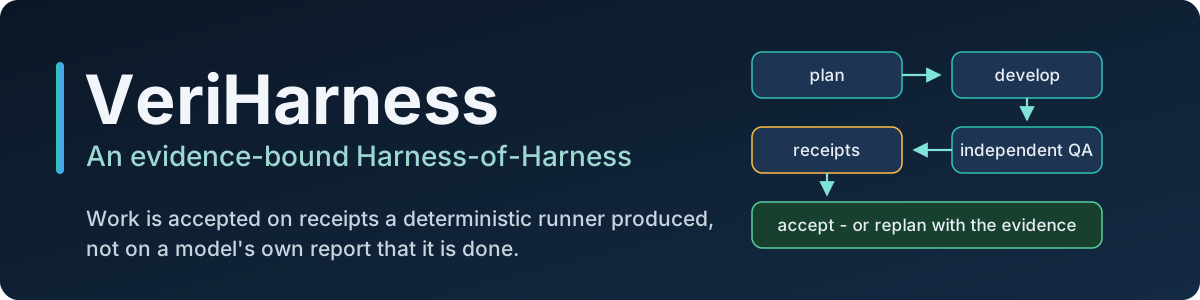
VeriHarness

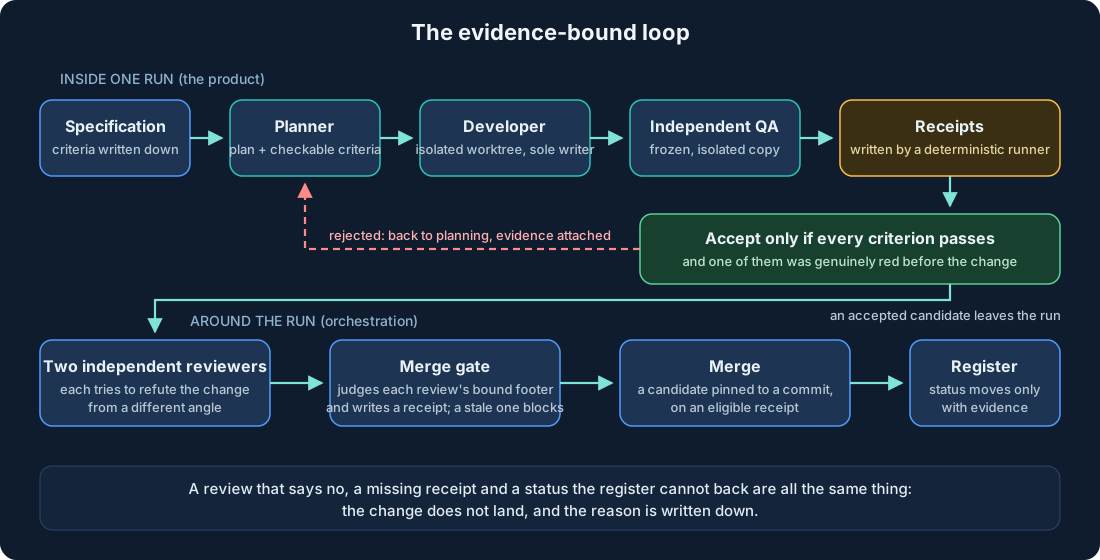
VeriHarness drives coding agents through a loop in which an agent's claim that it is done is never the evidence. A candidate is accepted on receipts that a deterministic runner produced, re-checked by an independent QA role, and attacked by two independent reviewers before it merges. What the system has not shown is written down next to what it has.
hoh is the package, the module and the command line that implement the pattern; VeriHarness is the project built on it. It sits on top of Herdr, a terminal multiplexer for coding agents, and it is an alpha and a research preview.
What it is
A specification goes in. A planner role turns it into a plan with machine-checkable acceptance criteria. A developer role implements it in an isolated worktree it alone writes to. An independent QA role re-executes the criteria against a frozen, isolated copy of the result. A deterministic runner, not a model, writes the receipts, and the product re-checks every verdict against them. A candidate is accepted only if every criterion passes and at least one of them was genuinely red before the change; a rejected candidate goes back into planning with its evidence attached, not into the trash.
Why that matters: an agent's report that "all tests pass" is a statement, not evidence, and a project that takes it for evidence cannot tell finished work from work that was only described as finished. docs/EVIDENCE_MODEL.md makes the full case, and docs/LIMITATIONS.md lists what this still does not guarantee, in 31 numbered limits [V45].
It runs itself
VeriHarness has been built with VeriHarness since 2026-09-07. An orchestrating agent session writes the specifications, starts the product runs, has every product-run candidate reviewed by two independent reviewer agents before it merges, merges what passes and keeps the records; the operator sets the direction, answers questions, and approves, or delegates for a stated window, every irreversible external act such as publishing a release. By the operator's own description the session runs mostly on the operator's comments and questions; the figures below are what can be checked of that. They are counted from the project's own records, at the dates they name; they are stated here and not linked, because those records carry working material and are not part of this export (the method and the limits of each figure are in the paragraphs under the table).
| What | Measured |
|---|---|
| Span | 2026-09-07 to the base commit: 44 days 21 hours, and 33 of the 45 calendar days carry a commit [V46] [V47] |
| History | 1,612 commits, 299 of them merges [V48]; 243 numbered ledger entries, O23 to O271 [V49] |
| Orchestrating session | 22 lease epochs from 2026-10-11 to 2026-10-20 (counted on 2026-10-21), of which 17 are verified successions that all ended COMPLETE; every one was requested by the rotation policy, at its context threshold or after its number of auto-compactions |
| Product runs | 257 run directories from 2026-10-01 on; in 230 of them an independent QA result had every check PASS; 97 product-run merges from 2026-09-25 to 2026-10-11 counted by merge title (the window of that count; later titles are not listed by the counting tool) [V01] |
| Independent review | 1209 review reports carry the machine-bound verdict footer since 2026-10-07; 235 of them (19.4 %) say RELEASE_NO |
| Who decided | 107 of 2,213 entries (about 5 %) of the orchestrator's running notes are marked as the operator's; 8 operator directives are stored verbatim, one file each; none of 369 attribution entries is booked to a human [V52] |
| Interruptions | 13 stops at the provider's usage limit, 2026-10-03 to 2026-10-07 [V55]; a power cut, a full disk, an inode exhaustion and an operator-requested WSL shutdown are recorded as well [V56] |
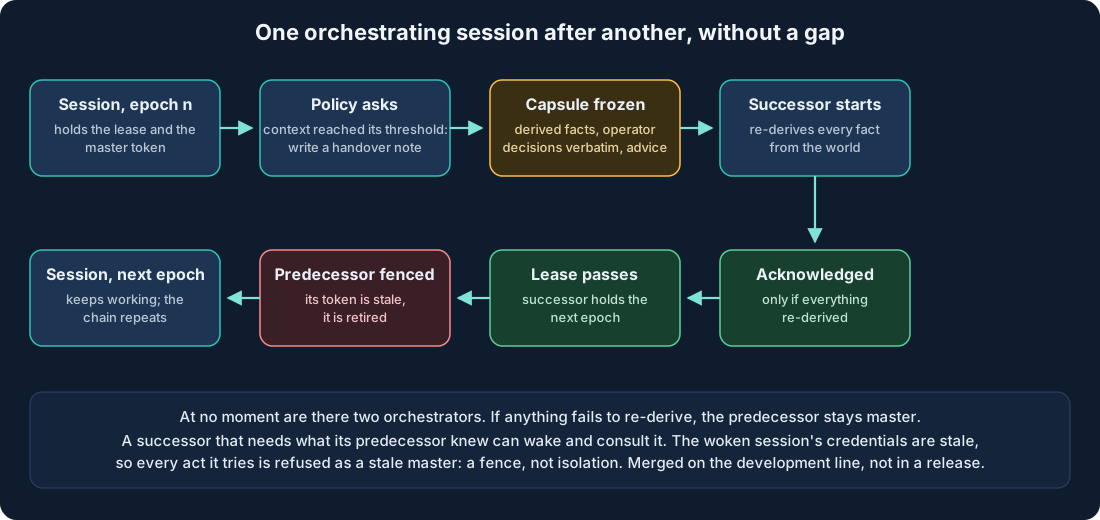
The chain of sessions. An orchestrating session works for hours; its context grows until each request is slow and its own earlier decisions blur. The remedy the product implements is a verified handover, not a longer session. A rotation policy asks the running session for a handover note when its context reaches a threshold. The product then freezes a capsule (derived facts that the successor must re-derive, the operator's decisions kept verbatim, advisory context with no authority), starts the successor, waits for its acknowledgement, passes the lease to the next epoch and fences the predecessor. If anything fails to re-derive, the predecessor stays master. At no moment are there two orchestrators.
Since the slice P3-ROTD, the request reaches the master where it works: inside Herdr the hold types a short fixed-form notice into the pane it was started in, which is the master's own, at the request, once more at half of the request's time to live if no handoff has appeared, and when the request ends. Before every typing it reads Herdr's state again and the pane's visible screen, and it types nothing while a dialog is open, while the agent is blocked or unknown, or when the screen cannot be read; Herdr's state alone is not trusted for dialogs, because an open autocompact choice was once reported idle. A request that cannot be typed is written to a request file and recorded as rotation_undeliverable. Delivery is on by default and --rotate-no-deliver turns it off. It is tested with fakes; the rotation log of the project that built this product holds no rotation_delivered row yet (taken on 2026-10-21), so a delivery into a live master has not been observed.
How the figures above were taken, and what they are not.
- Epochs and successions are counted from the orchestrator's lease, epoch and rollover logs of this build, which the product's own succession code writes. They start on 2026-10-11 at the first lease taken under the product's own rotation (the canary of amendment A7); earlier orchestrating sessions were handed over by written notes, from 2026-10-07 on, and are not itemised there
[V54]. Of the 22 epochs, 17 are successions, 4 are recoveries (a re-arm of the lease holder, not a handover: one re-arm after the operator's restart of the machine, two re-arms of the rotation policy at the operator's request, and one re-arm of the holder under P3-ROTD, so that rotation requests are delivered into the master's pane (no operator request is recorded)) and one is the first lease. 43 rotation requests were logged: 16 for the reasoncontext_tokens(the context threshold) and 27 for the reasoncompactions(a number of auto-compactions); 26 of them expired without a handover, so nothing rotated, and 17 finished with the outcome COMPLETE. The longest closed epoch lasted 152.6 hours; the median was 0.96 hours. - Product runs and QA are counted from the run directories of the project's runs tree, which holds the runs of 2026-10-01 and later; earlier runs were kept elsewhere. 267 QA result files exist, 230 with every check PASS and 37 with at least one check not PASS; a QA result with every check PASS is not by itself an accepted merge, which is why the merge count above is the one from git.
- Review counts report files that carry the six-line machine-bound footer (verdict, candidate, base, specification digest, open blockers, completeness) that the merge gate reads; it counts every round, so a candidate that was reviewed three times appears three times. RELEASE_NO is the reviewers' refusal: 231 of all footers declare at least one open blocking finding. A review that says no is the process working, not a defect.
- The operator's share is the share of entries of the orchestrator's running notes (they begin on 2026-10-02 at the ledger entry O252) that carry the word OPERATOR. It is a lower bound on the operator's messages, because not every message is written down as its own entry, and an entry may bundle several. It is not a measure of effort. The attribution file is written by the orchestrating session and is checked for tiling and for the run states it cites, not for authorship, so its count of human-booked entries is the session's own statement and not an independent measurement.
- Not unattended. The operator was reachable and was asked, and the line stopped several times, as the last row names. "Autonomous" here means that the session carried the work, the handovers and the records between the operator's messages for weeks; it does not mean that nobody was there.
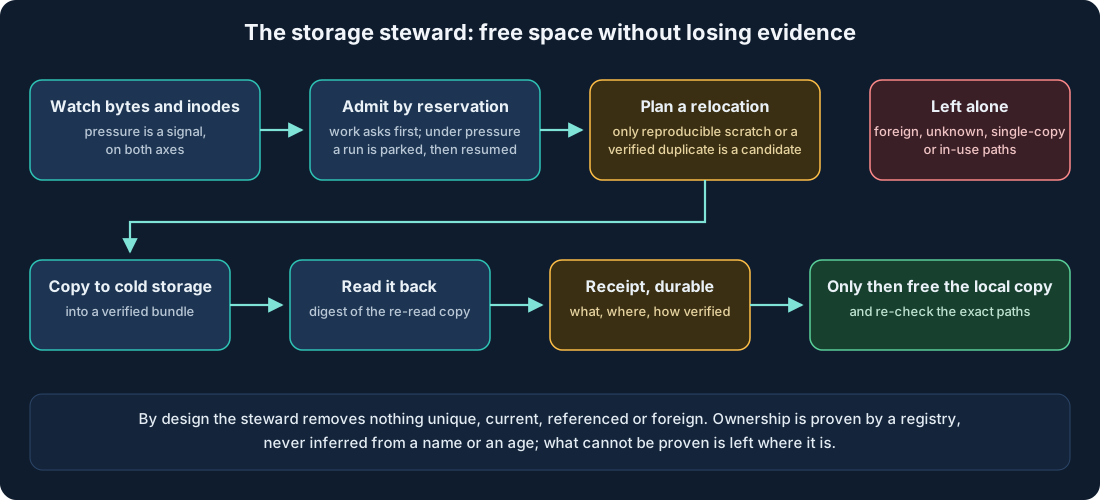
The storage steward. The build ran its disk and its inode table full more than once, which is why this part exists. The steward watches bytes and inodes, admits work by reservation, parks a run durably under pressure and resumes it, and relocates reproducible scratch to cold storage only through a verified relocation: the copy is read back and digested, a durable receipt is written, and only then is the local copy freed. Ownership is proven by a registry and never inferred from a name or an age; foreign, unknown and single-copy paths are left alone. The mechanism is built and tested (the requirements P2-38 to P2-41, P5-25 to P5-30, P5-32 and P5-33 read PROVEN). A policy and an archive target are configured for this project and no timer runs the steward; its plan-only runs found nothing of this project's to relocate and reported the remaining pressure as not this project's to free. The large cleanups were made by the orchestrating session with manifests, not by the steward: the first covered 4,211 trees with 15,558,933 entries [V36], the second inventoried 2,003 copies, proved 342 of them reproducible and removed 341, 6,562,367 entries in all [V37]; later archives of run arenas were made with the session's own archive scripts.
Other pieces, and their state.
- The merge gate.
hoh merge-gate checkjudges the review reports a candidate requires, binds each to the candidate, the base and the specification's digest, and writes the decision as a receipt. P5-36 reads PARTIAL: no merge step of the product calls it yet, and the receipt is not signed. - The double-down method. A blocked stage, phase or work package that does not clear with time is today listed for a person. Amendment A8 registers the method of the house rules (no negative without a proven root cause; a double-down that leaves the measured verdict alone) as a capability of the autonomous loop, as P3-42. P3-42 reads PARTIAL on the development line at the commit 3439fb9f (the register's word, set by the slices P3-DD1 to P3-DD3; it is not PROVEN). Built and merged, in the register's words: the double-down, the measurement of proposals and the recording of what becomes of a verified fix are on in
hoh resume-quotawithout a flag (the opt-outs are recorded); a proposal that carries a fix is, on a person's command, proven on a scratch copy of the run's candidate (red before and green after, the keep-green rows green before and after, the files written those the fix was read to write) and applied as a new iteration of the blocked run, with the approval recorded; a person can revert it. Still missing, in the register's words: no path applies a proven fix without a person, every verified fix is withheld; a later slice (DD4) lets only an unattended long-horizon contract apply a proven correction itself; the analysts stay opt-in, so by default only the derived proposals of trivial blocks exist and none carries a fix; only the block of a run is applied, not a node's or a project's, and a run whose budget is spent cannot continue; the halt class is not yet persisted on the node; and no capacity broker or budget reservation admits the analysts' dispatches or the runner executions. Until then the method is also applied by hand by the orchestrating session. - A successor that consults its predecessor. A successor that needs what its predecessor knew can wake it for one question; the woken session's credentials are stale, so the product refuses every act it tries as a stale master. That is a fence, not isolation. It is merged on the development line after
v0.3.0and is in no release beforev0.4.0a1. - Pre-authorised external acts. The bounded executor (
src/hoh/extexec.py) carries out an external act that a contract pre-authorised, and only narrowly: a target the contract names, within the pre-authorised number counted durably before the act, with create-only, digest-bound records; every release and publish class is refused whatever the contract says, the programme stop is honoured, and everything else stays with a person. No production actor is registered, so it carries nothing out for real yet. P3-32 reads PARTIAL in the register, in whose words: the bounded executor is built and gated (pre-authorised target, the pre-authorised number counted durably before the act, create-only digest-bound records, NEVER_AUTO_PUBLISH and every release/publish class refused, the programme stop honoured, everything else with a person); no production actor is registered yet -- which first actor class is an operator decision. - The dashboard. The operator watches progress on a generated dashboard that re-measures the capability register and the build plan on the live branch instead of reading a committed record. It is operator tooling kept by the orchestrating session, outside this repository, and not a product feature.
Where the project stands
v0.3.0 closed phase P2 (v0.3 Durable Program Runtime + Autonomy Contract Base): at the commit of its closure record all 43 requirements of P2 read PROVEN, with the limits that docs/LIMITATIONS.md states. Phase P3 (v0.4 Capacity-Aware Autonomous Parallelism) is in progress on the development line. Read the next table as a measurement of the development tip at the base commit named in paper/NUMBERS_V2.md, the commit 3439fb9f (2026-10-21 at 21:23 +0300), which is what tools/capability_matrix.py and tools/build_plan.py print there.
| Phase | Name | At the base commit |
|---|---|---|
| P1 | v0.2 Integrity & Productization | 16 of 16 PROVEN |
| P2 | v0.3 Durable Program Runtime + Autonomy Contract Base | closed at v0.3.0 (all 43 PROVEN at the closure commit); at this base 37 PROVEN and 6 IMPLEMENTED_NOT_PROVEN [V10c] |
| P3 | v0.4 Capacity-Aware Autonomous Parallelism | in progress: 25 PROVEN, 6 PARTIAL, 3 MISSING of 34 |
| P4 | v0.5 Evidence Efficiency + Context / Decision Efficiency | 23 MISSING of 23 |
| P5 | v0.6 Operability + Explainability | partly built ahead of its phase (the storage lifecycle, the merge gate): 10 PROVEN, 5 PARTIAL, 28 MISSING of 43 |
The register holds 236 requirements, 88 PROVEN, 11 PARTIAL, 6 IMPLEMENTED_NOT_PROVEN and 131 MISSING [V10]; of those registered for P3 to P12, 131 of 177 MISSING (11 PARTIAL, 35 PROVEN) [V11b]. PROVEN is the register's word for an implementation, a test, positive evidence and, where one applies, a discriminating control, each found by a probe the repository can run; it is not a claim that the capability has run in a live session, and docs/LIMITATIONS.md states the limits row by row.
Why six rows of P2 read IMPLEMENTED_NOT_PROVEN again. The durability evidence of P2 (crash and reboot recovery and the five exit conditions) is bound to digests of source files. The P3 slices merged since the tag changed some of those files, so the register marks that evidence stale until the eight-minute durability run is repeated; the P2 gate in tools/build_plan.py counts 0 blocking items for that reason [V12]. Amendment A7 treats this as a regression obligation, not as a re-opened phase. The released package v0.3.0 is the code the closure evidence was taken on.
Readiness is not claimed. The readiness board, docs/READINESS.md, reads TECHNICALLY_STABLE_READY = no [V13]. A closed phase is not a stable release. At its last committed measurement (2026-10-13) the board named these open conditions, each blocking: tests, union_invariants, benchmark_v3_preregistration, benchmark_v3, export_manifest, export_sync, docs_consistency and external_ci. Separately, the public CI was red from the push of v0.3.0a1 on 2026-10-08 on every push; the cause was an optional dependency that two test files import and the workflow did not install, and the workflow now installs it and gives the tests a git identity (.github/workflows/ci.yml). Behind that collection error the suite had further failures in a published clone, tests written in the development repository that read records the export withholds or need a live Herdr session; they now skip there with the reason named, only when the export manifest declares the record withheld (tests/conftest.py), and run in full in the development tree. The public CI of the tag v0.4.0a1 was red as well: on GitHub's runners the three test jobs failed (7 tests on Python 3.11, 3 on Python 3.12, 5 on Python 3.13, of about 12,900 each) while the other four jobs passed. The causes were found and fixed on the development line, some in tests and three in the package itself, and the release notes of v0.4.0a1 carry the dated corrections. The public CI of v0.4.0a2 is the evidence for the fix; this README does not state its result, and the badge above shows it.
Releases
| Release | State |
|---|---|
v0.3.0 |
The release at which phase P2 is closed, and the latest GitHub release at the time of writing. Install from the tag. |
v0.4.0a2 |
Pre-release, the second public release of the v0.4 line (phase P3, Capacity-Aware Autonomous Parallelism, in progress). From its tag on it is a GitHub pre-release; its upload to PyPI as a pre-release version, which pip installs only with --pre, is a separate step after the tag, so until PyPI lists it it cannot be installed from there; until its tag exists this row states an intention. Alpha, research preview; it carries this README, and it replaces v0.4.0a1. Nothing here claims it exists before its tag does. |
v0.4.0a1 |
Pre-release, published on GitHub on 2026-10-21. Superseded by v0.4.0a2: its public CI was red, its package carries four defects (a budget check that fails open on Python 3.11, a recursion error in two digests on Python 3.11, a read race in a record reader, and the same create-window race, fail-closed, in three more readers of single files; its release notes state them with the fix), and it was not uploaded to PyPI. Kept for the record. |
v0.4.0 |
Reserved for the closure of phase P3; unreleased. |
v0.1.0 |
The first stable release, tagged 2026-09-14, on PyPI since 2026-09-15; its benchmark is explained below. |
v0.3.0a1 to v0.3.0a3 |
Pre-releases of the v0.3 line, kept for the record. |
Quick start
pip install hoh
hoh --help
pip install hoh installs the newest stable release on PyPI, which is v0.1.0 as of 2026-10-21 (its history is at https://pypi.org/project/hoh/#history). The pre-release v0.4.0a2 is installed only with pip install --pre hoh once it has been uploaded; until then PyPI holds v0.1.0 only. v0.4.0a1 was never uploaded. To run a tagged release from source:
git clone https://github.com/SKZL-AI/veriharness.git
cd veriharness
git checkout v0.3.0
python -m pip install -e ".[test,archive]"
The package needs Python 3.11 or newer and targets Linux; actual agent runs need Herdr. A run is two commands on purpose, so that spending quota is a deliberate act: hoh start records a run, hoh run <id> dispatches the roles. examples/minimal/ ships a recorded rejection that you can read without an API key. Installation details, platform notes (NixOS, macOS, Ubuntu 24.04) and the policy layers are in the record below.
Benchmarks: what has been measured, and what has not
What exists. A matched-budget benchmark of three arms on five small tasks, three repetitions each, pre-registered before the first cell ran (45 cells; protocol docs/BENCHMARK_PROTOCOL.md, results docs/BENCHMARK_RESULTS_v3.md). Arm A is a plain agent with no harness; arm B is one hoh run; arm C is the full control plane with global gates and repair nodes. A hidden test suite per task, which no arm sees, decides the verdict. The budget is matched on the scarce resource, role dispatches: nine per cell, shared between a node and its repair nodes, and enforced.
| arm | hidden suite | false accepts | what it produced |
|---|---|---|---|
| A, plain agent | 15 of 15 PASS | 0 | answered |
B, one hoh run |
14 of 15 PASS | 1 | 15 of 15 accepted |
| C, full control plane | 14 of 15 PASS | 0 | 15 of 15 BUDGET_EXHAUSTED, 0 of 15 CLOSED |
How to read arm C, because the table invites a wrong reading. "15 of 15 BUDGET_EXHAUSTED" is not "our own tests failed 15 of 15". It says that the control plane spent its nine dispatches on the primary node, met a red global gate, spawned a repair node, and was refused the repair for want of budget, in every cell. The hidden suite of arm C passed in 14 of 15 cells; arm C simply never claimed to be finished, which is why its zero false accepts is not a success either. On these five tasks the plain agent was cheaper and at least as correct, and that is the result as it was measured and as it stays published.
What changed, and what is still published. The campaign before it, with a separate nine dispatches per run, which is eighteen per cell, closed five of five; the closure was bought with twice the declared resource. A separate test then gave the control plane a budget taken from what that campaign actually spent, eighteen, decided before the run: it reaches a real CLOSED fixpoint through a full repair cycle, 18 of 18 declared dispatches (9 primary, 9 repair), one repair node, zero human decisions. It is a row of the readiness board and reads PASS. Neither result replaces the other; both stay published as they were measured.
What is not measured. The benchmark has not been repeated on the v0.3 code. Five small tasks and three repetitions carry no rate, and nothing here shows that the harness performs better than a plain agent.
The next benchmark. A pre-registered agentic benchmark (SWE-bench Verified subset; four arms including a strong plain-agent control; primary endpoint: false accepts) is prepared and reviewed; its campaign runs with release 1.0.0 and its result will be published whatever it shows. No result of it exists: the protocol is pre-registered, and an instrument check that has run is not a result and no figure from it is stated anywhere in this repository. The only benchmark results in this repository are the v0.1.0 campaigns above, and they are published as they were measured, the unflattering ones included.
Limitations
docs/LIMITATIONS.md is the authority; the short list for a reader deciding whether to try this:
- It is an alpha and a research preview. The interfaces are not stable.
- Herdr is required for real runs; HoH refuses to start without it, and CI does not stand one up.
- It targets Linux. macOS is partially supported (no
--isolation strict), and the Nix packaging was written without a Nix binary and has never been built. - The durability evidence is one restart of a virtual machine on one host with fixture role runs, not a power cut, and it is stale on the development line until it is repeated.
- The orchestrating session of this build is an agent session with an operator behind it. The figures above say how little the operator had to type; they do not say that the system needs no operator.
A note on the name
A paper titled "VeriHarness: Scaling Agentic Verification for Long-Horizon Tasks" appeared on arXiv on 2026-10-01 (arXiv:2610.00972). This repository is unrelated to it. The first public release of this project, the GitHub release v0.1.0-rc1, is dated 2026-09-10, and the repository was created that day.
Citation
CITATION.cff carries the citation metadata (title, authors, version, licence); GitHub's "Cite this repository" button reads it. Cite the release you used, and say that it is an alpha.
The record
Everything below is this README as it stood on 2026-10-13, unchanged. It is a dated record: later paragraphs correct earlier ones by addition and name what they supersede, so read each statement with its date, and read the front above for the present state. The figures that carry a bracketed tag, such as [V10], are listed with their source and the command that regenerates them in paper/NUMBERS_V2.md.
VeriHarness -- Harness-of-Harness
VeriHarness — an evidence-bound Harness-of-Harness for verifiable
long-horizon agent development. hoh is the command-line package, module,
and CLI that implement the Harness-of-Harness pattern; VeriHarness is the
project and repository built on that pattern, not a second name for the
same thing. VeriHarness sits on top of Herdr, a terminal multiplexer for
coding agents, and drives a plan → develop → independent QA → evidence →
accept/reject → replan loop
around agent-written changes, so that acceptance rests on receipts a
deterministic runner produced, not on a model's own report that its work is
done. docs/EVIDENCE_MODEL.md makes the full case for why that distinction
matters; this file is the map of the rest.
State on 2026-10-09 (added; the opening paragraph above is unchanged). The latest stable release is v0.1.0. The
current pre-release is v0.3.0a3 (it was v0.3.0a2 on 2026-10-09; superseded on 2026-10-13 by the release v0.3.0, see the row Release below and State on 2026-10-13, release documents), an alpha and a research preview, installed from the tagged
source and not published to PyPI. The development line (phase P2) is in progress: 34 of its 43 registered requirements read PROVEN [V10c] [V10b],
and 9 blocking items of its gate are open [V12]. The line has been developed under its own orchestration since
2026-09-07, with 69 product-run merges since 2026-09-25 [V01], by an agent-orchestrated loop that an operator directs
and that stopped several times, over 32 days 15 hours [V46]; the account, the figures and the interruptions are under
Duration, autonomy and scale of the build below, and the parts and their states are under The parts, and what each
has and has not shown.
State on 2026-10-13 (added; the paragraphs above are unchanged). Phase P2 is closed at the commit of the records entry O268 of DOGFOOD_LEDGER.md,
the closure record that amendment A7 (the phase-closure amendment of the production line, pinned by digest in the programme's amendments file) names. That record names the sealing commit c4dc643d, the
succession capsule committed alone at 642a4fa9, the independent supervisor review 20261013T093422Z-S (a separate session on a read-only worktree; every
finding it inherited answered NO_ACTION, none blocking, the review complete), the checklist snapshot by its seal, the committed capability matrix by its digest
with every requirement of P2 PROVEN, and the durability evidence taken on e0d9bdff with an empty diff of the relevant source paths since. The closure is a
statement about that commit and about nothing later: a later change to the source creates regression obligations under A7 (the eight-minute durability run at
every records and release checkpoint, the reboot evidence at release checkpoints), not a re-opened phase, and an obligation that fails re-opens P2 by a records
entry. The limits of the evidence stand as docs/LIMITATIONS.md states them: one restart of a virtual machine on one host with fixture role runs, the checks of
the reboot scenario undiscriminated by any negative control, the approval-resume of a registered run not exercised. The readiness board still reads
TECHNICALLY_STABLE_READY = no: a closed phase is not a stable release. The release documents and the figures of this file are re-taken in the commits that
follow the closure record, before the tag v0.3.0; until then the dated sentences below that say P2 is open, in progress or not closed describe the state at
their dates and are superseded by this paragraph.
State on 2026-10-13, release documents of v0.3.0 (added; the paragraphs above are unchanged). The release v0.3.0 is cut
from the merge of its release documents after their review, behind the closure record of P2 (the paragraph above) and the regenerated figures
that follow it: pyproject.toml and CITATION.cff carry 0.3.0, RELEASE_NOTES.md opens with its account, CHANGELOG.md carries the
section generated from it, and .github/releases/v0.3.0.json names the title and the source of the release text. It is a release, not a
pre-release, and it is not a readiness claim: the board reads TECHNICALLY_STABLE_READY = no, a closed phase is not a stable release, and
v0.1.0 stays the only release on PyPI. The release changes no source file: every merge since the third alpha is records, tools, tests, the
register notes of three P2 rows (P2-07, P2-28 and P2-42, by addition) or the version line of pyproject.toml, and the diff of src/hoh/, the continuation unit, the durability harness and its fixture from e0d9bdff to the release commit prints nothing,
so the durability evidence of the closure is about the code the release ships; the operator ruled on 2026-10-12 that the tag therefore needs
no new reboot, and the eight-minute durability run at the tag is the orchestrating session's regression obligation under amendment A7, recorded
in the ledger entry of the tag. The sentences of this file that name v0.3.0a3 as the current pre-release describe their dates.
The figures of the moving present that paper/NUMBERS_V2.md derives were taken again for the release v0.3.0 at the commit f78d1cb9
(2026-10-13 at 19:29 +0300; the figures quoted in the updates above stay as written). At that base the register holds 235 requirements, 70 PROVEN
and 9 PARTIAL [V10]; all 43 requirements of P2 read PROVEN [V10c] [V10b], and the P2 gate reads 0 blocking open; 0 exit conditions bound to requirements not PROVEN; 0 exit conditions nothing measures yet; 165 open requirements, 125 behind a phase gate [V12]; of
those registered for P3 to P12, 156 of 176 MISSING (9 PARTIAL, 11 PROVEN) [V11b]. The history is 1,260 commits, 182 of them merges [V48]; the first and the
latest commit of the mainline are 36 days 19 hours apart [V46] and 27 of the 37 calendar days carry a commit [V47]; the ledger runs to O268 with 240
numbered entries [V49]. The development line has 97 product-run merges since 2026-09-25 [V01], 78 of which change src/hoh/ [V02], as
at the third alpha: the four product runs merged since carry titles that the counting tool does not list, and the release changes no tool. Of
320 development nodes after the attribution anchor [V06], 1 went through the shipped control plane end to end [V06a], 131 were developed by a
product run and merged by the orchestrating session after review [V06b], and 188 were written by the orchestrating session directly [V06c].
Where the project stands: release, pre-release, development, roadmap
Four things are easy to run together here, and this repository keeps them apart on purpose.
| Track | State | What it means for a reader |
|---|---|---|
| Latest stable release | v0.1.0, tagged 2026-09-14, on PyPI since 2026-09-15 |
The only stable release. The campaign figures, the benchmark and the findings further down this file describe the work that produced it, and they stay as they were measured. |
| Pre-release | v0.3.0a1 -- PRE-RELEASE, an alpha and a research preview, prepared, not yet cut |
Prepared at a documentation checkpoint, not at the end of a phase. Its integrity gate is met for the paths its reviewers replayed (the qaw-followup merge ab41589f closed the three findings that had held it; one residual is stated in docs/LIMITATIONS.md), and the cut waits for the operator's decision on the exact commit. Once cut, it is installed from the tagged source and is not published to PyPI: the distribution workflow of this repository accepts only the audited v0.1.0. pyproject.toml carries 0.3.0a1. RELEASE_NOTES.md opens with its account; its open gates are listed as NOT_YET_PROVEN there and in docs/LIMITATIONS.md. (Correction, 2026-10-09: v0.3.0a1 was cut on 2026-10-08; "prepared, not yet cut" and "the cut waits for the operator's decision" are the text of the checkpoint before the cut and are kept here. pyproject.toml now carries the next pre-release, in the next row.) |
| Newer pre-release | v0.3.0a2 -- PRE-RELEASE, an alpha and a research preview, tagged v0.3.0a2 |
Prepared at a documentation checkpoint after the ledger entries O256 to O260, not at the end of a phase. It adds a NixOS-first portability patch, hoh agent-setup, owned control of the agents HoH starts, more disk-full-safe writers, a classification of failed provider dispatches with its provenance and park binding, hoh migrate and hoh decision check, and the five P0 measurements; none of it was run on a real NixOS or macOS host or in a live coding-agent session. It is installed from the tagged source and is not published to PyPI. pyproject.toml carries 0.3.0a2. RELEASE_NOTES.md opens with its account; its open gates are listed as NOT_YET_PROVEN there and in docs/LIMITATIONS.md. |
| Newest pre-release | v0.3.0a3 -- PRE-RELEASE, an alpha and a research preview, tagged v0.3.0a3 |
Prepared at a documentation checkpoint after the ledger entries O261 to O265, not at the end of a phase. It adds the merge gate as a command, hoh wait, hoh surface, hoh run --detach, hoh pin and hoh import, the per-run storage account, target registration, and a rotation policy under which the product hands the orchestrating session over by itself; P2-41, P2-43, P2-14 and P2-20 read PROVEN, each with limits that RELEASE_NOTES.md states. It is installed from the tagged source and is not published to PyPI. pyproject.toml carries 0.3.0a3. P2 is not closed; its open gates are listed as NOT_YET_PROVEN in RELEASE_NOTES.md and in docs/LIMITATIONS.md. |
| Release | v0.3.0 -- the release at which phase P2 is closed, tagged v0.3.0 |
Cut from the merge of its release documents after their review, behind the closure record of P2 (records entry O268, 2026-10-13) and the regenerated figures that follow it. It is not a pre-release. It changes no source file against the third alpha: every merge since v0.3.0a3 is records, tools, tests, the register notes of three P2 rows or the version line of pyproject.toml, and the durability evidence of the closure is about the code it ships. It is installed from the tagged source and is not published to PyPI (the distribution workflow accepts only v0.1.0). pyproject.toml carries 0.3.0. Readiness is not claimed: the board reads TECHNICALLY_STABLE_READY = no, and RELEASE_NOTES.md opens with the account of the closure, its limits and the rows of the board that do not read PASS. |
| Current development | Phase P2, v0.3 Durable Program Runtime + Autonomy Contract Base -- IN PROGRESS | Not closed. The pre-release is a snapshot of this line, and a clone of the default branch may be ahead of the tag. (Closed at the commit of records entry O268, 2026-10-13; see State on 2026-10-13 above. The earlier text of this row stays as written.) |
| Long-term roadmap | Phases P0 to P12, v0.2 through v2.0 | A registered plan, not a promise. P1 was completed as an internal development milestone. No public v0.2 release was cut; the latest stable public release remains v0.1.0 while the development line continues through P2. Of the requirements registered for P3 to P12, 150 of 168 read MISSING [V11b]; ten of the 11 that read PROVEN are storage-lifecycle items that amendment A1 placed there and that were built early. (Updated 2026-10-09 at the O262 base: 158 of 176 read MISSING [V11b], because amendment A6 registered eight more requirements for phase P5; see The parts, and what each has and has not shown.) |
The board that says what holds today is docs/READINESS.md; at its last
committed measurement it reads TECHNICALLY_STABLE_READY = no, and that holds
for the pre-release too: v0.3.0a1 is not a stable release and does not claim
the board's conjunction. docs/READINESS.md is measured at commit 75214e31, not
at the commit that carries the pre-release: it is conservative (its attribution row
and its tests row predate the entries and the run that now close them), and it is
not regenerated at the cut, because regenerating it needs the network (the
clean_install row and the union gate's wheel build call the package index).
(Correction, 2026-10-08, of the text published with the pre-release tag: "close them" is inexact for the tests row. The last suite run of the checkpoint still had failed tests (two environment failures of the scratch placement and one artefact of that run's own PATH), so the row is stale and conservative, not closed. The earlier wording is kept and corrected here; the newest ledger entry has the figures.)
Figures below that carry a bracketed tag are listed,
with their source and the command that regenerates them, in
paper/NUMBERS_V2.md.
Duration, autonomy and scale of the build, measured on 2026-10-09
Added 2026-10-09; nothing above or below this block was edited. The campaign figures further down this file,
including their wall-clock row (five calendar days, three and a half days elapsed), are the measurement of the
v0.1.0 campaign, taken when that release was tagged on 2026-09-14. They are correct for that campaign, they stay
where they are, and they are not the age or the size of the project. The same kinds of figure for the whole
development line follow, at the base commit of paper/NUMBERS_V2.md (the O262 records commit, committed on 2026-10-09)
unless a row says it was counted later.
| What | Figure |
|---|---|
| Span | First commit 2026-09-07, latest commit 2026-10-09: 32 days 15 hours, four weeks and four days [V46] |
| Days with a commit | 23 of the 33 calendar days; no commit on 2026-09-15 to 2026-09-20 or on 2026-09-26 to 2026-09-29; a commit on each of the 10 days from 2026-09-30 to 2026-10-09 [V47] |
| History | 1,088 commits, 144 of them merges [V48]; 234 numbered ledger entries, O23 to O262 [V49] |
| Product runs | 69 product-run merges since 2026-09-25 [V01]; 117 run directories from 2026-10-01 on, counted on 2026-10-09 [V50] |
| Independent review | 459 first-round reviewer reports (771 report files in all, including re-review rounds) since 2026-09-30, counted on 2026-10-09 [V51] |
| Who wrote the code | Of 204 development nodes after the attribution anchor [V06], 1 went through the shipped control plane end to end [V06a], 94 were developed by a product run and merged by the orchestrating session after review [V06b], and 109 were written by the orchestrating session directly [V06c]. The attribution file books none to a human, category CAPTAIN [V52]; it is declared by the orchestrating session and checked for tiling and for the run states it cites, not for authorship |
| Direction | 6 operator directives stored verbatim, 2026-09-30 to 2026-10-09 [V53] |
| Orchestrator sessions | 4 in a row since the written hand-over began on 2026-10-07, with 3 acknowledged hand-overs [V54] |
What "autonomous" means here, and what it does not. The orchestrating session is an agent session (a Claude Code session) that drives VeriHarness through its own command line. In this build it wrote the specifications, started the product runs, had every product-run candidate reviewed by two independent reviewer agents before its merge (from 2026-09-25 on), ran the global gates, and kept the ledger and these documents. The operator set the direction and added work as it went (the directives above and the day-to-day items), approved, or delegated for a stated window, every irreversible external action such as publishing a release, decided the storage and policy questions that only a person may decide (which folders may be deleted, for one), and shut WSL down once on purpose to compact the disk. That is orchestrated, not unattended: the operator was reachable and was asked, and the line also stopped, as the next list names. The product's own runs carried the first two groups of the Who wrote the code row; the third, the larger group by count of nodes, the orchestrating session wrote directly.
Interruptions, named. The line did not run without stopping:
- No commit from 2026-09-15 to 2026-09-20, after the
v0.1.0tag (the publication to PyPI on 2026-09-15 is not a commit); the ledger gives no reason for the pause. - A power cut on 2026-09-10 (ledger entry O88): the project content was re-measured and found intact, and some
operator tools kept in volatile storage were lost
[V56]. - The disk under the development machine filled on 2026-09-25 (977 GiB of a 1 TiB volume)
[V16]; no commit from 2026-09-26 to 2026-09-29, and work resumed on 2026-09-30 under the storage lifecycle that the operator directed. - Provider quota: 13 stops between 2026-10-03 and 2026-10-07
[V55], one of them the weekly limit on 2026-10-06, which the operator reset. The product now classifies a provider limit it can read as a failed dispatch rather than a rejected iteration (P2-43, whose limits are stated indocs/LIMITATIONS.md). - Inode exhaustion on 2026-10-05 (67,107,099 of 67,108,864 inodes used)
[V35]. On 2026-10-09 it was inode pressure, not exhaustion: the product's storage guard reached CRITICAL on the inode axis and parked two runs until the operator's deletions allowed the product's own resume[V56]. - An operator-requested WSL shutdown and disk compaction on 2026-10-08, about one hour
[V56].
What this does and does not show. It shows that an agent-orchestrated build, with independent review of its
product-run candidates before their merge, kept a repository moving for more than four weeks of calendar time, through
quota stops and storage blocks, and that there was a commit on each of the last ten days of the measurement. It does
not show unattended operation: a person directed the work, was reachable and answered. It does not show continuous
running: there was no commit on ten of the 33 calendar days [V47]. It does not show that the product's own durable
runtime kept the build alive: the five exit conditions P2-33 to P2-37 read IMPLEMENTED_NOT_PROVEN, crash and reboot
recovery (P2-11) has never been exercised on a real reboot, and the orchestrating session was handed over by files the
outgoing session wrote, not by the product's rollover protocol, which has not run live (P2-14 reads PARTIAL).
docs/LIMITATIONS.md, limit 1, keeps the full account.
What changed after v0.1.0
Stated against the development repository at the commit the checkpoint was
prepared from. paper/POSITION_PAPER_V2.md gives the full account.
- HoH now builds HoH's own kernel. The v0.1.0 statement further down --
no run wrote HoH's own logic -- is true of that campaign and stays in place.
Since 2026-09-23, product runs have written kernel modules under
src/hoh/. From 2026-09-25 on, every such run worked in an isolated clone pinned to one commit, its accepted candidate was imported byte for byte, and two independent integration reviewers released it before it was merged: 55 of the 69 product-run merges between 2026-09-25 and 2026-10-09 changesrc/hoh/[V02][V01](34 of 46 as measured on 2026-10-07 for the first alpha, which was tagged 2026-10-08). - Acceptance is not merge. A product run writes candidate bytes; the
product's own QA and receipts decide acceptance; independent integration
review decides whether accepted bytes may be merged; the orchestrating
session holds the merge authority; and a phase closes only when its gate,
derived from the capability register, says so. The invariant, in one line:
candidate creation != product acceptance != integration acceptance != merge authority != phase closure. Each step has refused what the step before it passed: in the development ledger's entries O236 to O254, 26 candidates the product had accepted were refused at integration review[V07t]. - A durable programme runtime (P2). Durable timers, a sentinel and a
never-stuck check; session succession with a master epoch and a leader lease
(partial at the first alpha; P2-09 reads PROVEN since 2026-10-08, under the
limits
RELEASE_NOTES.mdstates); a resume loop that acts on due timers; an autonomy contract; and a programme checklist whose phase gate an independent supervisor review has to pass. 32 of P2's 43 registered requirements read PROVEN[V10c][V10b](26 as measured on 2026-10-07) [dated figures, added 2026-10-09: 26 of 43 on 2026-10-07 for the first alpha, 32 at thev0.3.0a2checkpoint, 34 at the O262 base on 2026-10-09, after the lifts of P2-41 and P2-43], and P2 is not closed. - The orchestrating session can be rolled over under a protocol (Layer A,
merged, not yet exercised live). Four commands (
hoh project hold,rollover,rollover-verify,rollover-accept) freeze a capsule whose entries are derived facts the successor must re-derive, the operator's decisions kept verbatim and never answered by the machine, and advisory context with no authority; a successor takes the master epoch only if everything re-derives, and a stale predecessor is fenced. It has been tested with fakes; no live succession has been run, so no P2 row is proven by it, and the one handoff of 2026-10-07 (by hand, before the protocol existed) is not that evidence. Seedocs/OPERATIONS.mdanddocs/LIMITATIONS.md. - HoH closes its own role panes and ends a role's processes before the
freeze (merged). The role-pane lifecycle never touches a foreign pane or
process, and refuses to close a pane whose role left marked processes outside
it; its first live use closed the planner and developer panes at turn end and,
for the QA pane, refused the release because two marked processes had escaped
it (named, never signalled); the QA pane was gone without anyone closing it by hand.
(Correction, 2026-10-08: the lifecycle log of that run,
pane-lifecycle.jsonl, also holds aclosingand aclosedline for the QA pane, in the same second as therefusedline; the earlier "closed three panes and refused one" counted that pane twice, and the text above replaced it.) (Further correction, 2026-10-08: theclosingline is written by HoH before its own close command and theclosedline only after a second snapshot no longer lists the pane, and a pane found already gone is written with analready_gonefield, which this line does not carry (_close_own_paneinsrc/hoh/dispatchers.py); so HoH itself closed the QA pane's tab, nobody closed it by hand, and therefusedline that follows names the two escaped processes, not a failed close.) - Every long role prompt goes through a pointer file (merged). A prompt above 8 KiB, or one holding a character an input box treats specially, is written to a file and the agent gets a short pointer, so the stalled-submit recovery can verify what is in the box for every prompt. The first prompt into a fresh pane still stalls; only its recovery works for every prompt.
- A storage lifecycle, after a real storage incident. An ownership
registry, admission by reservation, a durable park and resume under storage
pressure, disk-full-safe durable writes (partial), verified archive bundles,
registered ephemeral temporary roots, and
VERIFIED_RELOCATION-- the one operation in VeriHarness that may remove a local copy of project data, and only after the archive holding it has been verified. Its first real self-dogfood ran on the project itself: the project was adopted, the survey of legacy reviewer scratch found 0 of 188 roots eligible[V33], and the steward's real pass observed only and reclaimed nothing. - Failures the product found in itself. A capability witness that crashed
on a file name that is not UTF-8; role prompts longer than one command-line
argument may be (
MAX_ARG_STRLEN); an operator-side relaxation that silently weakened the shipped command guard; a dispatcher that read an agent ending its turn, while its own background job still ran, as finished; a QA role whose provider usage limit was booked as a rejected iteration, eight times[V26]; a run held for a capability violation that could be reported ACCEPTED, repaired by the reviewed qa-arena-write run for the states the current build writes and, for the three paths that run's reviewer then proved open (a legacy state, an open seal, a symlinked seal ledger) and a forged sibling-arena plan line, by the qaw-followup run; and evidence that went stale when the code it described changed. What was repaired, how, and what is still open is indocs/LIMITATIONS.md.
What is not true yet, stated as plainly as the rest. P2 is open. Its exit
conditions P2-33 to P2-37 were once proven on end-to-end durability evidence,
and that evidence went stale when the code changed; they read
IMPLEMENTED_NOT_PROVEN until it is taken again. P2-11, crash and reboot
recovery, has never been proven: a real reboot (stressor DS2) has not been
run. Disk-full-safe writes cover only part of the writers (P2-41, PARTIAL).
The pre-release's integrity gate is met for the paths its reviewers
replayed, and not claimed beyond them: the qaw-followup merge closed the
legacy-state, open-seal, symlinked-ledger and sibling-plan paths, each replayed
by both integration reviewers on the merged tree, and the strand states one
residual itself -- a role pane that has read the run's arena_secret and
copies iteration and attempt. The repair of the quota misclassification is
not merged: at this pre-release a provider usage limit that stops a QA role
is still booked as a rejected iteration, and the repair (failure-classes, the
core of amendment A5's P2 item P2-43) reads MISSING [V40]. The first prompt
after an agent starts can still be typed and not submitted; dispatch
recovers from it for every prompt, which is not a fix of the race, and the
recovery refuses (fails closed) when Claude Code word-wraps the pointer line in
a narrow pane: a 79-column pane blocked one run before any candidate, and the
readiness fix is the next P2 strand. A role's own background task is now ended
before the freeze by the merged role-pane lifecycle, which has had one live use
and carries tracked minor survivors. Context rollover is built and not
exercised: no live succession has run, the draining state is recorded and not
enforced, and five follow-up items are open (and nine guard rules have no test that kills their removal; corrected 2026-10-08 from "three", the count RELEASE_NOTES and LIMITATIONS list). The storage steward has not reclaimed anything of
VeriHarness's own data. The exact-head external CI, the benchmark freeze and
the programme supervisor's review of P2 all read red on the board. The full
list is Current open limitations at the top of docs/LIMITATIONS.md.
Update, 2026-10-09, for v0.3.0a2. The paragraph above is the text of the
first alpha. Since then the ledger entries O256 to O260 changed these
statements, and RELEASE_NOTES.md has the account and every limit:
- The first two slices of the quota repair are merged: a failed provider dispatch
is classified, QA re-raises a provider failure instead of booking it as a
rejected iteration, every dispatch records its provenance, and every park is
bound to what it stands on. The binding is written and not yet checked on
resume. P2-43 still reads MISSING
[V40]; the third slice is not merged. - First-prompt readiness is merged (a bounded wait before the first prompt, and a model of the box's word wrap); whether it cures the stall is SUSPECTED until a live check, so "the readiness fix is the next P2 strand" no longer holds.
- The follow-up items of the context rollover are fixed in code, the launcher can start its successor, and the acquire can be conditional (P2-09 reads PROVEN). It has still not run live.
- More writers are disk-full safe; P2-41 is PARTIAL still.
- New:
hoh agent-setup,hoh migrate,hoh decision check, owned agent control (P2-17 reads PROVEN, with limits), the NixOS-first portability patch (never run on a real NixOS or macOS host), and the five P0 measurements.
Update, 2026-10-09, after v0.3.0a2 (ledger entry O261). Two statements
above no longer hold on the development line: "Disk-full-safe writes cover only
part of the writers (P2-41, PARTIAL)" and "More writers are disk-full safe; P2-41
is PARTIAL still". The third and last slice of the P2-41 closure is merged, and
the capability matrix reads P2-41 PROVEN. Read that as narrowly as it is scoped:
the writers of run, project and receipt state that the writer scan lists as
migrated go through one disk-full-safe write primitive (durable_write,
durable_create, durable_append), and the scan fails on any raw write call it
does not classify; the storage modules keep their own temp-fsync-publish helpers
(the scan's OWN_DURABLE class), which are tested for a full disk to different
degrees, three of the eight functions not at all; the scan does not see aliased
calls; the matrix measures an import statement, not an execution; and a long
unattended run that survives a full disk end to end is not claimed. The limits
are in the register note of P2-41 and in the ledger entry O261. Nothing above
this paragraph was edited.
Update, 2026-10-09, after v0.3.0a2 (ledger entry O262). Two statements above no longer hold on the
development line, or were worded too narrowly; nothing above this paragraph was edited. First, the previous paragraph says
that three of the eight functions that keep their own temp-fsync-publish helper are not tested for a full disk at all;
the count is four, because the registry writer has a test of a failed replace and none of a full disk, as
docs/LIMITATIONS.md already says. Second, the list of the pre-release says that P2-43 still reads MISSING and that its
third slice is not merged. The third slice (the park binding is enforced on every automatic resume) and a fourth (a
developer turn that ends on a provider's usage- or rate-limit screen is a failed dispatch of its class, not a finished
turn) are merged, and the capability matrix reads P2-43 PROVEN. Read that as narrowly as it is scoped: the matrix
measures a symbol, a collected test and an import statement, not an execution; only the recorded shapes of the provider's
banner are read, whole, and no developer pane has ever been recorded on a real limit; a short good re-run after a wait is
parked again and again until the resume limit and is then handed to a person, and the fix is specified and not merged;
no real rate-limit body was ever recorded; a live run that meets a real provider limit is NOT_RUN. The limits are in the
register note of P2-43 and in the ledger entry O262.
Update, later on 2026-10-09 (ledger entry O264). The previous update says that the fix for the stale-banner re-park of P2-43 is
specified and not merged. It is merged: a limit banner that was already on the developer's pane when the prompt was sent is not
read as this turn's. That bounds the problem and does not remove it everywhere: a status-area line that a healed pane left in
its scrollback is still read, a repeated rate-limit body after a long turn is missed, and no developer pane has been recorded on
a real limit. Five further pieces are merged on the development line and are not in v0.3.0a2. Ephemeral temporary roots are used
by hoh run for a run of a registered project (P2-42 stays PARTIAL, because the role scratch is not a registered root).
hoh merge-gate checks a set of review reports and verifies a receipt; no merge step of the product calls it. hoh wait waits
on a run and on nothing else. hoh surface records the tabs of a run and closes the ones of a run that is over once the shell
in them is proven idle. Criterion fidelity refuses a plan that drops, re-types, wraps or deselects a declared criterion, and
holds only for a specification that declares its criteria in one block. The capability matrix reads P5-36 and P5-39 PARTIAL and
P5-43 MISSING, and lifts no requirement to PROVEN. None of this has run against a live Herdr session. The limits are in the
register notes and in docs/LIMITATIONS.md.
The figures of the moving present that paper/NUMBERS_V2.md derives were taken again at the commit of the records entry O264
(dff02f08, committed on 2026-10-09 at 22:14 +0300); the table in the section above, which names the O262 records commit as its
base, keeps its figures as written. At the new base the history is 1,130 commits, 153 of them merges [V48], and 236 numbered
ledger entries, O23 to O264 [V49]. Of 233 development nodes after the attribution anchor [V06], 1 went through the shipped
control plane end to end [V06a], 104 were developed by a product run and merged by the orchestrating session after review
[V06b], and 128 were written by the orchestrating session directly [V06c]. Of the requirements registered for P3 to P12, 156 of
176 read MISSING, 9 read PARTIAL and 11 read PROVEN [V11b].
Update, 2026-10-11 (ledger entry O265). Sixteen further merges are on the development line after the update above and are not in
v0.3.0a2. Two sentences of that update are out of date and are corrected here by addition. hoh wait no longer waits on a run and
on nothing else: it also waits on a review report (--report, with the footer check and the stable-age rule of the merge gate) and on
a process id (--pid); a durable list of what it reported and a trigger of the reaper are not built, and the register still reads
P5-43 MISSING. The scratch of the roles of a run of a registered project now lives below the iteration's registered workspace, and
hoh storage new-target and hoh storage register-project register a target clone; P2-42 still reads PARTIAL, because no run of a
registered project has been observed and nothing has run against a live Herdr session. The product now rotates the orchestrating
session by itself under a policy and creates the governed project record (hoh project create); that was tested with fakes, P2-14
still reads PARTIAL and is held until a live rotation has run. Also merged: hoh run --detach, hoh pin and hoh import, the
per-run storage account hoh storage account, a guarded read of the review reports for the merge gate (the product command has been
the gate of record since 1e633e46), the export leak scan for private identifiers, the refusal of run ids and project ids that are
not plain names, and the amendment A7, which records that a phase is closed at a commit and that later changes to the source create
regression obligations. No requirement was lifted to PROVEN. The limits are in the register notes and in docs/LIMITATIONS.md.
The figures of the moving present that paper/NUMBERS_V2.md derives were taken again at the commit of the records entry O265
(d88281da, committed on 2026-10-11 at 03:44 +0300); the paragraph above that names the O264 records commit as its base keeps its figures as written. At the new base the
history is 1,197 commits, 170 of them merges [V48], and 237 numbered ledger entries, O23 to O265 [V49]; the first and the
latest commit of the mainline are 34 days 3 hours apart [V46] and 25 of the 35 calendar days carry a commit [V47]. Of 281 development
nodes after the attribution anchor [V06], 1 went through the shipped control plane end to end [V06a], 125 were developed by a
product run and merged by the orchestrating session after review [V06b], and 155 were written by the orchestrating session
directly [V06c].
Update, 2026-10-11, later (ledger entry O265, second revision). The first rotation of the orchestrating session by the product has run, as
the canary of amendment A7: the policy asked for the rotation at its threshold, the master wrote its handoff, the successor verified the
frozen capsule against the world and took the lease as the second epoch, and the old session was fenced. On that evidence P2-14 and
P2-20 read PROVEN, and three sentences above are out of date and are corrected here by addition: the sentence in "Duration, autonomy
and scale of the build" that the session was handed over by files and not by the product's rollover protocol, "which has not run
live"; the row "Handing the orchestrating session over" of the table, which says "tested with fakes; no live succession has run";
and the paragraph of this entry that holds P2-14 at PARTIAL until a live rotation has run. What the evidence is not: one rotation, on
one host, of one role, with one successor model; the paths of expiry and error and a second rotation were not run live, the
capsule input of the canary was static and missed the newest run root (tracked), P2-11 and P2-33 to P2-37 are unchanged, and the gate
of P2 is still shut. P2-42 still reads PARTIAL. The strand rlname, merged before the canary, fixed the defect that the first
rehearsal found (the name of the successor's agent was refused by Herdr); it lifts no requirement.
The figures of the moving present that paper/NUMBERS_V2.md derives were taken again at the commit of the second revision of the records entry
O265 (29852843, committed on 2026-10-11 at 04:21 +0300). At that base the register holds 235 requirements, 63 PROVEN and
10 PARTIAL [V10]; of the requirements of P2, 36 PROVEN [V10c]; of those registered for P3 to P12, 156 of 176 MISSING (9 PARTIAL, 11 PROVEN) [V11b]. The history is
1,204 commits, 171 of them merges [V48], and 237 numbered ledger entries, O23 to O265 [V49]. Of 285 development nodes after
the attribution anchor [V06], 1 went through the shipped control plane end to end [V06a], 126 were developed by a product run and merged by the
orchestrating session after review [V06b], and 158 were written by the orchestrating session directly [V06c].
Update, 2026-10-11, third revision of the records entry O265 (review findings folded by addition). Three limits and three dated facts
qualify the paragraph above. First, the canary exercised the rotation of the session (the policy, the controller, the rollover); the item-level
context rotation that the probe of P2-14 names (rotate in src/hoh/rotation.py and reachable) has no caller outside the tests, so
the status PROVEN of P2-14 is a statement about the rotation of the session and the sentence of the register note that nothing rotates items
yet stays true. Second, where this README says that a second rotation was not run live, that was true when it was written; a second
rotation by the product completed later the same day (successor epoch three, outcome COMPLETE); it is recorded in the closure records and
is not counted here. Third, three further sentences of this README say that no succession has run and are out of date in the same way as
the three named above, all three in the section "What changed after v0.1.0": the paragraph on the rollover ("It has been tested with
fakes; no live succession has been run, so no P2 row is proven by it"), the sentence on what is built and not exercised ("Context
rollover is built and not exercised: no live succession has run") and the list item on its follow-up fixes ("It has still not run
live"). They are kept as written; the canary paragraph above and the limits of this paragraph supersede them.
The figures of the moving present that paper/NUMBERS_V2.md derives were taken again at the commit of the third revision of the records entry O265
(84384e1d, committed on 2026-10-11 at 05:06 +0300). At that base the history is 1,207 commits, 171 of them merges [V48]; of 287 development nodes after the
attribution anchor [V06], 1 went through the shipped control plane end to end [V06a], 126 were developed by a product run and merged by the orchestrating
session after review [V06b], and 160 were written by the orchestrating session directly [V06c].
Correction, 2026-10-11 (third revision of the records entry O265, second part). The paragraph on the third revision above says of the second rotation that it "is recorded in the closure records". That was wrong when it was set: no closure record exists yet (amendment A7 states it, and the gate of P2 is shut). It is replaced by: the second rotation is to be recorded in the closure records, none of which exists yet; it is observed in the canary root and in the orchestrator's ledger, and it is not counted here.
The figures of the moving present that paper/NUMBERS_V2.md derives were taken again at the commit of the second part of the third revision of the records
entry O265 (d70a1add, committed on 2026-10-11 at 05:26 +0300). At that base the history is 1,210 commits, 171 of them merges [V48]; of 289 development nodes
after the attribution anchor [V06], 1 went through the shipped control plane end to end [V06a], 126 were developed by a product run and merged by the
orchestrating session after review [V06b], and 162 were written by the orchestrating session directly [V06c].
Update, 2026-10-11, for v0.3.0a3 (release documentation). The documentation of the third alpha is prepared for the
tag v0.3.0a3, which is cut from the merge of this package after its review: pyproject.toml and CITATION.cff carry 0.3.0a3,
RELEASE_NOTES.md opens with its account, and CHANGELOG.md carries the section generated from it. The statement at the top of
this file that the current pre-release is v0.3.0a3, and the row of the table above, hold once that tag exists. The preparation
lifts no requirement and changes no source file; the lifts since the second alpha are those of the records entries O261, O262 and O265 (P2-41, P2-43,
P2-14 and P2-20 read PROVEN, each with the limits stated in docs/LIMITATIONS.md). P2 is not closed: P2-11 needs a real reboot
that has not been run, the durability evidence is not taken at this commit, and the hold on P2-42 stays. The statement of an
earlier update that no closure record exists yet is still true.
The figures of the moving present that paper/NUMBERS_V2.md derives were taken again at the commit 3517ce6f (2026-10-11 at 07:24 +0300; the
figures quoted in the updates above stay as written). At that base the register holds 235 requirements, 63 PROVEN and 10 PARTIAL
[V10]; of the requirements of P2, 36 PROVEN [V10c], and 7 blocking items of its gate are open [V12]; of those registered
for P3 to P12, 156 of 176 MISSING (9 PARTIAL, 11 PROVEN) [V11b]. The history is 1,217 commits, 173 of them merges [V48];
the first and the latest commit of the mainline are 34 days 7 hours apart [V46] and 25 of the 35 calendar days carry a commit
[V47]. The development line has 97 product-run merges since 2026-09-25 [V01], 78 of which change src/hoh/ [V02] (69 and 55
before): the count lists the titles of the merges since the second alpha one by one. Of 294 development nodes after the
attribution anchor [V06], 1 went through the shipped control plane end to end [V06a], 126 were developed by a product run and
merged by the orchestrating session after review [V06b], and 167 were written by the orchestrating session directly [V06c].
Update, 2026-10-11, after the operator's restart (records entry O266). The durability freeze and the restart that the paragraphs above say are still to come
have taken place. The durability end-to-end run was made on a git archive of e0d9bdff (the last commit that changed src/hoh/): all seven scenarios ran, all
twenty negative controls were caught, and the reboot scenario was armed, the operator ran wsl --shutdown and started Herdr again, and the verification after the
restart found the lease holder on another boot, spent an epoch as RECOVERY and closed the project with the canonical tick. On that evidence P2-11 and P2-33 to P2-37
read PROVEN. The limits are in docs/LIMITATIONS.md and the note of each row: the restart was the shutdown of a virtual machine and not a power cut; one reboot,
one host, fixture role runs and the harness's own tick loop (no systemd); the record lists every check of the reboot scenario as one that no negative control
targets; and the evidence is about one commit, so any change under src/hoh/ makes these rows read stale until the eight-minute run is repeated (amendment A7 makes
that a regression obligation). P2-42 reads PROVEN as well: the first run of a registered project was made (the strand leakids2, merged as f956b119, real Herdr
panes, every temporary workspace of the run found under the registered root by the readback); the approval-resume of a registered run (limit L2) did not occur in
it and is still not shown, and the other harnesses' temporary files are NOT_RUN. The product has rotated the orchestrating session six more times by its own
policy since the canary, took the lease again after the restart as a recovery and rotated once more from it. (Correction, 2026-10-12, records entry O267: the six rotations after the canary already include the one made from the recovered lease, so this sentence counts that rotation twice; at the commit of these figures the product's own log in the evidence copy holds seven finished rotations in all, the canary and six more, the last of them from epoch eight.) P2 is still not closed. The blocking requirements of its gate are all PROVEN,
and two exit conditions that the programme's own instruments measure are unmet: a current independent supervisor review (the preserved record is stale against the
matrix and the checklist snapshot and carries blocking findings) and the checklist consistency check, which refuses to close a phase over the nineteen
release-blocking findings that the preserved reviews of 2026-09-24 left unresolved. No closure record exists; one needs the review and that check first.
Sentences of this README that this update supersedes, kept as written: that the five exit conditions P2-33 to P2-37 read IMPLEMENTED_NOT_PROVEN and that
crash and reboot recovery (P2-11) has never been exercised on a real reboot (the paragraph on the build, and the section on what changed after v0.1.0); that P2-11
"has never been proven"; the row of the table on the exit conditions of P2; every statement that P2-42 reads PARTIAL or has no observed run of a registered
project; and, in the update for v0.3.0a3, "P2 is not closed: P2-11 needs a real reboot that has not been run". The dated paragraph headed "State on 2026-10-09"
names v0.3.0a3 beside figures of that date (thirty-four PROVEN, nine blocking): the figures of that paragraph are those of 2026-10-09, and the figures of the day are in
the paragraphs below. The install note under Installation names the tags v0.3.0a1 and v0.3.0a2; the same holds for the tag v0.3.0a3.
The figures of the moving present that paper/NUMBERS_V2.md derives were taken again at the commit of the records entry O266 (cc79b2ae, committed on 2026-10-11 at 16:01 +0300;
the figures quoted in the updates above stay as written). At that base the register holds 235 requirements, 70 PROVEN and
9 PARTIAL [V10]; of the requirements of P2, 43 PROVEN [V10c], and the P2 gate reads 0 blocking open; 0 exit conditions bound to requirements not PROVEN; 0 exit conditions nothing measures yet; 165 open requirements, 157 behind a phase gate [V12] -- that line counts requirements and
exit conditions bound to them, not the two checklist-gate conditions named above, which are unmet: the gate is shut; of those registered for P3 to P12, 156 of 176 MISSING (9 PARTIAL, 11 PROVEN) [V11b].
The history is 1,226 commits, 174 of them merges [V48], and 238 numbered ledger entries, O23 to O266 [V49]. The attribution check
counts 300 development nodes [V06]: 1 went through the shipped control plane end to end [V06a], 126 were developed by a product run and merged by
the orchestrating session after review [V06b], and 173 were written by the orchestrating session directly [V06c].
What this actually is
A specification goes in. A planner role turns it into a development plan with machine-checkable acceptance criteria. A developer role implements against that plan, in an isolated worktree it is the only writer to. An independent QA role re-executes the criteria against a frozen, isolated copy of the result and reports verdicts -- verdicts that HoH itself re-checks against the runner's own receipts before trusting them. A candidate is accepted only if every criterion passes and at least one of them is proven to have been genuinely red on the state before the change. A rejected candidate goes back into planning with its evidence attached, not into the trash.
docs/ARCHITECTURE.md draws the exact lines: what Herdr owns
(sessions, panes, worktrees, restore) and what HoH owns (the plan, the
evidence, acceptance, replanning, and objectives that span multiple runs).
The parts, and what each has and has not shown
Added 2026-10-09, from the capability register (tools/capability_matrix.py) at the base commit of
paper/NUMBERS_V2.md. The register holds 235 requirements [V10]. PROVEN is the register's word for an
implementation, a test, positive evidence and a discriminating control where one applies, each found by a probe the
repository can run (a symbol, a collected test, a readiness row). It is not a claim that the capability has run in a
live session, and docs/LIMITATIONS.md states the limits row by row.
| Part | What it is | State in the register |
|---|---|---|
| The per-run loop | Plan, develop in an isolated worktree, independent QA against a frozen copy, receipts from a deterministic runner, acceptance only when every criterion passes and one was red before the change, replanning from a rejection with its evidence. Exercised on the v0.1.0 campaign and in the product runs since |
The 16 requirements of phase P1: 16 of 16 PROVEN [V11] |
| Durable programme runtime | An event ledger, materialized programme state, run, session, provider and evidence state, durable timers, a sentinel, a never-stuck check, migrations and compact task state; session succession with a master epoch and a leader lease | PROVEN: P2-01 to P2-09, P2-12, P2-13. Crash and reboot recovery, P2-11, is IMPLEMENTED_NOT_PROVEN: a real reboot has not been run |
| Handing the orchestrating session over | Four commands (hold, rollover, rollover-verify, rollover-accept) that freeze a capsule the successor must re-derive, with a fence for a stale predecessor | PARTIAL: P2-14 and P2-20. Tested with fakes; no live succession has run |
| Recovery of failed provider dispatches | A failed dispatch is classified with its provenance, a park is bound to what it stands on and the binding is enforced on resume, and a developer turn that ends on a provider limit screen is a failed dispatch | P2-43 PROVEN with stated limits; a live run that meets a real provider limit is NOT_RUN |
| Autonomy governance | A user intent ledger, an autonomy contract and its profile compiler, a needs-you handling policy, a programme horizon and budget guard | PROVEN: P2-10, P2-22 to P2-25 |
| Programme control and checklist | The separation of programme logic from activities, a controller transition gate, a programme checklist with a reconciler, a supervisor agent with findings, an fsck and the phase-gate binding | PROVEN: P2-15, P2-16, P2-26 to P2-28 |
| Adapters and interfaces | Owned control of the agents HoH starts, an MCP gateway base, a decision exploration base with a decision fsck, the project contract, the state ownership contract, digital-thread identifiers and the evidence-claim schema | PROVEN: P2-17 to P2-19, P2-21, P2-29 to P2-32 |
| Storage lifecycle | An ownership registry, admission by reservation, a durable park and resume under pressure, disk-full-safe durable writes for the migrated writers, verified archive bundles, VERIFIED_RELOCATION, a steward, registered ephemeral temporary roots |
PROVEN: P2-38 to P2-41, P3-40, P5-25 to P5-33. P2-42 is PARTIAL |
| The exit conditions of phase P2 | The unattended test, no human attached, controller and session replacement, automatic continuation, no lost state | P2-33 to P2-37 are IMPLEMENTED_NOT_PROVEN: the end-to-end evidence went stale when the code changed |
| Everything after P2 | Phases P3 to P12 of the registered plan | 158 of the 176 requirements read MISSING [V11b] |
Phase P2 is not closed. Of its 43 requirements, 34 read PROVEN [V10c] [V10b] and the gate has 9 blocking items
open [V12]. The counts of P2 and of the later phases that are stated further up are those of the v0.3.0a2
checkpoint and stay where they were stated; the lifts of P2-41 and P2-43 and the eight requirements that amendment A6
registered for phase P5 have changed them since.
Installation
Install the command-line package from PyPI:
pip install hoh
To pin the current stable release:
pip install hoh==0.1.0
The package requires Python >=3.11 and targets Linux; actual agent runs require Herdr. Fresh PyPI installations passed the CLI, metadata, and policy checks on Python 3.11, 3.12, and 3.13. The distribution receipt records the immutable source, publication workflow, and artifact hashes.
For development, install an editable checkout:
git clone https://github.com/SKZL-AI/veriharness.git
cd veriharness
python -m pip install -e .
An editable checkout of the default branch is development code. Once the tag
v0.3.0a1 is cut, checking it out before installing gives the pre-release (see
Where the project stands above); pip install hoh==0.1.0 is the only package published
to PyPI. The same holds for the tag v0.3.0a2.
Platform notes
HoH is developed and tested on Ubuntu (including WSL2). Other platforms:
- NixOS and other Nix hosts.
flake.nixprovides a package, an app and a dev shell (nix develop). It was written without a Nix binary and has never been evaluated or built (NOT_RUN). Checks run under thebashfound in an absolutePATHentry when/bin/bashdoes not exist, and--isolation strictbinds/nix/store,/run/current-system/sw, and thestaticandprofilesdirectories of/etcread-only, only when the store exists (wording corrected 2026-10-08: the two paths were first written out in full, which the export leak scan reads as a system path). Everything in those roots is readable by a strict check, including source copies of projects and any secret a derivation put in the store; closure-only binds are deferred. Both behaviours are covered by tests that fake a Nix host; neither has been run on a real one. If your Herdr server runs under a wrapper with another process name, setHOH_HERDR_COMMto that name (herdrand.herdr-wrappedare recognised; the second is expected from nixpkgs wrappers and not yet observed). The wrapped package putsgit,bashandbubblewraponPATH;herdrand the agent CLIs you bring yourself. - macOS: partially supported. Only
--isolation noneexists (there is no bubblewrap);--isolation strictis refused with a message saying so. The arena guard and the approval scope were narrowed for macOS paths (text patterns only, not tested on a Mac). Herdr-driven role runs need/procand read-only sealing needsO_PATH, neither of which macOS has, so a full run is not expected to work. This README does not claim macOS support; a complete port is a separate task. - Ubuntu 24.04 and
--isolation strict.bubblewrapneeds unprivileged user namespaces, which Ubuntu 24.04 restricts by default (kernel.apparmor_restrict_unprivileged_userns=1). When bubblewrap cannot create a namespace, HoH refusesstrictbefore dispatching anything and says so. The preferred remedy is an AppArmor profile that grantsuserns,to thebwrappath; settingkernel.apparmor_restrict_unprivileged_userns=0removes that hardening system-wide and is a last resort.--isolation noneis unaffected.
Running it: two commands, on purpose
hoh start --repo <worktree> --spec <spec.md> --run-id <id>
hoh run <id> --iterations 2 --planner claude --developer claude --qa claude
hoh start only creates the run record. hoh run is the command that
actually dispatches roles and spends quota -- and it is a separate,
deliberate invocation for a reason, not an accident of the CLI's design.
Automation is policy-controlled, not implicit
HoH does not switch itself on. There is no background service that
intercepts agent work, watches for something worth planning, and starts
spending quota on it. Nothing happens until something explicitly calls
hoh start and then hoh run, naming a specific repository, a specific
specification, and a specific run.
Added after v0.1.0, so that the paragraph above is not over-read. The
repository now ships optional systemd user units under ops/: a supervised
quota resume, an unattended continuation, a storage-pressure resume and a
per-project storage-steward pass. Nothing in the package installs or enables
them; that is the operator's act. They act only on runs and projects that
already exist -- the unattended continuation drives on a project that
registered a driver, after a quota wait or after its previous master died --
and none of them creates a run or a project. Implicit start of new work is
still refused; implicit continuation of delegated work is now available, by
an operator's explicit choice. ops/README.md describes each unit.
That is a statement about implicit automation, not about automation as such -- and the distinction matters, because this project's own development depended on it. There are two ways to operate the loop, and both are intended:
Manual CLI mode. A person types the two commands. This is what the examples document and the right way to start.
Orchestrated mode. A long-running agent session drives the loop: it writes and revises specifications, starts runs, reads the resulting verdicts and receipts, decides what to merge, executes the global gates, turns gate failures into new repair runs, and repeats until the whole set closes. The kernel cannot tell the difference -- it is the same CLI either way -- but the horizon is, because a session that can read a rejection can also plan the next run from it.
Implicit automation is refused while orchestrated automation is not, and the reason is consent rather than capability. HoH costs three role runs per iteration plus one control run per new acceptance criterion. Something that quietly spends money in the background is exactly the surprise the rest of this design guards against. An orchestrator spends the same money -- but it does so because someone delegated that authority for a scope they named. Herdr exposes event hooks one could wire a trigger to; whether a given piece of work is worth the recurring cost is a policy decision, and this design's position is that the decision must be somewhere explicit, not that it must be re-made by hand every time.
Which decisions an orchestrator may take on its own is itself policy, not architecture. In the campaign described below, a small number were reserved for a human, and irreversible external actions -- publishing to a public remote, for one -- still are. Nothing in the design requires that particular split. A different deployment can delegate more, or less.
Four layers, and what each one decides
| Layer | Decides | Exercised here |
|---|---|---|
| Human policy authority | Policy limits, non-delegated decisions, irreversible external actions | 7 governance decisions; the public release |
| Agentic main orchestrator | Specifications, when to run, what to merge, global gates, repair work, closure | The campaign below |
| VeriHarness / HoH verification kernel | One run: plan → develop → independent QA → evidence → accept/reject → replan | 65 runs |
| Herdr runtime | Sessions, panes, worktrees, restore | Every run |
The "Exercised here" column describes the v0.1.0 campaign. The
package itself also carries a control plane, src/hoh/orchestrator.py, which
decides run order, global gates and repair nodes for a project; it was added
on 2026-09-11, before the tag, and it is what the benchmark's arm C and the
closure test exercise. The agentic orchestrator described next is a separate,
higher layer that drives the package from outside, and it still holds the
merge authority. docs/ARCHITECTURE.md records the correction.
The orchestrator is not hidden inside src/hoh/. It is a deployment layer
that drives HoH through the same CLI and Herdr interfaces anyone else would.
docs/ARCHITECTURE.md sets out what each layer may and may not do.
What has actually been exercised
VeriHarness was developed and released using VeriHarness, in orchestrated mode. Not as a demonstration assembled afterwards: the loop below produced this project's documentation, its position paper, its claims ledger, its export and release tooling, and the repair work that followed its own gate failures.
Measured on the campaign that produced this release, derived from the run records in the development repository. Those records are deliberately not part of this export -- they carry working material, not product -- so the figures are stated here rather than linked:
| Runs | 65 |
| Receipts | 1,988, of which 880 are control runs |
| Iterations that produced receipts | 100 (98 of them criterion receipts) |
| Distinct specifications | 51 |
| Merges into the mainline | 45 |
| Recorded findings | 127 |
| Human governance decisions | 7 |
| Wall-clock | five calendar days; 3.5 days elapsed |
Label added 2026-10-09: the table above is the v0.1.0 campaign, measured when that release was tagged on
2026-09-14. The same measurement for the whole development line, from 2026-09-07 to 2026-10-09, is under
"Duration, autonomy and scale of the build" near the top of this file.
The findings are the point of that table more than the run count is. A
campaign that produces 127 recorded findings against its own harness is not a
campaign that went smoothly. The findings themselves live in the development
repository's working ledger, which does not ship; what ships is the subset
that became a standing limit, written out in full in docs/LIMITATIONS.md
rather than summarised. Limits 8 and 9 there are both findings from this
campaign that were never fully closed.
Who wrote what
Three different authorities wrote to this repository, and collapsing them into "the loop wrote itself" would be false in both directions -- it would overstate the kernel and erase the work that happened above it.
| Author | What it wrote |
|---|---|
| HoH developer roles, inside scoped runs | Documentation, the position paper, examples, and -- where a specification named them -- test files |
| The orchestrating agent session, outside run write-boundaries | Specifications, core fixes to src/hoh/, gate and release tooling, merges |
| A human, as policy authority | Seven governance decisions, and every irreversible external action |
Measured over the non-merge commits reachable from the mainline of the
development repository, at commit 30ff053 -- a merge commit is the taking
of a run branch, not a direct write, so counting one as "written directly"
would invert what it shows. The published repository is an export with its own,
much shorter history; these counts do not describe it and are not reproducible
there.
| Path | Commits | Arrived via a run branch | Written directly |
|---|---|---|---|
src/hoh/ |
49 | 1 | 48 |
tests/ |
70 | 19 | 51 |
docs/ |
15 | 9 | 6 |
paper/ |
10 | 9 | 1 |
tools/ |
20 | 19 | 1 |
Naming that commit is not pedantry, and the first published version of this table got three of its five rows wrong for want of it. The table counts commits to paths the table itself lives in, so the commit that writes these numbers changes them, and a count taken "now" is stale the moment it is written down. A measurement of a tree has to name the tree.
The paper/ row deserves its own sentence, because it changed while this
release was being prepared. Nine of its ten commits came from runs: the
position paper was written by the loop, not by hand. The tenth is the
correction that produced this release -- sections 1.1 and 1.2, written directly
by the orchestrating session, outside any run. Until that commit the column
read zero, and saying so now rather than leaving the older, tidier number in
place is the same discipline the rest of this section is about.
The tools/ row is the one worth pausing on: all three of this project's
release-gate tools -- check_claims.py, export_manifest.py and
union_gate.py -- were created by runs, not written by hand, and so were the
three test files that guard them (tests/test_claims_anchors.py,
tests/test_export_manifest.py, tests/test_union_gate.py). The machinery
that decides whether this release may ship was itself produced through the
loop it gates.
The single src/hoh/ commit that arrived via a run branch added packaged
policy data -- the guard pattern lists under src/hoh/policy/ -- and no
Python. No run wrote HoH's own logic. A normal run's specification named
the paths it was allowed to touch, and HoH's source was excluded from that
set. Core fixes were therefore made deliberately outside the run boundary,
at the orchestrator level. Where those fixes repaired a defect this campaign
found in HoH itself -- eleven core defects and five guard gaps -- each was
declared as an exception and carries a test; the remainder of the 48 direct
commits is ordinary development that predates or sits outside that
accounting, and this README does not claim otherwise. All of it is a
considerably weaker claim than "the system repaired itself", and that is the
point of stating it this way.
After v0.1.0 this changed, and the paragraph above stays as the record of
the campaign it describes. From 2026-09-23 on, product runs wrote kernel
logic under src/hoh/ -- the programme checklist was the first -- and from
2026-09-25 on every such candidate came from an isolated clone pinned to one
commit and passed two independent integration reviewers before the
orchestrating session merged it. Core fixes written directly by the
orchestrating session still exist and are attributed as such. What changed
after v0.1.0 above and paper/POSITION_PAPER_V2.md give the account.
Measured against a plain agent: the matched-budget benchmark
For most of this project's life docs/LIMITATIONS.md limit 2 said there was
no baseline of any kind, so every claim about what the harness was worth
was a claim about its own internals. There are now three campaigns, and none
was edited in the light of another. The full protocol is
docs/BENCHMARK_PROTOCOL.md, frozen before the first cell ran; the results
are docs/BENCHMARK_RESULTS.md, _v2.md and _v3.md.
Five small tasks, three arms -- A a plain agent with no harness, B one
hoh run, C the full control plane with global gates and repair nodes --
a hidden test suite per task that decides the verdict and that no arm sees,
and a budget matched on the scarce resource, role dispatches. The headline
metric is the false accept: the arm's own checks green, the hidden suite
red.
Campaign v3 was pre-registered in full -- 5 tasks x 3 arms x 3 repetitions,
unconditionally -- and the registration's exact bytes were bound in a git
commit 12.8 seconds before the first cell started. That is established from
git objects in docs/benchmarks/v3/PREREGISTRATION_PROVENANCE.json and
re-derived by tests/test_prereg_provenance.py on every suite run, rather
than asserted.
| arm | hidden suite | false accepts | what it produced | dispatches |
|---|---|---|---|---|
| A -- plain agent | 15/15 PASS | 0 | answered | 1 per cell |
B -- one hoh run |
14/15 PASS | 1 | 15/15 accepted | 6-7 |
| C -- full control plane | 14/15 PASS | 0 | 15/15 BUDGET_EXHAUSTED, 0/15 CLOSED |
9 |
Read this the unflattering way, because it is the correct way. On these five tasks the plain agent was cheaper and at least as correct. Arm C's zero false accepts is not a correctness result: a false accept requires an arm to claim it is finished and be wrong, and arm C never claimed it -- it spent its nine dispatches, met a red global gate, spawned a repair node, and had the repair refused for want of budget, fifteen times out of fifteen. In v2 the same arm closed five of five, on eighteen dispatches per cell against a declared nine; the budget is now enforced per cell and shared with the repair nodes, and under that rule this control plane does not close on these tasks.
Arm B's one false accept is the finding the benchmark exists to produce -- and it reproduced v2's: the same task, the same arm, a normalisation that dropped a character. Three repetitions carry no rate; what they carry is that it was not a one-off.
benchmark_v3 = PASS on the readiness board means the campaign was
pre-registered, commit-bound, complete at 45/45, matched-budget-valid, and
reproducible from the raw cell files by a second, independently written
aggregation that never imports the reporter. It does not mean the harness
performed better.
At the current development head, the readiness row reads FAIL, and the
reason is not the campaign. Code under the campaign's freeze changed after
the campaign, and the drift accounting does not yet name all of it. The row still
reads the campaign as complete and matched-budget-valid; what fails is the
accounting for the code that moved since. Until that accounting is written,
the sentence above describes the board at v0.1.0, not the board today.
The positive path is measured separately, because a ceiling that refuses too
early is indistinguishable from one that refuses correctly if you only ever
measure the case where it binds. At a budget taken from what v2's arm C
actually spent -- eighteen, decided before the run, never raised afterwards --
the control plane reaches a real CLOSED fixpoint through a full repair
cycle: 18 of 18 declared dispatches, 9 primary and 9 repair, one repair node,
zero human decisions. The first attempt at that test failed with zero
provider calls, and that artifact is kept beside the result.
What it demonstrably does
The benchmark says what the harness did not do. This is what it did, each item bound to something you can re-run.
It makes "green" mean something, and proves it by failing on purpose. Five
release-critical metrics carry a falsifier -- a deliberately broken build the
instrument must catch, or the metric stays NOT_RUN. The dispatch-budget
instrument runs eleven controls at three ceilings ([9, 8, 4], at least one
of which must force the refusal inside an iteration, or the tool refuses to
run) plus two falsifiers that delete the enforcement. That rule exists because
an earlier version of the same instrument passed seven of eight controls
against a build with the enforcement removed: five of its controls were
reading the test fixture's own loop guard rather than the product's refusal.
Two reviewers tasked to refute it found that before campaign v3 was frozen.
It refuses states that are conventionally rounded up to a pass. NOT_RUN,
NOT_DETERMINABLE, UNSUPPORTED_ENVIRONMENT and INVALIDATED are separate
states, and none of them collapses into a pass. The public CI's sandbox job is
green with its relevant step skipped, because GitHub's runners cannot create
the namespace -- reported as UNSUPPORTED_ENVIRONMENT, never derived as a
pass from the green job. A fresh clone of this repository reports its passes
and its environment-gap skips as two separate numbers that are never summed,
each skip naming the withheld artifact and why. Measured on a fresh clone of
the published v0.1.0 tag: 30 skips in a --depth 1 clone, which is what
CI makes, and 28 in a full one -- two of them exist only when the history
is shallow, so the count is quoted with the clone it was taken in. The passes
beside them were 1221 and 1223 respectively; that number moves with every test
added, which is why the skip count is the one this paragraph is about. A skip is
authorised only when EXPORT_MANIFEST.json declares that path excluded for
the reason the test expects; missing-and-included fails, missing-and-
unclassified fails, missing-manifest fails, wrong-reason fails. Five negative
controls hold that rule in place, because the first version of it would have
turned a lost public file green by skipping instead of red.
It binds acceptance to receipts it did not write. A candidate is accepted only when a receipt a deterministic runner produced supports every criterion, and only when at least one criterion is proven to have been red on the state before the change. The planner's capability boundary is enforced by digest rather than requested in a prompt, and the instrument that measures it plants seven violations into throwaway copies and must catch each one -- 7 of 7.
Every number in the public documents is anchored. CLAIMS.json binds each
number-bearing sentence in README.md and docs/** to a claim with evidence,
or to an explicit not_claims entry with a reason. python3 tools/check_claims.py check all fails on an unbound sentence, on an anchor
whose content changed, and on two claims that share one resolution sentence.
This paragraph is itself subject to it.
And it found these things in itself. The list is the product more than the
software is: a benchmark whose reported cost was a constant written beside the
result rather than a measurement; an enforced ceiling off by one, where
max_dispatches=9 bought eight provider calls because the counter incremented
before the budget was consulted, with an existing test that passed against it
because it only checked that something raised; a dispatch log counted one
line per call, wrong in both directions; a budget a restart refunded; a
capability witness that could be made to absorb a hostile write during a
retry; a published claim that told readers how to verify it and did not
survive that verification (167 of 329 failures in an export tree carried no
environment-gap marker where the document promised none would); and three
release gates that had no state in which they could fail -- one of them asking
a remote the internal tree deliberately does not have, another comparing a
tree against itself.
Two more were found while writing this release, and they are here for the same reason the others are. A sentence in the position paper carried a correct count with a command beside it that computed something else -- lines rather than distinct ids -- so the figure could not be reproduced the way the paper told a reader to reproduce it. And the export's reference checker, which is supposed to catch a published document pointing at a file the export does not carry, harvests paths only from backticked spans and markdown links: sixteen new table rows naming internal evidence trees in bare form passed it green, and the one exemption that existed before them had only ever been caught because the same path happened to appear backticked elsewhere in its row. The first is fixed; the second is fixed for the references at hand and its detection gap is recorded as a tracked defect rather than patched in the hour before a tag.
The full board of what is verified, what is advisory and what is
UNSUPPORTED_ENVIRONMENT, with the exact command that re-derives each row, is
docs/READINESS.md.
The four real hurdles to using this
Adopting HoH is not free, and pretending otherwise would undercut the whole point of an evidence-first project. Four things stand between "I have an agent" and "I have HoH running":
| Hurdle | Why it counts |
|---|---|
| A written specification | Few projects have one going in. Without it, the planner has nothing to bind acceptance criteria to. |
Herdr must be running (HERDR_ENV=1) |
HoH refuses to start otherwise -- deliberately, but it is a real prerequisite, not a formality. |
| Three agent sessions of quota per iteration | Planner, developer, and QA each run as their own dispatch. That is the recurring price of the loop, before counting the per-criterion control runs. |
| Output is JSON | hoh commands print structured JSON, not prose. Operable by scripts and other tools; not designed to be inviting on its own. |
Honestly stated: HoH is currently a tool for someone who already wants this discipline -- specification-first, evidence-bound acceptance -- and is willing to pay its running cost, not one that makes that discipline easy or cheap to adopt. For a research preview, that is the right thing to say about it. Claiming general, low-friction usability would not be.
See it work -- including a rejection
examples/minimal/ is a complete, small specification you can run through
the real loop yourself, plus a recorded rejection copied unmodified from
this project's own dogfood evidence: a real candidate, a real failing
preservation check, and the receipts that show why it was rejected rather
than accepted. Read examples/minimal/README.md first if you only have a
few minutes -- watching the loop refuse a candidate, with the evidence to
back that refusal up, explains more about what HoH is for than a paragraph
of prose can.
The documents
| Document | What it covers |
|---|---|
docs/ARCHITECTURE.md |
The four layers -- policy, orchestrator, kernel, runtime -- and where each boundary is actually enforced in code |
docs/EVIDENCE_MODEL.md |
Candidate binding, receipts, the four evidence categories, and why PASS alone never suffices |
docs/RECOVERY.md |
Crashes, blocked dialogs, exhausted quotas -- the attach/evaluate/block verdicts and why an unclear state blocks rather than restarts |
docs/GOALBOOK.md |
Objectives across runs: PROPOSED does nothing, approval is a human decision, the frame gate |
docs/HERDR_INTEGRATION.md |
The Herdr plugin, its actions, and three properties of Herdr's plugin interface measured against a real Herdr 0.8.0 |
docs/OPERATIONS.md |
Prerequisites, the usual operational path, intervening in a running loop, the file layout, troubleshooting |
docs/LIMITATIONS.md |
What is not proven yet, stated specifically and without hedging |
docs/READINESS.md |
The board: every release condition, its state at the last measurement, and the command that re-derives it |
paper/POSITION_PAPER_V2.md |
The development after v0.1.0 -- durable programme state, HoH building its own kernel, storage safety, and the failures found on the way. Ships with the pre-release, with its own figures (paper/NUMBERS_V2.md) and audit (paper/AUDIT_V2.md) |
CHANGELOG.md |
User-visible changes by version; the 0.3.0a1 section is generated from RELEASE_NOTES.md by tools/changelog_from_release_notes.py |
Read docs/LIMITATIONS.md before deciding this is production-ready for
anything you care about. It names, among other things, that the guard around
acceptance-check commands is a tripwire against accidents rather than a
security boundary, and that multi-day orchestrated operation is
demonstrated while long-duration operation without any human intervention
is not.
Added 2026-10-09: "multi-day" in the sentence above is the v0.1.0 campaign. The development line has since been
measured at 32 days 15 hours [V46], driven by an agent session with the operator directing it, and with named
interruptions (see "Duration, autonomy and scale of the build" near the top of this file). Operation with no
person involved at all is still not shown; docs/LIMITATIONS.md, limit 1, keeps the account.
Existing internal documents
This project's original internal working documents -- planning and
operational notes written before this repository took its public form, in
German -- remain exactly as they are and stay on record. docs/OPERATIONS.md
is their English successor for operational purposes, not a replacement --
both stay on record.
1 maintainer

Metadata
1 maintainer
Release files for hoh 0.4.0a2
For a detailed explanation of source distributions (sdists) and built distributions (wheels), please see the package formats documentation.
Source distribution (sdist)
| File | Size | Uploaded | Provenance | |
|---|---|---|---|---|
| hoh-0.4.0a2.tar.gz | 3.9 MB | With provenance | Details |
Built distribution (wheel)
| File | Interpreter | ABI | Platform | Reset |
|---|---|---|---|---|
| hoh-0.4.0a2-py3-none-any.whl | Python 3 | none | any | Details |
Total release size: 5.3 MB
Release files / hoh-0.4.0a2.tar.gz
| Download URL | hoh-0.4.0a2.tar.gz |
|---|---|
| Size | 3.9 MB |
| Tags | Source |
|
SHA-256 checksum How to use checksums |
42db73f80275231e2392642e9a5afbf4d2eb11af3d98b7562d46aac01d9df316
|
|
BLAKE2b-256 checksum How to use checksums |
ceb969ba84b25a89c408cafc060af3a8be7efce3c371a3dfe27b3e08b883647c
|
| Upload date | |
|
Uploaded using Trusted Publishing? What is trusted publishing? |
Yes |
| Uploaded via |
twine/7.0.0 CPython/3.13.16
|
Provenance
Provenance describes where a file came from. On PyPI, provenance is shared via attestations, which provide a verifiable record of the build or publishing details. View details, limitations and caveats.


PyPI Publish Attestation
PyPI verified that this artifact, at this checksum, originated from the publisher listed below.
Signed by GitHub Actions, verified by PyPI on Oct 23, 2026.
Transparency logRelease files / hoh-0.4.0a2-py3-none-any.whl
| Download URL | hoh-0.4.0a2-py3-none-any.whl |
|---|---|
| Size | 1.4 MB |
| Tags | Python 3 |
|
SHA-256 checksum How to use checksums |
ec5d31ff86e9f78e660446701ccadf685b32e81c005dafc3091f84aa6ace9ec1
|
|
BLAKE2b-256 checksum How to use checksums |
29d1e7095b50b08268034515609471ecc885d18465b35cfa87ce8dcdc243a83b
|
| Upload date | |
|
Uploaded using Trusted Publishing? What is trusted publishing? |
Yes |
| Uploaded via |
twine/7.0.0 CPython/3.13.16
|
Provenance
Provenance describes where a file came from. On PyPI, provenance is shared via attestations, which provide a verifiable record of the build or publishing details. View details, limitations and caveats.
PyPI Publish Attestation
PyPI verified that this artifact, at this checksum, originated from the publisher listed below.
Signed by GitHub Actions, verified by PyPI on Oct 23, 2026.
Transparency logSecurity for hoh 0.4.0a2
Provenance
Provenance describes where a file came from. On PyPI, provenance is shared via attestations, which provide a verifiable record of the build or publishing details. View details, limitations and caveats.
Full provenance
All 2 files in this release have been uploaded with provenance metadata.
Attestation for hoh-0.4.0a2.tar.gz
PyPI Publish Attestation
PyPI verified that this artifact, at this checksum, originated from the publisher listed below.
Signed by GitHub Actions, verified by PyPI on Oct 23, 2026.
Transparency logA note on package security
PyPI is a repository for distributing packages, not a service for auditing them. While third-party security researchers and our staff do their best to detect and remove malicious packages, PyPI cannot guarantee the quality, security or suitability of any given package.
To learn more about protecting yourself from malicious actors, visit our package security documentation.














