
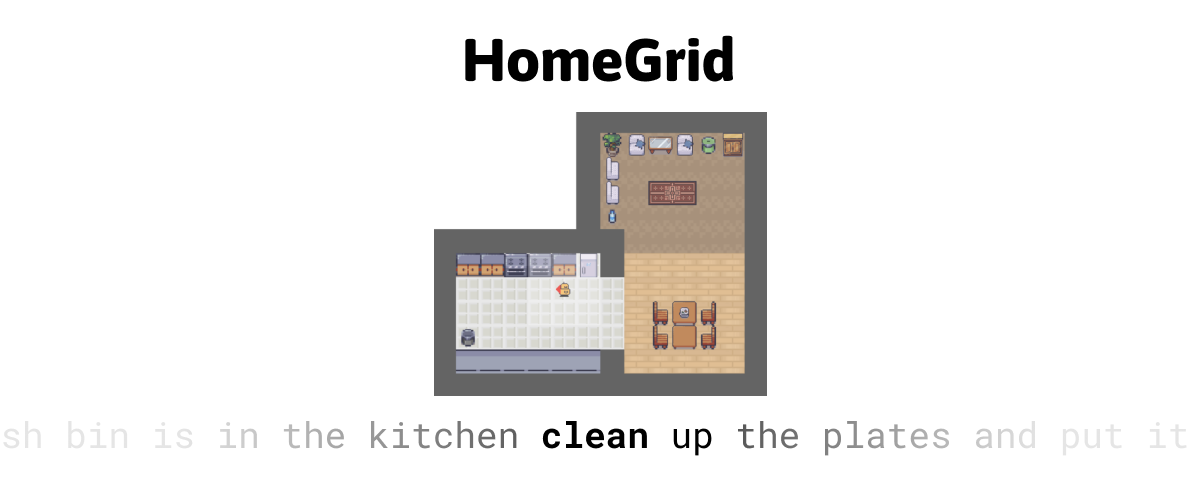
A minimal home grid world environment to evaluate language understanding in interactive agents.
🏠 Getting Started
Play as a human:
$ pip install -e .
$ ./homegrid/manual_control.py
Use as a gym environment:
import gym
import homegrid
env = gym.make("homegrid-task")
See homegrid/__init__.py for the environment configurations used in the paper Learning to Model the World with Language.
📑 Documentation
HomeGrid tests whether agents can learn to use language that provides information about the world. In addition to task instructions, the env provides scripted language hints, simulating knowledge that agents might learn from humans (e.g., in a collaborative setting) or read in text (e.g., on Wikipedia). Agents navigate around a house to find objects and interact with them to perform tasks, while learning how to understand language from experience.
⚡️ Quick Info
- pixel observations (3x3 partial view of the house)
- discrete action space (movement + object interaction)
- 3 rooms, 7 objects (3 trash bins, 4 trash objects)
- multitask with language instructions + hints
- randomized object placement and object dynamics
Task Templates (38 total tasks):
- find the
object/bin: the agent will receive a reward of 1 if it is facing the correct object / bin - get the
object: the agent will receive a reward of 1 if it has the correct object in inventory - put the
objectin thebin: the agent will receive a reward of 1 if the bin contains the object - move the
objectto theroom: the agent will receive a reward of 1 if the object is in the room - open the
bin: the agent will receive a reward of 1 if the bin is in the open state
Language Types and Templates
- Future Observations: descriptions of what agents might observe in the future, such as "The plates are in the kitchen."
- "
object/binis in theroom": the object or bin is in the indicated room - "i moved the
objectto theroom": the object has been moved to the room - "there will be
objectin theroom": the object will spawn in the room in five timesteps
- "
- Dynamics: descriptions of environment dynamics, such as "Pedal to open the compost bin."
- "
actionto open thebin": the indicated action is the correct action to open the bin
- "
- Corrections: interactive, task-specific feedback based on what the agent is currently doing, such as "Turn around."
- "no, turn around": the agent's distance to the current goal object or bin (given the task) has increased compared to the last timestep
Environment instances are provided for task instruction + each of the types above in homegrid/__init__.py.
Language is streamed one token per timestep by default. Some strings are higher priority than others and may interrupt a string that is currently being read. See homegrid/language_wrappers.py.
💻 Development
New development and extensions to the environment are welcome!
Adding new language utterances
Sentences are pre-embedded and cached into a file for training efficiency. You'll have to append the additional sentences to homegrid/homegrid_sentences.txt and re-generate the cached token and embedding file with the following command:
python scripts/embed_offline.py \
    --infile homegrid/homegrid_sentences.txt \
    --outfile homegrid/homecook_embeds.pkl \
    --model t5
Adding new layouts and objects
HomeGrid currently has one layout and a fixed set of objects that are sampled to populate each episode. Many of the receptacles and containers (e.g. cabinets) are disabled for simplicity.
To add new layouts, create a new class in homegrid/layout.py.
To add new static (non-interactive) objects, add assets to homegrid/assets.py and then specify where they are rendered in the homegrid/layout.py.
To add new interactive objects, additionally specify how they behave in homegrid/homegrid_base.py:step.
Acknowledgments
HomeGrid is based on MiniGrid. The environment assets are thanks to limezu and Mounir Tohami.
Citation
@article{lin2023learning,
         title={Learning to Model the World with Language},
         author={Jessy Lin and Yuqing Du and Olivia Watkins and Danijar Hafner and Pieter Abbeel and Dan Klein and Anca Dragan},
         year={2023},
         eprint={2308.01399},
         archivePrefix={arXiv},
}
1 maintainer

Release files for homegrid 0.1.1
For a detailed explanation of source distributions (sdists) and built distributions (wheels), please see the package formats documentation.
Source distribution (sdist)
| File | Size | Uploaded | |
|---|---|---|---|
| homegrid-0.1.1.tar.gz | 1.3 MB | Details |
Built distribution (wheel)
| File | Interpreter | ABI | Platform | Reset |
|---|---|---|---|---|
| homegrid-0.1.1-py3-none-any.whl | Python 3 | none | any | Details |
Total release size: 2.6 MB
Release files / homegrid-0.1.1.tar.gz
| Download URL | homegrid-0.1.1.tar.gz |
|---|---|
| Size | 1.3 MB |
| Tags | Source |
|
SHA-256 checksum How to use checksums |
41890971dc8868626bbdb26a78ee50679d9d30e744c8f474b095b42c84d3fdab
|
|
BLAKE2b-256 checksum How to use checksums |
4e2a9dedbcf630a90a1fd32d8e771e42eb2aff70c8c6a2204115e069e7d3aaab
|
| Upload date | |
|
Uploaded using Trusted Publishing? What is trusted publishing? |
No |
| Uploaded via |
twine/4.0.2 CPython/3.9.17
|
Release files / homegrid-0.1.1-py3-none-any.whl
| Download URL | homegrid-0.1.1-py3-none-any.whl |
|---|---|
| Size | 1.3 MB |
| Tags | Python 3 |
|
SHA-256 checksum How to use checksums |
5a8011038388dced3a8452ab131b051cdf153b258ddfe939edc48f3483d213ea
|
|
BLAKE2b-256 checksum How to use checksums |
f5a3ea5843d80f5d117aded1f1b4ddfa6ee0fbefaa1ffabd60c4b71beb71e2c4
|
| Upload date | |
|
Uploaded using Trusted Publishing? What is trusted publishing? |
No |
| Uploaded via |
twine/4.0.2 CPython/3.9.17
|













