
End-to-end Optical Music Recognition (OMR) system build on top of vision transformers.

Project description
homr
homr is an Optical Music Recognition (OMR) software designed to transform camera pictures of sheet music into machine-readable MusicXML format. The resulting MusicXML files can be further processed using tools such as musescore.

You might also want to check out Andromr, an Android app for optical music recognition using homr.
Prerequisites
- Python 3.11
- Poetry
- Optional: NVidia GPU with CUDA 12.1
Getting started (uv)
The easiest way to get started is using uvx (uv must be installed). Note that is does not make use of the GPU.
uvx homr <img>- The resulting MusicXML file will be saved in the same directory as the input image
- To combine the MusicXML results from multiple images, you can use relieur
Getting started (poetry)
- Clone the repository
- Install dependencies for:
- GPU (requires CUDA):
poetry install --only main,gpu - CPU:
poetry install --only main - Development:
poetry install
- GPU (requires CUDA):
- Run the program using
poetry run homr <image> - The resulting MusicXML file will be saved in the same directory as the input image
- To combine the MusicXML results from multiple images, you can use relieur
Example
The example below provides an overview of the current performance of the implementation. While some errors are present in the output, the overall structure remains accurate.
| Original Image | homr Result |
|---|---|
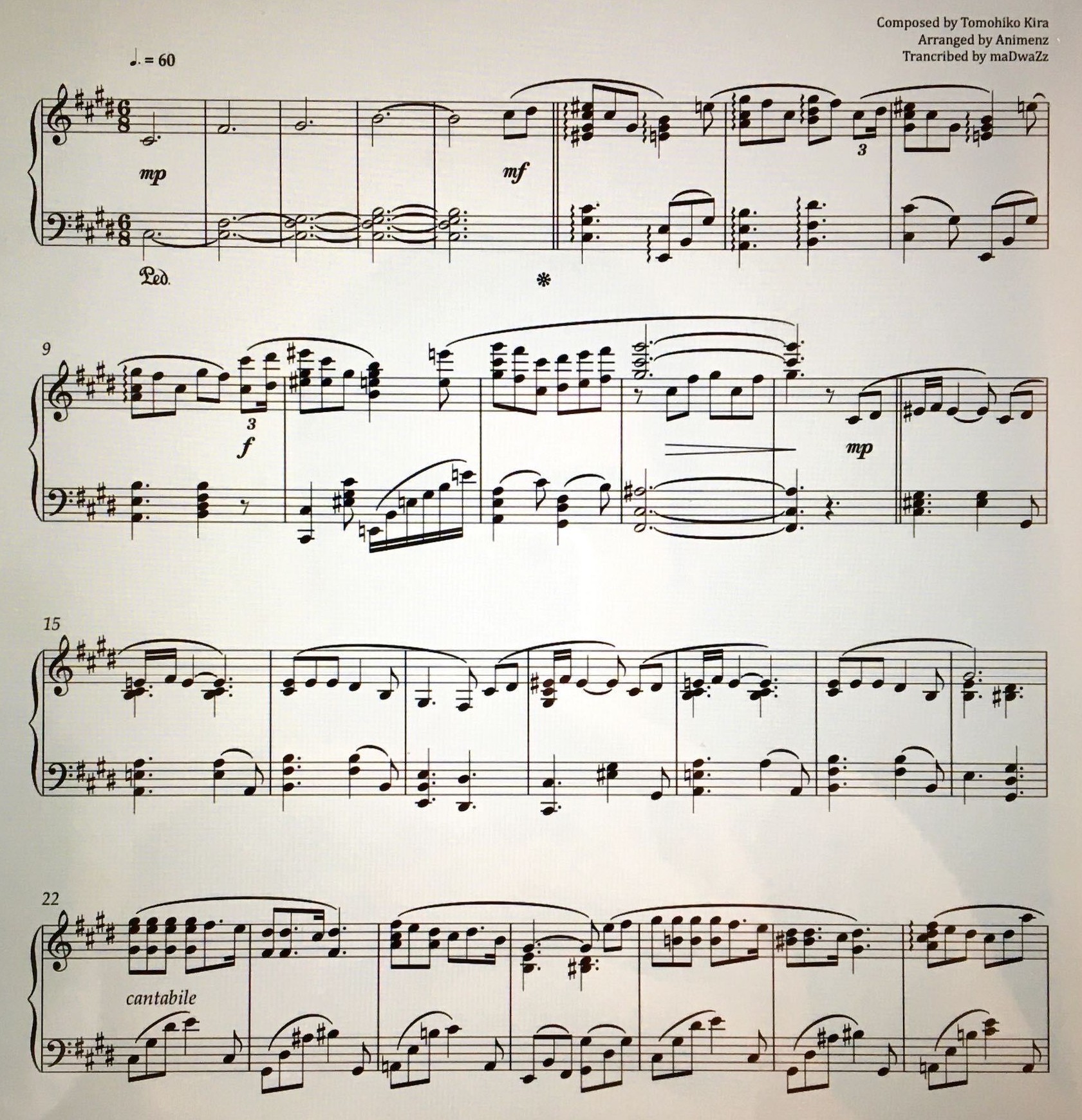 |
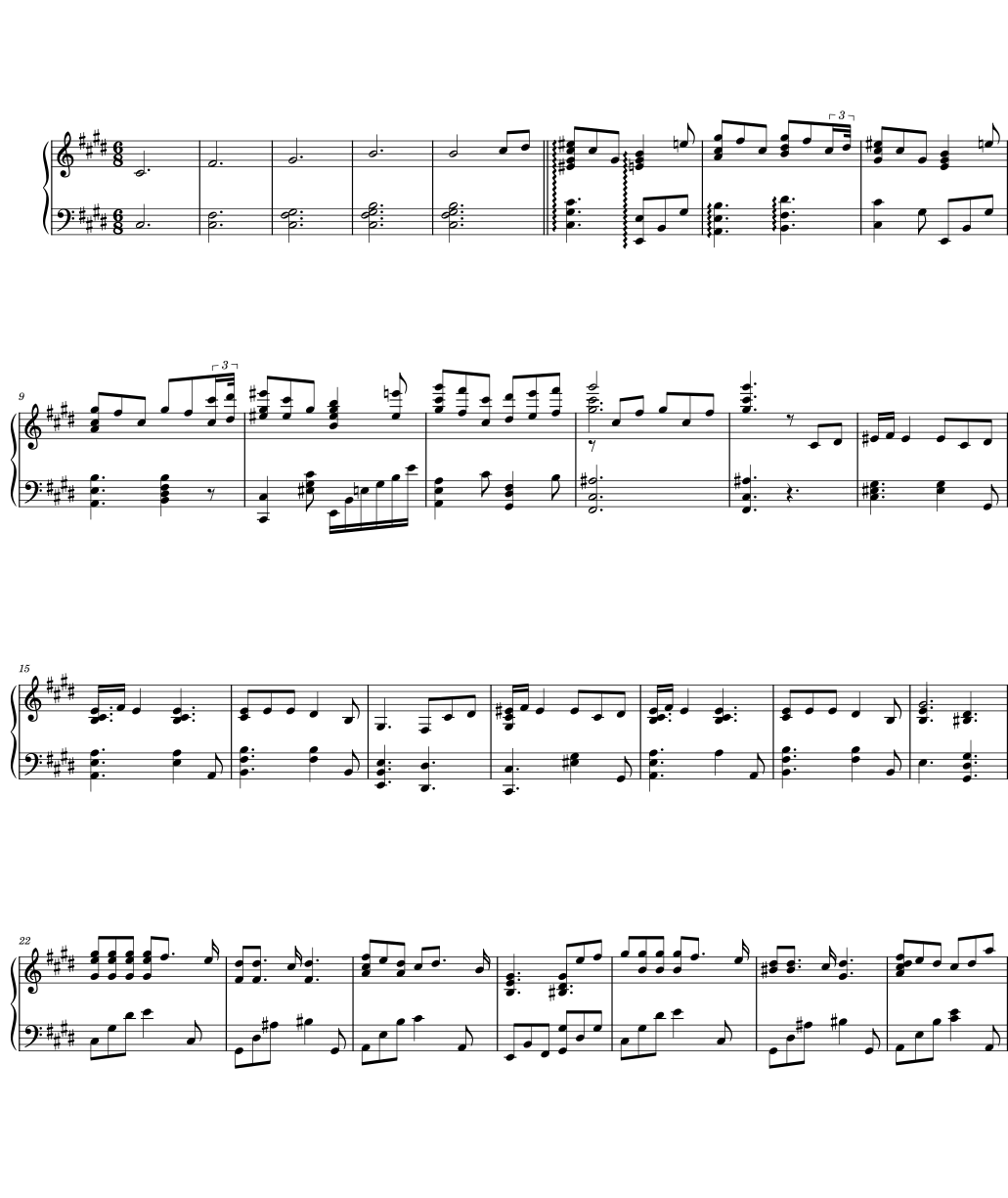 |
The homr result is obtained by processing the homr output and rendering it with musescore.
Limitations
The current implementation focuses on pitch and rhythm information on the bass or treble clef, neglecting dynamics, articulation, double sharps/flats, and other musical symbols.
Technical Details
homr uses a two-stage pipeline: segmentation for structural analysis followed by semantic symbol recognition via transformer models.
Stage 1: Image Segmentation and Structural Analysis
homr employs UNet-based segmentation models (adapted from oemer) to extract structural components from the sheet music image:
- Staff lines and symbols: Detected via trained segmentation networks that identify:
- Staff line fragments
- Note heads
- Stems and rests
- Bar lines
- Clefs and key signatures
The segmentation process generates bounding boxes for each detected element. These predictions serve as inputs for the staff detection algorithm.
Stage 2: Staff Detection and Merging
Using the segmentation outputs, homr constructs staffs through the following steps:
-
Staff Anchor Detection: The algorithm identifies "staff anchors" (clefs and bar lines) that serve as reference points for accurate staff localization, even when symbols partially obscure staff lines.
-
Unit Size Estimation: For each staff, the algorithm calculates the "unit size" (distance between staff lines). This accommodates camera perspective variations and non-uniform staff spacing.
-
Staff Reconstruction: Around each anchor, five staff lines are located and the remaining staff structure is reconstructed using the estimated unit size.
-
Grand Staff Merging: Braces and brackets are identified to merge related staffs, supporting:
- Grand staffs (piano, organ)
- Multiple voices on a single staff
- Mixed instrument groups
Stage 3: Semantic Symbol Recognition via Transformer
Each staff is dewarped (perspective-corrected) and passed through a transformer-based model (based on Polyphonic-TrOMR) that performs end-to-end symbol sequence recognition. The model outputs:
- Rhythm symbols: Note durations, rests, and tuplet information
- Pitch information: Absolute pitch values with accidentals (sharps, flats, naturals)
- Articulation marks: Accents, staccato, tenuto, and slur markers
- Performance annotations: Dynamic expressions and other musical notation
The transformer model generates these predictions in sequence, processing the dewarped staff image to understand the spatial and temporal relationships between musical symbols.
Note: The transformer output provides the sequence of symbols but does not include explicit positional information (horizontal or vertical coordinates). However, the model computes the center of attention as a byproduct of the attention mechanism, which can be used to estimate the focus point on the staff image.
Stage 4: MusicXML Output
The symbol sequence is converted into MusicXML format and saved to disk. The resulting file can be processed with tools like musescore or relieur (for multi-image combinations).
Citation
If you use this code in your research work, please cite oemer and Polyphonic-TrOMR.
Name
The name "homr" stands for Homer's Optical Music Recognition (OMR), leaving the interpretation of "Homer" to the user's discretion, whether referring to the ancient poet Homer or the iconic character from The Simpsons.
Thanks
This project builds upon previous work, including:
- The segmentation models of oemer
- The transformer model of Polyphonic-TrOMR
- The starter template provided by Benjamin Roland
Release history Release notifications | RSS feed


Download files
Download the file for your platform. If you're not sure which to choose, learn more about installing packages.
Source Distribution
Built Distribution
Filter files by name, interpreter, ABI, and platform.
If you're not sure about the file name format, learn more about wheel file names.
Copy a direct link to the current filters
File details
Details for the file homr-0.7.0.tar.gz.
File metadata
- Download URL: homr-0.7.0.tar.gz
- Upload date:
- Size: 83.3 kB
- Tags: Source
- Uploaded using Trusted Publishing? No
- Uploaded via: poetry/2.4.1 CPython/3.11.15 Linux/6.17.0-1018-azure
File hashes
| Algorithm | Hash digest | |
|---|---|---|
| SHA256 |
4078b9e70c16a1250288d92e065528bbd8712617339749407f057aebab9cfb7d
|
|
| MD5 |
aa325c936e732c3004379a9a8c0367dd
|
|
| BLAKE2b-256 |
250baa9b09fa55b7714af479051f49ce2c5f8a90fc5d3d29e9e63df30543f169
|
File details
Details for the file homr-0.7.0-py3-none-any.whl.
File metadata
- Download URL: homr-0.7.0-py3-none-any.whl
- Upload date:
- Size: 94.4 kB
- Tags: Python 3
- Uploaded using Trusted Publishing? No
- Uploaded via: poetry/2.4.1 CPython/3.11.15 Linux/6.17.0-1018-azure
File hashes
| Algorithm | Hash digest | |
|---|---|---|
| SHA256 |
84c6028df06e60b1aff158c9049d1876b22137144e319b61bacc41518842c4a9
|
|
| MD5 |
b8158d4bb46d78fb09a0cb609ff5b944
|
|
| BLAKE2b-256 |
bdccc313f3309b541cf6a3816666a7d9f4e2fdc1d34627281205e126597b0fe5
|






