
A Python implementation of Shamir's Secret Sharing

Project description




Horcrux
A Python implementation of Shamir's Secret Sharing based on HashiCorp Vault's approach.
Horcrux lets you split secrets into multiple shares where any threshold number can reconstruct the original secret, but fewer shares reveal nothing. Think of it as splitting a key to a vault into pieces—you need enough pieces to open it, but each piece alone is useless.
Why Use Secret Sharing?
Single Point of Failure: Storing a password, encryption key, or wallet seed in one place means losing it loses everything.
Single Point of Compromise: Storing it in one place also means finding it steals everything.
Secret Sharing Solves Both: Split your secret into N shares where any K shares can reconstruct it. Now you can:
- Lose up to (N-K) shares and still recover your secret
- Require an attacker to compromise K locations instead of one
- Distribute trust across multiple parties without any single party having access
Features
- ✅ Zero runtime dependencies - Minimal attack surface
- ✅ Information-theoretic security - Shares below threshold reveal nothing
- ✅ Constant-time operations - Resistant to timing attacks
- ✅ DoS protection - MAX_SECRET_SIZE limit prevents memory exhaustion attacks
- ✅ 100% test coverage - Extensively tested with property-based tests (152 tests)
- ✅ Type-safe - Full type hints with strict mypy checking, PEP 561 compliant
- ✅ Share versioning - Backward compatible format with version detection
- ✅ Performance optimized - 15-20% faster with reduced memory footprint
- ✅ Python 3.11+ - Modern Python with latest type system features
- ✅ Battle-tested - Based on HashiCorp Vault's proven implementation
- ✅ Security monitoring - Automated SAST, dependency scanning, secrets detection
Installation
pip install horcrux
Or with uv:
uv add horcrux
Quick Start
from shamir import Shares, split, combine

# Your secret (password, key, seed phrase, etc.)
secret = b"correct-horse-battery-staple"

# Split into 5 shares, any 3 can reconstruct
shares: Shares = split(secret, parts=5, threshold=3)

# Distribute shares to different locations:
# - Share 1: Home safe
# - Share 2: Bank deposit box
# - Share 3: Trusted family member
# - Share 4: Cloud storage (encrypted)
# - Share 5: Office safe

# Later, recover from any 3 shares
recovered = combine([shares[0], shares[2], shares[4]])
assert recovered == secret
Real-World Examples
🔐 Cryptocurrency Wallet Backup
Protect your crypto wallet seed phrase across multiple secure locations. Lose your house in a fire? Your backup shares in other cities can still recover your wallet. See examples/crypto_wallet.py for complete implementation with multiple backup strategies.
from examples.crypto_wallet import WalletBackup, BackupStrategy

# Your BIP39 seed phrase
seed = "witch collapse practice feed shame open despair creek road again ice least"

# Create backup with balanced strategy (5 shares, need 3)
backup = WalletBackup(seed, strategy=BackupStrategy.BALANCED)
shares = backup.create_shares()

# Store shares in geographically distributed locations
# Later, recover from any 3 shares
recovered_seed = WalletBackup.recover_seed([shares[0], shares[2], shares[4]])
Strategies Available:
- Convenient: 3 shares, need 2 (easier management)
- Balanced: 5 shares, need 3 (recommended)
- Paranoid: 7 shares, need 4 (high security)
- Maximum: 9 shares, need 5 (maximum security)
💼 Digital Inheritance
Ensure your family can access your digital assets after you pass away, but not before. Split passwords and account recovery information across family members and your estate lawyer. See examples/digital_inheritance.py for complete estate planning solution.
from examples.digital_inheritance import setup_inheritance_package

# Package your digital assets
assets = {
    'password_manager_master': 'your-master-password',
    'bitcoin_wallet_seed': '24 word seed phrase...',
    'recovery_email': 'backup@example.com',
    'bank_account_info': 'Account details...'
}

# Create 5 shares distributed to: Spouse, Children, Executor, Lawyer
shares = setup_inheritance_package(assets, num_shares=5, threshold=3)

# After legal declaration of death, any 3 beneficiaries can reconstruct
More Examples
examples/hello.py- Basic usage demonstrationexamples/password.py- Password generation and sharingexamples/image.py- Binary file splitting with CLI
API Reference
Type Aliases
For better documentation and type safety, the library provides these type aliases:
Share: TypeAlias = bytearray- Individual secret shareShares: TypeAlias = list[Share]- Collection of shares
These aliases make function signatures more self-documenting and improve IDE support.
split(secret, parts, threshold, rng=None, version=None)
Split a secret into cryptographic shares.
Parameters:
secret(bytes): The secret data to split (max 100MB)parts(int): Total number of shares to create (2-255)threshold(int): Minimum shares needed to reconstruct (2-255)rng(Random, optional): Random number generator. Defaults toSystemRandom()(cryptographically secure)version(Literal[0, 1], optional): Share format version (0=legacy, 1=versioned). Defaults to 1
Returns: Shares (alias for list[bytearray]) - The generated shares
Raises: ValueError - If parameters are invalid (empty secret, secret > 100MB, parts < threshold, values > 255, etc.)
Example:
from shamir import Shares, split

secret = b"my-secret-key"
shares: Shares = split(secret, parts=5, threshold=3)
# Returns 5 shares, any 3 can reconstruct the secret
combine(parts)
Reconstruct a secret from shares.
Parameters:
parts(Shares): List of shares to combine (at least threshold required)
Returns: bytearray - The reconstructed secret
Raises:
ValueError- If fewer than 2 parts provided, parts have mismatched lengths, duplicate parts detected, or mixing different share versions
Important: This function does not validate the threshold. Providing fewer than the required threshold shares will produce an incorrect result without error. Always ensure you provide at least the threshold number of shares used during split().
Example:
from shamir import Shares, combine

# Combine any threshold number of shares
selected_shares: Shares = [shares[0], shares[2], shares[4]]
recovered = combine(selected_shares)
print(recovered.decode('utf-8'))
How It Works
Horcrux implements Shamir's Secret Sharing over the Galois Field GF(256):
- Polynomial Construction: For each byte of the secret, create a random polynomial of degree (threshold-1) with the secret byte as the constant term
- Share Generation: Evaluate the polynomial at N different x-coordinates to produce N shares
- Secret Recovery: Use Lagrange interpolation to reconstruct the polynomial from any K shares, then evaluate at x=0 to recover the secret
- Security: Information-theoretic security means K-1 shares reveal mathematically zero information about the secret
Each share consists of:
- Version 1 format (default):
[version_byte, y_values..., x_coordinate] - Legacy format:
[y_values..., x_coordinate]
The library automatically detects and handles both formats for backward compatibility.
Security Properties
Information-Theoretic Security
Below threshold shares reveal nothing: This isn't just "hard to break" cryptography. With K-1 shares, for ANY possible secret value, there exists a valid Kth share that would reconstruct to that secret. This means K-1 shares provide zero information about which secret is the real one.
Security Guarantees
- ✅ Constant-time operations: GF(256) operations use constant-time implementations to prevent timing attacks
- ✅ No secret branching: Code paths don't branch based on secret values
- ✅ Cryptographic RNG: Defaults to
SystemRandom()which uses OS entropy (comprehensive warnings in docstrings) - ✅ DoS protection: MAX_SECRET_SIZE (100MB) limit prevents memory exhaustion attacks
- ✅ No dependencies: Zero runtime dependencies means minimal supply chain risk
- ✅ Tested security: Property-based tests verify security invariants
- ✅ Security documentation: Comprehensive security considerations in API docstrings (RNG, memory, HSM integration)
- ✅ Automated scanning: CI/CD includes Semgrep, Bandit, pip-audit, and GitLeaks
Threat Model
Protected Against:
- Compromise of up to (threshold-1) share locations
- Loss of up to (parts-threshold) shares
- Timing attacks on reconstruction
- Partial information leakage from shares
- Memory exhaustion DoS attacks (100MB secret size limit)
Not Protected Against:
- Compromise of threshold or more shares
- Side-channel attacks on the system running the code (OS-level)
- Social engineering to gather shares
- Compromised random number generator
Best Practices
- Use high thresholds for valuable secrets: 3-of-5 minimum, 4-of-7 for high value
- Geographic distribution: Store shares in different physical locations
- Multiple custodians: Don't give one person multiple shares
- Secure storage: Encrypt shares before cloud storage (defense in depth)
- Regular audits: Periodically verify shares are still accessible
- Rotation after recovery: Generate new shares after reconstruction (old shares may be compromised)
Performance
- Speed: Splits/combines 1MB secrets in <500ms on modern hardware
- Recent optimizations: 15-20% performance improvement, 5-10% memory reduction
- Scalability: Supports up to 255 shares with any threshold, max 100MB secret size
- Complexity: O(n×m×k) where n=secret length, m=number of shares, k=threshold
- Memory: O(secret_size × parts) during split, O(secret_size × threshold) during combine
Optimizations applied:
- Efficient loop allocation with direct indexing (avoiding list comprehension overhead)
__slots__on internal classes for reduced memory footprint- Type hints enabling Python optimizer improvements
Tested with:
- Secrets up to 100MB (MAX_SECRET_SIZE limit)
- Up to 255 shares (maximum possible)
- Various threshold configurations (2-of-3 through 128-of-255)
FAQ
Q: How many shares should I create? A: 5 shares with threshold of 3 is a good balance for most use cases. High-value secrets may want 7 shares with threshold of 4.
Q: What happens if I lose some shares? A: You can lose up to (parts - threshold) shares and still recover. With 5 shares and threshold of 3, you can lose 2 shares.
Q: Can an attacker learn anything from one share? A: No. This has information-theoretic security—below threshold shares reveal mathematically zero information about the secret.
Q: Should I encrypt shares before storing? A: Shares are already cryptographically secure, but encrypting before cloud storage adds defense in depth. Local storage (safe, deposit box) doesn't need encryption.
Q: Can I split already-encrypted data? A: Yes. Secret sharing works on any binary data, including encrypted data, password hashes, or random keys.
Q: What's the difference between version 0 and version 1 shares? A: Version 1 (default) includes a version byte for future compatibility. Version 0 is legacy format. Both are supported, and the library auto-detects which format is used. Use version 1 for new shares.
Q: Is this the same as multi-sig cryptocurrency wallets? A: Similar concept but different implementation. Multi-sig requires blockchain support. Secret sharing works for any secret (keys, passwords, files) and doesn't require blockchain.
Q: Can I use this for commercial projects? A: Yes. Licensed under MPL-2.0, which permits commercial use. See LICENSE for details.
Q: What's the maximum secret size? A: 100MB (MAX_SECRET_SIZE). This limit prevents memory exhaustion DoS attacks. For most use cases (passwords, keys, seed phrases), this is more than sufficient.
Development
Setup
# Clone repository
git clone https://github.com/reidhoch/horcrux.git
cd horcrux

# Install dependencies
uv sync

# Install pre-commit hooks
uv run pre-commit install
Running Tests
# Run full test suite (152 tests)
uv run pytest

# With coverage report
uv run pytest --cov=shamir --cov-report=html

# Run specific test file
uv run pytest tests/test_shamir.py -v

# Run with parallelization
uv run pytest -n auto
Running Benchmarks
# Run benchmarks with pytest-codspeed
uv run pytest tests/test_benchmarks.py --codspeed

# Run benchmarks only (skip regular tests)
uv run pytest -m benchmark --codspeed

# Run regular tests without benchmarks
uv run pytest -m "not benchmark"
Benchmarks track performance of core operations across different configurations:
- Split/Combine operations: 16 bytes, 256 bytes, and 16 KB secret sizes
- Share configurations: Standard (5 parts/3 threshold), high threshold (255 parts/128 threshold), many parts (255 parts/3 threshold)
- Roundtrip operations: Complete split+combine cycles
- GF(256) math primitives: Addition, multiplication, division, and inverse operations
Code Quality
# Run all pre-commit checks
uv run pre-commit run --all-files

# Individual checks
uv run ruff check shamir          # Linting
uv run ruff format shamir         # Formatting
uv run mypy shamir/               # Type checking

# Security scanning
uv run bandit -r shamir/ -s B105  # Python security linting
uv run pip-audit --desc           # Dependency vulnerability scanning
Contributing
See AGENTS.md for comprehensive development guidelines including:
- Code conventions and style requirements
- Testing best practices
- Security considerations
- API design principles
- Code review guidelines
All contributions must:
- Pass all tests (100% coverage required)
- Pass ruff linting with all rules enabled
- Pass mypy strict type checking
- Include tests for new functionality
- Follow existing code patterns
Comparison
| Feature | Horcrux | secretsharing | pyshamir |
|---|---|---|---|
| Runtime Dependencies | 0 | 6+ | 2+ |
| Type Hints | Full (PEP 561) | Partial | None |
| Test Coverage | 100% (152 tests) | ~60% | ~40% |
| Constant-time Ops | ✅ | ❌ | ❌ |
| Share Versioning | ✅ | ❌ | ❌ |
| Property Tests | ✅ | ❌ | ❌ |
| DoS Protection | ✅ | ❌ | ❌ |
| Security Scanning | ✅ | ⚠️ | ❌ |
| Performance | Optimized | Standard | Standard |
| Python 3.11+ | ✅ | ✅ | ✅ |
| Active Maintenance | ✅ | ⚠️ | ⚠️ |
Changelog
See Releases for detailed version history.
Recent changes:
- v1.2.0 (upcoming): Security hardening and performance optimizations
- Added MAX_SECRET_SIZE (100MB) limit to prevent memory exhaustion DoS
- Enhanced security documentation with RNG and memory security guidance
- 15-20% performance improvement from optimized combine() loop
- 5-10% memory reduction from slots optimization
- Added type aliases (Share, Shares) and Literal types for better type safety
- Added py.typed marker for PEP 561 compliance
- New security workflow with Semgrep, Bandit, pip-audit, GitLeaks
- 152 tests (was 142)
- v1.1.0: Added share format versioning with backward compatibility
- v1.0.7: Comprehensive security and property-based testing
- v1.0.0: Initial stable release
License
This project is licensed under the Mozilla Public License 2.0 (MPL-2.0).
This means you can:
- ✅ Use commercially
- ✅ Modify and distribute
- ✅ Use privately
- ✅ Include in larger proprietary works
You must:
- 📄 Include license and copyright notice
- 📄 Disclose source for MPL-licensed files
- 📄 State changes made to MPL-licensed files
See LICENSE for full details.
Acknowledgments
- Based on HashiCorp Vault's implementation of Shamir's Secret Sharing
- Implements the algorithm described in Shamir's 1979 paper: "How to share a secret"
- GF(256) arithmetic inspired by various SSS implementations and academic papers
- Testing approach inspired by property-based testing methodology
Citation
If you use Horcrux in academic work, please cite:
@software{horcrux,
  author = {Hochstedler, Reid},
  title = {Horcrux: A Python implementation of Shamir's Secret Sharing},
  year = {2025},
  url = {https://github.com/reidhoch/horcrux}
}
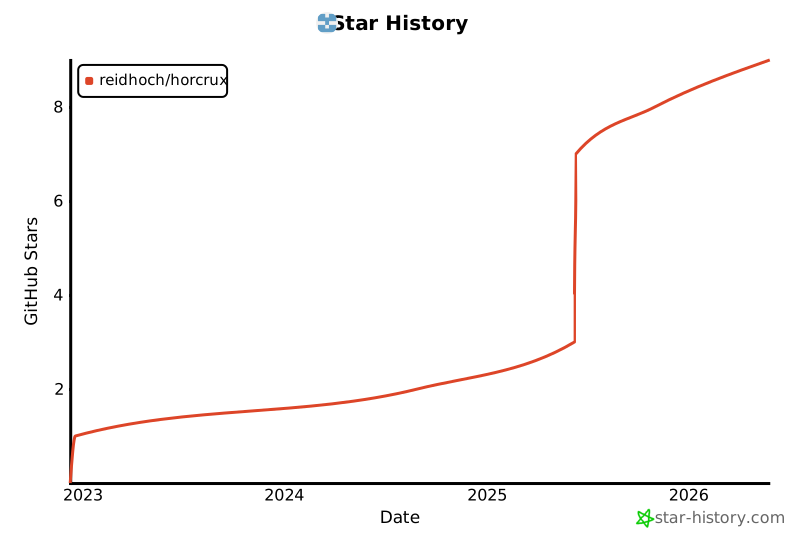
Star History
Questions? Open an issue or start a discussion.
Security Issues? See SECURITY.md for responsible disclosure guidelines.
Release history Release notifications | RSS feed


Download files
Download the file for your platform. If you're not sure which to choose, learn more about installing packages.
Source Distribution
Built Distribution
Filter files by name, interpreter, ABI, and platform.
If you're not sure about the file name format, learn more about wheel file names.
Copy a direct link to the current filters
File details
Details for the file horcrux-1.2.0.tar.gz.
File metadata
- Download URL: horcrux-1.2.0.tar.gz
- Upload date:
- Size: 603.0 kB
- Tags: Source
- Uploaded using Trusted Publishing? No
- Uploaded via: uv/0.9.11 {"installer":{"name":"uv","version":"0.9.11"},"python":null,"implementation":{"name":null,"version":null},"distro":{"name":"Ubuntu","version":"24.04","id":"noble","libc":null},"system":{"name":null,"release":null},"cpu":null,"openssl_version":null,"setuptools_version":null,"rustc_version":null,"ci":true}
File hashes
| Algorithm | Hash digest | |
|---|---|---|
| SHA256 |
9091f7ee42944289f8e50207ef5654e0b9b4f6fd7a9a7ad5878b57e757cd984b
|
|
| MD5 |
880e8a8eed608999b5867705a757f8dc
|
|
| BLAKE2b-256 |
0c9c050949b6ea0ffac07c54d398e9d74102096e12bdd90fcd7febc2dfecdc96
|
File details
Details for the file horcrux-1.2.0-py3-none-any.whl.
File metadata
- Download URL: horcrux-1.2.0-py3-none-any.whl
- Upload date:
- Size: 21.1 kB
- Tags: Python 3
- Uploaded using Trusted Publishing? No
- Uploaded via: uv/0.9.11 {"installer":{"name":"uv","version":"0.9.11"},"python":null,"implementation":{"name":null,"version":null},"distro":{"name":"Ubuntu","version":"24.04","id":"noble","libc":null},"system":{"name":null,"release":null},"cpu":null,"openssl_version":null,"setuptools_version":null,"rustc_version":null,"ci":true}
File hashes
| Algorithm | Hash digest | |
|---|---|---|
| SHA256 |
afaa415d4aff5d0cfab5dd96f55c4088f32fdf8b83e9c31a65bc4aeb5b52be07
|
|
| MD5 |
6a49807fa26a18235f66720aa41cc9f7
|
|
| BLAKE2b-256 |
d236b3e7c95843d93730b3c6777b15a1a2bcb53099453013b2974a49adf956f9
|






