
Horus Runtime
Reproducible scientific workflows, from your laptop to the HPC cluster.






Horus Runtime is the open-source engine behind the Temple Compute platform: you describe a pipeline once, in YAML or Python, and run it wherever the compute lives. It tracks every artifact a task produces, moves those artifacts between machines for you, and skips work that is already done when you run it again.
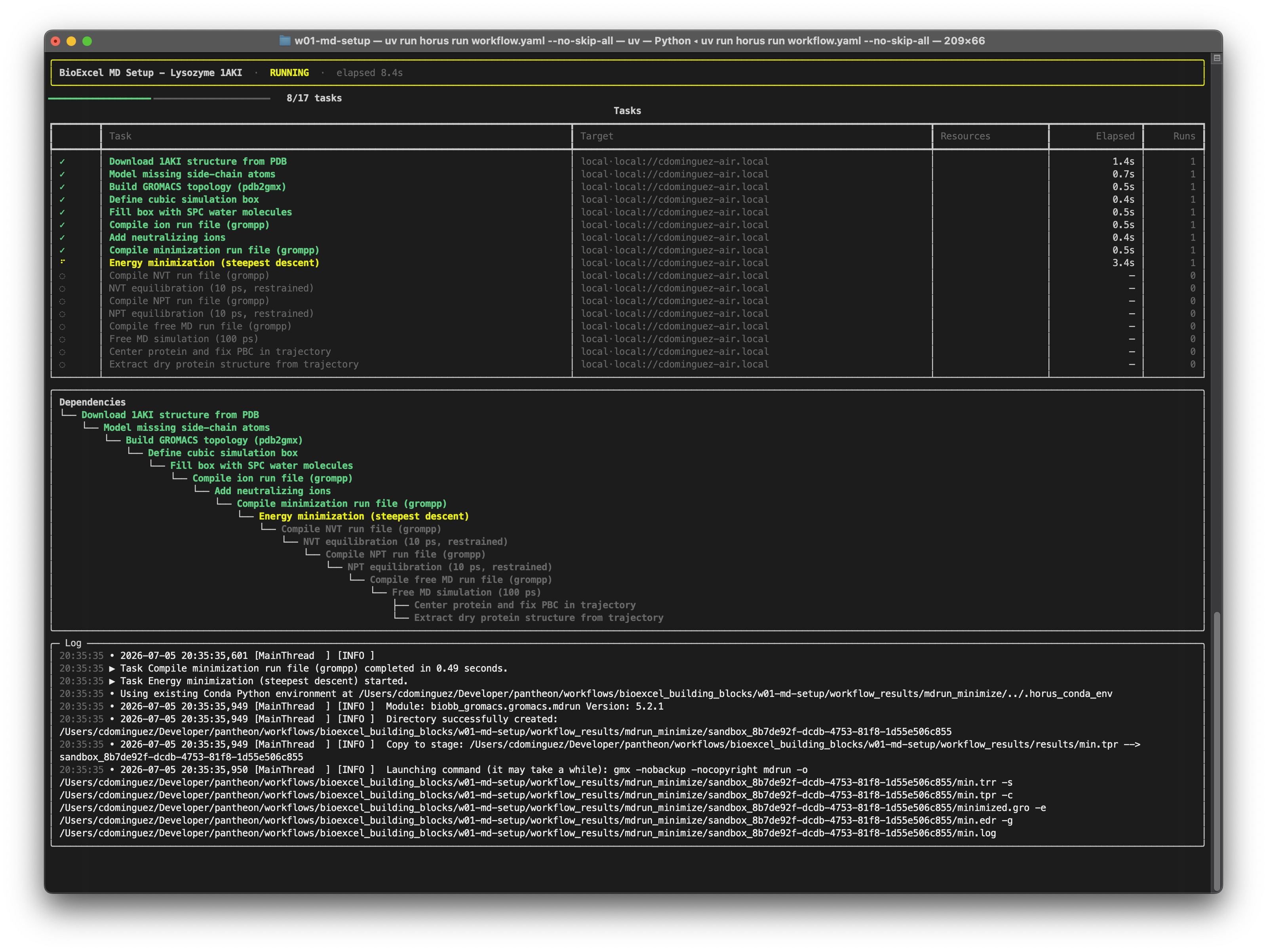
Quickstart
Install it:
uv add horus-runtime # or: pip install horus-runtime
Save this as workflow.yaml:
name: example_pipeline
kind: horus_workflow

tasks:
  - id: producer
    name: Produce data
    kind: horus_task
    runtime:
      kind: command
      # $data renders to the on-target path of the "data" output artifact.
      command: "mkdir -p /tmp/horus_example && echo 42 > $data"
    executor:
      kind: shell
    target:
      kind: local
    outputs:
      - id: data
        kind: file
        path: /tmp/horus_example/data.txt

  - id: consumer
    name: Summarize data
    kind: horus_task
    runtime:
      kind: command
      command: "wc -l ${data_in} > $summary"
    executor:
      kind: shell
    target:
      kind: local
    inputs:
      - id: data_in
        kind: file
        path: /tmp/horus_example/data.txt
    outputs:
      - id: summary
        kind: file
        path: /tmp/horus_example/summary.txt

# Edges are the DAG: producer.data feeds consumer.data_in, so producer runs
# first and its output is transferred before the consumer starts.
edges:
  - source: producer
    source_output: data
    target: consumer
    target_input: data_in
Run it:
horus run workflow.yaml
[HorusTask._run] Task Produce data started.
[TaskTimeMiddleware.after] Task Produce data completed in 0.01 seconds.
[HorusTask._run] Task Summarize data started.
[TaskTimeMiddleware.after] Task Summarize data completed in 0.03 seconds.
[WorkflowTimeMiddleware.after] Workflow example_pipeline completed in 0.05 seconds.
Run it a second time and nothing re-executes, because both tasks' output artifacts already exist:
[BaseTask.run] Skipping task Produce data. Already complete.
[BaseTask.run] Skipping task Summarize data. Already complete.
Delete the outputs, or pass --no-skip-all, to force a fresh run.
Why Horus
- Write once, run anywhere. A task declares what to run (
runtime), how to run it (executor), and where (target). Moving a stage from your laptop to a SLURM cluster is a change to thetargetblock, not a rewrite. - Artifacts, not filenames. Inputs and outputs are typed, addressable objects. Horus resolves them into your commands, transfers them between targets when an edge crosses machines, and knows when they already exist.
- Restartable by default. Completed tasks are skipped on re-run, so a pipeline that failed at hour nine picks up at hour nine.
- Everything is a plugin. Targets, runtimes, executors, artifacts, tasks, transfer
strategies, and middleware are all registered
kinds. Adding one is a package with an entry point, never a fork. - Built for real science. Resource requests, subworkflows, mapped fan-out, run packaging, and a live TUI, driven from a file you can commit and diff.
CLI
| Command | What it does |
|---|---|
horus run WORKFLOW_YAML |
Execute the workflow. --trigger picks the starting task, --no-tui streams plain logs, --no-skip TASK_ID / --no-skip-all force re-runs, --debug turns on debug logging. |
horus package WORKFLOW_YAML |
Bundle the workflow and every file it references into a zip, so it runs on a machine that never had your directory. |
horus sanitize WORKFLOW_YAML |
Promote implicit root inputs into declared top-level artifacts, which is what lets a UI offer them as workflow inputs. |
Full CLI and SDK reference: docs.templecompute.com.
Built-in kinds
Everything below ships with the runtime and is usable straight after install.
| Category | Kinds |
|---|---|
| Targets | local |
| Runtimes | command, python, python_string, python_script |
| Executors | shell, python_exec, python_fn, python_fn_external |
| Artifacts | file, folder, json, pickle, number, boolean, string |
| Tasks | horus_task, subworkflow |
| Workflows | horus_workflow |
Ecosystem
Official plugins, installable alongside the runtime:
| Plugin | Adds |
|---|---|
| horus-slurm | Run tasks as SLURM jobs on an HPC cluster. |
| horus-docker | Execute tasks inside Docker containers. |
| horus-singularity | Execute tasks inside Singularity/Apptainer containers. |
| horus-environments | Auto-provision per-task Python environments with uv or conda. |
And for ready-made science: Pantheon is a curated library of production workflows, from drug discovery (Boltz-2 virtual screening, AutoDock Vina docking) to molecular dynamics setup with BioExcel Building Blocks (GROMACS, AMBER). Contributions welcome there too.
Writing your own plugin
A plugin is an ordinary Python package that declares a horus.* entry point:
[project.entry-points."horus.target"]
my_cluster = "my_package.target"
Once installed, kind: my_cluster works in any workflow. Start from the
plugin template and see the
SDK docs for the base classes.
Contributing
Contributions are very welcome, from bug reports to new plugins.
- Read CONTRIBUTING.md for dev setup and the PR checklist.
- Browse good first issues.
- Ask questions in Discussions.
- Be excellent to each other: Code of Conduct.
Found a security issue? Please follow SECURITY.md instead of opening an issue.
Funding & Credits
Developed by Temple Compute.
License
horus-runtime is licensed under the GNU Affero General Public License v3.0 (AGPL-3.0).
See the LICENSE file for details.
For commercial licensing and support, contact Temple Compute at christian@templecompute.com.
1 maintainer

Metadata
1 maintainer
Release files for horus-runtime 0.6.0
For a detailed explanation of source distributions (sdists) and built distributions (wheels), please see the package formats documentation.
Source distribution (sdist)
| File | Size | Uploaded | |
|---|---|---|---|
| horus_runtime-0.6.0.tar.gz | 293.2 kB | Details |
Built distribution (wheel)
| File | Interpreter | ABI | Platform | Reset |
|---|---|---|---|---|
| horus_runtime-0.6.0-py3-none-any.whl | Python 3 | none | any | Details |
Total release size: 577.1 kB
Release files / horus_runtime-0.6.0.tar.gz
| Download URL | horus_runtime-0.6.0.tar.gz |
|---|---|
| Size | 293.2 kB |
| Tags | Source |
|
SHA-256 checksum How to use checksums |
fe622c5966cd23402188acb378b15d6454b17980824bbc9aeb7cc58278da54a6
|
|
BLAKE2b-256 checksum How to use checksums |
7ea9456bba018892cfab39a9f4ace600df65d44d60b7ca794f3907392cd0402e
|
| Upload date | |
|
Uploaded using Trusted Publishing? What is trusted publishing? |
Yes |
| Uploaded via |
twine/7.0.0 CPython/3.13.14
|
Provenance
Provenance describes where a file came from. On PyPI, provenance is shared via attestations, which provide a verifiable record of the build or publishing details. View details, limitations and caveats.


PyPI Publish Attestation
PyPI verified that this artifact, at this checksum, originated from the publisher listed below.
Signed by GitHub Actions, verified by PyPI on Sep 13, 2026.
Transparency logRelease files / horus_runtime-0.6.0-py3-none-any.whl
| Download URL | horus_runtime-0.6.0-py3-none-any.whl |
|---|---|
| Size | 283.9 kB |
| Tags | Python 3 |
|
SHA-256 checksum How to use checksums |
4e87b6563cbb20a9e1ce40c26b1e7b3fb209130f740aef5ddcc0575f1b66f18f
|
|
BLAKE2b-256 checksum How to use checksums |
28de7cfa6df8498c1a60418382a6279457337440e8d04a7577607565f510fa6b
|
| Upload date | |
|
Uploaded using Trusted Publishing? What is trusted publishing? |
Yes |
| Uploaded via |
twine/7.0.0 CPython/3.13.14
|
Provenance
Provenance describes where a file came from. On PyPI, provenance is shared via attestations, which provide a verifiable record of the build or publishing details. View details, limitations and caveats.
PyPI Publish Attestation
PyPI verified that this artifact, at this checksum, originated from the publisher listed below.
Signed by GitHub Actions, verified by PyPI on Sep 13, 2026.
Transparency log













