











hosh - Identification based on group theory
Website | Latest Release | Current Code | API Documentation
This Python library / code provides a reference implementation for the UT*.4 specification presented here. A previous version, containing extra group theory content, is available in the package GaROUPa.
Please see the website for more detailed usage information.
We adopt a novel paradigm to universally unique identification (UUID), making identifiers deterministic and predictable,
even before an object is generated by a (possibly costly) process.
Here, data versioning and composition of processing steps are directly mapped as simple operations over identifiers.
We call each of the latter a Hosh, i.e., an identifier is an operable hash.
A first implementation of the remaining ideas from the paper is provided in this
cacheable lazy dict which depends on hosh and serves as an advanced usage example.
A second (entirely rewritten) version is available in the package idict, succeeded by hoshmap.
The most recent rewritten version of a hosh-based dict (and the most robust, recommended, one) is available in the package hdict.
Overview
A product of identifiers produces a new identifier as shown below, where sequences of bytes (b"...") are passed to simulate binary objects to be hashed.
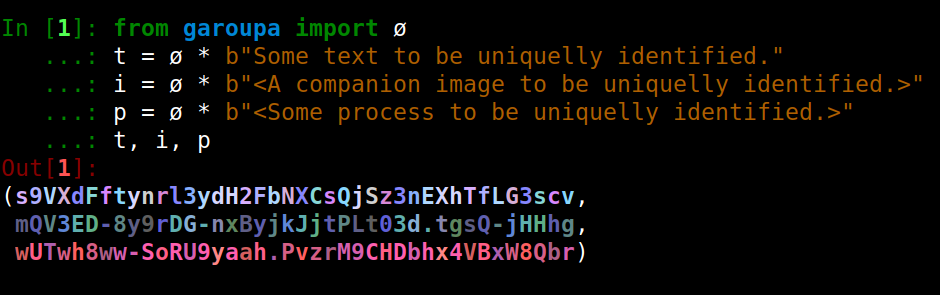 |
New identifiers are easily created from the identity element ø. Also available as identity for people or systems allergic to utf-8 encoding. |
|---|
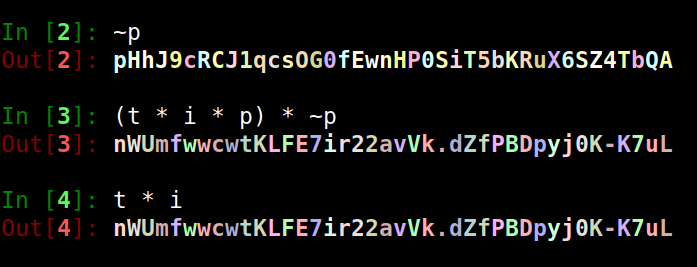 |
Operations can be reverted by the inverse of the identifier. |
|---|
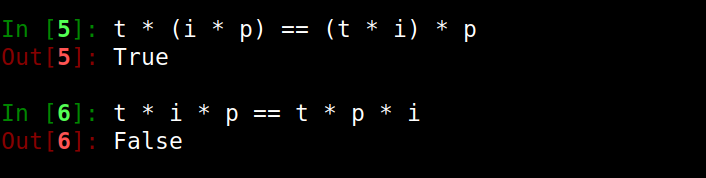 |
Operations are associative. They are order-sensitive by default, in which case they are called ordered ids. |
|---|
| However, order-insensitive (called unordered) and order-insensitive-among-themselves (called hybrid) identifiers are also available. | . |
|---|---|
 |
. |
| This is how they affect each other: | . |
|---|---|
 |
. |
The chance of collision is determined by the number of possible identifiers of each type. Some versions are provided, e.g.: UT32.4, UT40.4 (default), UT64.4. They can be easily implemented in other languages and are intended to be a specification on how to identify multi-valued objects and multi-step processes. Unordered ids use a very narrow range of the total number of identifiers. This is not a problem as they are not very useful.
| One use for unordered ids could be the embedding of authorship or other metadata into an object without worrying about the timing, since the resulting id will remain the same, no matter when the unordered id is operated with the id of the object under construction. | . |
|---|---|
 |
. |
Conversely, hybrid ids are excelent to represent values in a data structure like a map, since the order is not relevant when the consumer process looks up for keys, not indexes. Converselly, a chain of a data processing functions usually implies one step is dependent on the result of the previous step. This makes ordered ids the perfect fit to identify functions (and also their composition, as a consequence).
Relationships can also be represented
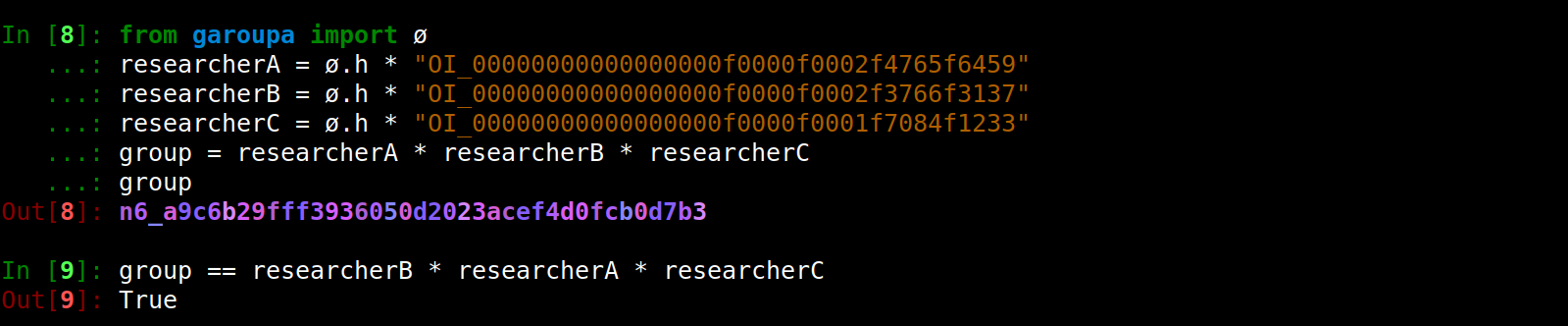
Here is another possible use. ORCIDs are managed unique identifiers for researchers.
They can be directly used as digests to create operable identifiers.
We recommend the use of 40 digits to allow operations with SHA-1 hashes.
They are common in version control repositories among other uses.

Unordered relationships are represented by hybrid ids.
Automatic transparent conversion between ORCID dashes by a hexdecimal character can be implemented in the future if needed.
More info
Aside from the paper, PyPI package
and GitHub repository,
one can find more information, at a higher level application perspective,
in this presentation:

Python installation
from package
# Set up a virtualenv.
python3 -m venv venv
source venv/bin/activate

# Install from PyPI
pip install hosh
from source
git clone https://github.com/davips/hosh
cd hosh
poetry install
Examples
Some usage examples.
Basic operations
from hosh import Hosh, ø  # ø is a shortcut for identity (AltGr+O in most keyboards)

# Hoshes (operable hash-based elements) can be multiplied.
a = Hosh(content=b"Some large binary content...")
b = Hosh(content=b"Some other binary content. Might be, e.g., an action or another large content.")
c = a * b
print(f"{a} * {b} = {c}")
"""
8CG9so9N1nQ59uNO8HGYcZ4ExQW5Haw4mErvw8m8 * 7N-L-10JS-H5DN0-BXW2e5ENWFQFVWswyz39t8s9 = z3EgxfisgqbNXBd0eqDuFiaTblBLA5ZAUbvEZgOh
"""
print(~b)
# Multiplication can be reverted by the inverse hosh. Zero is the identity hosh.
print(f"{b} * {~b} = {b * ~b} = 0")
"""
Q6OjmYZSJ8pB3ogBVMKBOxVp-oZ80czvtUrSyTzS
7N-L-10JS-H5DN0-BXW2e5ENWFQFVWswyz39t8s9 * Q6OjmYZSJ8pB3ogBVMKBOxVp-oZ80czvtUrSyTzS = 0000000000000000000000000000000000000000 = 0
"""
print(f"{b} * {ø} = {b * ø} = b")
"""
7N-L-10JS-H5DN0-BXW2e5ENWFQFVWswyz39t8s9 * 0000000000000000000000000000000000000000 = 7N-L-10JS-H5DN0-BXW2e5ENWFQFVWswyz39t8s9 = b
"""
print(f"{c} * {~b} = {c * ~b} = {a} = a")
"""
z3EgxfisgqbNXBd0eqDuFiaTblBLA5ZAUbvEZgOh * Q6OjmYZSJ8pB3ogBVMKBOxVp-oZ80czvtUrSyTzS = 8CG9so9N1nQ59uNO8HGYcZ4ExQW5Haw4mErvw8m8 = 8CG9so9N1nQ59uNO8HGYcZ4ExQW5Haw4mErvw8m8 = a
"""
print(f"{~a} * {c} = {~a * c} = {b} = b")
"""
RNvSdLI-5RiBBGL8NekctiQofWUIeYvXFP3wvTFT * z3EgxfisgqbNXBd0eqDuFiaTblBLA5ZAUbvEZgOh = 7N-L-10JS-H5DN0-BXW2e5ENWFQFVWswyz39t8s9 = 7N-L-10JS-H5DN0-BXW2e5ENWFQFVWswyz39t8s9 = b
"""
# Division is shorthand for reversion.
print(f"{c} / {b} = {c / b} = a")
"""
z3EgxfisgqbNXBd0eqDuFiaTblBLA5ZAUbvEZgOh / 7N-L-10JS-H5DN0-BXW2e5ENWFQFVWswyz39t8s9 = 8CG9so9N1nQ59uNO8HGYcZ4ExQW5Haw4mErvw8m8 = a
"""
# Hosh multiplication is not expected to be commutative.
print(f"{a * b} != {b * a}")
"""
z3EgxfisgqbNXBd0eqDuFiaTblBLA5ZAUbvEZgOh != wwSd0LaGvuV0W-yEOfgB-yVBMlNLA5ZAUbvEZgOh
"""
# Hosh multiplication is associative.
print(f"{a * (b * c)} = {(a * b) * c}")
"""
RuTcC4ZIr0Y1QLzYmytPRc087a8cbbW9Nj-gXxAz = RuTcC4ZIr0Y1QLzYmytPRc087a8cbbW9Nj-gXxAz
"""
Performance
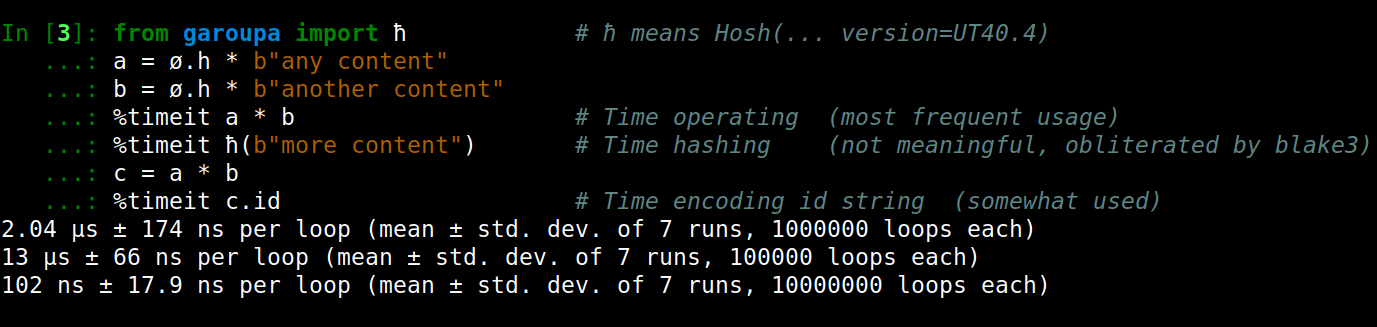
Computation time for the simple operations performed by hosh can be considered negligible for most applications,
since the order of magnitude of creating and operating identifiers is around a few μs:
hosh.
As the performance of the current hosh seems already very high (only ~2x slower than if it was implemented in native code in like rust),
we don't have plans for a new 'rust' implementation in the near future.
Grants
This work was partially supported by Fapesp under supervision of Prof. André C. P. L. F. de Carvalho at CEPID-CeMEAI (Grants 2013/07375-0 – 2019/01735-0).
1 maintainer

Metadata
1 maintainer
Release files for hosh 3.260103.2
For a detailed explanation of source distributions (sdists) and built distributions (wheels), please see the package formats documentation.
Source distribution (sdist)
| File | Size | Uploaded | |
|---|---|---|---|
| hosh-3.260103.2.tar.gz | 45.3 kB | Details |
Built distribution (wheel)
| File | Interpreter | ABI | Platform | Reset |
|---|---|---|---|---|
| hosh-3.260103.2-py3-none-any.whl | Python 3 | none | any | Details |
Total release size: 100.1 kB
Release files / hosh-3.260103.2.tar.gz
| Download URL | hosh-3.260103.2.tar.gz |
|---|---|
| Size | 45.3 kB |
| Tags | Source |
|
SHA-256 checksum How to use checksums |
9e3efee39883bb933519416faa99ad105d20c38bb8792cb2c8839703aeb5fe45
|
|
BLAKE2b-256 checksum How to use checksums |
55f7da993fea510cbc25ca75093d863e1162c44e55709e3fa7c8f60d8456c646
|
| Upload date | |
|
Uploaded using Trusted Publishing? What is trusted publishing? |
No |
| Uploaded via |
poetry/2.1.2 CPython/3.10.12 Linux/6.8.0-90-generic
|
Release files / hosh-3.260103.2-py3-none-any.whl
| Download URL | hosh-3.260103.2-py3-none-any.whl |
|---|---|
| Size | 54.8 kB |
| Tags | Python 3 |
|
SHA-256 checksum How to use checksums |
2715844f5678393f49aca6a0ec2217da1b009900698f9ae34a97cfd5508b67ed
|
|
BLAKE2b-256 checksum How to use checksums |
5fd7c3b16a36740195ccf3775f79a6450727e0b5fa6a11ae2af99b9883ab1b40
|
| Upload date | |
|
Uploaded using Trusted Publishing? What is trusted publishing? |
No |
| Uploaded via |
poetry/2.1.2 CPython/3.10.12 Linux/6.8.0-90-generic
|














