
Hill of Towie - Open Source Dataset
Analysis of the Hill of Towie wind farm open dataset: https://zenodo.org/records/22662930
This repo contains analysis and helper functions to:
- download the open dataset from Zenodo which includes 10-minute SCADA, ~1Hz fastlog collected by Anemo, controller telemetry and LiDAR data.
- estimate energy uplift thanks to upgrades using the wind-up library
- ad-hoc analysis of the Dynamic Yaw trial, including wake-steering event finding and LiDAR analysis.
New to the dataset? Field definitions, reference frames and known data quality issues are
documented in Hill_of_Towie_data_dictionary.md in the
Zenodo data pack.
Working with the fastlog? How it is resampled to a regular timebase, which aggregates are available, and how to reuse the chunked cache on your own data source is described in docs/fastlog_resampling.md.
The repository currently covers three upgrade validation campaigns:
- the Dynamic Yaw wake steering and collective yaw control trial, analysis first published in 2026 (
scripts/wfc_analysis_2026) - the earlier AeroUp and TuneUp turbine upgrades, analysis first published in 2025 (
scripts/uplift_analysis_2025)
Quickstart
Analysis scripts in this repo download the input data from Zenodo automatically on first
use — no manual data staging is required. See scripts/wfc_analysis_2026/inspect_data.py
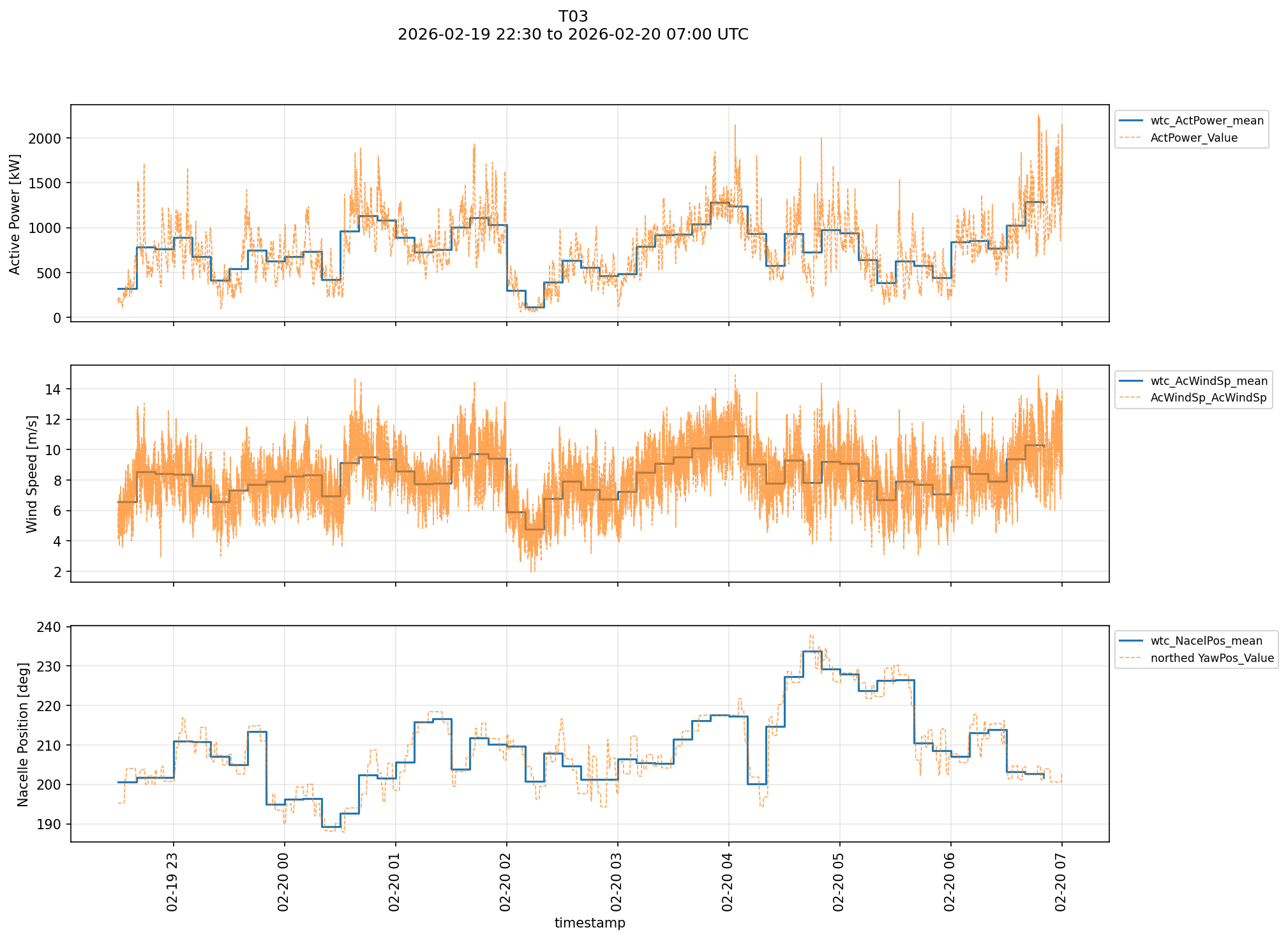
for a short example of loading the open dataset into pandas dataframes. An example plot
this script makes is shown below; this plot compares standard SCADA 10-min data with the
controller fastlog data available thanks to Anemo.
Dynamic Yaw analysis
A presentation explaining Dynamic Yaw and the analysis in this repo is available here.
The folder scripts/wfc_analysis_2026 analyses the energy uplift from the
Dynamic Yaw (DY) controller trial at Hill of Towie. DY combines two control features which both provide energy uplift in different ways:
- Wake Steering (WS) — selected upwind turbines steer to
deflect their wake away from a downwind partner. The controller applies a non-zero
wake-steering offset only when the wind direction falls inside one of the pre-defined
steering windows in
controller_config/wake-steering-lookup.csv. - Collective Control (CC) — every controlled turbine gets an improved wind direction signal based on pooled information from all turbines. This helps the turbine ignore turbulence when deciding whether to yaw or not, which can reduce yaw activity and increase energy yield. This is also essential for steering turbines to mitigate sensor bias during the steer.
DY is switched on and off by a synthetic toggle generated from UTC time (50-minute
on/off period, see hot_dy_toggle_df() in uplift_ws.py). The toggle pattern
lets wind-up estimate uplift from interleaved on/off pairs rather than a single
before/after split.
The driver script is scripts/wfc_analysis_2026/total_uplift.py. It runs the WS
and CC analyses end-to-end, generates many plots including all the plots shown below, and combines the two
results into a long-term AEP figure via compute_lt_uplift().
Site layout
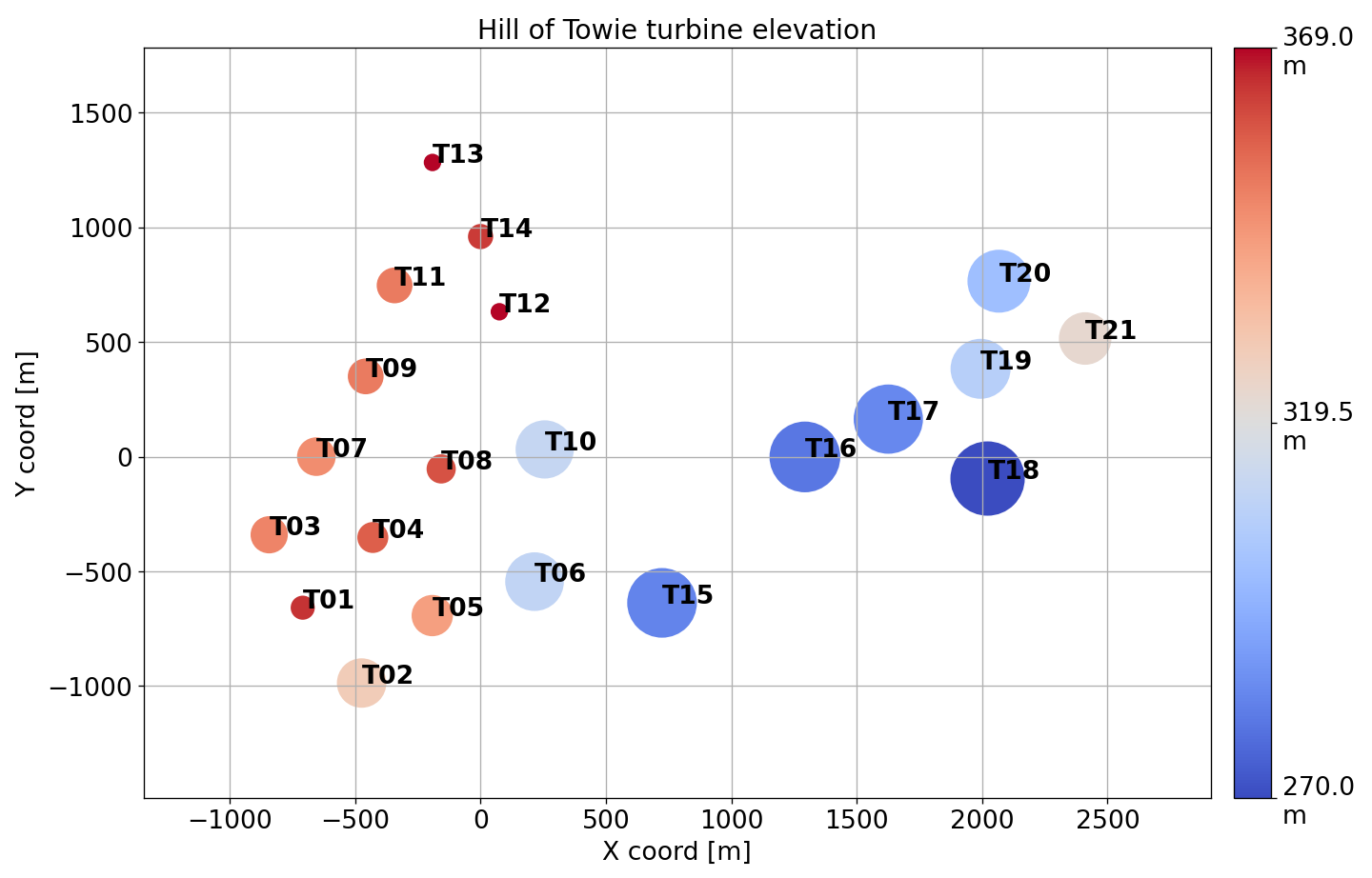
The bubble plot below shows the layout and ground elevation of each turbine — the west cluster sits on the higher, exposed hilltop while the east cluster sits on a second smaller hill:
Wake Steering result
scripts/wfc_analysis_2026/uplift_ws.py runs one wind-up analysis per
steering window. Each window uses a wind direction filter that matches the
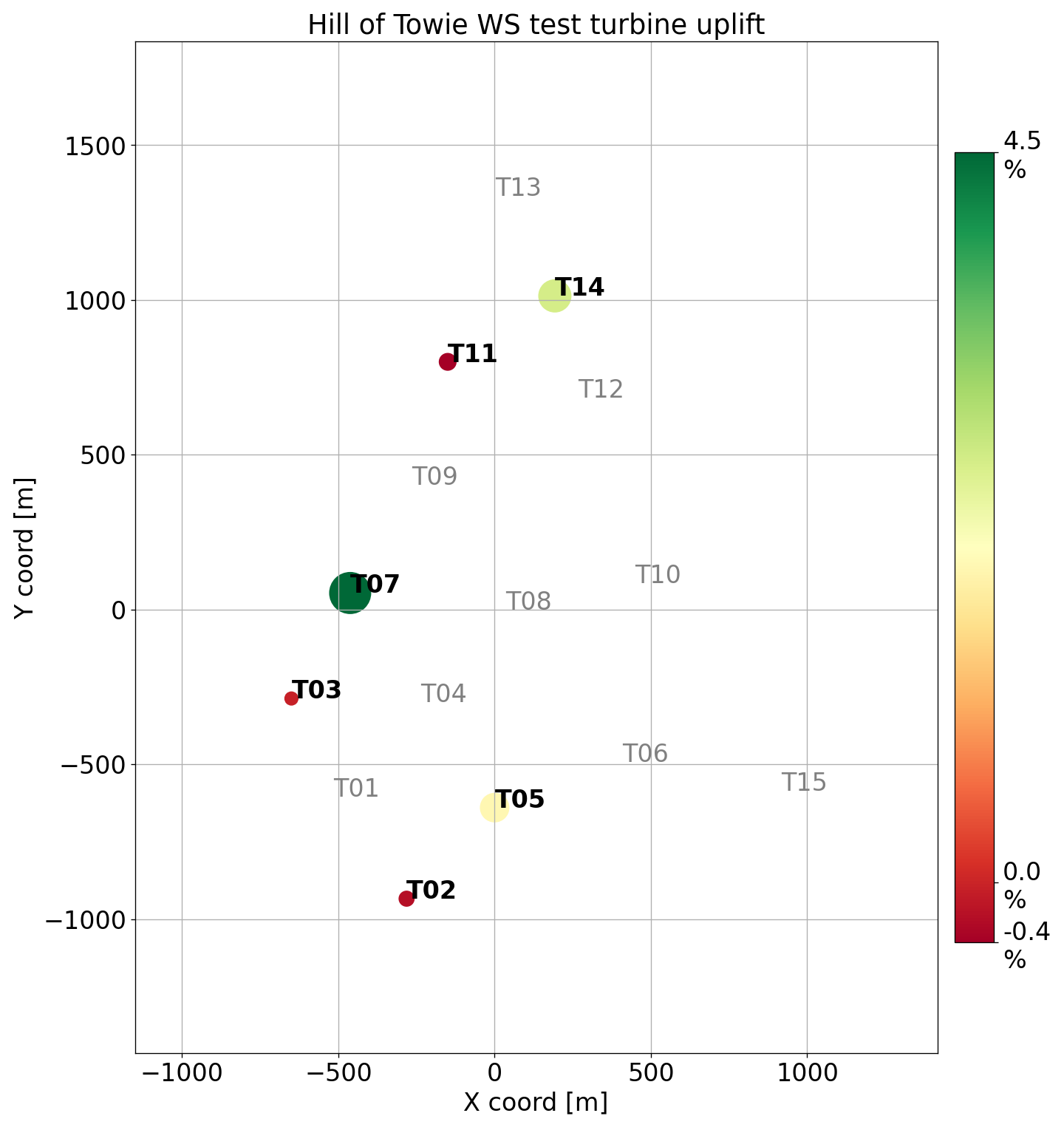
upwind turbine's steering range. The P50 wake-steering uplift across the
qualifying steering events is +1.32% (σ = 0.54%).
The plot below shows the per-turbine WS uplift across the west of the farm:
Collective Control result
scripts/wfc_analysis_2026/uplift_cc.py runs wind-up on the 10-min
periods that the per-steer analysis did not consume, isolating the contribution of
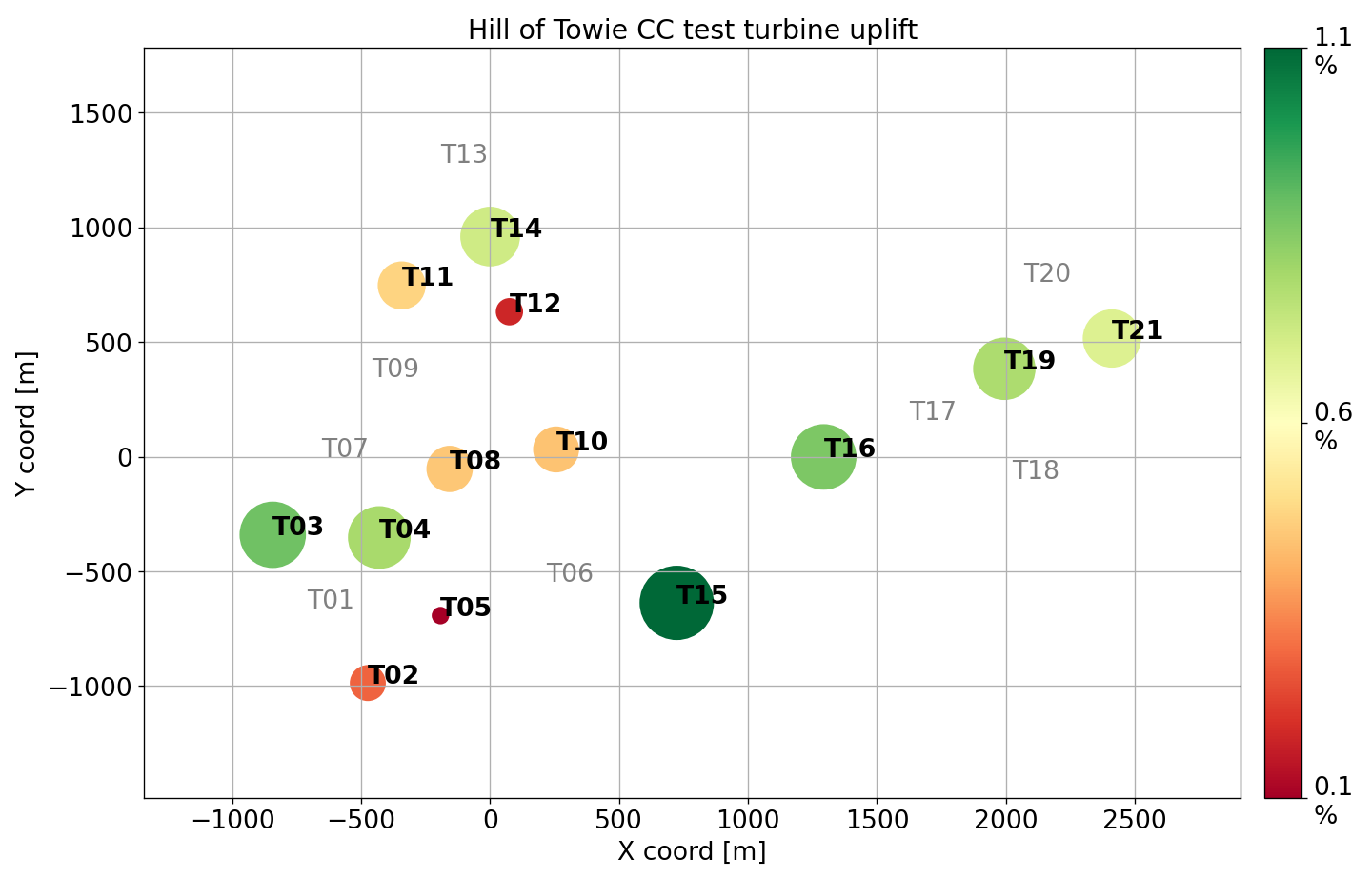
CC to uplift. T07 is excluded from the CC test set because it was not actively controlled during the campaign.
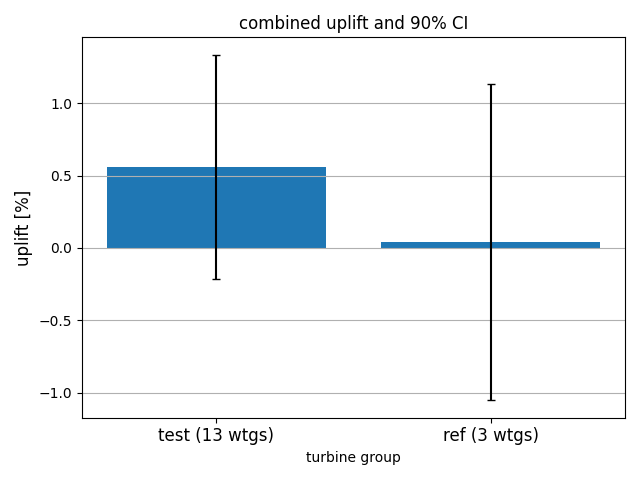
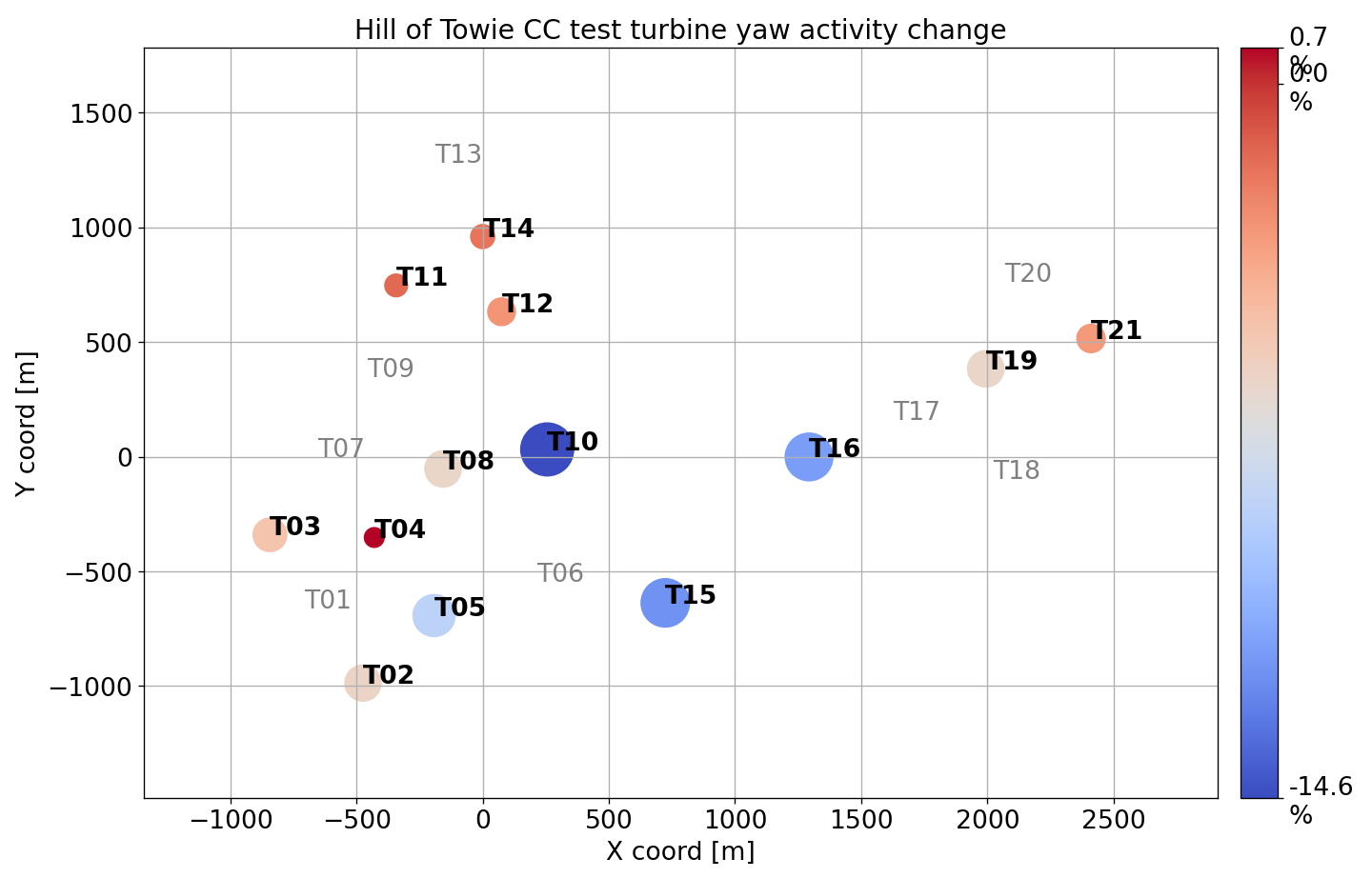
Across the 13 CC test turbines the P50 uplift is +0.56% (σ = 0.47%) with an average yaw-activity reduction of −6.0%. The headline test-vs-reference bar chart shows ~0% uplift on the four references (three reference turbines and the ZX300 LiDAR) as expected, while the test group is positive:
CC also changes how much each turbine yaws. The bubble plot below shows the per-turbine yaw activity change: blue means the turbine yawed less under CC:
Combined long-term AEP
compute_lt_uplift() in total_uplift.py blends the WS and CC results into a
long-term AEP figure using FLORIS-derived fractions of time and energy that the
long-term steering schedule will spend in each mode. The combination gives:
- AEP uplift P50: +0.7%, σ = 0.4%, P95 = 0.0%
- Long-term yaw-activity change: −2.4% wind farm average, with an individual turbine maximum of +8.1% on T03 (the most actively-steered turbine).
scripts/wfc_analysis_2026 also includes:
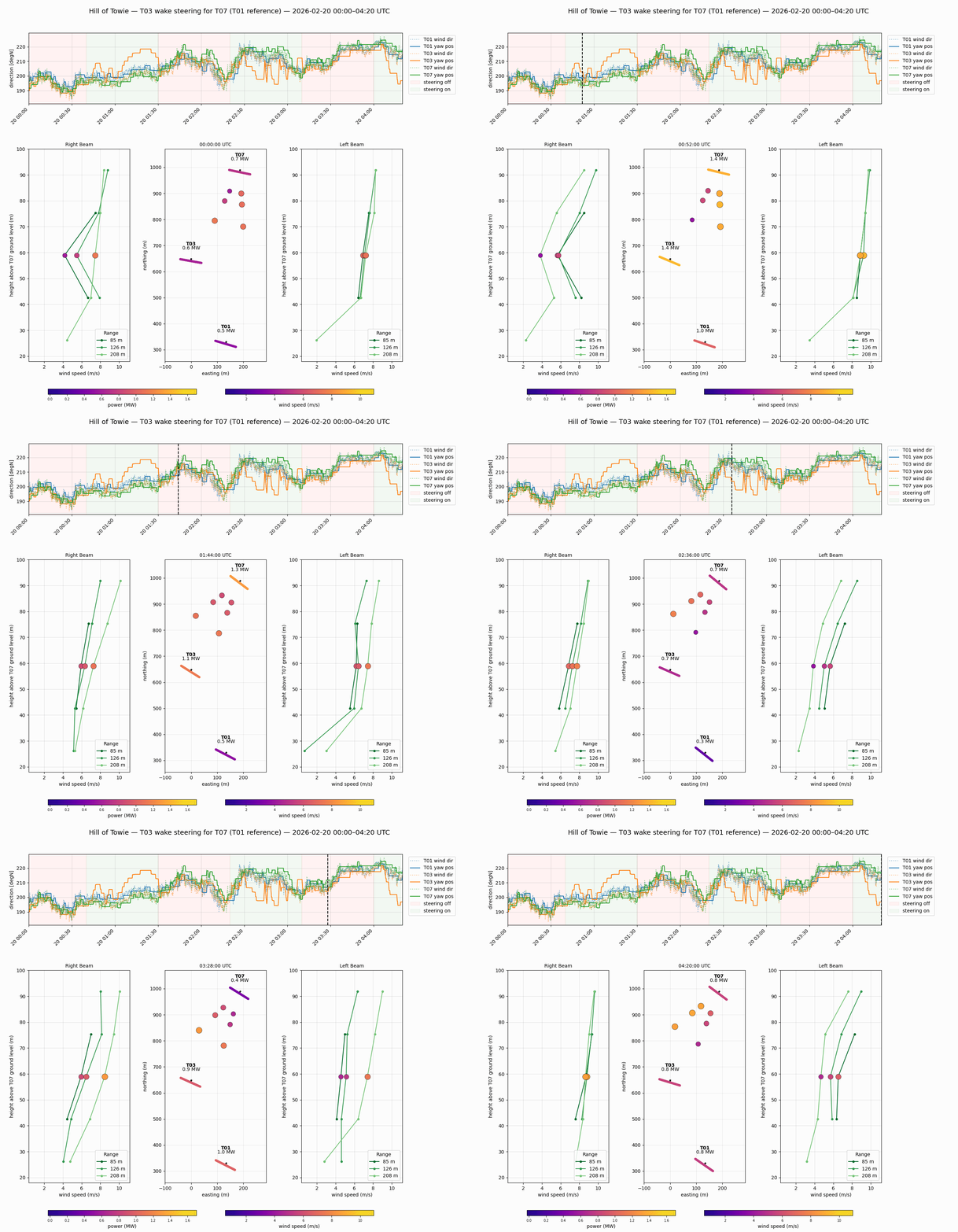
inspect_data.py— quick sanity plots of all data sources together.zx300_wake_steers.py,zxtm_wake_steers.py— wake steer plots with data from the on-site ZX300 (near T11) and ZXTM (on T07) LiDARs.z300_wake_steer_animation.py,zxtm_wake_steer_animation.py— matplotlib animations of LiDAR and turbine data during steering events.
The output of zxtm_wake_steer_animation.py is shown below (note wind is coming from SSW, bottom left of the middle plot):
Earlier upgrade analysis (published in 2025)
The folder scripts/uplift_analysis_2025 uses wind-up to run two analyses of energy uplift
after turbine upgrades.
Note any analysis can be run without running the others, e.g. you do not need to run northing.py before aero_up.py.
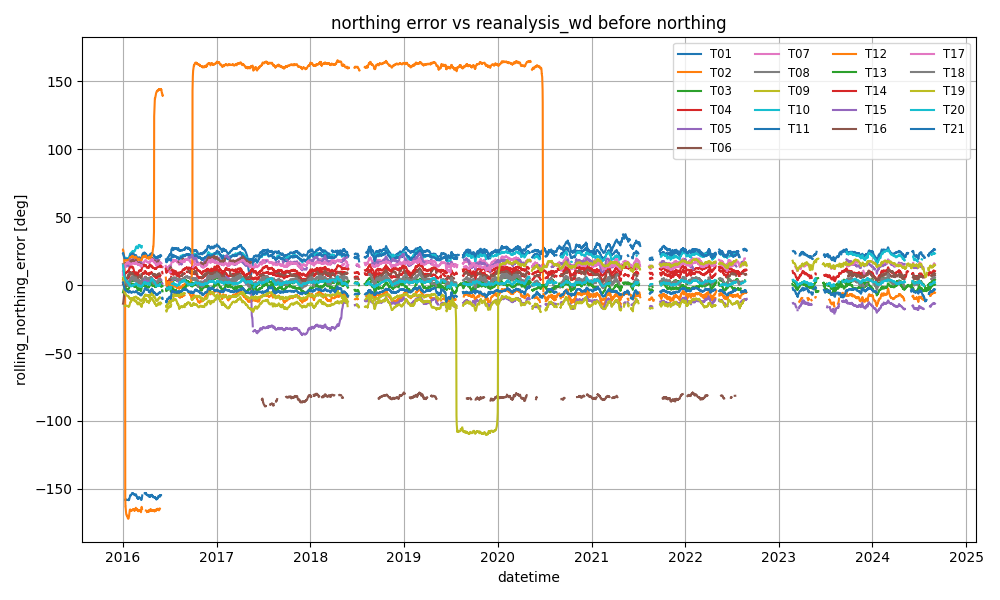
The script scripts/uplift_analysis_2025/northing.py calculates the northing corrections saved to
scripts/uplift_analysis_2025/wind_up_config/northing/optimized_northing_corrections.yaml and used in subsequent analyses. The plot
below shows the circular difference of ERA5 wind direction to each turbine's yaw direction before the northing
correction. The turbine north calibrations are apparently often wrong, which means the northing correction is quite
important.
AeroUp
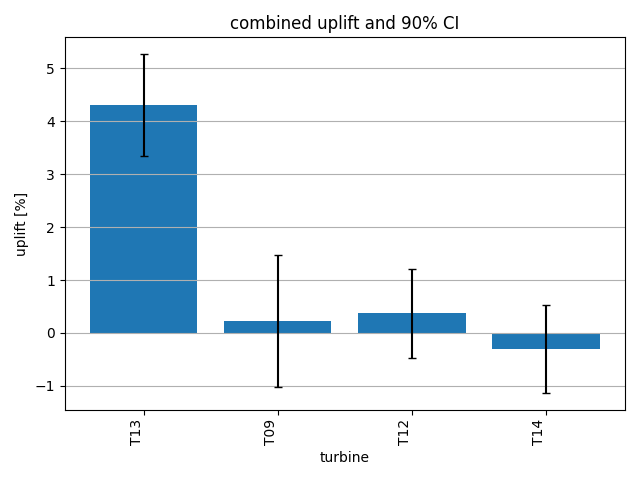
The script scripts/uplift_analysis_2025/aero_up.py analyses the energy uplift thanks
to AeroUp for T13.
The result is a P50 uplift of 4.3% with a 90% confidence interval of 3.3% to 5.3%. This is visualized in the plot below
along with the uplift results for the three selected reference turbines, which are near 0% uplift as expected:
TuneUp
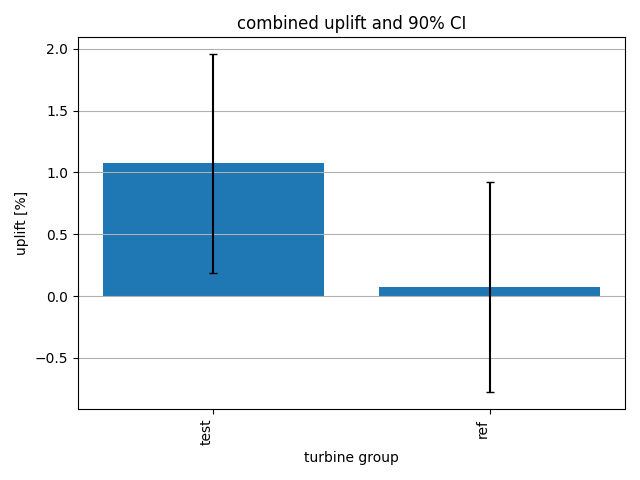
The script scripts/uplift_analysis_2025/tune_up.py analyses the energy uplift thanks
to TuneUp for nine test turbines. The result is a P50 uplift of
1.1% with a 90% confidence interval of 0.2% to 2.0%. This is visualized in the plot below along with the uplift result for
the ten unchanged reference turbines, which is near 0% uplift as expected:
Code for WeDoWind challenge
scripts/wedowind_challenge_2025 contains code used for the
WeDoWind 2025 power prediction kaggle competition,
which used the Hill of Towie open dataset.
solution_using_wind_up.py needs a few extra packages that are not in the locked environment;
see its docstring.
Using hot_open in another project
The helper package is published on PyPI:
uv add hot-open
Releases follow semantic versioning; while the version is 0.x, a minor
version bump may contain breaking changes. Release notes are on the
GitHub releases page.
The analysis scripts under scripts/ are not part of the package.
Python environment
The environment can be created and managed using uv. To create the environment:
uv sync
To run formatting and linting:
uv run poe all
Configuration
All filesystem paths used by the scripts and helpers are controlled by environment
variables. Each variable is optional — if unset, the default location under your
home directory is used and created on first access. Values can either be exported
in your shell or written to a .env file at the repo root (auto-loaded via
python-dotenv).
| Variable | Default | Used for |
|---|---|---|
HOT_OPEN_DATA_DIR |
~/temp/hill-of-towie-open-source-analysis/data |
Input data: Zenodo downloads land here (SCADA zips, LiDAR data, fastlog data, metadata CSV). |
HOT_OPEN_OUTPUT_DIR |
~/temp/hill-of-towie-open-source-analysis/output |
Per-script output directory (one subfolder per script, named after the script's filename). |
HOT_OPEN_CACHE_DIR |
~/temp/hill-of-towie-open-source-analysis/cache |
Parquet caches for unpacked SCADA, fastlog-by-day, ERA5, and wind-up intermediates. Safe to delete to force a rebuild. |
HOT_OPEN_FILESTORE_DIR |
<HOT_OPEN_DATA_DIR>/turbine_fastlog/Filestore |
Fastlog tree (FL/<park>/<device>/<date>/). When set explicitly, load_hot_fl_data() skips the Zenodo download of turbine_fastlog.zip. |
WINDUP_OUTPUT_DIR |
~/temp/hill-of-towie-open-source-analysis/windup_output |
Root directory wind-up analyses write their per-assessment output into. |
Example .env:
HOT_OPEN_DATA_DIR=D:/hot_open/data
HOT_OPEN_CACHE_DIR=D:/hot_open/cache
WINDUP_OUTPUT_DIR=D:/hot_open/windup_output
Contact
1 maintainer

Metadata
1 maintainer
Release files for hot-open 0.2.0
For a detailed explanation of source distributions (sdists) and built distributions (wheels), please see the package formats documentation.
Source distribution (sdist)
| File | Size | Uploaded | |
|---|---|---|---|
| hot_open-0.2.0.tar.gz | 39.5 kB | Details |
Built distribution (wheel)
| File | Interpreter | ABI | Platform | Reset |
|---|---|---|---|---|
| hot_open-0.2.0-py3-none-any.whl | Python 3 | none | any | Details |
Total release size: 78.7 kB
Release files / hot_open-0.2.0.tar.gz
| Download URL | hot_open-0.2.0.tar.gz |
|---|---|
| Size | 39.5 kB |
| Tags | Source |
|
SHA-256 checksum How to use checksums |
8fc1a1d4de78d995896733ecb921b97e9d54198fcae51b660316b7d53c304246
|
|
BLAKE2b-256 checksum How to use checksums |
5965ae0f05cb63f94c6d9e579344498718be8a8a757b2661eaf3527dc6d92921
|
| Upload date | |
|
Uploaded using Trusted Publishing? What is trusted publishing? |
Yes |
| Uploaded via |
twine/7.0.0 CPython/3.13.14
|
Provenance
Provenance describes where a file came from. On PyPI, provenance is shared via attestations, which provide a verifiable record of the build or publishing details. View details, limitations and caveats.


PyPI Publish Attestation
PyPI verified that this artifact, at this checksum, originated from the publisher listed below.
Signed by GitHub Actions, verified by PyPI on Oct 16, 2026.
Transparency logRelease files / hot_open-0.2.0-py3-none-any.whl
| Download URL | hot_open-0.2.0-py3-none-any.whl |
|---|---|
| Size | 39.2 kB |
| Tags | Python 3 |
|
SHA-256 checksum How to use checksums |
23ea9f00e03ad6970b8763cd08cd83ca06d37fd4de328423ec25b90532034892
|
|
BLAKE2b-256 checksum How to use checksums |
880bc8280be1c71261746b65191a1d4e600528614fcfb75197c505b1ff619bbf
|
| Upload date | |
|
Uploaded using Trusted Publishing? What is trusted publishing? |
Yes |
| Uploaded via |
twine/7.0.0 CPython/3.13.14
|
Provenance
Provenance describes where a file came from. On PyPI, provenance is shared via attestations, which provide a verifiable record of the build or publishing details. View details, limitations and caveats.
PyPI Publish Attestation
PyPI verified that this artifact, at this checksum, originated from the publisher listed below.
Signed by GitHub Actions, verified by PyPI on Oct 16, 2026.
Transparency log













