
hplusminus
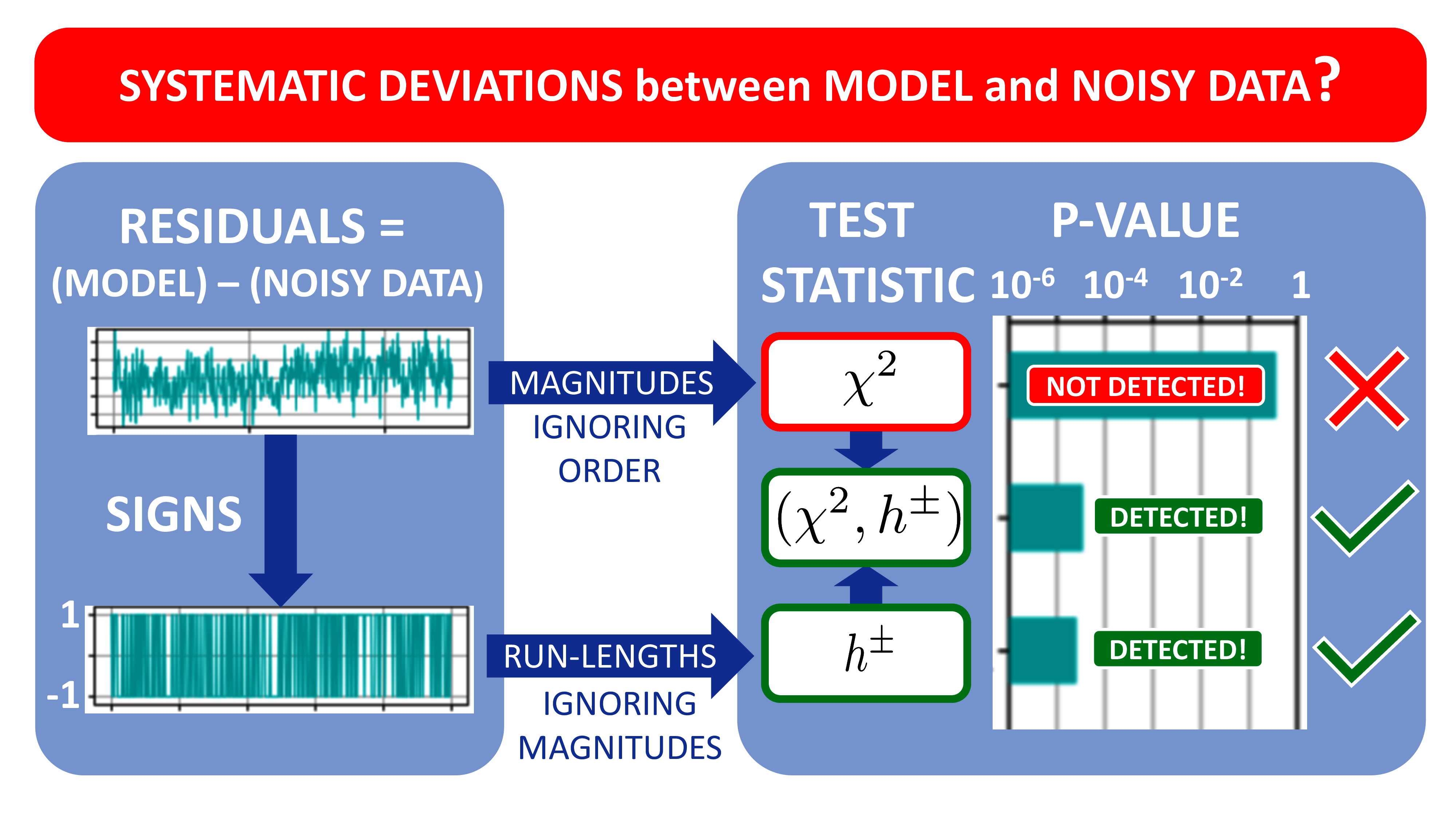


Copyright (C) 2020 Juergen Koefinger, Max Planck Institute of Biophysics, Frankfurt am Main, Germany
With contributions from Klaus Reuter, Max Planck Computing and Data Facility, Garching, Germany.
Released under the MIT Licence, see the file LICENSE.txt.
Reference
Powerful statistical tests for ordered data
Juergen Koefinger and Gerhard Hummer
Preprint: https://doi.org/10.26434/chemrxiv.13373351 (2020)
Requirements
- Python 3
- Jupyter (for Jupyter notebooks only)
- Python modules (can be installed with
piporconda):- numpy
- scipy
- mpmath
- matplotlib (for Jupyter notebooks only)
Installation
The hplusminus package can be installed in the following ways:
pip installation
To install via pip please run:
pip install --user hplusminus
Installation from source
After downloading and unpacking the source tarball please run:
python setup.py install --user
Python script
hplusminus_tests.py
Python 3 script to evaluate test statistics for normalized residuals. This script contains the central functionality.
See help for more information and usage:
python hplusminus_tests.py -h
Example for alternative model
python hplusminus_tests.py ./examples/alternative_model_normalized_residuals.txt
Example for true model
python hplusminus_tests.py ./examples/true_model_normalized_residuals.txt
Jupyter notebooks
Notebooks in the directory ./ipynb/ serve to explore the capabilties of our statistical tests. See notebooks themselves for more details on purpose and usage.
hplusminus_tests.ipynb
Evaluate statistical tests.
Addtionally to the functionality of hplusminus_tests.py, the notebook provides plots of normalized residuals and signs and a bar-plot to visually compare the p-values of the various tests.
hplusminus_statistical_power.ipynb
Calculate statistical power for all tests and given model
generate_models_for_residuals.ipynb
Generate models for residuals, which can be used with the Python script hplusminus_tests.py and the Jupyter notebooks hplusminus_tests.ipyn and hplusminus_statistical_power.ipynb.
Python package hplusminus
tests.py
Python 3 module file containing functions for the convenient evaluation of the statistical tests.
io.py
Python 3 module file for input and output.
rld.py
Python 3 module file for the calculation of the Shannon information (neg. log-probabilities) of all test statistics (rld for Run-Length Distribution). Required by Python script hplusminus_tests.py and Jupyter notebooks hplusminus_tests.ipynb and hplusminus_statistical_power.ipynb.
sid.py
Python 3 module file for the calculation of p-values using the gamma distribution approximation of the cumulative Shannon information distributions (SID). Required by Python script hplusminus_tests.py and Jupyter notebooks hplusminus_tests.ipynb and hplusminus_statistical_power.ipynb.
Directories
./hplusminus/
Python module hplusminus
./examples/
Examples for normalized residuals generated with generate_models_for_residuals.ipynb.
./hplusminus/gsp/
Numpy binary files containing B-spline parameters (knots and coefficients) for gamma distribution parameters for all tests. Information is read from these files. No need for user interaction.
./ipynb
Directory containing Jupyter notebooks.
./ipynb/data/
Directory used by Jupyter notebooks for input/output.
1 maintainer

Metadata
1 maintainer
Release files for hplusminus 1.0.2
For a detailed explanation of source distributions (sdists) and built distributions (wheels), please see the package formats documentation.
Source distribution (sdist)
| File | Size | Uploaded | Provenance | Actions |
|---|---|---|---|---|
| hplusminus-1.0.2.tar.gz | 1.4 MB | Without provenance | Details for hplusminus-1.0.2.tar.gz |
Built distribution (wheel)
| File | Interpreter | ABI | Platform | Actions Reset |
|---|---|---|---|---|
| hplusminus-1.0.2-py3-none-any.whl | Python 3 | none | any | Details for hplusminus-1.0.2-py3-none-any.whl |
Total release size: 1.5 MB
Release files / hplusminus-1.0.2.tar.gz
| Download URL | hplusminus-1.0.2.tar.gz |
|---|---|
| Size | 1.4 MB |
| Tags | Source |
|
SHA-256 checksum How to use checksums |
d990efc27d8a2615107f68be4ded23c0abc63b6adb012294fffedf3ea1cc0ab8
|
|
BLAKE2b-256 checksum How to use checksums |
8961a352c9714bc92483dba81b1d76e7f5e428052f5ab6b773bcb7e495047553
|
| Upload date | |
|
Uploaded using Trusted Publishing? What is trusted publishing? |
No |
| Uploaded via |
twine/7.0.0 CPython/3.12.3
|
Release files / hplusminus-1.0.2-py3-none-any.whl
| Download URL | hplusminus-1.0.2-py3-none-any.whl |
|---|---|
| Size | 19.9 kB |
| Tags | Python 3 |
|
SHA-256 checksum How to use checksums |
7c67a42d64a352a9c3e3b7cd4c844f142a375aef32236477ee0390480a579473
|
|
BLAKE2b-256 checksum How to use checksums |
9e802616fedd16ba7c1bc7edecc947a08fe708de8e86a48762d366ce99009604
|
| Upload date | |
|
Uploaded using Trusted Publishing? What is trusted publishing? |
No |
| Uploaded via |
twine/7.0.0 CPython/3.12.3
|
Security for hplusminus 1.0.2
Provenance
Provenance describes where a file came from. On PyPI, provenance is shared via attestations, which provide a verifiable record of the build or publishing details. View details, limitations and caveats.
No provenance found
None of the files in this release were uploaded with provenance metadata.
A note on package security
PyPI is a repository for distributing packages, not a service for auditing them. While third-party security researchers and our staff do their best to detect and remove malicious packages, PyPI cannot guarantee the quality, security or suitability of any given package.
To learn more about protecting yourself from malicious actors, visit our package security documentation.














