





Penguin-inspired self-organizing load balancer with adaptive thermal eviction.
Emperor Penguins survive Antarctic blizzards without any central coordinator — each bird follows one rule: if you're cold, push inward; if you're warm, drift outward. The huddle self-organizes.
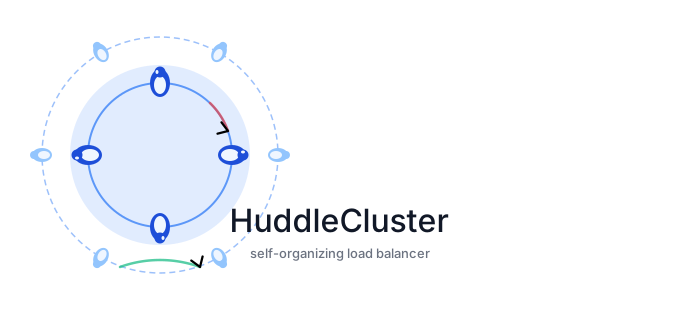
HuddleCluster applies this directly to server scheduling. Servers that run hot rotate to an outer ring to cool down. Cooled servers rotate back in. No manual tuning. No fixed thresholds. The cluster finds its own equilibrium.
Install
pip install huddle-cluster
Optional extras: fastapi · redis · grpc · kubernetes
Single-instance
from huddle_cluster import create_cluster
import requests

cluster = create_cluster([
    ("web-1", "10.0.0.1", 8080),
    ("web-2", "10.0.0.2", 8080),
    ("web-3", "10.0.0.3", 8080),
])
cluster.start()

with cluster.get_server_context() as server:
    response = requests.get(f"http://{server.host}:{server.port}/api")
What the cluster reports at any point:
print(cluster.health_report())
{
  "inner_servers": ["web-1", "web-3"],
  "outer_servers": ["web-2"],
  "fairness_score": 0.94,
  "rotation_count": 12,
  "requests_per_sec": 847.3,
  "cluster_health": "healthy"
}
Multi-node cluster
Coordinate a fleet of hosts — each node runs its own HuddleCluster; the master tracks enrollment, heartbeats, and health.
# Start the coordinator
huddle-cluster master start --port 7070

# Enroll nodes on each host
huddle-cluster agent start --id web-01 --master http://master:7070 --port 8080

# Inspect from anywhere
huddle-cluster nodes list
NODE ID                ADDRESS                STATUS       HB       LAST SEEN
─────────────────────────────────────────────────────────────────────────────
web-01                 10.0.0.1:8080          alive        142      0.8s ago
web-02                 10.0.0.2:8080          alive        139      1.1s ago
web-03                 10.0.0.3:8080          dead         41       34.2s ago
Ask the scheduler which node to send the next workload to:
curl http://master:7070/v1/scheduler/next
{ "ok": true, "node": { "node_id": "web-01", "address": "10.0.0.1", "port": 8080 } }
Live topology and Prometheus metrics are built in:
http://master:7070/dashboard      → real-time cluster topology
http://master:7070/v1/metrics     → Prometheus scrape endpoint
http://master:7070/v1/docs        → interactive API explorer (Swagger UI)
How it works
| Concept | What it means |
|---|---|
| Inner ring | Active servers handling traffic right now |
| Outer ring | Servers cooling down after a hot streak |
| Thermal score | EMA of relative latency anomaly, CPU, memory, error rate |
| Rotation | Overheated servers evict outward; cooled servers return inward |
| Relative anomaly | Compared to the cluster median — adapts to any baseline automatically |
No server is permanently marked bad. Every server gets rest and returns.
Performance
Under server failure, P95 latency stays under 86 ms where NGINX round-robin reaches 5,027 ms — a 58× reduction. Full methodology and results in the research paper below.
Documentation
| Single-instance guide | USAGE.md |
| Cluster system | docs/CLUSTER.md — MasterNode, Scheduler, RBAC, dashboard, API |
| API explorer | http://your-master:7070/v1/docs (live, once the master is running) |
| Research paper | docs/HuddleCluster.pdf · arXiv preprint |
Roadmap
- Thermal eviction, relative anomaly scoring, adaptive thresholds — v1.x
- Redis backend, gRPC routing, Kubernetes discovery, Prometheus, webhooks — v1.4
- Cluster system: MasterNode, AgentNode, CLI — v2.0
- Auto recovery, RBAC, metrics, dashboard, OpenAPI + Swagger UI — v2.x
- Cluster Scheduler — thermal-fitness workload placement — v3.0
- Cluster Auto Scaler — load-signal scale recommendations — v3.1
- Rolling Updater — zero-downtime batch upgrades with health gate — v3.2
- Service Discovery — health-aware registry, metadata-driven, DNS responder — v3.3
- HA Master — simplified Raft leader election, state replication, write redirect — v3.4
- Multi-Region — cross-datacenter topology, region-aware scheduling — v3.5
- Cluster Circuit Breaker — error-rate-based automatic trip/reset, scheduler exclusion — v4.0
- Rate Limiter — per-node token bucket, burst protection, scheduler exclusion — v4.1
- Canary Deployment — weight-based traffic splitting, start/advance/promote/abort — v4.2
- Planned (Level 4): observability
Citation
Bhuiya, R. (2025). HuddleCluster: A Penguin-Inspired Self-Organizing Load Balancer
with Adaptive Thermal Eviction. https://github.com/rahadbhuiya/HuddleCluster
Bhuiya, Rahad (2026). HuddleCluster. figshare. Journal contribution.
https://doi.org/10.6084/m9.figshare.32397180
Bhuiya, Rahad (2026). HuddleCluster. Zenodo. https://doi.org/10.5281/zenodo.20348019
Author: Rahad Bhuiya · License: MIT
1 maintainer

Download files
Download the file for your platform. If you're not sure which to choose, learn more about installing packages.
Source Distribution
Built Distribution
Filter files by name, interpreter, ABI, and platform.
If you're not sure about the file name format, learn more about wheel file names.
Copy a direct link to the current filters
File details
Details for the file huddle_cluster-4.2.0.tar.gz.
File metadata
- Download URL: huddle_cluster-4.2.0.tar.gz
- Upload date:
- Size: 180.2 kB
- Tags: Source
- Uploaded using Trusted Publishing? Yes
- Uploaded via:
twine/6.1.0 CPython/3.13.12
File hashes
| Algorithm | Hash digest | |
|---|---|---|
| SHA256 |
0e5425542773b51998005f2d0d786080fbc9d52a660fbc6e33f7e306d0ba1720
|
|
| MD5 |
0c5b5de070b59ae126b18f6d5c65c8e2
|
|
| BLAKE2b-256 |
d8d748d640de05b7b65a6560248fb525bf67e7a9f7dc84647f48040bcab6d7b3
|
Provenance
The following attestation bundles were made for huddle_cluster-4.2.0.tar.gz:
Publisher:
publish.yml on rahadbhuiya/HuddleCluster
-
Statement:
-
Statement type:
https://in-toto.io/Statement/v1 -
Predicate type:
https://docs.pypi.org/attestations/publish/v1 -
Subject name:
huddle_cluster-4.2.0.tar.gz -
Subject digest:
0e5425542773b51998005f2d0d786080fbc9d52a660fbc6e33f7e306d0ba1720 - Sigstore transparency entry: 2164200377
- Sigstore integration time:
-
Permalink:
rahadbhuiya/HuddleCluster@956d0e39275eb319704cc13380bda894e9a38acd -
Branch / Tag:
refs/tags/v4.2.0 - Owner: https://github.com/rahadbhuiya
-
Access:
public
-
Token Issuer:
https://token.actions.githubusercontent.com -
Runner Environment:
github-hosted -
Publication workflow:
publish.yml@956d0e39275eb319704cc13380bda894e9a38acd -
Trigger Event:
push
-
Statement type:
File details
Details for the file huddle_cluster-4.2.0-py3-none-any.whl.
File metadata
- Download URL: huddle_cluster-4.2.0-py3-none-any.whl
- Upload date:
- Size: 126.5 kB
- Tags: Python 3
- Uploaded using Trusted Publishing? Yes
- Uploaded via:
twine/6.1.0 CPython/3.13.12
File hashes
| Algorithm | Hash digest | |
|---|---|---|
| SHA256 |
9e860847b363c0399240510b17c8dc6bc7676709210eac0a494efba0a1697ad3
|
|
| MD5 |
8878393e29d7ef6b432253b1c94e8725
|
|
| BLAKE2b-256 |
4790d35e30f717283fc9095453560e9b966dabe282cc5feebb2d282d7b87dbd0
|
Provenance
The following attestation bundles were made for huddle_cluster-4.2.0-py3-none-any.whl:
Publisher:
publish.yml on rahadbhuiya/HuddleCluster
-
Statement:
-
Statement type:
https://in-toto.io/Statement/v1 -
Predicate type:
https://docs.pypi.org/attestations/publish/v1 -
Subject name:
huddle_cluster-4.2.0-py3-none-any.whl -
Subject digest:
9e860847b363c0399240510b17c8dc6bc7676709210eac0a494efba0a1697ad3 - Sigstore transparency entry: 2164200471
- Sigstore integration time:
-
Permalink:
rahadbhuiya/HuddleCluster@956d0e39275eb319704cc13380bda894e9a38acd -
Branch / Tag:
refs/tags/v4.2.0 - Owner: https://github.com/rahadbhuiya
-
Access:
public
-
Token Issuer:
https://token.actions.githubusercontent.com -
Runner Environment:
github-hosted -
Publication workflow:
publish.yml@956d0e39275eb319704cc13380bda894e9a38acd -
Trigger Event:
push
-
Statement type:







