
Huevat
Scientific color palettes and gradients for Matplotlib, Plotly and UltraPlot. Choose colors for categories, continuous fields, or values above and below a center.
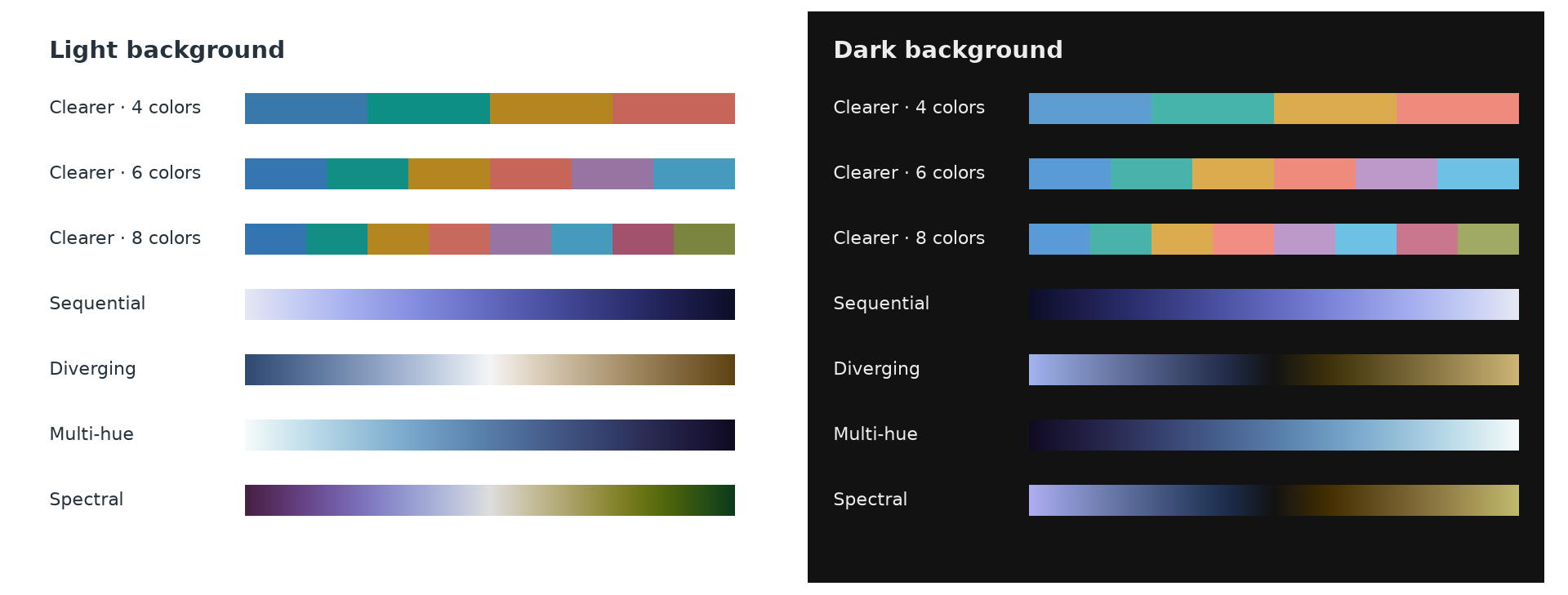
Clearer is the default categorical palette. Use background="dark" for dark figures.
Quick start · Plotting examples · Figure doctor · API guide · Release notes
Recent updates
- 18 named gradients, including six new choices: Cobalt, Copper, Dusk, Orchid, Tundra and Verdant, each with light and dark versions.
- Revised Aerosol, Bathymetry and Thermal to distinguish the reported lookalike routes. Earlier versions remain available through their saved recipes and immutable design IDs.
- Nine colors by default with
gradient.discrete(). Diverging and Spectral gradients include the exact neutral as the fifth color. Explicit even counts are supported and omit the midpoint. - Named suffixes:
_rreverses,_dselects dark, and_d_ror_r_dcombines both.
All eighteen named gradients are supported. Numerical screening results and usage guidance are available in the methods documentation. See the release notes and installation and release guide.
Install
Install Huevat from PyPI with your plotting library:
python -m pip install "huevat[matplotlib]"
python -m pip install "huevat[plotly]"
python -m pip install "huevat[ultraplot]"
Requires Python 3.10+. For colors alone, use python -m pip install huevat.
Make a plot
import numpy as np
import matplotlib.pyplot as plt
import huevat as hv
from huevat.adapters import matplotlib as hmpl

xx, yy = np.meshgrid(np.linspace(-3, 3, 160), np.linspace(-2, 2, 100))
field = (8 * np.exp(-((xx - .7)**2 + (yy - .1)**2))
         - 2 * np.exp(-((xx + 1.1)**2 + (yy + .2)**2) / .4))
gradient = hv.diverging()
nine_colors = gradient.discrete()  # default: 9, including the neutral midpoint
boundaries = [-2, -1.5, -1, -.5, -.1, .1, 1, 2, 4, 8]
palette = hv.categorical(5)

fig, axes = plt.subplots(1, 3, figsize=(12, 3.5), layout="constrained")
continuous = axes[0].imshow(field, cmap=hmpl.colormap(gradient), origin="lower",
                            norm=hmpl.normalizer(-2, 8, center=0))
discrete = axes[1].imshow(field, cmap=hmpl.colormap(nine_colors), origin="lower",
                          norm=hmpl.boundary_normalizer(nine_colors, boundaries))
axes[0].set_title("Continuous · zero at neutral")
axes[1].set_title("9 colors · neutral bin around zero")
fig.colorbar(continuous, ax=axes[0], orientation="horizontal")
fig.colorbar(discrete, ax=axes[1], orientation="horizontal")

axes[2].set_prop_cycle(hmpl.cycle(palette, markers=["o", "s", "^", "D", "v"],
                                 linestyles=["-", "--", ":", "-.", "-"]))
x = np.linspace(0, 1, 25)
for i, label in enumerate(["Blue", "Teal", "Ochre", "Coral", "Purple"]):
    axes[2].plot(x, .12 * i + .08 * np.sin(2 * np.pi * x + i / 2),
                 label=label, markevery=4)
axes[2].set_title("Clearer · specified markers and dashes")
axes[2].legend(fontsize=8, loc="upper right")
plt.show()
For a field, pass hmpl.colormap(hv.sequential()) to imshow or pcolormesh.
Use hv.diverging() with hmpl.normalizer(vmin, vmax, center=0) for signed data.
The discrete example uses nine colors, with zero inside the neutral bin
from −0.1 to +0.1. Choose bin boundaries to suit your data.
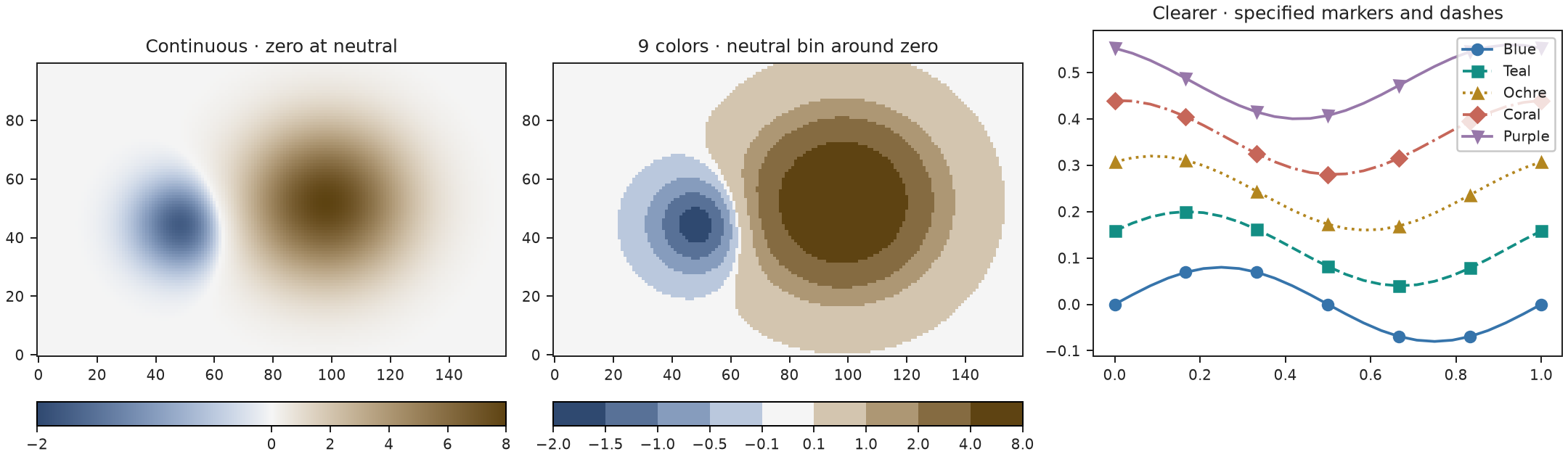
See complete examples for all three plotting libraries.
More gradients
Eighteen additional gradients cover general plots, seismic data, terrain, depth, and atmospheric fields, with supported light and dark variants.
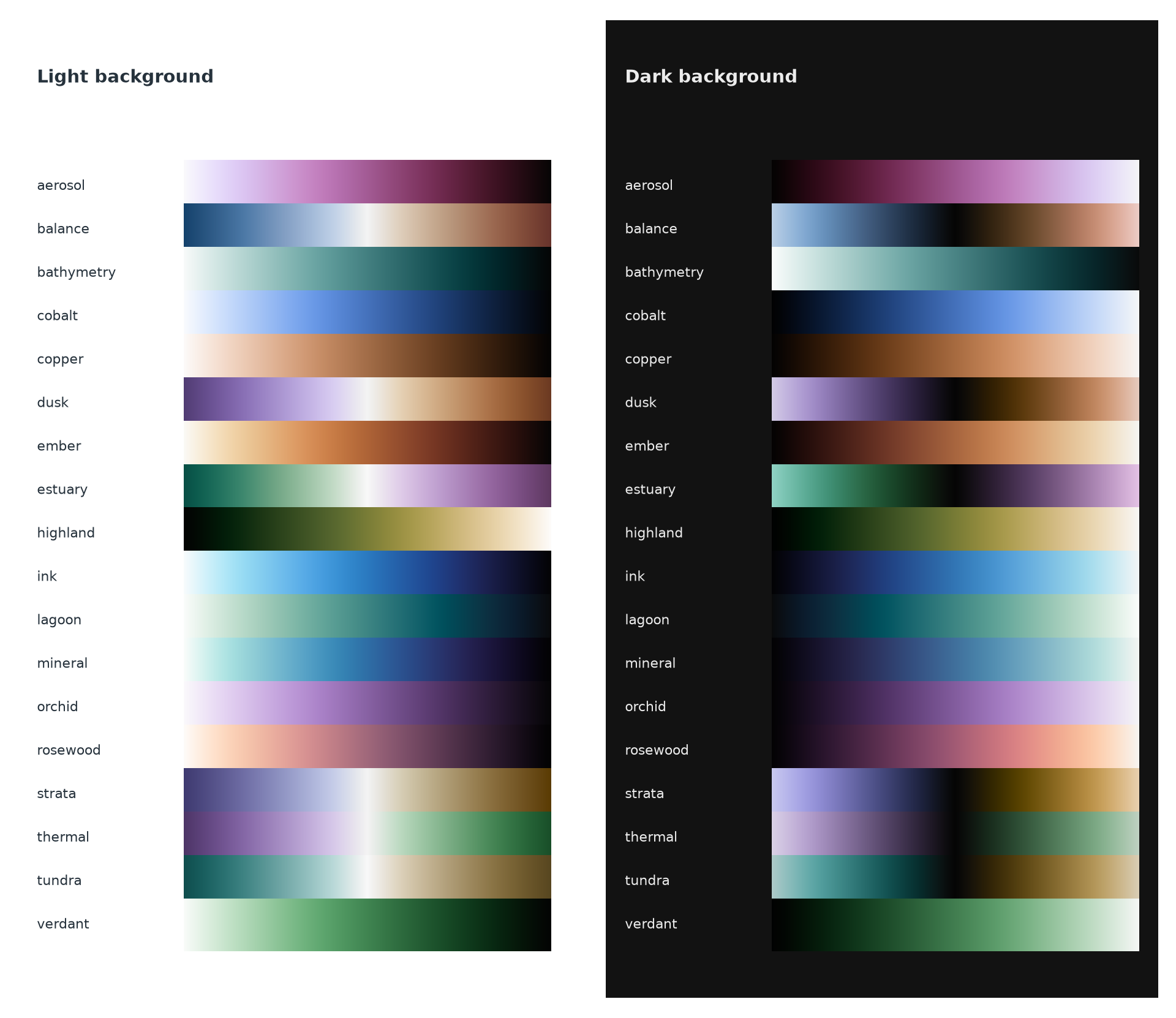
gradient = hv.gradient("bathymetry")
new_gradient = hv.gradient("verdant")
reversed_gradient = hv.gradient("thermal_r")
dark_gradient = hv.gradient("thermal_d")
dark_reversed_gradient = hv.gradient("thermal_d_r")
print(hv.gradient_names())
The revised routes are:
| Gradient | Current route | Previously similar to |
|---|---|---|
| Aerosol | Deep red → magenta → pale violet | Rosewood |
| Bathymetry | Pale cyan → turquoise → deep ocean, darkening with depth | Mineral |
| Thermal | Violet → neutral → green | Balance |
Append _r to reverse a named gradient or _d to select its dark version;
combine them as _d_r or _r_d. gradient.reversed() also changes direction.
_d is equivalent to background="dark"; combining it with an explicit
background="light" is an error.
For separate colors, gradient.discrete() selects nine bins. Diverging scales
include their neutral midpoint; explicit even counts remain available.
signed = hv.diverging()
nine_colors = signed.discrete()  # neutral is nine_colors.colors[4]
assert nine_colors.colors[4] == hv.to_hex(signed.at(0.5))
Check hv.known_counts(gradient) for tested counts.
hv.optimized_discrete(gradient, n) searches for better-spaced colors and
requires the design extra.
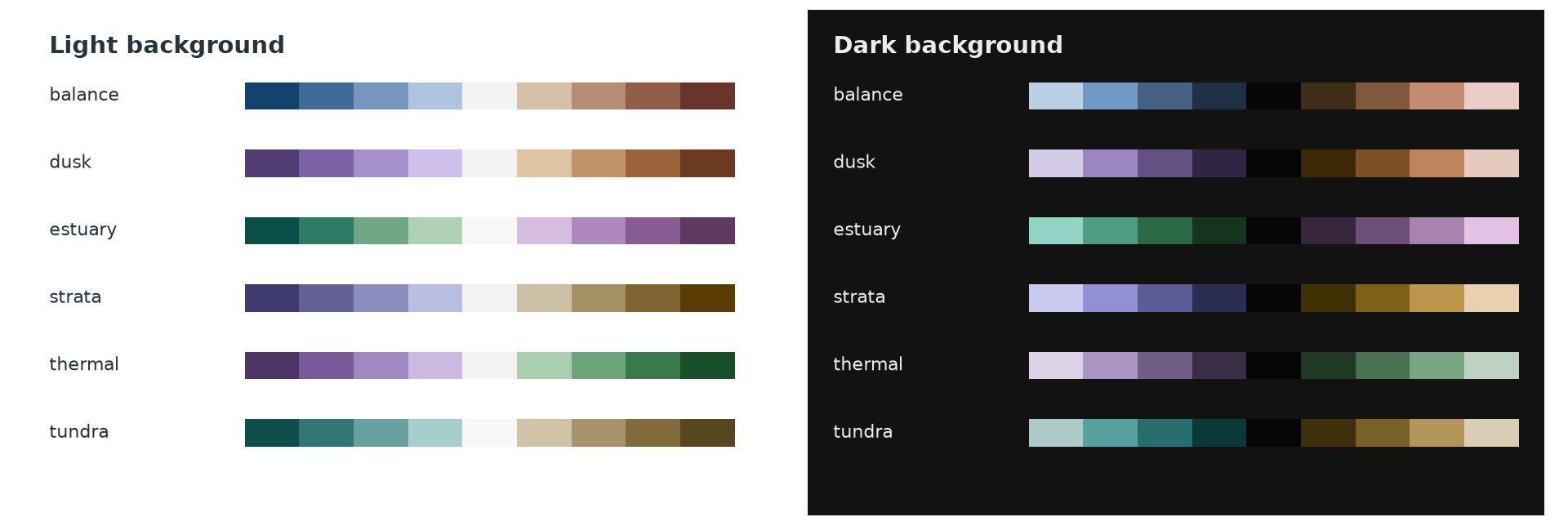
Figure doctor
Coordinate colors, markers and dashes in an existing figure. Repeated labels keep the same style across panels.
| Before | After |
|---|---|
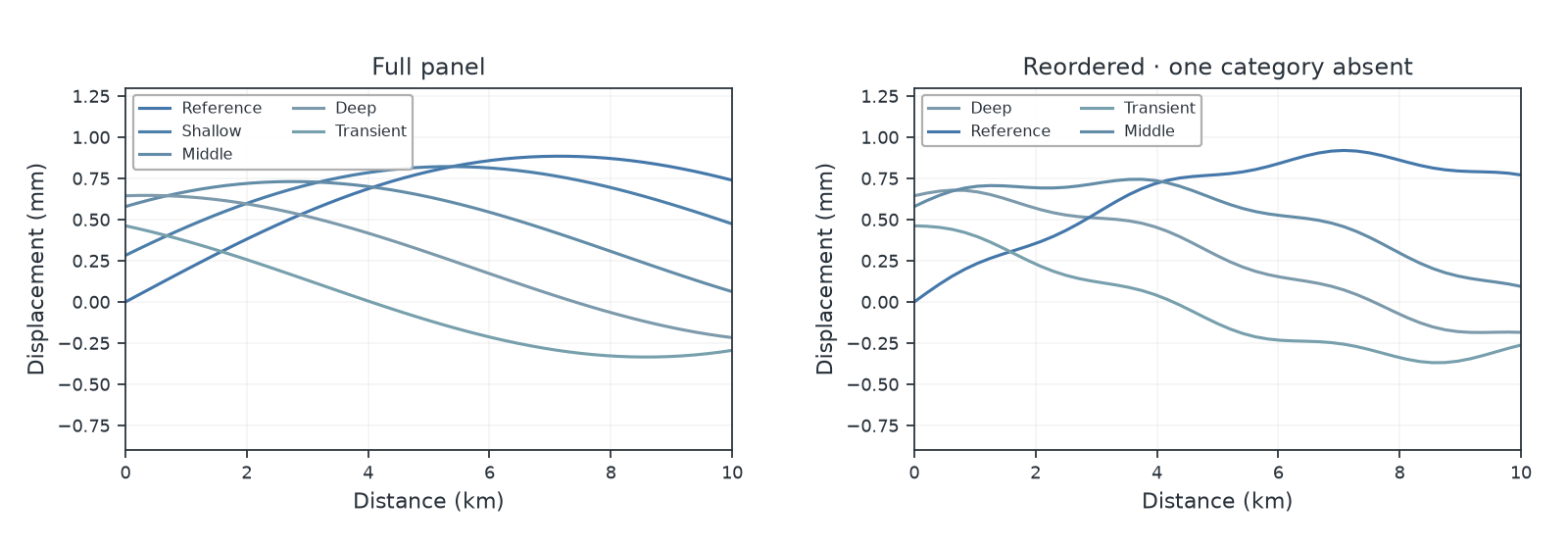 |
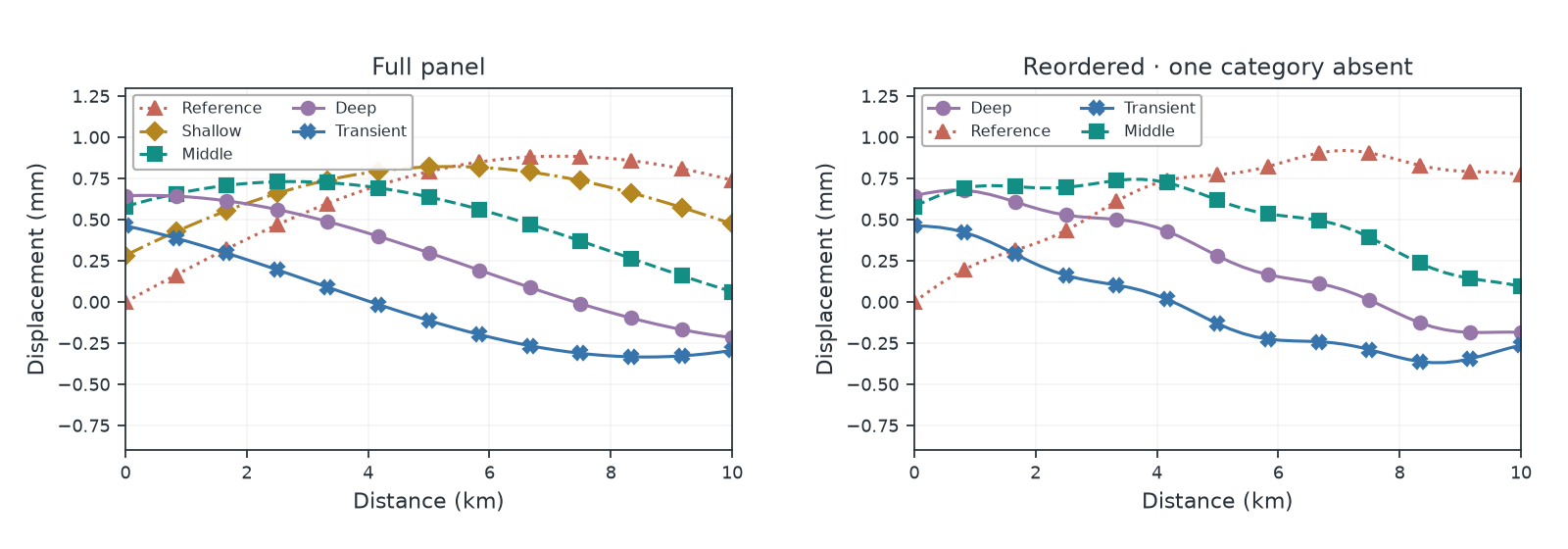 |
Install with python -m pip install "huevat[design,matplotlib]", or replace
matplotlib with plotly or ultraplot.
from huevat import doctor

scene = doctor.inspect(fig)
closer, separation, simple = doctor.propose(scene)
preview = doctor.preview(fig, separation)
change = doctor.apply(fig, separation)
change.undo()
Figure doctor guide explains previews, fixed colors and keeping styles across figures. Review the result at the size you intend to use.
Save colors
hv.export(palette).write("palette.json")
restored = hv.load_export(open("palette.json", encoding="utf-8").read()).design
hv.export(hv.diverging(), n=7, format="csv").write("colors.csv")
JSON saves a design for reuse. CSV and hex give you color lists; CSS is also available. See the quick start for labels and more examples.
1 maintainer

Metadata
1 maintainer
Release files for huevat 0.1.0
For a detailed explanation of source distributions (sdists) and built distributions (wheels), please see the package formats documentation.
Source distribution (sdist)
| File | Size | Uploaded | Provenance | Actions |
|---|---|---|---|---|
| huevat-0.1.0.tar.gz | 2.1 MB | With provenance | Details for huevat-0.1.0.tar.gz |
Built distribution (wheel)
| File | Interpreter | ABI | Platform | Actions Reset |
|---|---|---|---|---|
| huevat-0.1.0-py3-none-any.whl | Python 3 | none | any | Details for huevat-0.1.0-py3-none-any.whl |
Total release size: 4.0 MB
Release files / huevat-0.1.0.tar.gz
| Download URL | huevat-0.1.0.tar.gz |
|---|---|
| Size | 2.1 MB |
| Tags | Source |
|
SHA-256 checksum How to use checksums |
2008f3cbb26461b1b98160db28318365c63c75bef5ea55cab0cca07c64438fd3
|
|
BLAKE2b-256 checksum How to use checksums |
229a170e9df7fc4777704e5e5bdb77981f77be0fb30fbd48499f16ea78183462
|
| Upload date | |
|
Uploaded using Trusted Publishing? What is trusted publishing? |
Yes |
| Uploaded via |
twine/7.0.0 CPython/3.13.16
|
Provenance
Provenance describes where a file came from. On PyPI, provenance is shared via attestations, which provide a verifiable record of the build or publishing details. View details, limitations and caveats.


PyPI Publish Attestation
PyPI verified that this artifact, at this checksum, originated from the publisher listed below.
Signed by GitHub Actions, verified by PyPI on Oct 27, 2026.
Transparency logRelease files / huevat-0.1.0-py3-none-any.whl
| Download URL | huevat-0.1.0-py3-none-any.whl |
|---|---|
| Size | 1.9 MB |
| Tags | Python 3 |
|
SHA-256 checksum How to use checksums |
6b81403bea8ad5114c4a818d1ea1e5a6cd06b6a1bfba11decf02a42b4cdf0e09
|
|
BLAKE2b-256 checksum How to use checksums |
3a1684799d9e0d4dc3eddcf1f7e61f9a5b6def8ebfca057040be818746f0d4cc
|
| Upload date | |
|
Uploaded using Trusted Publishing? What is trusted publishing? |
Yes |
| Uploaded via |
twine/7.0.0 CPython/3.13.16
|
Provenance
Provenance describes where a file came from. On PyPI, provenance is shared via attestations, which provide a verifiable record of the build or publishing details. View details, limitations and caveats.
PyPI Publish Attestation
PyPI verified that this artifact, at this checksum, originated from the publisher listed below.
Signed by GitHub Actions, verified by PyPI on Oct 27, 2026.
Transparency logSecurity for huevat 0.1.0
Provenance
Provenance describes where a file came from. On PyPI, provenance is shared via attestations, which provide a verifiable record of the build or publishing details. View details, limitations and caveats.
Full provenance
Both files in this release have been uploaded with provenance metadata.
Attestation for huevat-0.1.0.tar.gz
PyPI Publish Attestation
PyPI verified that this artifact, at this checksum, originated from the publisher listed below.
Signed by GitHub Actions, verified by PyPI on Oct 27, 2026.
Transparency logA note on package security
PyPI is a repository for distributing packages, not a service for auditing them. While third-party security researchers and our staff do their best to detect and remove malicious packages, PyPI cannot guarantee the quality, security or suitability of any given package.
To learn more about protecting yourself from malicious actors, visit our package security documentation.













