
hvspatialpy
A python package that evaluates the spatial variability of a site utilizing HVSR.







Authors
Francisco Javier G. Ornelas1, Scott J. Brandenberg1, Jonathan P. Stewart1
1 University of California, Los Angeles (UCLA)
Table of Contents
Introduction
A python package that can evaluate the spatial variability of a site utilizing the Horizontal-to-Vertical Spectral Ratio (HVSR). This package works by taking multiple HVSR curves that were evalautes around a site, and compares them to a reference curve. These curves are then separated further by frequency interval to evalaute the variability in terms of resonant peaks. This package was developed by Francisco Javier G. Ornelas under the supervision of Dr. Jonathan P. Stewart and Dr. Scott J. Brandenberg at the University of California, Los Angeles (UCLA).
Background
HVSR is derived from ratios of the horizontal and vertical components of a Fourier Amplitude Spectrum (FAS) from a 3-component recording of microtremors or earthquakes. This is done by recording ground vibrations either from temporarily-deployed or permanently-installed seismometers, for a relatively short period of time (~1-2 hrs) or a longer period of time.
This method or technique was first proposed by Nogoshi and Igarashi (1971) [ABSTRACT] and later popularized by Nakamura (1989) [ABSTRACT]. The method works by assuming that the horizontal wavefield is amplified as seismic waves propagate through the soil deposits compared to the vertical wavefield.
HVSR can be useful in site characterization since it can identify resonant frequencies at sites, through peaks in an HVSR spectrum. Studies have also found that the lowest peak in HVSR spectra can be associated with the fundamental frequency of a site (e.g., [ABSTRACT]). The identification of these peaks is significant because they correlate with impedance contrasts at a given site. When multiple HVSR surveys are conducted at the same location, it becomes possible to illustrate the spatial variability of impedance contrasts across the site. Consequently, HVSR is a valuable tool for assessing and understanding the spatial heterogeneity of site characteristics
Getting started
Installation
hvspatialpy is available using pip and can be installed with:
- Jupyter Notebook
pip install hvspatialpy - PyPI
py -m pip install hvspatialpy
Usage
hvspatialpy is a python package that evaluates spatial variability at a site utilizing HVSR.
The library contains various features, such as:
- A graphical user interface (GUI) to use in inputting parameters.
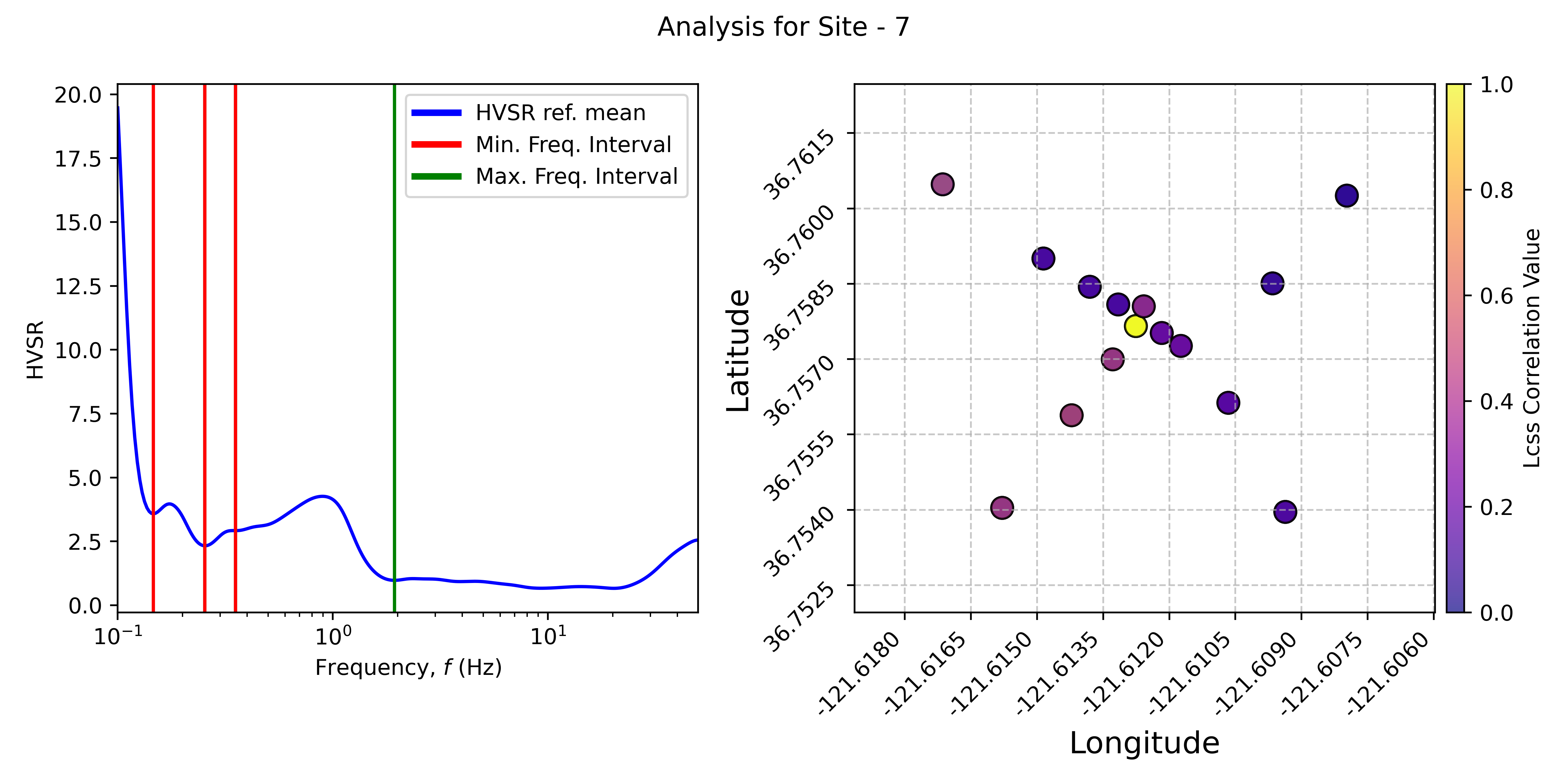
- The ability to vary the frequency interval of interest, to narrow down which peaks one wants to evaluate.
- A plot showing the approximate location of the site with all the tests done. These tests are color coded based on the correlation type used (e.g., LCSS).
Examples of these can be found under the examples folder in the Github repository [GIT]
Example of Frequency Interval Selection and Test Locations
Citation
If you use hvspatialpy (directly or as a dependency of another package) for work resulting in an academic publication or other instances, we would appreciate if you cite the following:
Ornelas, F. J. G., Brandenberg, S. J., & Stewart, J. P. (2024). hvspatialpy (v1.0.0). Zenodo. https://doi.org/10.5281/zenodo.13770432.
Issues
Please report any issues or leave comments on the Issues page.
License
This project has been licensed under 
1 maintainer

Metadata
1 maintainer
Release files for hvspatialpy 1.0.0
For a detailed explanation of source distributions (sdists) and built distributions (wheels), please see the package formats documentation.
Source distribution (sdist)
| File | Size | Uploaded | |
|---|---|---|---|
| hvspatialpy-1.0.0.tar.gz | 29.4 kB | Details |
Built distribution (wheel)
| File | Interpreter | ABI | Platform | Reset |
|---|---|---|---|---|
| hvspatialpy-1.0.0-py3-none-any.whl | Python 3 | none | any | Details |
Total release size: 58.7 kB
Release files / hvspatialpy-1.0.0.tar.gz
| Download URL | hvspatialpy-1.0.0.tar.gz |
|---|---|
| Size | 29.4 kB |
| Tags | Source |
|
SHA-256 checksum How to use checksums |
d5981e988c3c022d139f727a23d96682a4bb0abc57f86163f15756e1b0f475a9
|
|
BLAKE2b-256 checksum How to use checksums |
d95c0db95b91a7a3f1beceea32614def347dfd273c390f2e494a2bea63be1f74
|
| Upload date | |
|
Uploaded using Trusted Publishing? What is trusted publishing? |
No |
| Uploaded via |
twine/5.1.0 CPython/3.9.13
|
Release files / hvspatialpy-1.0.0-py3-none-any.whl
| Download URL | hvspatialpy-1.0.0-py3-none-any.whl |
|---|---|
| Size | 29.3 kB |
| Tags | Python 3 |
|
SHA-256 checksum How to use checksums |
9ccc37a68dfb2b4ea859778f9844b2e74ee1f72c8ea4a504a09997da3e379fb5
|
|
BLAKE2b-256 checksum How to use checksums |
2f2a9750e23a8712581934c97db83a3de2f985df756234b878ae09e6b8f4e7cf
|
| Upload date | |
|
Uploaded using Trusted Publishing? What is trusted publishing? |
No |
| Uploaded via |
twine/5.1.0 CPython/3.9.13
|













