
Hydra ETL
Your data pipelines are described, not programmed.






Website · Docs & playground · MCP server · VS Code extension · Changelog
Hydra is an open-source declarative ETL engine. You write what a pipeline is in YAML;
Hydra validates it before touching any data, then runs it. The same manifests run from
the terminal, a REST API, or a visual editor in your browser, with one pip install and nothing else to deploy.

Quick start
pip install "hydra-etl[server]"
hdrctl serve --open            # Studio + API on http://localhost:5678
Or stay in the terminal:
hdrctl init my_job             # scaffold one of six templates
hdrctl validate my_job         # strict validation, no data touched
hdrctl run my_job              # execute
No Node, no build step, no database, no message broker. Python 3.9+ on Linux, macOS or Windows.
Why Hydra
- Validate before you run.
hdrctl validatechecks sources, steps, types and destinations deterministically, before any data is read or written. - Declarative, visual, zero deployment. YAML manifests, a browser editor that outputs the same YAML, and a single Python process. No cluster, no JVM, no container required.
- Built for CI/CD. Manifests are versioned and reviewed like code;
hdrctlscaffolds, validates, tests and runs from a terminal or a CI job. - Built-in scheduler. DAG workflows with dependencies, parallel branches, delayed retries, cron triggers, conditional guards and eleven actions (webhook, email, Bash, PowerShell, SSH, Python…).
- One job, many environments.
{{ param: }},{{ env: }}and${SECRET:}keep the manifest identical across dev, staging and production. - Two engines per operation. pandas or DuckDB, chosen step by step, with optional Rust acceleration (see Native acceleration).
- AI-ready. An MCP server lets Claude, Cursor or VS Code write pipelines that Hydra validates.


How it compares
| Hydra | Airflow | dbt | Airbyte | NiFi / Apache Hop | |
|---|---|---|---|---|---|
| Pipelines defined in | YAML | Python | SQL + YAML | UI / config | UI flows |
| Scope | Extract, transform, load | Orchestration | Transform in the warehouse | Extract & load | Extract, transform, load |
| Visual editor | Included | Monitoring UI | Not in dbt Core | Included | Included |
| To get started | pip install |
Scheduler, webserver, metadata DB | A data warehouse | Docker / Kubernetes | JVM |
Hydra is not a replacement for all of these. It targets file-and-database pipelines that should stay readable and run without extra infrastructure.
What you get
| Component | Description |
|---|---|
| Engine | Declarative jobs: one source, N transformations, one destination |
| CLI | hdrctl: scaffold, validate, run, inspect. English and Spanish |
| API | FastAPI, with interactive docs at /docs |
| Studio | Visual editor for jobs and workflows, served by the same process |
| Workflows | Multi-job DAG with dependencies, actions, retries and runtime parameters |
| MCP | Natural-language pipeline authoring, validated by Hydra |
Connectors (sources and destinations):
 CSV |
 JSON |
 Parquet |
 MySQL / MariaDB |
 PostgreSQL |
 MongoDB |
 Web API |
|---|
Transformation engines: pandas and DuckDB.
Who it is for
- Data engineers and analysts who need repeatable file-and-database pipelines without standing up infrastructure for them.
- Teams where pipelines must stay readable by people who do not write Python: a YAML manifest reviewed in a pull request, not a script.
- Developers embedding ETL in a product, who want a CLI and a REST API over the same engine.
A job in four files
A job is a folder. Four manifests describe it, and each one answers a single question.
sources.yaml: where the data comes from
version: "1.0"
sources:
  src_input:
    type: csv
    extract:
      table: ./input.csv
transformations.yaml: how it is reshaped
version: "1.0"
steps:
  - cast:
      mapping:
        amount: float
  - filter:
      expr: "amount > 0"
  - aggregate:
      by: [name]
      agg:
        total: { func: sum, col: amount }
A CSV carries no types, so cast comes before any numeric comparison.
destinations.yaml: where it goes
version: "1.0"
destinations:
  dest_output:
    type: csv
    load:
      table: ./output.csv
      mode: replace          # append | replace | upsert
pipeline.yaml: which source feeds which destination
version: "1.0"
pipeline:
  from: src_input
  to: dest_output
hdrctl validate my_job && hdrctl run my_job
Workflows: order several jobs
version: "1.0"
workflow:
  name: daily_etl
  trigger:
    type: schedule
    cron: "0 8 * * *"
  steps:
    - name: extract
      type: job
      job: ./jobs/extract
      depends_on: []

    - name: transform
      type: job
      job: ./jobs/transform
      depends_on: ["extract"]     # always a list, supports fan-in

    - name: notify
      type: action
      action: webhook
      params: { url: "{{ env:WEBHOOK_URL }}" }
      depends_on: ["transform"]
      on_failure: skip
hdrctl workflow validate ./workflow.yaml
hdrctl workflow run      ./workflow.yaml
An edge is a dependency, not a pipe: it decides when a job runs, never what data reaches it. Steps that share no dependency run in parallel.

Parameters
Values can be declared once and reused, or created while the workflow runs.
- filter:
    expr: "region == '{{ param:region }}'"
{{ param:NAME }} reads a parameter, {{ env:NAME }} an environment variable, ${SECRET:NAME} a secret.
The set_param and assign_param actions create and change parameters mid-run, so two jobs can share a
placeholder and produce different results.
Install what you need
The base install is the engine and the CLI. Everything else is opt-in.
pip install hydra-etl                  # engine + CLI
pip install "hydra-etl[server]"        # + API + Studio
pip install "hydra-etl[postgres]"      # + PostgreSQL driver
pip install "hydra-etl[mssql]"         # + Microsoft SQL Server driver
pip install "hydra-etl[all]"           # everything
Available extras: server, native, duckdb, parquet, mysql, postgres, mssql, mongodb, http, mcp, all.
Serving
hdrctl serve                 # Studio and API on port 5678
hdrctl serve --open          # and open the browser
hdrctl serve --no-studio     # API only, for a headless server
hdrctl serve --port 8080
The server writes projects into the directory you launch it from. Interactive API docs are at /docs.
Your AI assistant, connected (MCP)
Hydra ships an MCP server. Point Claude Desktop, Cursor, VS Code or any MCP client at it, and ask for a pipeline in plain language.
pip install "hydra-etl[mcp]"
hydra-mcp
Your assistant writes the manifests; Hydra validates them before anything is written, and nothing runs until you ask. Requires Python 3.10+. See docs/MCP.md for client configuration.
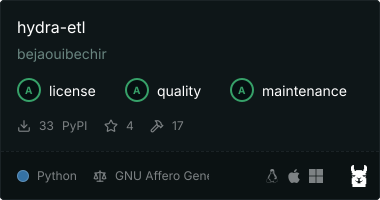
Graded by Glama, which builds the server in a sandbox, runs security checks and scores the tool definitions:
Native acceleration (optional)
Parts of the engine have a Rust implementation. It is optional and off by default: without it, Hydra behaves exactly the same.
pip install "hydra-etl[native]"
HYDRA_BACKEND=rust hdrctl run ./jobs/sales
Or per operation, with a hydra.backends.yaml file next to the job:
default: python
overrides:
  csv.read: rust      # currently the only accelerated operation
On one million rows, CSV reading is about four times faster, with byte-for-byte identical results
(parity checked on 26,000 CSV files and one million floats against CPython repr()). Hydra falls back to
Python automatically whenever that guarantee cannot be kept. Benchmarks: bench/.
VS Code extension
Completion and validation for Hydra manifests inside the editor, without installing Hydra.
Download the .vsix from the latest release,
or build it yourself from vscode-extension/ (python build_vsix.py, no Node required).

Project status
Beta. The documented connectors and steps are implemented and covered by tests. The shape of the YAML DSL is settled; any breaking change will be announced in the release notes before 1.0. Use it on real work, and pin your version.
Contributing
Issues, ideas and pull requests are welcome. See CONTRIBUTING.md. If Hydra is useful to you, a ⭐ on GitHub helps others find it.
License
Hydra ETL is open source under the GNU Affero General Public License v3.0 or later (AGPL-3.0-or-later).
You can, for free
- Use Hydra ETL for any purpose, including inside a company and for commercial work.
- Run your own pipelines with it, internally or for clients.
- Modify it and redistribute it.
Using Hydra ETL to move your data does not make your data, your YAML pipelines or your other applications subject to the AGPL.
The one obligation
If you modify Hydra ETL itself and make it available to others — including over a network, for example as a hosted service — you must publish your modified source code under the same license.
Commercial license
If that obligation does not fit your case — typically, you embed a modified Hydra ETL in a proprietary product or offer it as a service without publishing your changes — a commercial license is available.
Contact: admin@hydraetl.com — reply within 2 business days.
Support and services
- Support with response time commitments
- Help migrating existing scripts or tools to Hydra ETL
1 maintainer

Metadata
1 maintainer
Release files for hydra-etl 0.11.0
For a detailed explanation of source distributions (sdists) and built distributions (wheels), please see the package formats documentation.
Source distribution (sdist)
| File | Size | Uploaded | |
|---|---|---|---|
| hydra_etl-0.11.0.tar.gz | 3.1 MB | Details |
Built distribution (wheel)
| File | Interpreter | ABI | Platform | Reset |
|---|---|---|---|---|
| hydra_etl-0.11.0-py3-none-any.whl | Python 3 | none | any | Details |
Total release size: 6.3 MB
Release files / hydra_etl-0.11.0.tar.gz
| Download URL | hydra_etl-0.11.0.tar.gz |
|---|---|
| Size | 3.1 MB |
| Tags | Source |
|
SHA-256 checksum How to use checksums |
977cc27b6d6e22684b6be1a9dab7054af205b651ef7ca587b0642aa003f0301f
|
|
BLAKE2b-256 checksum How to use checksums |
5444d7cf4cf1992a8d3a88ec130c31ec5dbc50f45c4b25bfa7b1313d40a7de4b
|
| Upload date | |
|
Uploaded using Trusted Publishing? What is trusted publishing? |
No |
| Uploaded via |
twine/7.0.0 CPython/3.13.14
|
Release files / hydra_etl-0.11.0-py3-none-any.whl
| Download URL | hydra_etl-0.11.0-py3-none-any.whl |
|---|---|
| Size | 3.2 MB |
| Tags | Python 3 |
|
SHA-256 checksum How to use checksums |
fb033b8a1ea4b49d7cdc50e3c6572e746cbb08c52b4280c6f1a3cf5ef2642101
|
|
BLAKE2b-256 checksum How to use checksums |
86609d78ccb27c2e55f999fffc055ace5719441d932230bb220677bdb62f60cf
|
| Upload date | |
|
Uploaded using Trusted Publishing? What is trusted publishing? |
No |
| Uploaded via |
twine/7.0.0 CPython/3.13.14
|














