





A suite of convenience functions for exploring water data in Python.
Features
Retrieves stream data from the USGS NWIS service
Select data using multiple site numbers, by state, county codes, or a boundary box
Preserves NWIS metadata, including NoData values
Helpful error messages to help you write valid requests
Extracts data into a Pandas dataframe, json, or dict
- Plot beautiful graphs in Jupyter Notebooks
hydrographs (or time series of any data)
flow duration charts
cycle plots to illustrate annual or diurnal cycles
Interactive map for finding stream gauge ID numbers
Plotting and manipulation through Pandas dataframes
Retrieve USGS rating curves, peak discharges, field notes, and site files for gauging stations
Retrieve USGS daily, monthly, and annual statistics for gauging stations
Saves data in compact, easy-to-use parquet files instead of requesting the same dataset repeatedly
Massive Users Guide that makes Hydrology AND Data Science easy!
Still in active development! Let me know what features you want!
Read the Users Guide for more details.
Basic Usage
First, import hydrofunctions into your project. If you plan to work with Jupyter notebooks, then go ahead and enable automatic chart display:
In  [1]: import hydrofunctions as hf
         %matplotlib inline
Create an NWIS data object to hold our request and the data we will retrieve. We will request the instantaneous values (‘iv’) for site ‘01585200’ for the past 55 days:
In  [2]: herring = hf.NWIS('01585200', 'iv', period='P55D')
Requested data from https://waterservices.usgs.gov/nwis/iv/?format=json%2C1.1&sites=01585200&period=P55D
You can check that the request went smoothly:
In  [3]: herring.ok
Out [3]: True
Find out what data we received:
In  [4]: herring
Out [4]: USGS:01585200: WEST BRANCH HERRING RUN AT IDLEWYLDE, MD
             00060: <5 * Minutes>  Discharge, cubic feet per second
             00065: <5 * Minutes>  Gage height, feet
         Start: 2019-05-25 01:05:00+00:00
         End:   2019-07-19 19:05:00+00:00
This tells us the name of our site and gives a list of the parameters that we have. For each parameter it lists how frequently the data were collected, and it shows the common name of the parameter and its units.
Create a dataframe using only our discharge data, and list the first five items:
In  [5]: herring.df('discharge').head()
Out [5]:
–a table with our data appears–
datetimeUTC
USGS:01585200:00060:00000
2019-05-25 01:05:00+00:00
1.57
2019-05-25 01:10:00+00:00
1.57
2019-05-25 01:15:00+00:00
1.51
2019-05-25 01:20:00+00:00
1.57
2019-05-25 01:25:00+00:00
1.57
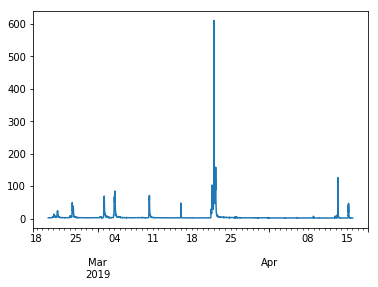
If we’re using Jupyter Lab, we can plot a graph of the data using built-in methods from Pandas and mathplotlib:
In  [6]: herring.df('q').plot()
Out [6]:
–a stream hydrograph appears–
Learn more:
Easy Installation
The easiest way to install Hydrofunctions is by typing this from your command line:
$ pip install hydrofunctionsHydrofunctions depends upon Pandas and numerous other scientific packages for Python. Anaconda is an easy, safe, open-source method for downloading everything and avoiding conflicts with other versions of Python that might be running on your computer.
Visit the Installation Page in the Users Guide to learn how to install Anaconda, or if you have problems using the Easy Installation method above.
1 maintainer

Metadata
1 maintainer
Release files for hydrofunctions 0.2.4
For a detailed explanation of source distributions (sdists) and built distributions (wheels), please see the package formats documentation.
Source distribution (sdist)
| File | Size | Uploaded | |
|---|---|---|---|
| hydrofunctions-0.2.4.tar.gz | 4.6 MB | Details |
Built distribution (wheel)
| File | Interpreter | ABI | Platform | Reset |
|---|---|---|---|---|
| hydrofunctions-0.2.4-py3-none-any.whl | Python 3 | none | any | Details |
Total release size: 4.6 MB
Release files / hydrofunctions-0.2.4.tar.gz
| Download URL | hydrofunctions-0.2.4.tar.gz |
|---|---|
| Size | 4.6 MB |
| Tags | Source |
|
SHA-256 checksum How to use checksums |
4cfd7ef59d62206d71c36309020a201e3a37d0604e9f41a991880310be4cc0d6
|
|
BLAKE2b-256 checksum How to use checksums |
e1fa56308ce64ea14bee1aa9d75d8a3d0f4aaaf940e07dd0e9d5b868476b9de4
|
| Upload date | |
|
Uploaded using Trusted Publishing? What is trusted publishing? |
No |
| Uploaded via |
twine/4.0.1 CPython/3.11.4
|
Release files / hydrofunctions-0.2.4-py3-none-any.whl
| Download URL | hydrofunctions-0.2.4-py3-none-any.whl |
|---|---|
| Size | 40.0 kB |
| Tags | Python 3 |
|
SHA-256 checksum How to use checksums |
a8ff9c3d6aa737634472a3e01116b876aba031c5e2d62232af0d51f921698d12
|
|
BLAKE2b-256 checksum How to use checksums |
ed79f855b9f26e57da1a0978d28c3412e64e8a09cee13e505bfc6022186fcf8a
|
| Upload date | |
|
Uploaded using Trusted Publishing? What is trusted publishing? |
No |
| Uploaded via |
twine/4.0.1 CPython/3.11.4
|














