
HydroSeason





HydroSeason reads a monthly surface-water extent record (for example, from Digital Earth Australia Water Observations) and tells you whether the catchment floods and dries on a reliable annual cycle. If it does, you get per-year boundaries and wet/dry phases. If it doesn't, you get flood events and low-water spells instead of a forced calendar.
Scope: HydroSeason measures surface-water extent. It does not estimate discharge, depth, volume, or groundwater.
Documentation: tayerthiaggo.github.io/hydroseason
What you get
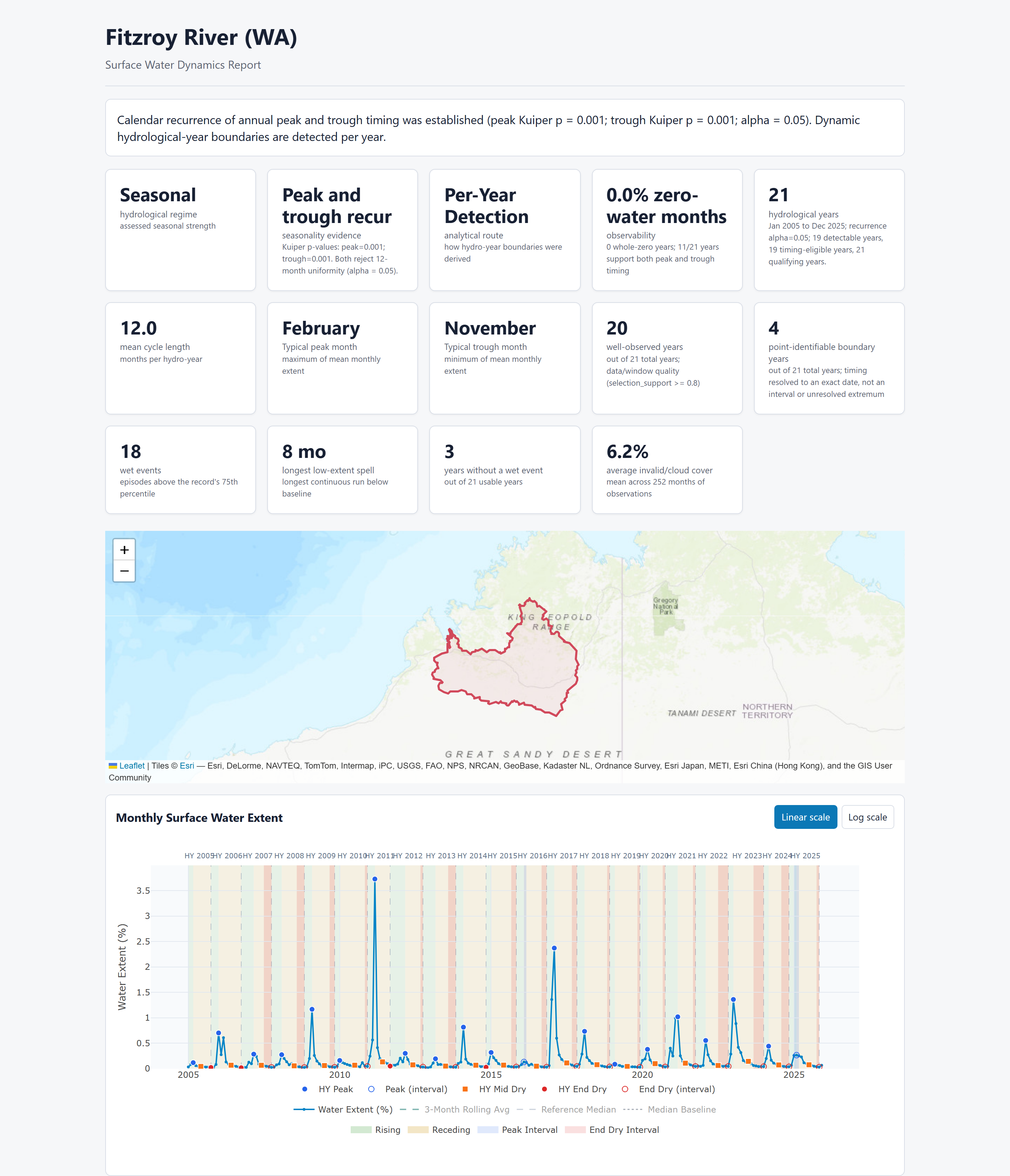
One call writes a self-contained HTML report, four CSVs (_monthly,
_hydro_years, _wet_event, _low_spells), and a run manifest that
records the method version and input checksums.
Open a real report (no install needed):
- Fitzroy River (WA) — seasonal: per-year boundaries
- Lachlan River (NSW) — aseasonal: events and dry spells
- Fitzroy River + rainfall — rainfall shown as context only
Browse a complete output folder (no install needed):
docs/examples/fitzroy-river-wa/
— the HTML report, the four CSVs
(monthly,
hydro years,
wet events,
low spells),
and the run manifest.
Install
pip install hydroseason              # CSV input (pandas + numpy only)
pip install "hydroseason[raster]"    # + NetCDF/Zarr/xarray input and SILO rainfall
pip install "hydroseason[stac]"      # + fetch DEA Water Observations directly
pip install "hydroseason[all]"       # everything: all inputs, DEA fetch, rainfall
Python 3.10–3.13. Run hydroseason doctor to check which inputs your
environment supports.
Quickstart
From a monthly extent CSV (date, extent_pct, optional invalid_pct):
from hydroseason import run_hydroseason

result = run_hydroseason(
    "monthly_extent.csv",
    output_dir="output/report",
    aoi_name="My AOI",
)
print(result.analysis.regime.regime)  # "seasonal", "aseasonal", or "insufficient_record"
print(result.analysis.route)          # "per_year_detection", "event_characterisation", ...
print(result.artifacts.html)
Or fetch DEA data for a polygon, from the command line:
hydroseason run --aoi catchment.geojson --aoi-name "My catchment" \
  --start-date 2005-01-01 --end-date 2025-12-01 \
  --output-dir output/report --cache-dir cache
The same function also takes NetCDF/Zarr rasters, optional rainfall, and —
through run_hydroseason_many — many AOIs at once. See the
Usage Guide and the
notebooks.
How it works
- Screen — on a DEA fetch, one read of the all-time WOfS statistics checks the AOI holds recurrent water before any monthly data is downloaded.
- Test seasonality — circular Kuiper tests ask whether annual peaks and troughs recur in the same calendar months (at least five detectable years required).
- Route — a seasonal record with at least seven resolved cycles gets per-year boundaries, refined with a robust (Huber) profile fit. Anything else gets flood-event and low-spell analysis.
- Report — rainfall, if added, annotates the report but never changes the answer, which is decided from water alone.
Every run uses one frozen method, hydroseason-v0.2.0, recorded in the run
manifest. Details: Methods Reference.
Case studies
Three reproducible studies on five Australian catchments (DEA 30 m, 2005–2025): the main workflow, resolution sensitivity, and rainfall context.
Citation
Please cite the software release (CITATION.cff):
@software{tayer_hydroseason,
  author  = {Tayer, Thiaggo C.},
  title   = {HydroSeason: Remote-sensing-first hydrological year and season detection},
  year    = {2026},
  url     = {https://github.com/tayerthiaggo/hydroseason},
  doi     = {10.5281/zenodo.21866898}
}
See Citation for version-specific DOIs.
License
MIT — see LICENSE.
1 maintainer

Release files for hydroseason 0.2.0
For a detailed explanation of source distributions (sdists) and built distributions (wheels), please see the package formats documentation.
Source distribution (sdist)
| File | Size | Uploaded | |
|---|---|---|---|
| hydroseason-0.2.0.tar.gz | 745.7 kB | Details |
Built distribution (wheel)
| File | Interpreter | ABI | Platform | Reset |
|---|---|---|---|---|
| hydroseason-0.2.0-py3-none-any.whl | Python 3 | none | any | Details |
Total release size: 1.5 MB
Release files / hydroseason-0.2.0.tar.gz
| Download URL | hydroseason-0.2.0.tar.gz |
|---|---|
| Size | 745.7 kB |
| Tags | Source |
|
SHA-256 checksum How to use checksums |
269b40b5d8b5fa6e7784699d96aa4aa97b35bdd45ae135c2b32b357ae6843e1c
|
|
BLAKE2b-256 checksum How to use checksums |
fb53fc36c6eead6fe0ea47be19659434b2fa26aabea7e7d88b60a17bee6bd52c
|
| Upload date | |
|
Uploaded using Trusted Publishing? What is trusted publishing? |
Yes |
| Uploaded via |
twine/7.0.0 CPython/3.13.14
|
Provenance
Provenance describes where a file came from. On PyPI, provenance is shared via attestations, which provide a verifiable record of the build or publishing details. View details, limitations and caveats.


PyPI Publish Attestation
PyPI verified that this artifact, at this checksum, originated from the publisher listed below.
Signed by GitHub Actions, verified by PyPI on Sep 25, 2026.
Transparency logRelease files / hydroseason-0.2.0-py3-none-any.whl
| Download URL | hydroseason-0.2.0-py3-none-any.whl |
|---|---|
| Size | 774.3 kB |
| Tags | Python 3 |
|
SHA-256 checksum How to use checksums |
af5135324254a95510b61e20099b24aa85a0e0480065cca7d91d25a83899decd
|
|
BLAKE2b-256 checksum How to use checksums |
92795fe9ceae2215eda016ef945f74c75ede4e8d9b37bd4046f8c2fc2dd9a32e
|
| Upload date | |
|
Uploaded using Trusted Publishing? What is trusted publishing? |
Yes |
| Uploaded via |
twine/7.0.0 CPython/3.13.14
|
Provenance
Provenance describes where a file came from. On PyPI, provenance is shared via attestations, which provide a verifiable record of the build or publishing details. View details, limitations and caveats.
PyPI Publish Attestation
PyPI verified that this artifact, at this checksum, originated from the publisher listed below.
Signed by GitHub Actions, verified by PyPI on Sep 25, 2026.
Transparency log













