

Constitutive hyperelastic material formulations for FElupe.








This package provides the essential building blocks for constitutive hyperelastic material formulations. This includes material behaviour-independent spaces and frameworks as well as material behaviour-dependent model formulations.
Spaces (hyperelastic.spaces) are full or partial deformations on which a given material formulation should be projected to, e.g. to the distortional (part of the deformation) space. Generalized Total-Lagrange Frameworks (hyperelastic.frameworks) for isotropic hyperelastic material formulations based on the invariants of the right Cauchy-Green deformation tensor and the principal stretches enable a clean coding of isotropic material formulations.
The hyperelastic.math-module provides helpers in reduced vector (Voigt) storage for symmetric three-dimensional second-order tensors along with a matrix storage for (at least minor) symmetric three-dimensional fourth-order tensors. Shear terms are not doubled for strain-like tensors, instead all math operations take care of the reduced vector storage.
$$ \boldsymbol{C} = \begin{bmatrix} C_{11} & C_{22} & C_{33} & C_{12} & C_{23} & C_{13} \end{bmatrix}^T $$
Installation
Install Python, fire up 🔥 a terminal and run 🏃
pip install hyperelastic
Usage
Material model formulations have to be created as classes with methods for the evaluation of the gradient (stress) and the hessian (elasticity) of the strain energy function. It depends on the framework which derivatives have to be defined, e.g. the derivatives w.r.t. the invariants of the right Cauchy-Green deformation tensor or w.r.t. the principal stretches. An instance of a Framework has to be finalized by the application on a Space.
ⓘ Note Define your own material model formulation with manual, automatic or symbolic differentiation with the help of your favourite package, e.g. PyTorch, JAX, Tensorflow, TensorTRAX, SymPy, etc.
First, let's import hyperelastic (and its math module).
import hyperelastic as hel
import hyperelastic.math as hm
Invariant-based material formulations
A minimal template for an invariant-based material formulation applied on the distortional space:
class MyInvariantsModel:
    def gradient(self, I1, I2, I3, statevars):
        """The gradient as the partial derivative of the strain energy function w.r.t.
        the invariants of the right Cauchy-Green deformation tensor."""

        return dWdI1, dWdI2, dWdI3, statevars

    def hessian(self, I1, I2, I3, statevars_old):
        """The hessian as the second partial derivatives of the strain energy function
        w.r.t. the invariants of the right Cauchy-Green deformation tensor."""

        return d2WdI1I1, d2WdI2I2, d2WdI3I3, d2WdI1I2, d2WdI2I3, d2WdI1I3


model = MyInvariantsModel()
framework = hel.InvariantsFramework(model)
umat = hel.DistortionalSpace(framework)
Available isotropic hyperelastic invariant-based material formulations
The typical polynomial-based material formulations (Neo-Hooke, Mooney-Rivlin, Yeoh) are all available as submodels of the third order deformation material formulation.

Principal stretch-based material formulations
A minimal template for a principal stretch-based material formulation applied on the distortional space:
class MyStretchesModel:
    def gradient(self, λ, statevars):
        """The gradient as the partial derivative of the strain energy function w.r.t.
        the principal stretches."""

        return [dWdλ1, dWdλ2, dWdλ3], statevars

    def hessian(self, λ, statevars_old):
        """The hessian as the second partial derivatives of the strain energy function
        w.r.t. the principal stretches."""

        return d2Wdλ1dλ1, d2Wdλ2dλ2, d2Wdλ3dλ3, d2Wdλ1dλ2, d2Wdλ2dλ3, d2Wdλ1dλ3


model = MyStretchesModel()
framework = hel.StretchesFramework(model)
umat = hel.DistortionalSpace(framework)
Available isotropic hyperelastic stretch-based material formulations
Lab
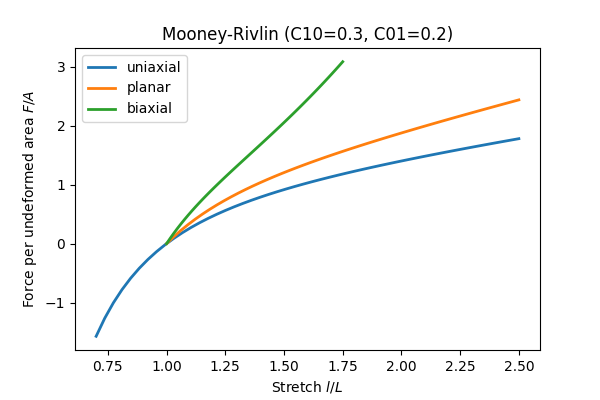
In the Lab, Simulations on homogeneous load cases provide a visualization of the material response behaviour.
import numpy as np
import hyperelastic

stretch = np.linspace(0.7, 2.5, 181)
parameters = {"C10": 0.3, "C01": 0.2}

def material(C10, C01):
    tod = hyperelastic.models.invariants.ThirdOrderDeformation(C10=C10, C01=C01)
    framework = hyperelastic.InvariantsFramework(tod)
    return hyperelastic.DeformationSpace(framework)

ux = hyperelastic.lab.Simulation(
    loadcase=hyperelastic.lab.Uniaxial(label="uniaxial"),
    stretch=np.linspace(0.7, 2.5),
    material=material,
    labels=parameters.keys(),
    parameters=parameters.values(),
)

ps = hyperelastic.lab.Simulation(
    loadcase=hyperelastic.lab.Planar(label="planar"),
    stretch=np.linspace(1.0, 2.5),
    material=material,
    labels=parameters.keys(),
    parameters=parameters.values(),
)

bx = hyperelastic.lab.Simulation(
    loadcase=hyperelastic.lab.Biaxial(label="biaxial"),
    stretch=np.linspace(1.0, 1.75),
    material=material,
    labels=parameters.keys(),
    parameters=parameters.values(),
)

fig, ax = ux.plot_stress_stretch(lw=2)
fig, ax = ps.plot_stress_stretch(ax=ax, lw=2)
fig, ax = bx.plot_stress_stretch(ax=ax, lw=2)

ax.legend()
ax.set_title(rf"Mooney-Rivlin (C10={parameters['C10']}, C01={parameters['C01']})")
License
Hyperelastic - Constitutive hyperelastic material formulations for FElupe (C) 2024 Andreas Dutzler, Graz (Austria).
This program is free software: you can redistribute it and/or modify it under the terms of the GNU General Public License as published by the Free Software Foundation, either version 3 of the License, or (at your option) any later version.
This program is distributed in the hope that it will be useful, but WITHOUT ANY WARRANTY; without even the implied warranty of MERCHANTABILITY or FITNESS FOR A PARTICULAR PURPOSE. See the GNU General Public License for more details.
You should have received a copy of the GNU General Public License along with this program. If not, see https://www.gnu.org/licenses/.
1 maintainer

Metadata
1 maintainer
Release files for hyperelastic 0.10.2
For a detailed explanation of source distributions (sdists) and built distributions (wheels), please see the package formats documentation.
Source distribution (sdist)
| File | Size | Uploaded | |
|---|---|---|---|
| hyperelastic-0.10.2.tar.gz | 72.2 kB | Details |
Built distribution (wheel)
| File | Interpreter | ABI | Platform | Reset |
|---|---|---|---|---|
| hyperelastic-0.10.2-py3-none-any.whl | Python 3 | none | any | Details |
Total release size: 135.6 kB
Release files / hyperelastic-0.10.2.tar.gz
| Download URL | hyperelastic-0.10.2.tar.gz |
|---|---|
| Size | 72.2 kB |
| Tags | Source |
|
SHA-256 checksum How to use checksums |
5c2a847968a33bb9ac6e10eefc1d55d76868973c7b2738017a6c060ee4601e09
|
|
BLAKE2b-256 checksum How to use checksums |
ffe36f36cd2eb63526c4e4ab175e535db4681efcd84f93d2c188c9b3f788190c
|
| Upload date | |
|
Uploaded using Trusted Publishing? What is trusted publishing? |
No |
| Uploaded via |
twine/6.1.0 CPython/3.12.9
|
Release files / hyperelastic-0.10.2-py3-none-any.whl
| Download URL | hyperelastic-0.10.2-py3-none-any.whl |
|---|---|
| Size | 63.4 kB |
| Tags | Python 3 |
|
SHA-256 checksum How to use checksums |
3a5ff2aeb05da5a7bdffe6c36ea515750be29376aa93b3c7f7719eea68cda81a
|
|
BLAKE2b-256 checksum How to use checksums |
77a2f12d7d51b78f3b34677d423cc88bc36b0246dbad97ef326c4e2782420ea8
|
| Upload date | |
|
Uploaded using Trusted Publishing? What is trusted publishing? |
No |
| Uploaded via |
twine/6.1.0 CPython/3.12.9
|














