







Hyperpack is the first open-source 2D-Binpacking problem solver and optimizer in Python, based on my personally developed heuristics. If you are curious on the heuristics or the python implementation, please contact me.
Problem description
The hyperpack library is an API for solving instances of the 2D Binpacking problem and also - as of v1.1.0 - strip packing instances!
The library is multiprocessing enabled to minimize execution times and utilizes only pure python, making the package dependency free.
Many different variations can be created and solved, accordind to the instantiation data. The solvable variants can be summarized in the below characteristics: - Any number and sizes of (rectangular) items. - Any number and sizes of (rectangular) bins (containers). - The items can be rotated or not.
The above items’ charascteristics can also be applied to strip packing problems.
The bin/strip packing problem has been used in many sectors of the industry, and mostly where manufacturing or industrial management needs arise.
The theory of this library’s implementation and mechanics can be found in author’s document “A hyper-heuristic for solving variants of the 2D bin packing problem”.
Installation
Install using pip:
pip install hyperpack
Quickstart
A quickstart for testing the library can be made through the generate_problem_data utility function.
>>> from hyperpack import generate_problem_data, HyperPack
>>> problem_data = hyperpack.generate_problem_data(containers_num=2)
Containers number =  2
Containers:
{
    "container-0": {
        "W": 48,
        "L": 53
    },
    "container-1": {
        "W": 53,
        "L": 49
    }
}
Items number =  60
>>> problem = HyperPack(**problem_data)
>>> problem.hypersearch()
>>> problem.create_figure(show=True)
>>> # figure opened in default browser
>>>
>>> # to see parameter explanation do:
>>> help(generate_problem_data)
Defining the problem
Instantiate your problem with proper arguments
>>> from hyperpack import HyperPack
>>> problem = hyperpack.HyperPack(
>>>     containers=containers, # problem parameter
>>>     items=items, # problem parameter
>>>     settings=settings # solver/figure parameters
>>> )
According to the arguments given, the corresponding problem will be instantiated, ready to be solved with provided guidelines. The items and containers (bins) structure:
containers = {
    "container-0-id": {
        "W": int, # > 0 container's width
        "L": int # > 0 container's length
    },
    "container-1-id": {
        "W": int, # > 0 container's width
        "L": int # > 0 container's length
    },
    # ... rest of the containers
    # minimum 1 container must be provided
}

items = {
    "item-0-id": {
        "w": int, # > 0 item's width
        "l": int, # > 0 item's length
    },
    "item-1-id": {
        "w": int, # > 0 item's width
        "l": int, # > 0 item's length
    },
    # ... rest of the items
    # minimum 1 item must be provided
}
See documentation for detailed settings structure.
Usage
Do Local search with default settings:
>>> from hyperpack import HyperPack
>>> problem_data = {
>>>     "containers": containers,
>>>     "items": items,
>>>     "settings": settings
>>> }
>>> problem = HyperPack(**problem_data)
>>> problem.local_search()
After solving has finished, the solution can be found in problem.solution instance attribute.
Alternatively for a deep search and maximum bin utilization in mind:
>>> problem = HyperPack(**problem_data)
>>> problem.hypersearch()
Solution logging
Use the log_solution method to log an already found solution:
>>> problem.log_solution()
Solution Log:
Percent total items stored : 100.0000%
Container: container-0-id 60x30
        [util%] : 100.0000%
Container: container-1-id 60x50
        [util%] : 91.2000%

Remaining items : []
Create a figure
Warning : plotly (5.14.0 or greater) is needed for figure creation and kaleido (0.2.1 or greater) for figure exportation to image. These libraries are not listed as dependencies providing liberty of figure implementation.
>>> problem.create_figure(show=True)The figure below is opened in default browser:
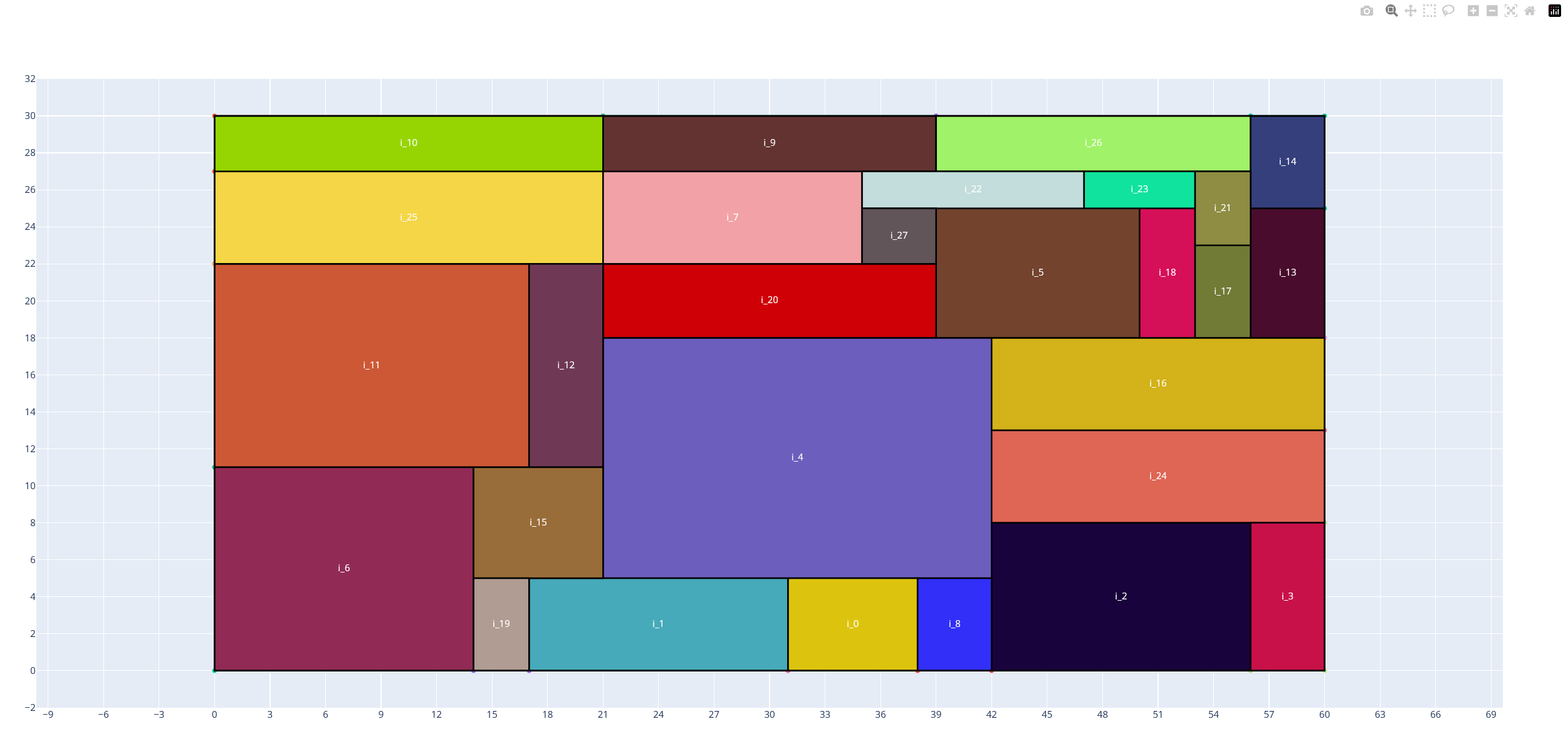
For more information, visit the documentation page.
Future development
Many ideas and concepts can be implemented in this library. The most propable depending on the community’s interest:
Augmentation of the objective function to deal with a bigger plethora of problems.
Implementation of the strip packing problem.
Django integrations.
Large Neighborhood Search for big instances of the problem.
Other shapes of the container.
A dynamic live terminal display.
Execution speed optimization.
Multiprocessing for the local search alone (combined with Large Neighborhood Search).
More detailed figures.
Figures with other libraries (matplotlib).
If interested with development with some of these features please contact me.
Theoretical foundations
This packages inner mechanics and theoretical design are based upon this documentation.
Helping
Creating issues wherever bugs are found and giving suggestions for upcoming versions can surely help in maintaining and growing this package.
1 maintainer

Release files for hyperpack 1.3.0
For a detailed explanation of source distributions (sdists) and built distributions (wheels), please see the package formats documentation.
Source distribution (sdist)
| File | Size | Uploaded | |
|---|---|---|---|
| hyperpack-1.3.0.tar.gz | 44.6 kB | Details |
Built distribution (wheel)
| File | Interpreter | ABI | Platform | Reset |
|---|---|---|---|---|
| hyperpack-1.3.0-py3-none-any.whl | Python 3 | none | any | Details |
Total release size: 91.9 kB
Release files / hyperpack-1.3.0.tar.gz
| Download URL | hyperpack-1.3.0.tar.gz |
|---|---|
| Size | 44.6 kB |
| Tags | Source |
|
SHA-256 checksum How to use checksums |
ccd87850fa3251496376e8069e86959f9235dd5555ba051cde4bc4ed4b3f7011
|
|
BLAKE2b-256 checksum How to use checksums |
97909ff695119aa210606cf99c38f1506c0d7136809796407c31be26c0aec822
|
| Upload date | |
|
Uploaded using Trusted Publishing? What is trusted publishing? |
No |
| Uploaded via |
twine/6.2.0 CPython/3.12.3
|
Release files / hyperpack-1.3.0-py3-none-any.whl
| Download URL | hyperpack-1.3.0-py3-none-any.whl |
|---|---|
| Size | 47.3 kB |
| Tags | Python 3 |
|
SHA-256 checksum How to use checksums |
8e6e3e3221c7b7fdd04b2baf5ca26b1c1008385a0e98e7cd8540c6fe93251c17
|
|
BLAKE2b-256 checksum How to use checksums |
08d574297076c2b169d557e43220ca078ae2830477d6c50ffd1f42753b301d94
|
| Upload date | |
|
Uploaded using Trusted Publishing? What is trusted publishing? |
No |
| Uploaded via |
twine/6.2.0 CPython/3.12.3
|














