
attp (Adaptive Train Test Partitioner)
Cluster-stratified train/test splitting on an LDA-reduced feature space (S-ATTP).
Instead of stratifying on the class label alone, sattp also stratifies on where a row sits in
feature space, so the test set covers the same sub-populations as the train set.
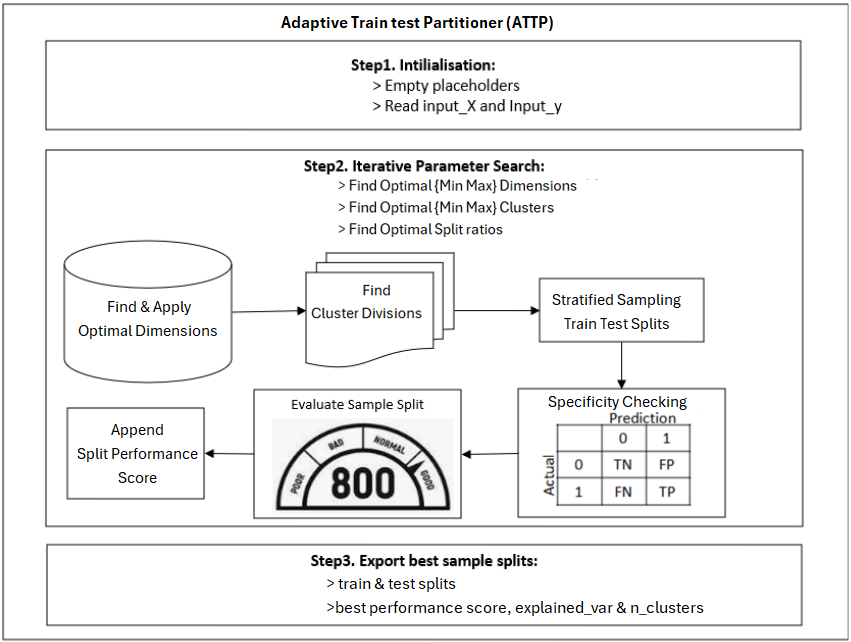
How it works
- Reduce the features with LDA, using the fewest components that reach 85% of the explained variance (configurable).
- For each candidate cluster count, run K-Means once on the LDA components and reuse those
clusters across candidate train fractions (
MiniBatchKMeansabove 50,000 rows). - Build strata from
class × clusterand do a stratified split. Strata with a single member can't be split, so those rows always go to the train set. - Score a classifier on every
(train fraction, n_clusters)pair and return the split with the best test score.
Process Flow Diagram
Install
pip install i-attp
Or install directly from GitHub:
pip install git+https://github.com/Jabualani/ATTP.git
For development:
git clone https://github.com/Jabualani/ATTP.git
cd ATTP
pip install -e ".[dev]"
pytest
Version history and migration
| Version | Main functionality |
|---|---|
0.1.2 |
The original S-ATTP classifier split, exposed as sattp_split, plus the legacy S_ATTP wrapper. |
0.2.0 |
The classifier's preferred name is s_attp_clf; sattp_split and S_ATTP remain available. Adds classification, regression, time-series, and clustering variants, including s_attp_clustered_sampling. |
0.2.1 |
Includes the ATTP Framework Reference Architecture PDF in the repository and package distributions. |
0.2.2 |
Expands the README with parameter references and examples for classification and clustered sampling. |
0.2.3 |
Uses absolute GitHub URLs for the README image and framework PDF so both resolve in the PyPI description. |
The 0.2.0 release also adds the optional dr_reducer=True output for retrieving a fitted
dimensionality reducer. The original s_attp_clf call continues to return its SplitResult by
default; most added variants return (X_train, X_test, y_train, y_test), while time-series,
pool, clustering, and outlier/inlier methods have their own output shapes as documented below.
To migrate from 0.1.2, prefer the new import name:
from attp import s_attp_clf

result = s_attp_clf(X, y)
Existing code can continue importing sattp_split or S_ATTP. Documentation-only changes do not
inherently require a version bump; this update is designated as 0.2.3 and synchronizes the
package metadata. For future releases, reserve patch increments for bug fixes and documentation
updates, and use a minor increment for backward-compatible API additions while the project remains
in the 0.x series. Review return shapes and behavior before each release.
Classification usage
s_attp_clf parameters
s_attp_clf(X, y, ...) evaluates candidate train fractions and cluster counts, then returns the
split with the highest classifier score. X must be a numeric pandas DataFrame or 2D NumPy
array; y may be a pandas Series/DataFrame or a 1D sequence/array of class labels. Rows must
align, and features must not contain missing or non-numeric values.
| Parameter | Accepted type; default | Meaning and when to use it |
|---|---|---|
X |
DataFrame or 2D ndarray; required |
Feature matrix. DataFrame row labels are preserved in the result. |
y |
Series, one-column DataFrame, 1D sequence or ndarray; required |
Classification target; missing labels are not accepted. |
splits |
Sequence of float; (0.7, 0.8) |
Candidate train fractions, each strictly between 0 and 1. Use several values to compare train/test proportions. |
min_clusters |
int; 2 |
Smallest K-Means cluster count to evaluate. Must be at least 1. |
max_clusters |
int; 10 |
Largest cluster count to evaluate; cannot exceed the number of rows. Larger ranges take longer. |
DR_Comps_Min |
int; 1 |
Minimum number of LDA components considered. |
DR_Comps_Max |
int; 3 |
Maximum number of LDA components considered; must be at least DR_Comps_Min. |
model |
scikit-learn ClassifierMixin or None; None |
Classifier used to score candidates. None uses scikit-learn LDA. Supply a compatible estimator to optimize for a different classifier. |
scoring |
callable or None; None |
Optional function (fitted_model, X, y) -> number. With None, the estimator's .score() is used. Scores must be finite. |
variance_threshold |
float from 0 to 1; 0.85 |
Target cumulative explained-variance ratio used when choosing LDA component count. |
random_state |
int or None; 0 |
Seed for repeatable clustering, splitting, and model evaluation. |
verbose |
bool; False |
Print progress, skipped candidates, scores, and the selected split. |
test_size |
float or None; None |
Optional single test fraction. If supplied, it overrides splits with train fraction 1 - test_size. |
dr_reducer |
bool; False |
If True, return (SplitResult, fitted_lda) instead of only SplitResult; useful for inspecting or reusing the fitted feature reducer. |
The result unpacks in this order: (X_train, y_train, X_test, y_test). It also provides
best_split, best_n_clusters, n_lda_components, explained-variance information, candidate
metrics, and train/test indices. Rows in singleton class-cluster strata are kept in training.
The scores are for selecting a representative split, not unbiased model evaluation (see
Caveats).
Classification examples
from attp import s_attp_clf

result = s_attp_clf(
    X, y,
    splits=[0.7, 0.75, 0.8],   # candidate train fractions
    min_clusters=2,
    max_clusters=10,
)

X_train, y_train, X_test, y_test = result      # unpacks like a 4-tuple
print(result.best_split, result.best_n_clusters, result.n_lda_components)
print(result.explained_variance_ratio)          # ratio explained by each LDA component
print(result.total_explained_variance)           # combined ratio for the selected components
print(result.metrics.head())                    # every candidate, best first
Row labels of the original X/y are preserved in the outputs.
s_attp_clf is the current name for the original S-ATTP split function. The previous
sattp_split name remains available as a backward-compatible alias.
Useful options: model= (any scikit-learn classifier used for scoring; defaults to LDA),
scoring= (custom (fitted_model, X, y) -> float), variance_threshold=, random_state=,
test_size= to provide one holdout size (otherwise splits contains candidate train fractions),
and verbose=True to print progress and the selected split. Set DR_Comps_Min= and
DR_Comps_Max= to choose the LDA component range.
Set dr_reducer=True on any splitter to receive (normal_output, reducer). The reducer is the
fitted LDA, PCA, or PLS estimator where that method uses one; splitters that do not reduce features
return None as the reducer. The default dr_reducer=False preserves the normal return value.
Other classification functions
Classification variants accept X as a pandas DataFrame or 2D NumPy array, and labeled
variants accept y as a pandas Series/DataFrame or 1D array/sequence. Their usual split
output is (X_train, X_test, y_train, y_test); pool splitting returns (X_train, X_test).
dr_reducer=True wraps that output as (normal_output, reducer); methods without a reducer
provide None.
| Function | Parameters beyond X / y |
Notes |
|---|---|---|
m_attp_clf |
test_size: float=0.2, random_state: Optional[int]=42, dr_method: str="pca", n_clusters: int=5, dr_reducer: bool=False, **kwargs |
PCA is applied when dr_method="pca"; other values use standardized features directly. A Gaussian mixture creates clusters. **kwargs is accepted but ignored. |
b_attp_clf |
test_size: float=0.2, random_state: Optional[int]=42, balance_method: str="random_over", dr_reducer: bool=False, **kwargs |
Only "random_over" is supported. Oversampling affects training rows only. **kwargs is forwarded to s_attp_clf. |
mc_mcls_attp_clf |
test_size: float=0.2, random_state: Optional[int]=42, dr_reducer: bool=False, **kwargs |
Reproducible class-stratified split; **kwargs is accepted but ignored. |
auto_attp_al_clf |
test_size: float=0.2, random_state: Optional[int]=42, dr_reducer: bool=False, **kwargs |
Splits an unlabeled X_pool into two feature sets using K-Means; **kwargs is accepted but ignored. |
auto_attp_clf |
test_size: float=0.2, random_state: Optional[int]=42, dr_reducer: bool=False, **kwargs |
Delegates to s_attp_clf; forwards **kwargs except splits, which is discarded in favor of test_size. |
Other variants return scikit-learn-ordered tuples: (X_train, X_test, y_train, y_test);
pool and clustering functions without targets return (X_train, X_test).
from attp import (
    b_attp_clf, m_attp_clf, mc_mcls_attp_clf,
    s_attp_reg, m_attp_reg, r_t_attp, r_f_attp,
    s_attp_ts,
)

# PCA/GMM classifier split; random oversampling is applied to training rows only.
X_train, X_test, y_train, y_test = m_attp_clf(X, y, test_size=0.2)
X_train, X_test, y_train, y_test = b_attp_clf(X, y, test_size=0.2)

# Regression: target-bin and feature-aware options.
X_train, X_test, y_train, y_test = s_attp_reg(X, y, test_size=0.2)
X_train, X_test, y_train, y_test = m_attp_reg(X, y, test_size=0.2)
r_t_attp(X, y)  # target-bin stratification
r_f_attp(X, y)  # feature-cluster stratification

# Temporal splits preserve row order; clustered sampling accepts labeled or unlabeled data.
X_train, X_test, y_train, y_test = s_attp_ts(X, y)
Clustering usage
s_attp_clustered_sampling parameters
This method preprocesses mixed feature data, reduces it with supervised LDA (when y is supplied)
or unsupervised PCA (when y=None), then partitions rows by cluster strata. X accepts a pandas
DataFrame or 2D NumPy array; optional y accepts a pandas Series/DataFrame or 1D array.
For labeled data, shared DataFrame/Series indices are aligned; array targets are matched by row
position. By default it imputes missing values, encodes categorical columns, removes date-like and
high-missingness columns, and filters highly correlated columns.
| Parameter | Accepted type; default | Meaning and when to use it |
|---|---|---|
X |
DataFrame or 2D ndarray; required |
Feature matrix. It must contain at least two rows and one feature for clustering. |
y |
Series, DataFrame, 1D ndarray or None; None |
Optional labels. With labels, reduction and strata use target class; without them, PCA and cluster-only strata are used. |
test_size |
float, int, or list of floats/ints; 0.2 |
Test fraction (0 < value < 1) or absolute test-row count (1 to n_rows-1). A list supplies candidates; the method chooses the candidate with the best row/strata feasibility score (ties keep the first). |
o_i |
bool; False |
Enable outlier/inlier mode instead of train/test splitting. Returns inlier rows before outlier rows, followed by corresponding targets when y is supplied. |
outlier_quantile |
float or None; None |
In o_i mode, choose an upper-tail distance cutoff; e.g. 0.05 uses the 95th-percentile cutoff. Must be strictly between 0 and 1. With None, the method estimates a cutoff from the largest gap in the distance tail. |
reducer_pipeline |
scikit-learn-style transformer/pipeline or None; None |
Optional custom reducer. It is fit with fit_transform when available (LDA receives y); otherwise transform is used. Custom preprocessing is responsible for handling raw data. |
n_clusters |
int or None; None |
Requested number of clusters; explicit values are capped at the row count. None uses min(10, max(2, n_rows // 100)); smaller datasets therefore default to 2 clusters. |
random_state |
int or None; 42 |
Seed for PCA/K-Means and splitting. |
drop_corr_threshold |
float from 0 to 1; 0.95 |
Drop one of a pair of features whose absolute correlation is greater than this threshold. |
max_missing_rate |
float from 0 to 1; 0.30 |
Drop columns with a missing-value rate above this limit before imputing remaining values. |
row_threshold_minibatch |
positive int; 50_000 |
Use MiniBatchKMeans above this row count; use standard K-Means at or below it. Lower it to switch to minibatch clustering sooner. |
dr_reducer |
bool; False |
If True, return (normal_output, fitted_reducer). The reducer may be LDA, PCA, the supplied transformer, or None when supervised reduction is not applicable. |
Normal labeled split output is (X_train, X_test, y_train, y_test); without labels it is
(X_train, X_test). In outlier/inlier mode the outputs are (X_inliers, X_outliers) or
(X_inliers, X_outliers, y_inliers, y_outliers). Each order is preserved when dr_reducer=True
by wrapping the normal output and reducer together.
Other clustering functions
m_attp_cluster accepts a numeric pandas DataFrame or 2D NumPy array. It uses standardized
features and Gaussian-mixture clusters, returning (X_train, X_test). Its optional y is accepted
for call compatibility but ignored; additional keyword arguments are also ignored.
| Function | Parameters beyond X |
Meaning |
|---|---|---|
m_attp_cluster |
y: Series, DataFrame, ndarray, or None=None, test_size: float=0.2, random_state: Optional[int]=42, n_clusters: int=5, dr_reducer: bool=False, **kwargs |
Uses GMM cluster labels to stratify a split. dr_reducer=True returns (normal_output, None) because this method does not fit a dimensionality reducer. y and **kwargs are ignored. |
s_attp_cluster |
Same parameters as s_attp_clustered_sampling |
Backward-compatible alias. Prefer s_attp_clustered_sampling for new code. |
Clustering examples
from attp import s_attp_clustered_sampling

# Labeled split: preprocessing, LDA, and class-by-cluster stratification.
X_train, X_test, y_train, y_test = s_attp_clustered_sampling(
    X, y, test_size=0.2, n_clusters=5
)

# Unlabeled split: preprocessing, PCA, and cluster-only stratification.
X_train, X_test = s_attp_clustered_sampling(X, test_size=0.2)

# Isolate the upper-distance tail as outliers.
X_inliers, X_outliers = s_attp_clustered_sampling(X, o_i=True)
The ATTP Framework Reference Architecture Documentation
describes the library's concepts and variants. It is included in the GitHub repository and in the
installed attp package.
Set dr_reducer=True to append the fitted reducer to the normal result; it is None only when
supervised reduction cannot be applied (for example, a single target class).
The package also exports auto_attp_clf, auto_attp_reg, auto_attp_ts,
auto_attp_al_clf, auto_attp_al_reg, mc_mcls_attp_reg, r_tf_attp,
r_ra_attp, r_d_attp, m_attp_ts, and m_attp_cluster.
Original function signature
S_ATTP keeps the original call signature for existing code:
from attp import S_ATTP

X_tr, y_tr, X_te, y_te = S_ATTP(
    X_df, y_df, "target_col", [0.7, 0.8], 2, 10, 1, 3, None, "frames", False, False
)
return_type="indices" returns (train_index, test_index), and
return_split_metadata=True appends the metrics DataFrame. If no valid split exists it returns
Nones, like the original.
Caveats
- LDA is fitted on the whole dataset (using all labels) before splitting, and the winning split is chosen by its test score. Both make the reported test score optimistic. Treat it as a way to build a representative split, not as an unbiased performance estimate.
- For
s_attp_clf, features must be numeric with no missing or infinite values. Thes_attp_clustered_samplingmethod instead preprocesses mixed types and imputes remaining missing values by default.
License
MIT
1 maintainer

Metadata
1 maintainer
Release files for i-attp 0.2.3
For a detailed explanation of source distributions (sdists) and built distributions (wheels), please see the package formats documentation.
Source distribution (sdist)
| File | Size | Uploaded | |
|---|---|---|---|
| i_attp-0.2.3.tar.gz | 346.3 kB | Details |
Built distribution (wheel)
| File | Interpreter | ABI | Platform | Reset |
|---|---|---|---|---|
| i_attp-0.2.3-py3-none-any.whl | Python 3 | none | any | Details |
Total release size: 581.0 kB
Release files / i_attp-0.2.3.tar.gz
| Download URL | i_attp-0.2.3.tar.gz |
|---|---|
| Size | 346.3 kB |
| Tags | Source |
|
SHA-256 checksum How to use checksums |
ec2f3999833ae9ada0700cbc50354177ccedad9279c2ba9fb48c5d17033478cb
|
|
BLAKE2b-256 checksum How to use checksums |
154720ec4e9b3bc86e564f502cd8556d7a0efc20d89c5d464ebb1d9f6b3c1fa1
|
| Upload date | |
|
Uploaded using Trusted Publishing? What is trusted publishing? |
Yes |
| Uploaded via |
twine/7.0.0 CPython/3.13.14
|
Provenance
Provenance describes where a file came from. On PyPI, provenance is shared via attestations, which provide a verifiable record of the build or publishing details. View details, limitations and caveats.


PyPI Publish Attestation
PyPI verified that this artifact, at this checksum, originated from the publisher listed below.
Signed by GitHub Actions, verified by PyPI on Oct 17, 2026.
Transparency logRelease files / i_attp-0.2.3-py3-none-any.whl
| Download URL | i_attp-0.2.3-py3-none-any.whl |
|---|---|
| Size | 234.7 kB |
| Tags | Python 3 |
|
SHA-256 checksum How to use checksums |
86a4d7c061d00dc7418e1c417bb1862e1265b1c17c023e60fc95483fab2ac5e6
|
|
BLAKE2b-256 checksum How to use checksums |
193069a1f53e3a2874706608dae55726e47958c429376adced23c54885fbbe6c
|
| Upload date | |
|
Uploaded using Trusted Publishing? What is trusted publishing? |
Yes |
| Uploaded via |
twine/7.0.0 CPython/3.13.14
|
Provenance
Provenance describes where a file came from. On PyPI, provenance is shared via attestations, which provide a verifiable record of the build or publishing details. View details, limitations and caveats.
PyPI Publish Attestation
PyPI verified that this artifact, at this checksum, originated from the publisher listed below.
Signed by GitHub Actions, verified by PyPI on Oct 17, 2026.
Transparency log













