
The ionospheric bubble probability statistical model is a Swarm L2 product, named IBP_CLI. The output of the Ionospheric Bubble Probability (IBP) product is an index, that depends on the day of year or the month of the year, geographic longitude, local time and solar flux index.
The output floating point index ranges 0-1 and characterizes the percentage probability of low latitude bubble occurence at the specified time, location and solar flux.
This empirical IBP model has been derived from magnetic observations obtained by the CHAMP and Swarm missions as described in Stolle et al. (2024). In addition to the magnetic observations, the IBP model has recently been expanded to incorporate electron density observations from Swarm using a machine learning (ML) framework. The ML component of IBP model is found to be more sensitive in detecting weaker plasma bubbles that do not have a strong imprint in the magnetic field. The models are representative for the altitude range 350 - 500 km and low geographic latitudes of +/- 45 degree.
Documentation
Detailed documentation can be found at: https://ibp-model.readthedocs.io
Quick Start
Installation
Using pip:
$ pip install ibpmodelDependencies:
numpy
pandas
matplotlib
scipy
cdflib
Usage
The return value of the function ibpmodel.calculateIBPindex() is of type pandas.DataFrame.
>>> import ibpmodel as ibp
>>> ibp.calculateIBPindex(day_month=15,           # Day of Year or Month
              longitude=0,                        # Longitude in degree
              local_time=20.9,                    # Local time in hours
              f107=150)                           # F10.7 cm Solar Flux index
   Doy  Month  Lon    LT  F10.7     IBP
0   15      1    0  20.9    150  0.4332
>>> ibp.calculateIBPindex(day_month=['Jan','Feb','Mar'], local_time=22)
Doy Month Lon LT F10.7 IBP
0 15 1 -180 22 150 0.0700
1 15 1 -175 22 150 0.0699
2 15 1 -170 22 150 0.0690
3 15 1 -165 22 150 0.0687
4 15 1 -160 22 150 0.0726
.. ... ... ... .. ... ...
211 74 3 155 22 150 0.2462
212 74 3 160 22 150 0.2460
213 74 3 165 22 150 0.2482
214 74 3 170 22 150 0.2511
215 74 3 175 22 150 0.2533
[216 rows x 6 columns]>>> ibp.plotIBPindex(doy=349)
>>>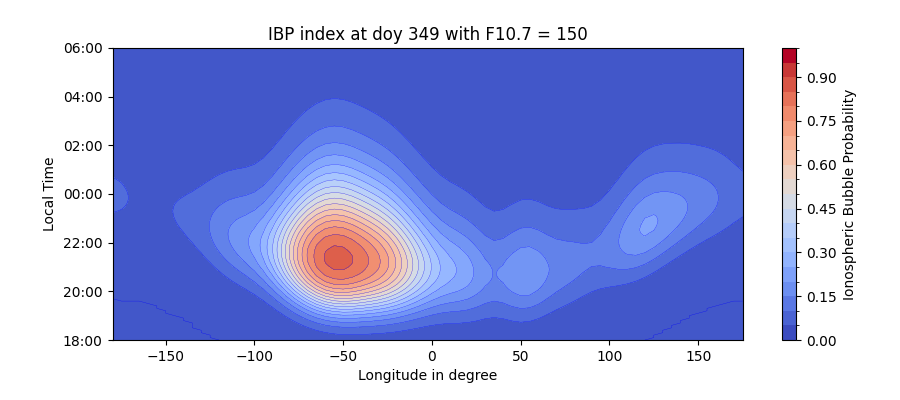
The IBP model reproduces the high occurrence probability of EPDs ranging between 50-90% over the South American (75-25°W) sector and low occurrence probability over the Pacific sector during the period around December solstice.
>>> ibp.plotButterflyData(f107=150)
>>>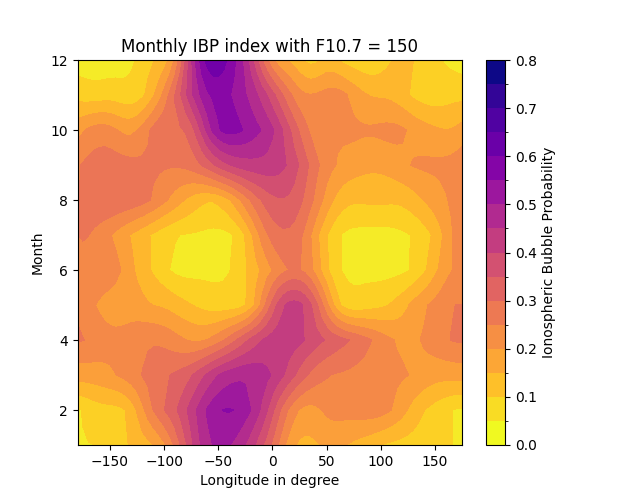
The monthly global occurrence rate of EPDs from the IBP model, is derived for a fixed value of F10.7=150 s.f.u for all integer longitudes at a resolution of 5° at the middle of each month and averaged between 19 and 1 LT. The seasonal and longitudinal variations of the EPD occurrence rates are particularly well-characterized by the IBP model as compared to its climatology with highest rates seen around the equinoxes and winter solstice in the America-Atlantic-Africa region and lowest rates during November-February in the Pacific sector and during May-July in the America-Atlantic and Indian sectors.
References
Stolle, C., Feizbaksh, M., Das, S. K., Yamazaki, Y., Siddiqui, T. A., Schreiter, L. (2025). Statistical model of night-time equatorial F region plasma irregularities based on Swarm geomagnetic and plasma density data. 15th Swarm DQW (Oslo, Norway).
Stolle, C., Siddiqui, T. A., Schreiter, L., Das, S. K., Rusch, I., Rother, M., & Doornbos, E. (2024). An empirical model of the occurrence rate of low latitude post‐sunset plasma irregularities derived from CHAMP and Swarm magnetic observations. Space Weather, 22, e2023SW003809. https://doi.org/10.1029/2023SW003809
Lucas Schreiter, Anwendungsorientierte Modellierung der Auftretenswahrscheinlichkeit und relativen Häufigkeit von äquatorialen Plasmabubbles, Master’s thesis, Institute of Mathematics, University of Potsdam, 2016. (in German only)
Information for developers
Setup environment
$ git clone https://igit.iap-kborn.de/ibp/ibp-model.git
$ cd ibp-model
$ pip install -r requirements-dev.txt
$ pip install -e .
Test of package using doctest
$ python src/ibpmodel/ibpcalc.pyNo error should occur.
Test run of the documentation
$ cd docs
$ make clean && make html
The docs/build/html/ directory contains the html files. Open index.html in browser. The results of the code examples on the usage page are generated automatically. Therefore the ibpmodel package must be installed (pip install -e .).


Release files for ibpmodel 2.0.2
For a detailed explanation of source distributions (sdists) and built distributions (wheels), please see the package formats documentation.
Source distribution (sdist)
| File | Size | Uploaded | |
|---|---|---|---|
| ibpmodel-2.0.2.tar.gz | 7.7 MB | Details |
Built distribution (wheel)
| File | Interpreter | ABI | Platform | Reset |
|---|---|---|---|---|
| ibpmodel-2.0.2-py3-none-any.whl | Python 3 | none | any | Details |
Total release size: 8.0 MB
Release files / ibpmodel-2.0.2.tar.gz
| Download URL | ibpmodel-2.0.2.tar.gz |
|---|---|
| Size | 7.7 MB |
| Tags | Source |
|
SHA-256 checksum How to use checksums |
ff48fbaf03875a154f13952a6d5a0f46c862b1a0a98069a4a42356ce7f7e510e
|
|
BLAKE2b-256 checksum How to use checksums |
0d6ecad083dc8f2bcb1c875d64c1a1b62018775a0d293d684106c85502e330b3
|
| Upload date | |
|
Uploaded using Trusted Publishing? What is trusted publishing? |
No |
| Uploaded via |
twine/6.2.0 CPython/3.12.8
|
Release files / ibpmodel-2.0.2-py3-none-any.whl
| Download URL | ibpmodel-2.0.2-py3-none-any.whl |
|---|---|
| Size | 287.1 kB |
| Tags | Python 3 |
|
SHA-256 checksum How to use checksums |
622da82b25cac1c8de042ddb051d26eaf28c9aa8b8518aa2151328117126909f
|
|
BLAKE2b-256 checksum How to use checksums |
9bb8f78367aa7065250472e09160d41391e3f951f1cee0803dd13c2a54ae8ffe
|
| Upload date | |
|
Uploaded using Trusted Publishing? What is trusted publishing? |
No |
| Uploaded via |
twine/6.2.0 CPython/3.12.8
|














