





Ask Claude about your week, your inbox or the file you saved last spring, and it just knows.
iCloud MCP connects Claude, or any MCP client, to the Apple account you already live in.
It runs on your own machine, keeps your password there, and asks before anything leaves.
Just ask.
"Find the email from my landlord about the heating and draft a polite reply."
"When am I free for an hour next week? Book lunch with Anna then."
"Move Thursday's dentist appointment to Friday, same time. Only that one."
"Remind me to renew my passport on the first of next month."
"Find my tax return PDF in iCloud Drive and tell me what I paid last year."
Private by design.
Your password stays home.
Apple has no sign-in for these services other than an app-specific password.
It lives only on your machine or in your Mac's Keychain. Claude never sees it.
Nothing leaves without you.
Mail Claude writes waits for your approval, or lands in your Drafts.
Invitations to other people are off. Deletes go to the Trash.
Built for mail from strangers.
Everything Claude reads is marked as someone else's words, not instructions.
Hidden characters are stripped, and phishing tricks are called out.
Tested where it counts.
385 offline tests on every change, integration tests against real mail and calendar servers,
and hands-on runs against a live iCloud account for the quirks only Apple's servers have.
New in 0.4.
| Faster mail Logged-in connections are reused, so repeat mail calls are about 40% quicker. |
What changedmail_changes lists only new and changed messages since the last check. |
Newsletter radar Bulk mail is marked in every search; mail_senders shows who fills your inbox. |
| Safe bulk clean-up Archive, trash or mark read by search, with a preview, a token and a 30-day undo. |
Unsubscribe safely The standard one-click request or an email; links in the body are never followed. |
Exact bookings Flights, hotels, trains, tickets and invitations read from the booking data, never guessed. |
| Edit notes Append to or rewrite a note, guarded by a content hash and backed up first. |
Search inside files Find words in your iCloud Drive PDFs and documents, not just their names. |
Send Drive filesdrive_get_file hands over the file itself, so it can be attached or sent on. |
| Birthdays Upcoming birthdays from your contacts, with the age they turn. |
Ready-made workflows Triage my inbox, Plan my week, Prepare for an appointment, Birthdays coming up. |
Shortcuts Run the Shortcuts you allow, allowlisted on the server and again on the Mac. |
Also in 0.3: the one-click Claude Desktop extension, local mode, Keychain storage, free time, RSVP, single occurrences, invitation delivery reports and scam warnings.
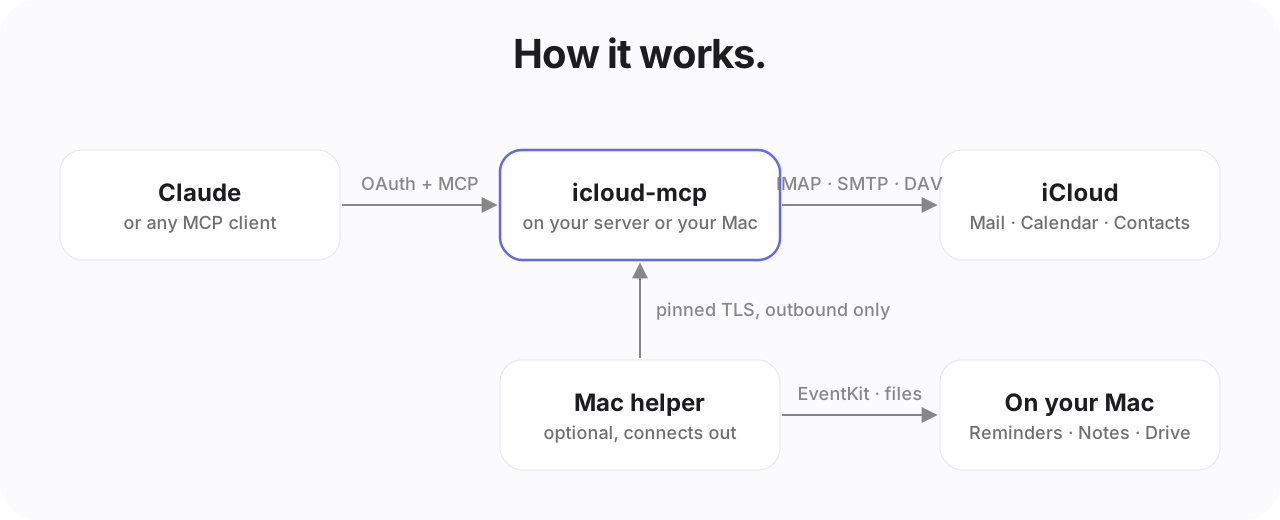
Mail, Calendar and Contacts use Apple's standard protocols.
Reminders, Notes and iCloud Drive go through an optional helper on your Mac.
It connects out, so your Mac never opens a port.
| Claude Desktop | Claude Code | Your own server | |
|---|---|---|---|
| Setup | Double-click an extension | One command | Docker and an HTTPS address |
| Works in | Claude Desktop on this computer | Claude Code on this computer | Claude on the web, desktop and phone |
| Outgoing mail | Saved to Drafts for you to send | Saved to Drafts for you to send | Waits for your approval in a browser |
| Guide | Install › | Set up › | Quick start › |
Run it locally (Claude Desktop and Claude Code)
The server runs on your own computer. Your client starts it when it needs it and talks to it directly, so there is no public address, tunnel, Docker or OAuth. Claude on the web and on your phone can't reach it; for that, host it.
Claude Desktop in one click
- Download
icloud-mcp-<version>.mcpbfrom the latest release. - Double-click it, or drag it onto Claude Desktop → Settings → Extensions.
- Fill in your Apple Account email, an app-specific password (Claude Desktop keeps it in your system keychain), your name and your time zone, such as
Europe/Amsterdam.
It starts approval-first: mail is saved to Drafts for you to send, and invitations to other people are off. This covers Mail, Calendar and Contacts. Reminders, Notes and iCloud Drive need the Mac helper and the manual setup below.
Manual setup (Claude Code, or Claude Desktop with more options)
1. Put your settings in a file only you can read.
mkdir -p ~/.icloud-mcp && chmod 700 ~/.icloud-mcp
cat > ~/.icloud-mcp/icloud.env <<'END'
ICLOUD_USERNAME=you@icloud.com
ICLOUD_DISPLAY_NAME=Your Name
DEFAULT_TIMEZONE=Europe/Berlin
END
chmod 600 ~/.icloud-mcp/icloud.env
2. Keep the password in your Keychain (on a Mac). It asks for the app-specific password and never shows it on the command line:
uvx icloud-mcp-server --store-password
Not on a Mac? Add ICLOUD_APP_PASSWORD=xxxx-xxxx-xxxx-xxxx to the file instead. Any setting from Configuration can go in it; MCP_PUBLIC_URL and MCP_OWNER_PASSWORD are not needed.
3. Add it to your client (needs uv).
Claude Code:
claude mcp add icloud -- uvx icloud-mcp-server --local --env-file ~/.icloud-mcp/icloud.env
Claude Desktop: Settings → Developer → Edit Config, add this to claude_desktop_config.json, and restart Claude:
{
  "mcpServers": {
    "icloud": {
      "command": "uvx",
      "args": ["icloud-mcp-server", "--local", "--env-file", "/Users/YOU/.icloud-mcp/icloud.env"]
    }
  }
}
If Claude Desktop can't find uvx, use its full path (which uvx). Without uv, pip install icloud-mcp-server and use icloud-mcp as the command.
How sending works locally. There is no approval page, so with the default SEND_REQUIRES_APPROVAL=true every message Claude sends is saved to your Drafts folder instead, and the result says so. You review it in Mail and press Send yourself. Set SEND_REQUIRES_APPROVAL=false to let Claude send directly; your client's own "ask before use" setting is then the only check.
Reminders, Notes and iCloud Drive locally. Add ENABLE_REMINDERS=true (and/or ENABLE_NOTES, ENABLE_DRIVE) and a BRIDGE_TOKEN to the env file, start your client once, then install the Mac helper with server https://127.0.0.1:8001 and the fingerprint from ~/.icloud-mcp/bridge_fingerprint.txt. In local mode the bridge only listens on 127.0.0.1. If two clients start the server at once, only the first gets the Mac tools; Mail, Calendar and Contacts work in both.
Quick start
Host it once, and Claude reaches your iCloud from the web, the desktop app and your phone.
You need
- Docker with the compose plugin (or Python 3.11+).
- An Apple Account with two-factor authentication and an app-specific password (account.apple.com → Sign-In and Security → App-Specific Passwords).
- A public HTTPS address. Claude connects from Anthropic's cloud, so a LAN or VPN address won't work. A Cloudflare Tunnel is the simplest: outbound only, no port forwarding.
- A Claude plan that supports custom connectors.
1. Configure
git clone https://github.com/epinethrone/icloud-mcp.git && cd icloud-mcp
cp .env.example .env     # fill in ICLOUD_USERNAME, ICLOUD_APP_PASSWORD, ICLOUD_DISPLAY_NAME,
                         # MCP_PUBLIC_URL (your https address, no trailing slash), MCP_OWNER_PASSWORD
chmod 600 .env
MCP_OWNER_PASSWORD is a new random password (12+ characters) that you type when approving a client and on the outbox page. It is not your Apple password. ./configure.sh asks for the secrets with silent prompts if you prefer.
2. Check your credentials against the real iCloud before exposing anything
docker build -t icloud-mcp:local .
docker run --rm --env-file .env icloud-mcp:local python -m icloud_mcp.selftest                              # logs in to IMAP, SMTP, CalDAV, CardDAV; sends nothing
docker run --rm --env-file .env icloud-mcp:local python -m icloud_mcp.selftest --probe-sent you@example.com   # sends ONE test mail
If a login fails, the login name is the usual cause: set IMAP_USERNAME, SMTP_USERNAME, CALDAV_USERNAME or CARDDAV_USERNAME separately.
3. Run it
docker compose up -d --build # listens on 127.0.0.1:8000 only
For the bundled Cloudflare Tunnel: create a tunnel, point its public hostname (the host in MCP_PUBLIC_URL) at http://icloud-mcp:8000, put the token in .tunnel.env as TUNNEL_TOKEN=..., and start with docker compose --profile tunnel up -d --build. Any TLS front (Caddy, nginx) works too, as long as it keeps the Host header. MCP_PUBLIC_URL must match the public address exactly.
4. Connect Claude
Settings → Connectors → Add custom connector → https://<your-host>/mcp. Your server shows an approval page: enter the owner password. Reconnect the connector whenever you change tools or settings, because Claude caches tool definitions. To revoke every connected client, delete oauth_state.json in the data volume and restart.
5. Check it works
In a new chat, ask "Check my iCloud connection." Claude runs icloud_check_health, which signs in to each service and reports how long each took. Then try "What's on my calendar this week?" and ask Claude to email yourself. With the default settings nothing is sent: the message waits at https://<your-host>/outbox until you approve it. If anything fails, see Troubleshooting.
Approving outgoing mail
With the default SEND_REQUIRES_APPROVAL=true, mail_send, mail_reply and mail_forward return queued_for_owner_approval and nothing leaves. Open https://<your-host>/outbox (bookmark it, and only type the password there, never on a link an agent gives you), enter the owner password, review the exact recipients and text, then approve or discard. Queued messages expire after OUTBOX_TTL_SECONDS (24 hours by default) and are released at most once.
Security
A connector that can read your mail and act for you is a prompt-injection target: a hostile email or invitation can contain text that tries to steer the agent. The server labels all such content as untrusted and tells agents to treat it as data, but that is a request to a language model, not a guarantee. What actually protects you is configuration:
| Risk | Default | Setting |
|---|---|---|
| Agent sends mail on injected instructions | Sending only queues the message for your approval at /outbox (locally: saves it to Drafts) |
SEND_REQUIRES_APPROVAL=true |
| Agent emails invitations to strangers | Attendee changes are blocked | ALLOW_CALENDAR_INVITES=false |
| Agent mails arbitrary addresses | Any address, at most 25 per message | SEND_ALLOWLIST, MAX_RECIPIENTS |
| Agent destroys mail | Delete moves to Trash; permanent delete is off | ALLOW_PERMANENT_DELETE=false |
| Agent destroys notes or files | Notes go to Recently Deleted, Drive files to the Trash. Nothing through the Mac helper is ever deleted permanently | always on |
| Agent changes anything at all | Everything writable | READ_ONLY=true for a read-only connector |
In Claude you can also set the send, reply, forward and delete tools to "ask before use". Anyone who obtains the app-specific password has full access to mail, calendar and contacts (Apple offers no narrower scope), so protect the server and its .env accordingly.
The full security model
- iCloud credentials exist only in the server environment or the macOS Keychain. Clients hold short-lived bearer tokens for this server.
- Clients may register dynamically, but nothing is authorised without the owner password. Redirect hosts are restricted. Tokens are stored as SHA-256 hashes (file mode 600). The approval and outbox pages lock after 10 wrong passwords in 15 minutes (server-wide; existing tokens keep working).
- Every refused sign-in renewal is logged with its reason (already rotated, expired, wrong client, not recognised), never with token values, and unauthenticated callers cannot flood the log:
docker compose logs icloud-mcp | grep 'oauth:'. - Text from mail, events, notes and files is stripped of invisible steering characters (Unicode tag characters, zero-width spaces, direction overrides; the marks Kurdish, Persian and Arabic text need are kept), and results carry
safety_warningswhen the text addresses an AI, asks for passwords or codes, or says bank details changed (English and Dutch). - Health-check errors are redacted: no passwords, account addresses or account ids.
- The MCP endpoint validates
HostandOrigin. Tool results carry an untrusted-content notice. HTTP-client request logging is disabled so account identifiers do not reach the logs. - The Mac bridge runs on its own private TLS port with a self-signed certificate the helper pins by fingerprint, plus a bearer token. It is never served on the public address or through the tunnel. The server sends only an operation name and validated arguments from a fixed list, never script text.
- Single-owner by design: one deployment serves one iCloud account. It is not multi-tenant, and storing other people's app-specific passwords is deliberately out of scope.
Tools
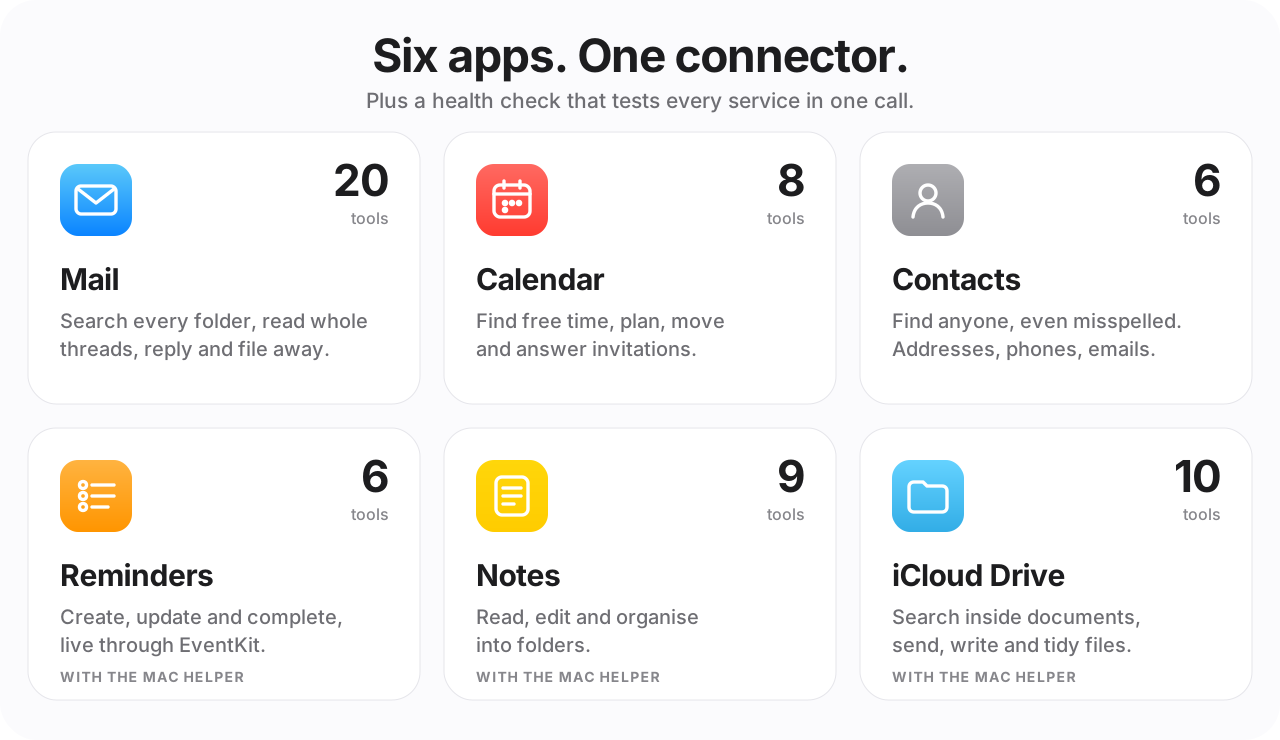
63 tools. 35 for Mail, Calendar, Contacts and the health check, 26 more with the optional Mac helper, and 2 for Shortcuts you allowlist. Open a section for the details.
Mail · 20 tools
| Kind | Tools |
|---|---|
| Read | mail_list_folders, mail_search, mail_changes, mail_find_correspondent, mail_get_message, mail_get_messages (up to 25 in one call), mail_get_thread, mail_get_attachment, mail_extract_bookings |
| Read | mail_senders (who fills a folder, busiest first, with bulk and unsubscribe info) |
| Write | mail_send, mail_reply (including reply-all), mail_forward, mail_mark, mail_move, mail_delete (to Trash), mail_create_folder, mail_bulk_action, mail_bulk_undo, mail_unsubscribe |
- Replies keep the
Re:subject,In-Reply-ToandReferences, the right recipients and the quoted original in plain text and HTML. Sent mail is copied to Sent and the original is flagged Answered (forwards get$Forwarded).draft=truesaves to Drafts instead of sending. mail_get_messagesreads a batch (a day's unread mail, a whole thread) in one IMAP round trip, about 7 times faster than one at a time.- Search every folder at once.
mail_searchwithall_folders=truelooks in Archive, Sent, Junk and your own folders too, newest first, because mail rules and replies file messages away from the inbox. - Newsletters are told apart from people. Search results mark
bulkmail (a List-Unsubscribe or List-Id header, bulk precedence, automated or no-reply senders) and say how it can be unsubscribed from;mail_sendersgroups a folder by sender. - Clean up in bulk, safely.
mail_bulk_action(move, archive, trash, mark read) always previews first: the count, a sample and a confirm token that stands for exactly those messages. Running needs that token, so mail that arrived since is never touched. Every run is logged by Message-ID andmail_bulk_undoreverses it for 30 days. It needs at least one filter and never deletes permanently. - Unsubscribe without following links.
mail_unsubscribeuses only the List-Unsubscribe header: the standard one-click request (RFC 8058, HTTPS to public addresses only) or an unsubscribe email through the normal send path, so approval rules apply. Links in the body are never followed, unsubscribe web pages are only handed to you, and mail in Junk is refused. - Bookings come out exact.
mail_extract_bookingsreads the schema.org booking data airlines, hotels, rail and ticket shops embed (flights, stays, trains, buses, rental cars, restaurants, events) and.icsinvitations, and returns each with a readycalendar_create_eventblock. Nothing is guessed from the wording; a message without that data says so. - Only what changed.
mail_changesreturns a token; passed back next time, it lists just the new messages and those whose read, flagged or answered state changed, using IMAP CONDSTORE instead of re-reading the folder. If iCloud renumbered the folder, it says to start over rather than guess. - Stale ids are refused. Every message comes with its folder's
uidvalidity; tools that act on a uid accept it back and refuse if iCloud has renumbered the folder since, instead of touching a different message. - Reading a message does not mark it read. Bcc recipients receive the mail, but the header is stripped on the wire.
- Recipients accept
a@b.com,Name <a@b.com>ormailto:a@b.com. Anything else is rejected with a clear error and never silently dropped.
Calendar · 8 tools
calendar_list_calendars, calendar_list_events, calendar_find_free_time, calendar_get_event, calendar_create_event, calendar_update_event, calendar_delete_event, calendar_rsvp
- Multiple calendars, recurring events expanded when listing, all-day events, alerts, links, notes and attendees. Editing or deleting a recurring event changes the whole series, or just one date when you pass
occurrence_start(the rest of the series is left alone). - Finding free time is one call.
calendar_find_free_timereturns openings of a given length within your hours and chosen weekdays. Travel time counts as busy; events marked free, cancelled events and invitations you declined do not; all-day events are listed separately instead of guessed about. - Know whether an invitation went out. After inviting people, the result reports what iCloud recorded for each guest (sent, delivered, or refused, for example a mistyped address), so an agent never claims someone was invited when they were not.
- Answer invitations.
calendar_rsvpaccepts, declines or marks tentative, for the whole series or one date; iCloud emails the organizer itself. - Safe to retry.
calendar_create_eventandcontacts_createtake an optionalrequest_id: if a call times out and is retried with the same one, the first attempt is found instead of creating a duplicate. - Apple travel time and map locations. Events can carry Apple's travel time (by bike, on foot, by car or public transport) and a structured destination, which is what makes Apple draw the map card.
- Adding a guest leaves everyone else alone. Updating the guest list merges instead of replacing, so existing guests keep their RSVP and aren't sent the invitation again. Invitations are emailed by iCloud itself and are off unless you allow them.
Contacts · 6 tools
contacts_search, contacts_get, contacts_upcoming_birthdays, contacts_create, contacts_update, contacts_delete
- Contacts are fetched whole, cached and searched locally by name, nickname, company, email or phone, ignoring accents. A contact with no email comes back with
has_email: false, so an agent asks instead of guessing. - Misspelled names are handled.
contacts_searchsuggests similar-sounding names when nothing matches exactly, andmail_find_correspondentfinds people you've emailed by approximate name, address or company, reading only message headers. Approximate matches are labelled, and agents must ask you to confirm before sending, inviting or editing on one. - Postal addresses are read and written as street, city, region, postcode and country, with home, work or your own labels ("Holiday house"), stored the way Apple's Contacts app expects.
- Birthdays coming up.
contacts_upcoming_birthdayslists them soonest first, with the age turned when the year is known (Apple's "year unknown" 1604 is understood, and 29 February falls on the 28th in other years). - Updates keep every field outside the changed ones and use ETags to refuse stale overwrites. Contact photos and notes are never returned.
Reminders · 6 tools, with the Mac helper
reminders_lists, reminders_list, reminders_create, reminders_update, reminders_complete, reminders_delete
- Runs through Apple's EventKit: every read is live and takes about 20 to 40 ms, however long your lists are. Only active reminders are returned.
- List names can repeat across accounts, so tools accept a
list_idand refuse an ambiguous name. Due dates are validated as real dates (a bare date means 09:00 local time).
Notes · 9 tools, with the Mac helper
notes_folders, notes_list, notes_read, notes_create, notes_append, notes_update, notes_create_folder, notes_move, notes_delete
- Read, create, edit and organise: add to a note (
notes_append, keeps headings, lists and styling; notes with tables are refused) or rewrite it (notes_update, keeps the title), create folders and subfolders, and move notes between them. - Edits are guarded.
notes_readreturns acontent_hash; append and update need it with the current title, so a note that changed since it was read is never overwritten. Locked notes, notes with attachments and notes in Recently Deleted are refused, and the old version is saved to~/Library/Application Support/icloud-mac-helper/note-backups/before anything is written. - Move and delete act on one note at a time and need its current title as well as its id, so a stale or wrong id changes nothing.
- Delete moves a note to Recently Deleted, where you can recover it for about 30 days. It refuses locked notes, and notes already in Recently Deleted, because removing them from there would be permanent. Nothing is ever moved into Recently Deleted.
iCloud Drive · 10 tools, with the Mac helper
drive_list, drive_search, drive_search_content, drive_info, drive_read, drive_get_file, drive_write, drive_create_folder, drive_move, drive_trash
- Works on your whole iCloud Drive as your Mac keeps it in sync, so every change syncs to your other devices by itself.
drive_readreturns text from plain text files, PDFs and Word, RTF, ODT and HTML documents. Files offloaded by "Optimise Mac Storage" are downloaded first. If that takes too long, the answer says the file is still downloading, instead of timing out.- Search inside files.
drive_search_contentfinds words in the text of plain text, PDF, Word, RTF, ODT and HTML files (case and accents ignored) and returns an excerpt for each match. Each file is read once and its text kept in a private cache on the Mac (drive-text-cache.sqlite, mode 600), so later searches are fast and still work after macOS offloads the file. Files that are only in iCloud are skipped unlessdownload=true, and the answer always says how many were left out. (Spotlight was tried first and dropped: its index of iCloud Drive was measurably incomplete.) drive_writecreates plain text files. Replacing a file needsoverwrite, and the old version goes to the Trash.drive_movenever overwrites.drive_get_filehands over the file itself (base64, up toMAX_ATTACHMENT_BYTES), so an agent can attach it or send it on, the waymail_get_attachmentdoes for mail.- Nothing is ever deleted permanently.
drive_trashmoves items to the Trash, where you can recover them. - Paths are relative to the Drive and can't leave it, not through
..and not through a symbolic link (links that lead outside are not even listed). The Drive's trash folder is off limits.
Status · 2 tools
icloud_check_health checks every enabled area in one call (signs in to mail, lists calendars, reads the address book, asks whether the Mac helper is online) and says how long each took. mac_helper_status says whether the Mac helper is online, when it was last seen and which version it runs.
Ready-made workflows
The server also offers MCP prompts your client can show as one-click workflows: Triage my inbox, Plan my week, Prepare for an appointment and Birthdays coming up. Each only appears when the areas it needs are on, and each tells the agent to show you what it would do before sending, booking, moving or deleting anything.
Reminders, Notes and iCloud Drive through your Mac
Apple only exposes Reminders, Notes and iCloud Drive on its own devices, so a small helper (mac-helper/) runs on your Mac and does the work when the server asks.
- Nothing listens on your Mac. The helper connects out to a private HTTPS port of the server (never the public address, never the tunnel) and long-polls for jobs.
- No code is ever sent. The server sends an operation name and validated arguments from a fixed list. Reminders run a small EventKit program the installer builds on your Mac. Notes run static scripts. iCloud Drive runs one fixed Python script under Apple's own Python. In every case the arguments arrive as one JSON value, never as code.
- Pinned and authenticated. TLS with a self-signed certificate the helper pins by fingerprint, plus a bearer token.
- Honest when it's off. It works while your Mac is on and reachable (home network or VPN). When it isn't, the tools say so.
Enable it in .env with any of ENABLE_REMINDERS=true, ENABLE_NOTES=true and ENABLE_DRIVE=true, a BRIDGE_TOKEN of at least 32 random characters, and BRIDGE_BIND set to the address the Mac reaches the server on. The server logs the certificate fingerprint for the installer, and also writes it to bridge_fingerprint.txt in its data folder. Then follow the Mac helper guide.
Shortcuts, allowlisted twice. To let the assistant run some of your Shortcuts (shortcuts_list, shortcuts_run), list their exact names in SHORTCUTS_ALLOW on the server and, one per line, in ~/Library/Application Support/icloud-mac-helper/shortcuts-allow.txt on the Mac. A name must be on both lists, so a compromised server can never run a shortcut you did not allow at the Mac itself. Apple's shortcuts command runs it, with optional text input, and its text output comes back. The tools do not exist without an allowlist or on a read-only server.
Configuration
Everything is an environment variable. .env.example has a comment for each one.
All settings
| Variable | Default | Meaning |
|---|---|---|
ICLOUD_USERNAME |
required | The Apple Account you sign in with |
ICLOUD_APP_PASSWORD |
required (or Keychain) | App-specific password |
ICLOUD_KEYCHAIN, ICLOUD_KEYCHAIN_SERVICE |
true, icloud-mcp | macOS: read the app-specific password from the login Keychain when ICLOUD_APP_PASSWORD is not set (store it with --store-password) |
ICLOUD_EMAIL_ADDRESS |
username | From address (your iCloud address or alias) |
ICLOUD_DISPLAY_NAME, EMAIL_SIGNATURE |
empty | Sender name; plain-text signature added to sent mail (\n = new line) |
IMAP_HOST/PORT/SECURITY/USERNAME |
imap.mail.me.com, 993, ssl, username |
IMAP |
SMTP_HOST/PORT/SECURITY/USERNAME |
smtp.mail.me.com, 587, starttls, username |
SMTP |
CALDAV_URL, CALDAV_USERNAME, CALDAV_REQUIRE_TLS |
https://caldav.icloud.com, username, true |
CalDAV |
CARDDAV_URL, CARDDAV_USERNAME |
https://contacts.icloud.com, username |
CardDAV |
DEFAULT_TIMEZONE, DEFAULT_CALENDAR |
UTC, auto |
Timezone for times without an offset (an IANA name such as Europe/Amsterdam); calendar for new events (else "Calendar" or "Home", else the first) |
ENABLE_MAIL, ENABLE_CALENDAR, ENABLE_CONTACTS |
true | Switch whole areas off |
ENABLE_REMINDERS, ENABLE_NOTES, ENABLE_DRIVE |
false | Areas that go through the Mac helper (need BRIDGE_TOKEN) |
TOOLS |
all | essential and/or tool names to expose; everything else is not registered at all. An unknown name stops the server and lists the real ones |
BRIDGE_TOKEN, BRIDGE_BIND |
empty, 127.0.0.1 | Mac helper secret (32+ characters) and the address its private port is published on |
BRIDGE_HOST |
0.0.0.0 (127.0.0.1 in local mode) | Address the bridge binds to inside the process. Use 127.0.0.1 when the server runs directly on the helper's Mac |
SHORTCUTS_ALLOW |
empty | Exact names of Shortcuts the assistant may run through the Mac helper, separated by commas (or by ; when a name contains a comma); the Mac must list them too (see below) |
BRIDGE_JOB_TIMEOUT_SECONDS |
60 | How long a tool call waits for the Mac |
READ_ONLY |
false | No sending, moving, deleting, or calendar, contact, reminder, note or file changes |
ALLOW_SEND |
true | false = agents can only save drafts |
SEND_REQUIRES_APPROVAL |
true | Queue outgoing mail for browser approval (locally: save it to Drafts) |
OUTBOX_TTL_SECONDS, OUTBOX_MAX |
86400, 20 | Queue lifetime and size |
ALLOW_CALENDAR_INVITES |
false | Allow attendees (iCloud then emails invitations, updates and cancellations) |
SEND_ALLOWLIST |
empty | Only these addresses or domains may receive mail (@example.org,friend@example.com) |
MAX_RECIPIENTS |
25 | Per message |
ALLOW_PERMANENT_DELETE |
false | Allow deleting mail from Trash |
SAVE_SENT_COPY |
true | Copy sent mail to Sent (iCloud doesn't do it itself) |
MAX_BODY_CHARS, MAX_ATTACHMENT_BYTES |
30000, 5 MiB | Result size caps |
MCP_PUBLIC_URL, MCP_OWNER_PASSWORD |
required when hosted | Public https address; owner password (12+ characters) |
MCP_HOST, MCP_PORT, MCP_EXTRA_ALLOWED_HOSTS |
0.0.0.0, 8000, empty | Bind address and extra allowed Host headers |
MCP_STATELESS |
true | No server-side MCP sessions, so a restart never breaks a connected client ("Missing session ID") |
TOOL_TIMEOUT_SECONDS |
90 | A tool call running longer is abandoned with an error instead of hanging |
IMAP_POOL_SIZE, IMAP_IDLE_SECONDS |
2, 600 | Logged-in mail connections kept for reuse (0 = log in on every call), and how long an unused one is kept |
DATA_DIR |
./data (/data in Docker) |
OAuth state and the outbox |
OAUTH_ALLOWED_REDIRECT_HOSTS |
claude.ai,claude.com,localhost,127.0.0.1 |
Clients that may register |
ACCESS_TOKEN_TTL, REFRESH_TOKEN_TTL |
3600, 30 days | Token lifetimes (refresh tokens rotate) |
LOG_LEVEL |
INFO |
Troubleshooting
Start by asking Claude to "check my iCloud connection": icloud_check_health tests every enabled area and names the one that fails.
Claude Desktop extension
| Symptom | Fix |
|---|---|
| "Failed to initialize cache", "Operation not permitted" or "Unable to connect to extension server" | Security software is probably blocking the uv and Python the extension downloads (antivirus application control, such as F-Secure's, does this for unsigned programs). Allow uv and its Python in that software, or quit it once to confirm, or use the manual setup with a Python you already trust. |
| Times are off by an hour or more | The time zone field needs one IANA name, such as Europe/Amsterdam, and nothing else. Change it under Settings → Extensions → iCloud. |
| Reminders, Notes or Drive are missing | The extension covers Mail, Calendar and Contacts. The Mac areas need the manual setup and the Mac helper. |
Server and connection
| Symptom | Fix |
|---|---|
selftest fails to log in |
The login name is the usual cause. Some accounts sign in to one service with a different name: set IMAP_USERNAME, SMTP_USERNAME, CALDAV_USERNAME or CARDDAV_USERNAME separately. Use an app-specific password, never your Apple Account password. |
| Claude can't reach the connector, or the approval page never appears | MCP_PUBLIC_URL must match the public address exactly, with no trailing slash, and your TLS front must keep the Host header. Make sure no login wall such as Cloudflare Access sits in front of the server. |
| The approval or outbox page won't accept your password | After 10 wrong passwords in 15 minutes the pages lock for everyone. Wait, then use the owner password from .env, not your Apple password. |
| New tools or changed settings don't show up in Claude | Claude caches tool definitions. Reconnect the connector in Claude's settings and start a new chat. |
| "Missing session ID" after the server restarted | Leave MCP_STATELESS=true (the default). If you turned it off, reconnect the connector after every restart. |
| A tool call times out | iCloud can be slow; a call is abandoned after TOOL_TIMEOUT_SECONDS (90 by default). Retry, and check the server logs if it keeps happening. |
Mail, calendar and contacts
| Symptom | Fix |
|---|---|
| Claude says it sent an email but nothing arrived | That is the approval step working. Hosted: open https://<your-host>/outbox, review the message and approve it. Locally: it is in your Drafts. |
| Adding a guest to an event is refused | Invitations are off by default. Set ALLOW_CALENDAR_INVITES=true if you want Claude to invite people. |
| Mail to a certain address is refused | Check SEND_ALLOWLIST and MAX_RECIPIENTS. |
| Sent mail doesn't appear in Sent | iCloud doesn't file sent mail by itself. Keep SAVE_SENT_COPY=true (the default). |
Mac helper: Reminders, Notes and iCloud Drive
| Symptom | Fix |
|---|---|
| Tools say the Mac helper is offline | The Mac must be on, awake, logged in and able to reach the bridge address (home network or VPN). Ask "Is the Mac helper online?", and check ~/Library/Logs/icloud-mac-helper/helper.log on the Mac. |
| The helper log shows "No route to host" | macOS blocks third-party Python from the local network. Use Apple's Python (the installer picks it), or allow it under Privacy & Security > Local Network. |
| Reminders are refused | Allow Full Access to Reminders for "iCloud Mac Helper (Reminders)" under Privacy & Security > Reminders, then run the helper's self-test. |
| Notes are refused ("not allowed to control") | Allow the helper's Python to control Notes under Privacy & Security > Automation. |
| iCloud Drive says the helper has no access | Give Full Disk Access to the Command Line Tools Python.app, and make sure the helper runs as that executable (re-run the installer). See the Mac helper guide. |
| Reading a Drive file says it is still downloading | The file was only in iCloud ("Optimise Mac Storage"). Its download has started; ask again in a minute. |
iCloud quirks this project works around
These only show up against Apple's real servers, never against local test servers:
- CalDAV rejects UID-filtered queries (
412), so events are fetched by resource name with a scan fallback. An attendee who is the account owner is rewritten to an internal path with the address in theEMAILparameter. - IMAP has no
MOVE. Moving and deleting use COPY, flag\Deleted, thenUID EXPUNGEof exactly those messages (never a plainEXPUNGE). iCloud doesn't file sent mail by itself. - CardDAV discovery ends on a different host than it starts on (follow the returned links), returns the whole address book in one request, and stores about half of all emails in grouped
itemN.EMAILproperties with labels initemN.X-ABLabel. - Travel time is a number Apple stores, not a live estimate. It is never recomputed, so an origin or travel mode without a duration is refused instead of silently doing nothing.
Limits
- Reminders, Notes and iCloud Drive need the Mac helper and a Mac that is on. Contact photos and notes are deliberately not exposed to agents, and deleting a contact is permanent.
- One identity: aliases can't be used as the From address. Attachments that aren't text come back as base64 and are size-capped.
- Mail calls reuse up to two logged-in connections, which saves the login (about a second) on each call after the first; calendar and contacts calls take about 1.5 to 5 seconds against iCloud.
- Claude doesn't show custom icons for custom connectors yet (open request). The server serves and advertises the project logo anyway, so clients that do show icons, and your browser tab on the approval and outbox pages, display it.
Contributing
Issues and pull requests are welcome. Every pull request gets the offline tests on Python 3.11 to 3.13 and an automated security-minded review.
- Security problems: please don't open a public issue. Follow the security policy instead.
- Before a pull request: make sure
pytest tests --ignore=tests/integrationpasses, and add tests for new behaviour. - Anything that talks to iCloud: run
selftest, and try it by hand against a real account. Local test servers accept things iCloud doesn't. - New tools: keep the safety defaults intact. Anything that sends, invites or deletes must stay behind the existing settings, and anything read from iCloud must be treated as data, never as instructions.
Development
python -m venv .venv && . .venv/bin/activate
pip install -e ".[test]"
pytest tests --ignore=tests/integration      # offline tests, no network
sudo apt install dovecot-imapd && dev/start_local_stack.sh
pytest tests                                 # adds integration tests against local Dovecot, an SMTP sink and Radicale
python packaging/mcpb/build.py               # builds the Claude Desktop extension into dist/
python dev/readme_art.py                     # redraws the README artwork in assets/readme/
dev/e2e_http.py drives a running server over HTTP (OAuth plus tool calls). Local test servers accept things iCloud doesn't (see the quirks above), so treat selftest and a manual run against a real account as part of testing any change.
Acknowledgements
Built on the MCP Python SDK, IMAPClient, caldav, icalendar, html2text, python-dateutil, Uvicorn and HTTPX. The Notes scripts are adapted from MrGo2/icloud-mcp (MIT); see THIRD_PARTY_NOTICES.md.
MIT License · Made for people who want an assistant for their Apple life without handing their Apple Account to anyone.
1 maintainer

Release files for icloud-mcp-server 0.4.0
For a detailed explanation of source distributions (sdists) and built distributions (wheels), please see the package formats documentation.
Source distribution (sdist)
| File | Size | Uploaded | |
|---|---|---|---|
| icloud_mcp_server-0.4.0.tar.gz | 261.7 kB | Details |
Built distribution (wheel)
| File | Interpreter | ABI | Platform | Reset |
|---|---|---|---|---|
| icloud_mcp_server-0.4.0-py3-none-any.whl | Python 3 | none | any | Details |
Total release size: 427.1 kB
Release files / icloud_mcp_server-0.4.0.tar.gz
| Download URL | icloud_mcp_server-0.4.0.tar.gz |
|---|---|
| Size | 261.7 kB |
| Tags | Source |
|
SHA-256 checksum How to use checksums |
d6bf6d3f6527e053f7adb924e02217444a2d1453462455f80b403417a25846ec
|
|
BLAKE2b-256 checksum How to use checksums |
f7dfcf6882f0dfd87fff20859c2d44792d36369a804f64631b5cb38e19dd2cbc
|
| Upload date | |
|
Uploaded using Trusted Publishing? What is trusted publishing? |
Yes |
| Uploaded via |
twine/7.0.0 CPython/3.13.14
|
Provenance
Provenance describes where a file came from. On PyPI, provenance is shared via attestations, which provide a verifiable record of the build or publishing details. View details, limitations and caveats.


PyPI Publish Attestation
PyPI verified that this artifact, at this checksum, originated from the publisher listed below.
Signed by GitHub Actions, verified by PyPI on Sep 24, 2026.
Transparency logRelease files / icloud_mcp_server-0.4.0-py3-none-any.whl
| Download URL | icloud_mcp_server-0.4.0-py3-none-any.whl |
|---|---|
| Size | 165.4 kB |
| Tags | Python 3 |
|
SHA-256 checksum How to use checksums |
268e6502e7b8467507b4b722a3ec6355bbbfcf93e4160958f7658bafb878491f
|
|
BLAKE2b-256 checksum How to use checksums |
f45c12d4cabd451a86e7584c4235d2a718e7e4a32f4476715b7e1de2b5e386c1
|
| Upload date | |
|
Uploaded using Trusted Publishing? What is trusted publishing? |
Yes |
| Uploaded via |
twine/7.0.0 CPython/3.13.14
|
Provenance
Provenance describes where a file came from. On PyPI, provenance is shared via attestations, which provide a verifiable record of the build or publishing details. View details, limitations and caveats.
PyPI Publish Attestation
PyPI verified that this artifact, at this checksum, originated from the publisher listed below.
Signed by GitHub Actions, verified by PyPI on Sep 24, 2026.
Transparency log













