
Geodesic Icosahedron
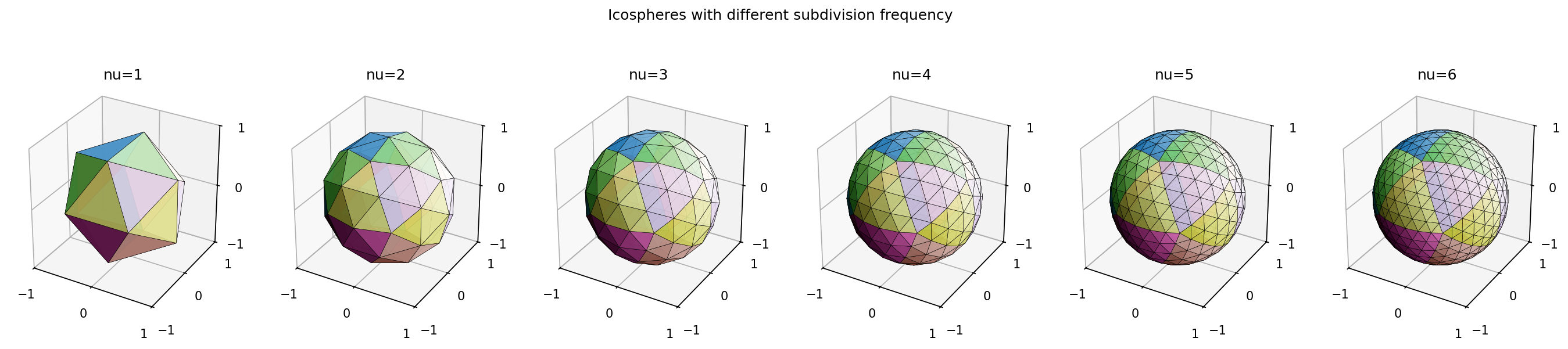
Creates a geodesic icosahedron given a subdivision frequency.

Installation
Install with pip install icosphere, or clone this repository.
Usage
from icosphere import icosphere
nu = 5  # or any other integer
vertices, faces = icosphere(nu)
Examples
See examples in the icosphere GitHub repository:
example_in_matplotlib.pyuses matplotlib for visualization.Example_in_plotly.ipynbuses plotly for interactive visualization.
You can also open the notebooks in Colab:
- plotly
Why use subdivision frequency?
For a certain subdivision frequency nu, each edge of the icosahedron will be split into nu segments, and each face will be split into nu**2 faces.
This is different from a more common approach that recursively applies subdivision with nu = 2, as used in pytorch3d ico_sphere, pymeshlab sphere, trimesh icosphere, and PyMesh generate_icosphere.
The subdivision-frequency approach gives better control of mesh resolution than recursive subdivision. In this approach, mesh resolution grows quadratically with nu, while in recursive subdivision it grows exponentially with the number of iterations. More precisely, under recursive subdivision, the number of vertices and faces in the resulting icosphere grows with iterations iter as nr_vertex = 12 + 10 * (4**iter - 1) and nr_face = 10 * 4**iter, which gives the sequence of vertex counts
12, 42, 162, 642, 2562, 10242, 40962, 163842, 655362, 2621442, 10485762...
Notice, for example, that there is no mesh with a vertex count between 2562 and 10242. Using subdivision frequency, the number of vertices and faces grows with nu as nr_vertex = 12 + 10 * (nu**2 - 1) and nr_face = 20 * nu**2, which gives the sequence of vertex counts
 12, 42, 92, 162, 252, 362, 492, 642, 812, 1002, 1212, 1442, 1692, 1962,
 2252, 2562, 2892, 3242, 3612, 4002, 4412, 4842, 5292, 5762, 6252, 6762,
 7292, 7842, 8412, 9002, 9612, 10242...
Now there are 15 meshes with vertex counts between 2562 and 10242. The advantage is even more pronounced at higher resolutions.
The code was originally developed for this work.
Reference this work
Dahl, V. A., Dahl, A. B., & Larsen, R. (2014). Surface Detection Using Round Cut. 2014 2nd International Conference on 3D Vision. https://doi.org/10.1109/3dv.2014.60
@inproceedings{Dahl_2014,
	doi = {10.1109/3dv.2014.60},
	url = {https://doi.org/10.1109%2F3dv.2014.60},
	year = 2014,
	month = {dec},
	publisher = {{IEEE}},
	author = {Vedrana A. Dahl and Anders B. Dahl and Rasmus Larsen},
	title = {Surface Detection Using Round Cut},
	booktitle = {2014 2nd International Conference on 3D Vision}
}
1 maintainer

Metadata
1 maintainer
Release files for icosphere 0.2.0
For a detailed explanation of source distributions (sdists) and built distributions (wheels), please see the package formats documentation.
Source distribution (sdist)
| File | Size | Uploaded | |
|---|---|---|---|
| icosphere-0.2.0.tar.gz | 14.8 kB | Details |
Built distribution (wheel)
| File | Interpreter | ABI | Platform | Reset |
|---|---|---|---|---|
| icosphere-0.2.0-py2.py3-none-any.whl | Python 2, Python 3 | none | any | Details |
Total release size: 30.3 kB
Release files / icosphere-0.2.0.tar.gz
| Download URL | icosphere-0.2.0.tar.gz |
|---|---|
| Size | 14.8 kB |
| Tags | Source |
|
SHA-256 checksum How to use checksums |
36fc68f4343435873486fcc78e8e6ee9735b8141a9ef9d1afe5c0a66e6056648
|
|
BLAKE2b-256 checksum How to use checksums |
9571f04c567027913b7423d8c59db7ee83fa3f091a9901b4f6fc00f0bee023e5
|
| Upload date | |
|
Uploaded using Trusted Publishing? What is trusted publishing? |
No |
| Uploaded via |
twine/6.2.0 CPython/3.9.12
|
Release files / icosphere-0.2.0-py2.py3-none-any.whl
| Download URL | icosphere-0.2.0-py2.py3-none-any.whl |
|---|---|
| Size | 15.5 kB |
| Tags | Python 2 Python 3 |
|
SHA-256 checksum How to use checksums |
51daed55e216773110395e35a70a714ad27bcb44189813c8e66ad9c034ffc465
|
|
BLAKE2b-256 checksum How to use checksums |
8cfe62ec5e3a6deb2a736f80908cbd97ca9e8eefec69b707445e21572f720bb8
|
| Upload date | |
|
Uploaded using Trusted Publishing? What is trusted publishing? |
No |
| Uploaded via |
twine/6.2.0 CPython/3.9.12
|














