
iDeepLC: A deep Learning-based retention time predictor for unseen modified peptides with a novel encoding system
Overview
iDeepLC is a deep learning-based tool for retention time prediction in proteomics.
Features
- Retention Time Prediction: Predict retention times for peptides, including modified ones.
- Fine-Tuning: Fine-tune the pre-trained model for specific datasets.
- Visualization: Generate scatter plots and other figures for analysis.
installation
Intall the package using pip:
pip install iDeepLC
Usage
Graphical user interface (GUI)
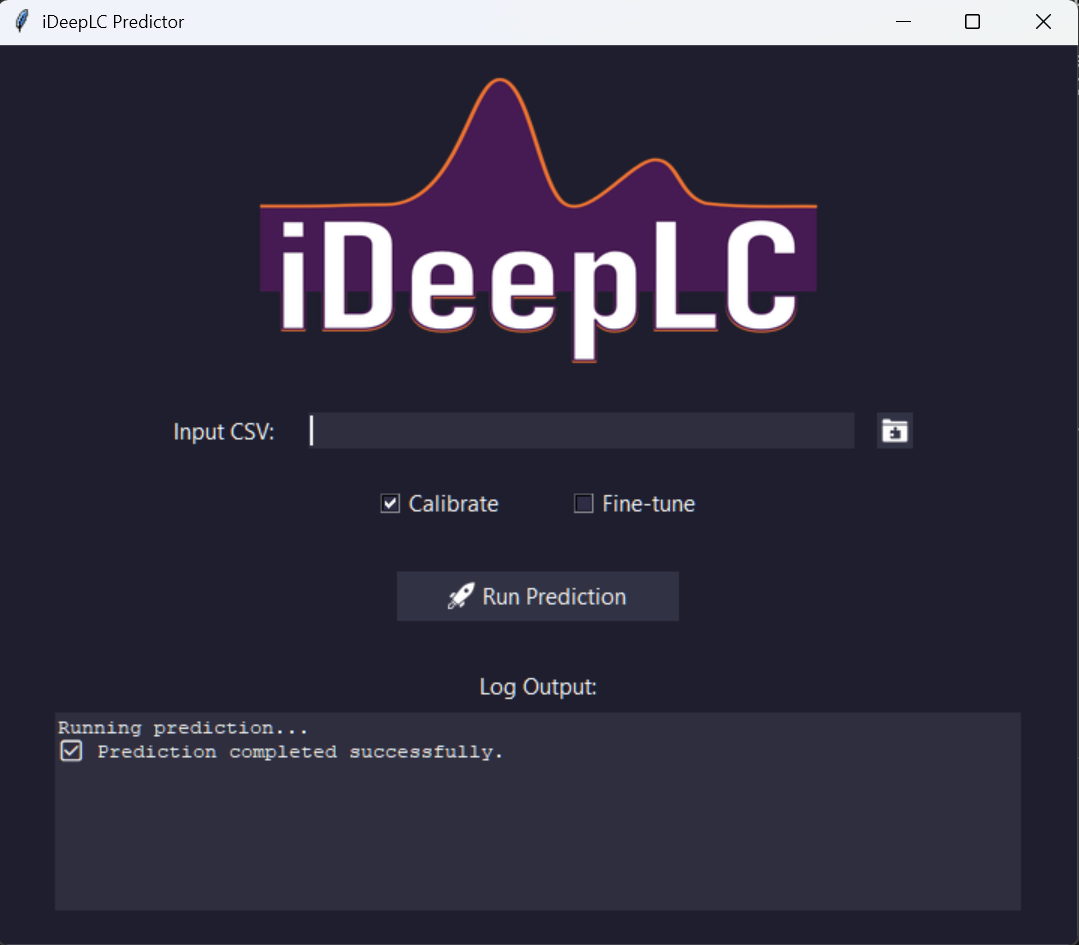
If you prefer not to install Python or any dependencies, you can use the standalone iDeepLC GUI for Windows.
This is a single .exe file that runs without any installation.
How it works
- When you run the
.exe, a terminal window will first appear.
This terminal acts as the logger for the GUI, showing progress and messages as the program runs. - Any results and generated figures will be saved in the same folder where the
.exefile is located.
Running the executable
- Download the
.exefile from the latest release. - Double-click the file to run it.
- If Windows shows a security message:
- "Windows protected your PC" — this is a standard warning for applications not signed with a commercial certificate.
- Click More info and then Run anyway to start iDeepLC.
This warning appears because the executable is built by the developers without a paid code-signing certificate.
The file is safe if downloaded from the official GitHub release page.
CLI
The iDeepLC package provides a CLI for easy usage. Below are some examples:
Prediction
ideeplc --input <path/to/peptide_file.csv> --save
Fine-tuning
ideeplc --input <path/to/peptide_file.csv> --save --finetune
When you run fine-tuning, the updated model is saved as finetuned_model_.pth in the project directory.
Calibration
ideeplc --input <path/to/peptide_file.csv> --save --calibrate
Example
ideeplc --input ./data/example_input/Hela_deeprt --save --finetune --calibrate
Custom modification features
If you have new modification entries with columns name, aa, and smiles, you can generate a standardized feature table and then use it during prediction:
ideeplc --input peptide_file.csv --user-mods user_mods.csv
Example input file for custom modifications:
name,aa,smiles
CustomOxidation,M,[O]
CustomAcetyl,K,CC(=O)C
CustomPhospho,S,OP(=O)(O)O
iDeepLC converts this CSV internally, creates the standardized modification features, and merges them with the built-in dictionary automatically. The name value is stored internally in the format modification#amino_acid, for example CustomOxidation#M.
For more detailed CLI usage, you can run:
ideeplc --help
Input file format
The input file should be a CSV file with the following columns:
seq: The amino acid sequence of the peptide. (e.g.,ACDEFGHIKLMNPQRSTVWY)modifications: A string representing modifications in the sequence. (e.g.,11|Oxidation|16|Phospho)tr: The retention time of the peptide in seconds. (e.g.,1285.63)
For example:
NQDLISENK,,2705.724
LGSPPPHK,3|Phospho,2029.974
RMQSLQLDCVAVPSSR,2|Oxidation|4|Phospho,4499.832
Citation
If you use iDeepLC in your research, please cite our paper:
📄 iDeepLC: A deep Learning-based retention time predictor for unseen modified peptides with a novel encoding system
🖊 Alireza Nameni, Arthur Declercq, Ralf Gabriels, Robbe Devreese, Lennart Martens, Sven Degroeve , and Robbin Bouwmeester
📅 2025
🔗 DOI


Release files for ideeplc 1.4.1
For a detailed explanation of source distributions (sdists) and built distributions (wheels), please see the package formats documentation.
Source distribution (sdist)
| File | Size | Uploaded | Provenance | |
|---|---|---|---|---|
| ideeplc-1.4.1.tar.gz | 8.2 MB | With provenance | Details |
Built distribution (wheel)
| File | Interpreter | ABI | Platform | Reset |
|---|---|---|---|---|
| ideeplc-1.4.1-py3-none-any.whl | Python 3 | none | any | Details |
Total release size: 16.3 MB
Release files / ideeplc-1.4.1.tar.gz
| Download URL | ideeplc-1.4.1.tar.gz |
|---|---|
| Size | 8.2 MB |
| Tags | Source |
|
SHA-256 checksum How to use checksums |
627c4bdf4e421bdc1cd32c2079b05c619ade9324582efbe17ee29ebd78a62a5c
|
|
BLAKE2b-256 checksum How to use checksums |
0af44e188860821cd727fd99f4f5b00eb3f19c7026c1f476d66a53a82422758a
|
| Upload date | |
|
Uploaded using Trusted Publishing? What is trusted publishing? |
Yes |
| Uploaded via |
twine/6.1.0 CPython/3.13.7
|
Provenance
Provenance describes where a file came from. On PyPI, provenance is shared via attestations, which provide a verifiable record of the build or publishing details. View details, limitations and caveats.


PyPI Publish Attestation
PyPI verified that this artifact, at this checksum, originated from the publisher listed below.
Signed by GitHub Actions, verified by PyPI on Apr 3, 2026.
Transparency logRelease files / ideeplc-1.4.1-py3-none-any.whl
| Download URL | ideeplc-1.4.1-py3-none-any.whl |
|---|---|
| Size | 8.2 MB |
| Tags | Python 3 |
|
SHA-256 checksum How to use checksums |
2c558644d76e7dcac346a0a21103181cd50a8704cd3710c7081b19671abc0c58
|
|
BLAKE2b-256 checksum How to use checksums |
6f73bc5d0345ffb2d6cefc5cee93de3ba337f3538836273e9eb3112cc0f82631
|
| Upload date | |
|
Uploaded using Trusted Publishing? What is trusted publishing? |
Yes |
| Uploaded via |
twine/6.1.0 CPython/3.13.7
|
Provenance
Provenance describes where a file came from. On PyPI, provenance is shared via attestations, which provide a verifiable record of the build or publishing details. View details, limitations and caveats.
PyPI Publish Attestation
PyPI verified that this artifact, at this checksum, originated from the publisher listed below.
Signed by GitHub Actions, verified by PyPI on Apr 3, 2026.
Transparency logSecurity for ideeplc 1.4.1
Provenance
Provenance describes where a file came from. On PyPI, provenance is shared via attestations, which provide a verifiable record of the build or publishing details. View details, limitations and caveats.
Full provenance
All 2 files in this release have been uploaded with provenance metadata.
Attestation for ideeplc-1.4.1.tar.gz
PyPI Publish Attestation
PyPI verified that this artifact, at this checksum, originated from the publisher listed below.
Signed by GitHub Actions, verified by PyPI on Apr 3, 2026.
Transparency logA note on package security
PyPI is a repository for distributing packages, not a service for auditing them. While third-party security researchers and our staff do their best to detect and remove malicious packages, PyPI cannot guarantee the quality, security or suitability of any given package.
To learn more about protecting yourself from malicious actors, visit our package security documentation.














