
Telegram Bot MCP
MCP (Multi-purpose Computing Platform) for working with Telegram Bot API. Provides functions for sending and receiving messages through Telegram bot.
Features
- Send text messages to chats
- Send media content (photos, documents, videos, audio)
- Create and send polls
- Get bot information
- Get updates (messages, events) from users
- Delete messages
Installation
git clone https://github.com/coderroleggg/telegram-bot-mcp
cd telegram-bot-mcp
uv venv
source .venv/bin/activate
uv pip install -e .
Connecting to Claude Desktop, Cursor
Add the telegram-bot block to your mcp.json or claude_desktop_config.json or completely replace the file content with:
{
    "mcpServers": {
        "telegram-bot": {
            "type": "stdio",
            "command": "uv",
            "args": [
                "run",
                "--directory",
                "/Users/yourusername/Downloads/telegram-bot-mcp", // path to the bot code folder
                "server"
            ],
            "name": "Telegram Bot API",
            "description": "MCP for working with Telegram Bot API. Send messages, media and work with bot.",
            "config": {
                "token": "YOUR_BOT_TOKEN_HERE"
            }
        }
    }
}
Available Functions
sendMessage- send text messagesendPhoto- send photodeleteMessage- delete messagegetMe- get bot informationgetUpdates- get new messages and events
Usage Examples
Sending a Message
response = mcp.call("sendMessage", {"chatId": "12345678", "text": "Hello, world!"})
print(response)
Getting Updates
updates = mcp.call("getUpdates", {})
for update in updates["updates"]:
    print(update)
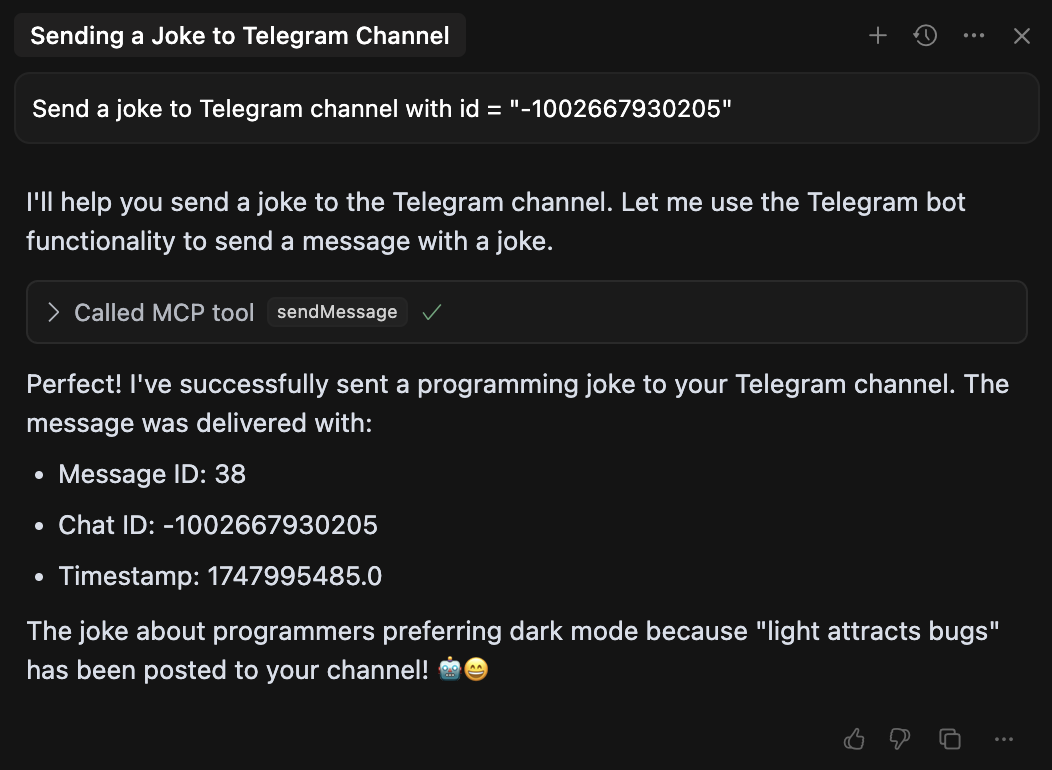
Example Usage in Cursor
Here's how to use the Telegram Bot MCP in Cursor:
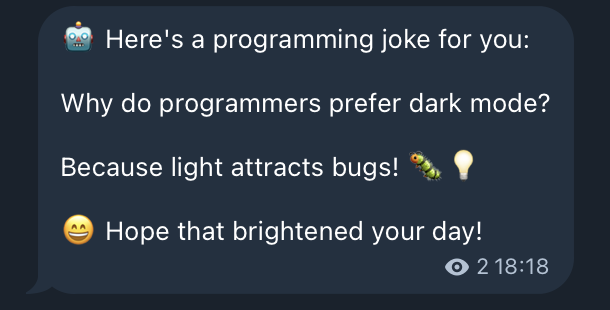
Result Message
Example of a message sent through the bot:
License
MIT
API Tools
initialize
Initializes configuration for Telegram Bot MCP.
Parameters:
token: Your Telegram bot token obtained from @BotFather
sendMessage
Sends a text message to the specified chat.
Parameters:
chatId: Chat ID where to send the message (string or number)text: Message text to send
sendPhoto
Sends a photo to the specified chat.
Parameters:
chatId: Chat ID where to send the photo (string or number)photoUrl: Photo URL or path to local filecaption: Photo caption (optional)
sendDocument
Sends a document to the specified chat.
Parameters:
chatId: Chat ID where to send the document (string or number)documentUrl: Document URL or path to local filecaption: Document caption (optional)filename: File name (optional)
sendVideo
Sends a video to the specified chat.
Parameters:
chatId: Chat ID where to send the video (string or number)videoUrl: Video URL or path to local filecaption: Video caption (optional)duration: Video duration in seconds (optional)width: Video width (optional)height: Video height (optional)
sendAudio
Sends audio to the specified chat.
Parameters:
chatId: Chat ID where to send the audio (string or number)audioUrl: Audio URL or path to local filecaption: Audio caption (optional)duration: Audio duration in seconds (optional)performer: Performer (optional)title: Track title (optional)
sendPoll
Sends a poll message to the specified chat.
Parameters:
chatId: Chat ID where to send the poll (string or number)question: Poll questionoptions: List of answer options (strings)isAnonymous: Whether the poll is anonymous (optional, default True)allowsMultipleAnswers: Whether multiple answers are allowed (optional, default False)
getMe
Gets information about the bot.
Parameters: none
getUpdates
Gets updates (messages, events) from Telegram Bot API.
Parameters:
offset: ID of the first update to return (optional)limit: Maximum number of updates to return (optional, default 100)timeout: Timeout in seconds (optional, default 0)
deleteMessage
Deletes a message from the chat.
Parameters:
chatId: Chat ID from which to delete the message (string or number)messageId: Message ID to delete (number)
How to Get chatId?
To get a chat or user ID, there are several ways:
-
Use the
getUpdatestool and find the needed ID after sending a message to your bot -
Use a bot like @userinfobot: send it a message, and it will return your ID
-
For group chats: add your bot to the group, send a message and use
getUpdatesto find the group ID -
For channels:
- First, add your bot as an administrator to the channel with permission to send messages
- Forward any message from the channel to @userdatailsbot
- The bot will return the channel ID (it will be negative and start with -100)
- Use this ID as
chatIdwhen sending messages to the channel
Limitations
- Bot cannot start a conversation with a user first, the user must send a message to the bot first
- Bot can only send messages to chats where it is present
- Some file formats may be restricted by Telegram
- When sending local files, they must be accessible to the process in which MCP is running
Additional Information
For more information about Telegram Bot API:
1 maintainer

Metadata
1 maintainer
Release files for iflow-mcp_coderroleggg-telegram-bot-mcp 1.0.0
For a detailed explanation of source distributions (sdists) and built distributions (wheels), please see the package formats documentation.
Source distribution (sdist)
| File | Size | Uploaded | |
|---|---|---|---|
| iflow_mcp_coderroleggg_telegram_bot_mcp-1.0.0.tar.gz | 18.8 kB | Details |
Built distribution (wheel)
| File | Interpreter | ABI | Platform | Reset |
|---|---|---|---|---|
| iflow_mcp_coderroleggg_telegram_bot_mcp-1.0.0-py3-none-any.whl | Python 3 | none | any | Details |
Total release size: 44.1 kB
Release files / iflow_mcp_coderroleggg_telegram_bot_mcp-1.0.0.tar.gz
| Download URL | iflow_mcp_coderroleggg_telegram_bot_mcp-1.0.0.tar.gz |
|---|---|
| Size | 18.8 kB |
| Tags | Source |
|
SHA-256 checksum How to use checksums |
87d852beefbda64d3ddf47380c30a21c4ca5b7fe3155e62bb87d08815cb68fde
|
|
BLAKE2b-256 checksum How to use checksums |
2ed23da7c75de969556f778be4347142998849080cef5b039571851161809055
|
| Upload date | |
|
Uploaded using Trusted Publishing? What is trusted publishing? |
No |
| Uploaded via |
uv/0.10.0 {"installer":{"name":"uv","version":"0.10.0","subcommand":["publish"]},"python":null,"implementation":{"name":null,"version":null},"distro":{"name":"Debian GNU/Linux","version":"13","id":"trixie","libc":null},"system":{"name":null,"release":null},"cpu":null,"openssl_version":null,"setuptools_version":null,"rustc_version":null,"ci":null}
|
Release files / iflow_mcp_coderroleggg_telegram_bot_mcp-1.0.0-py3-none-any.whl
| Download URL | iflow_mcp_coderroleggg_telegram_bot_mcp-1.0.0-py3-none-any.whl |
|---|---|
| Size | 25.2 kB |
| Tags | Python 3 |
|
SHA-256 checksum How to use checksums |
e154792186bae193c17f725436e7b6f3f70f7ab4b12f8fc967acc7dd69e4f99e
|
|
BLAKE2b-256 checksum How to use checksums |
a492bb34f9fa850b813be05fff0bd8acaada3ff7039e2192a9eaea57f0438c57
|
| Upload date | |
|
Uploaded using Trusted Publishing? What is trusted publishing? |
No |
| Uploaded via |
uv/0.10.0 {"installer":{"name":"uv","version":"0.10.0","subcommand":["publish"]},"python":null,"implementation":{"name":null,"version":null},"distro":{"name":"Debian GNU/Linux","version":"13","id":"trixie","libc":null},"system":{"name":null,"release":null},"cpu":null,"openssl_version":null,"setuptools_version":null,"rustc_version":null,"ci":null}
|













