
IFUL: Integral Field Unit Lensing 



A Python pipeline for joint-modeling and simulation of strong gravitational lensing and their source kinematics.
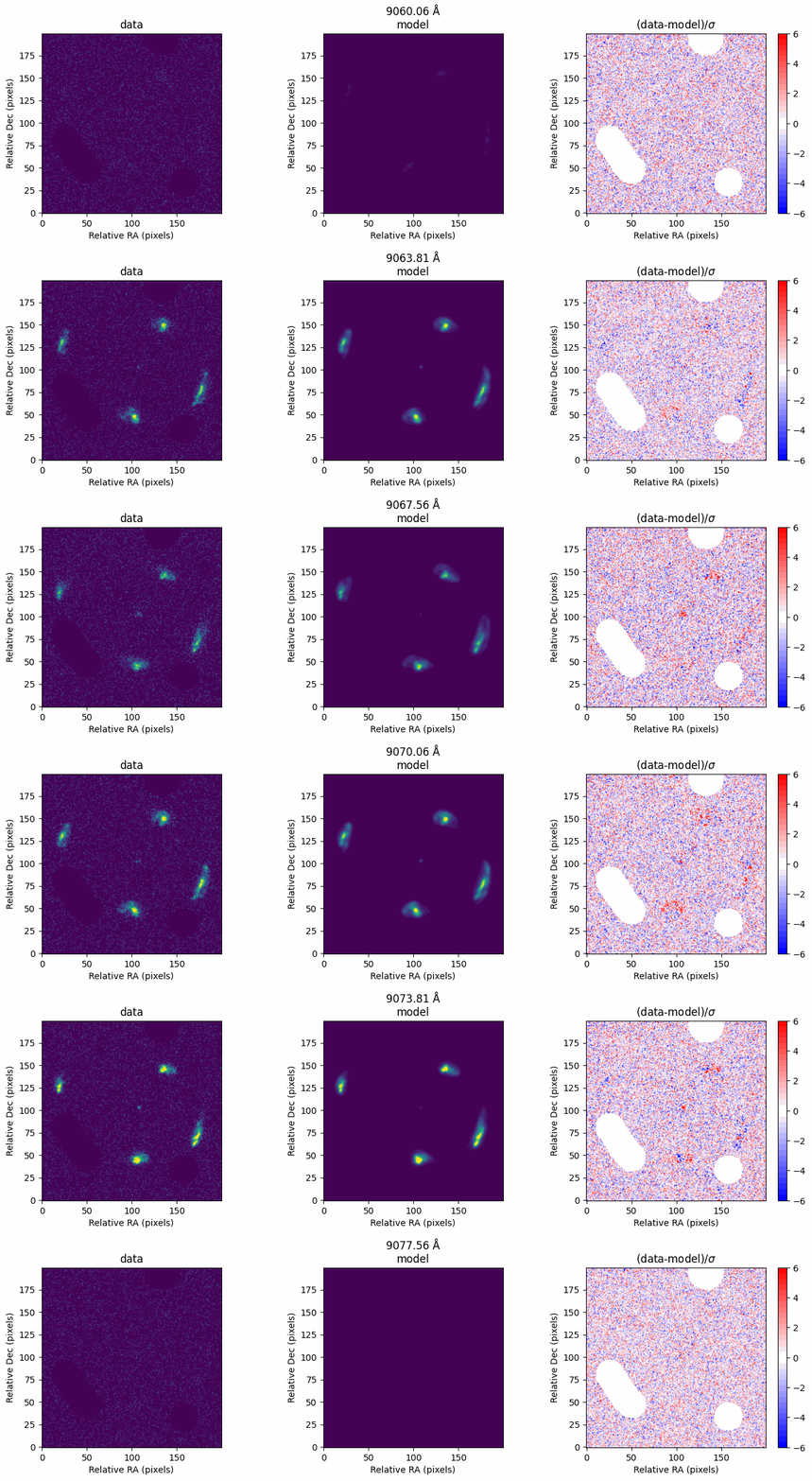
Strong gravitational lensing is a cornerstone probe of observational cosmology—enabling independent measurements of the Hubble constant ($H_0$) to break the Hubble tension via time-delay cosmography, constraining the dark energy equation-of-state ($w$) and matter density ($\Omega_{\rm m, 0}$) via compound lensing systems, and probing dark matter substructure and high-redshift galaxy structures. All of these cosmological and astrophysical applications fundamentally depend on the ability to precisely and accurately model the lensing mass distribution.
IFUL (Integral Field Unit Lensing) introduces an end-to-end forward-modeling framework that incorporates the spatially resolved dynamics of the source galaxy directly into the macro lens model. Observed with modern Integral Field Spectroscopy instruments (e.g., JWST NIRSpec, VLT MUSE, Keck KCWI/KCRM, and OSIRIS), IFUL forward-models every individual spatial pixel (spaxel) in the 3D IFU datacube from a joint parameterization of:
- Macro Lens Mass & Light Profiles (via
lenstronomy, or binned profiles), - Source Line-of-Sight Velocity Fields ($v_{\mathrm{los}}$) (Arctan, Tanh, Multi-parameter, or binned profiles),
- Source Velocity Dispersion Fields ($\sigma_v$) (Exponential, constant, Keplerian, or binned profiles).
By leveraging dynamical markers within lensed arcs as additional kinematic constraints, isolating source emission line light to completely remove lens-light contamination, and reconstructing unlensed source dynamics across multiple lensed images, IFUL provides tighter constraints on lens mass profiles, profile slopes, and high-redshift source dynamics than imaging data alone.
Key Features
- Joint Lensing & Kinematics Modeling: Simultaneously model 2D image-plane lensing light/mass distributions and 3D IFU datacube velocity and dispersion fields.
- Flexible Kinematic Profiles: Support for standard kinematic models including Arctan velocity curves, Tanh profiles, multi-parameter profiles, central supermassive black hole (BH) influence, and custom dispersion profiles.
- Datacube Processing (
ImageSet): Built-in continuum subtraction, outlier rejection (IQR), custom aperture masking, white-light image collapse, and noise estimation. - Fast Linear Inversion: Accelerated linear solver for source plane flux maps to reduce MCMC/optimization overhead.
- Simulation API (
simulation_api): Easily generate mock JWST NIRSpec or ground-based IFU lensed galaxy datacubes with realistic PSF convolution and instrument noise for mock challenges and forecast studies. - Power Binning Support: Integrated adaptive Power spatial binning (an improvement to traditional Voronoi binning) using
powerbin.
Installation
Option 1: Install via pip (Recommended)
pip install iful
Option 2: Install from Source
Clone the repository and install in editable mode:
git clone https://github.com/williyamshoe/iful.git
cd iful
pip install -e .
To install with testing dependencies:
pip install -e .[test]
Quickstart Example
Here is a quick example creating a mock lensed IFU datacube and configuring the lensing and kinematics models:
import numpy as np
from iful.util import *
from iful.simulation_api import (
    SimulationMockImageSet,
    create_simulation_models,
    run_galaxy_simulation,
    add_instrument_noise,
    export_to_fits
)

psf_path = "path/to/psf"
zs = 3.8

imset = SimulationMockImageSet(
    size=40,
    pixscale_arcsec=0.075,
    zs=zs,
    wavelengths_full=np.linspace(23650.0 - 300, 24250.0 + 300, 120),
    psf_path=psf_path
)
imset.restwave_peaks = [4959.0, 5007.0]
# parameters format: [z, sigma_ang, amp_0, ratio (5007/4959 = 3.0)]
imset.init_spec_fit = np.array([zs, 24.0, 1.0, 3.0])

# Setup FlatModel and IFULModel from simulation API
fm, ifulmodel = create_simulation_models(
    imset,
    theta_E=1.0,
    source_x=-0.01,
    source_y=-0.01,
    iful_profiles=["ARCTAN", "EXPONENTIAL", "SERSIC"]
)

# Extract parameters
sim_params = [
    # EPL_Q_PHI (6 params): theta_E, gamma, q, phi, center_x, center_y
    1., 1.8, 0.75, 0.5, -0.1, -0.1,
    # SHEAR (2 params): gamma1, gamma2
    0.05, -0.05,
    # Source (6 params): R_sersic, n_sersic, e1, e2, center_x, center_y
    0.3, 1.2, 0.0, 0.0, -0.01, -0.01,
    # v_los (4 params): v_pa, v_a, v_b, v_c (sys_vel = zs * c)
    -45.0, 300.0, 15, zs * 299792,
    # v_disp (3 params): central_vd, scale_rad, flat_vd
    40.0, 0.02, 175.0,
    # flx (1 param): scale factor
    1e6
]

# Run galaxy simulation from API
results = run_galaxy_simulation(
    ifulmodel,
    sim_params,
    source_grid_size=100,
    source_grid_scale=0.015
)
lensed_image, unlensed_source, ra_crit, dec_crit, ra_caustic, dec_caustic = results

res, simulated_datacube = ifulmodel.generate_residuals(
    sim_params,
    return_datacube=True,
    vd_plots=False
)
simulated_datacube_noisy, bg_noise = add_instrument_noise(
    simulated_datacube,
    bg_noise_std_frac=0.02,
    seed=42
)

# Save simulated datacube using simulation API
fits_filename = "simulated_lensed_galaxy_datacube.fits"
export_to_fits(
    fits_filename,
    simulated_datacube_noisy,
    imset.wavelengths_full,
    imset.aux_info["header_wcs"],
    redshift=zs,
    exptime=1000.0
)

# Display the generated GIF
gif_filename = "simulated_datacube.gif"
gen_obs_gif(
    simulated_datacube_noisy,
    ifulmodel.datacube_mask,
    imset.wavelength,
    gif_filename,
    overwrite=True,
    pixscale=0.075
)

from IPython.display import Image as imp
imp(filename=gif_filename)
For comprehensive tutorials, check out the notebooks in the examples/ directory. In particular, see the s4c_ series of notebooks for a tutorial on simulating and fitting to real data.
Repository & Package Structure
iful/
├── src/iful/                # Package source code
│   ├── __init__.py
│   ├── image_set.py         # 3D Datacube processing & masking
│   ├── flat_modeling.py     # Lensing model wrapper
│   ├── iful_modeling.py     # Joint lensing + IFU kinematics model
│   ├── simulation_api.py    # Mock dataset creation & FITS export
│   └── util.py              # Mathematical profiles & utilities
├── examples/                # Jupyter notebook tutorials
├── tests/                   # Automated pytest suite
├── docs/                    # Documentation assets
└── paper/                   # Paper-related files
Documentation
See https://iful.readthedocs.io/en/latest/ for the readthedocs API documentation.
Contributing
Contributions, bug reports, and feature requests are welcome! Please feel free to open an issue or submit a pull request on GitHub.
See CONTRIBUTING.md for details on guidelines and local setup.
License
Distributed under the MIT License. See LICENSE for details.
1 maintainer

Metadata
1 maintainer
Release files for iful 1.0.0
For a detailed explanation of source distributions (sdists) and built distributions (wheels), please see the package formats documentation.
Source distribution (sdist)
| File | Size | Uploaded | Provenance | Actions |
|---|---|---|---|---|
| iful-1.0.0.tar.gz | 40.2 kB | Without provenance | Details for iful-1.0.0.tar.gz |
Built distribution (wheel)
| File | Interpreter | ABI | Platform | Actions Reset |
|---|---|---|---|---|
| iful-1.0.0-py3-none-any.whl | Python 3 | none | any | Details for iful-1.0.0-py3-none-any.whl |
Total release size: 75.5 kB
Release files / iful-1.0.0.tar.gz
| Download URL | iful-1.0.0.tar.gz |
|---|---|
| Size | 40.2 kB |
| Tags | Source |
|
SHA-256 checksum How to use checksums |
0e08030d23d43a3c3b1015c26c0a8cabaf89329f42d6e8dcb990bcb7e6d75fc8
|
|
BLAKE2b-256 checksum How to use checksums |
b71cc81853128767c0b5c20541a9390e295267a58ef07ff795edbe3df80196a3
|
| Upload date | |
|
Uploaded using Trusted Publishing? What is trusted publishing? |
No |
| Uploaded via |
twine/7.0.0 CPython/3.13.11
|
Release files / iful-1.0.0-py3-none-any.whl
| Download URL | iful-1.0.0-py3-none-any.whl |
|---|---|
| Size | 35.3 kB |
| Tags | Python 3 |
|
SHA-256 checksum How to use checksums |
78bb40a1ada1128796e28cadc29631302204dc563ad773210e32007a16addcab
|
|
BLAKE2b-256 checksum How to use checksums |
adc5862b0951c68c562a0409554824140e9d38bd689c5fbeb86c2a5c33578ef6
|
| Upload date | |
|
Uploaded using Trusted Publishing? What is trusted publishing? |
No |
| Uploaded via |
twine/7.0.0 CPython/3.13.11
|
Security for iful 1.0.0
Provenance
Provenance describes where a file came from. On PyPI, provenance is shared via attestations, which provide a verifiable record of the build or publishing details. View details, limitations and caveats.
No provenance found
None of the files in this release were uploaded with provenance metadata.
A note on package security
PyPI is a repository for distributing packages, not a service for auditing them. While third-party security researchers and our staff do their best to detect and remove malicious packages, PyPI cannot guarantee the quality, security or suitability of any given package.
To learn more about protecting yourself from malicious actors, visit our package security documentation.













