




Apache-2.0 · Python 3.9–3.13 · Linux · macOS · Windows · zero network, by design
Ten seconds · What it catches · The local web door · Where it sits · Five doors · Honest coverage · Roadmap · In your product
Ten seconds
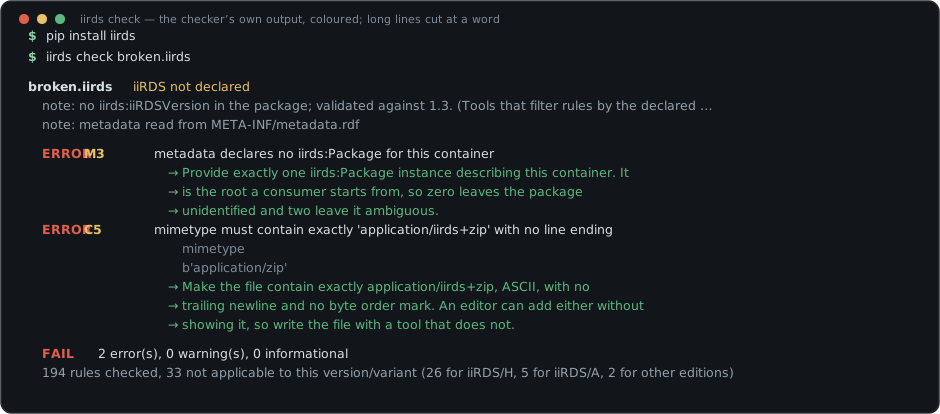
$ pip install iirds
Three parts, every time: what is wrong → the evidence as read from your file → how to fix it. A rule without a prescription does not ship. The old distribution name iirds-validate and the short command iirdsv remain as aliases of the same package.
A second sample, generated and verified by the test suite
$ iirds manual.iirds
manual.iirds   iiRDS 1.3
  note: metadata read from META-INF/metadata.rdf

  ERROR M11       Rendition must have exactly one iirds:format
                      urn:example:manual has-rendition
                      0 found
                    → Give the Rendition exactly one iirds:format, holding the media type of the
                    → file it points at, for example application/xhtml+xml or application/pdf.
                    → Add one if there is none; remove the extras if there are several.
  WARN  L1        relation points at an IRI that is never described in this package
                      urn:example:event/al-204
                      referenced by Operating manual via relates-to-event
                    → Either describe the target in this package, or drop the reference. A
                    → relation pointing at an IRI nothing here mentions gives a consumer a name
                    → and no way to resolve it.

  FAIL  1 error(s), 1 warning(s), 0 informational
  208 rules checked, 28 not applicable to this version/variant (26 for iiRDS/H, 2 for other editions)
$ echo $?
1
What it catches
| You ship this | iirds says |
|---|---|
mimetype containing application/zip |
ERROR C5 — must be exactly application/iirds+zip, and the fix names the editors that break it |
metadata with no iirds:Package root |
ERROR M3 — zero leaves the package unidentified, two leave it ambiguous |
| a Package that identifies no product variant while every Document looks fine | ERROR R13 — the Package itself must say what it documents |
| a vCard reference pasted as a plain string | ERROR R12 — a reference must be a resource, not a literal |
| a zip bomb, or XML with external entities | every read is bounded, an entry whose compression method cannot be read within a bound is not opened at all (ERROR S14), and no entity is expanded. SECURITY.md says what these limits reach and what they do not |
Every code carries a prescription and the section of the specification it enforces — iirds rules C5 -v shows any rule's source and remedy.
It asks whether the package will work, not only whether it conforms. Sixteen interoperability rules, most with no counterpart in the specification, because a conformant package can still be undeliverable:
The fifteen, briefly
| L1 | a relation points at an IRI the package never describes |
| L2 | iirds:source names a file that was not packed |
| L3 | a directory node unreachable from any root — invisible in every viewer |
| L4 | a cycle in the navigation structure |
| L5 | a proprietary class not linked to any iiRDS class |
| L6 | a metadata value with no label a consumer could display or match |
| L7 | an information unit with no title |
| L8 | references out to vocabularies an offline consumer cannot resolve |
| L9 | the RDF/XML and JSON-LD metadata describe different graphs |
| L10 | an abstract iiRDS class used to type an instance directly |
| L11 | content named .xhtml but declared as another media type, so nothing checked it |
| L12 | two entries differing only in case, so one is lost when the package is unpacked |
| L13 | a name in the iiRDS namespace that the standard does not define, with the term that was probably meant |
| L14 | a namespace one character from an iiRDS namespace, so that every name under it resolves to nothing |
| L15 | a name from a later edition of iiRDS than the package declares, so a consumer reading it as declared has no definition for it |
| L16 | a relation carrying text where a reference belongs, so the relation exists and its target does not |
The local web door
For people who do not read terminals — that is literally what the help says:
$ iirds serve
opens a drop page on your own machine: drag a package, read the verdict. Loopback only — any other host is refused by design. Nothing is uploaded anywhere, because there is nowhere to upload to.
Where it sits
flowchart LR
    A[Authoring · CCMS · DITA-OT] --> P([.iirds package])
    P --> C{{iirds check}}
    C -- "PASS" --> D[Delivery portal · customer]
    C -- "findings + remedies" --> A
    classDef ref fill:#2f5d8a,stroke:#2f5d8a,color:#ffffff
    class C ref
The referee between producer and receiver. Same file → same verdict, byte for byte — no uploads, no telemetry, no model in the judgement loop.
Five doors, one judgement
| Door | For | What you get |
|---|---|---|
iirds check |
a person at a terminal | colour, evidence, prescriptions |
iirds serve |
non-developers | a local drop page, loopback only |
iirds check -f json |
CI and pipelines | machine-readable findings, exit codes |
iirds diff |
anyone with a report they kept | what changed since it, and what moved underneath the comparison |
import iirds |
Python programs | reader + writer as a library |
iirds.pyz |
locked-down machines | one file, no install, byte-identical for a commit and a set of dependency versions — see docs/offline-install.md |
Honest coverage
At a glance — 236 rules across five editions and three profiles · 169 SHACL shapes carrying the language-neutral encoding · one pure-Python dependency (rdflib), zero for the single-file
.pyz· every number in this section is read by a test that fails the build when it goes stale.
$ iirds rules
container  19/19    the ZIP and its layout  +4 of its own
schema     135/135  the metadata graph  +35 of its own
system     3/3      the run itself  +13 of its own
content    -        iiRDS XHTML5 (Appendix B)  +11 of its own
lint       -        will a consumer be able to use it  +16 of its own
157 of 157 catalogued rules, plus 79 of this project's own.
| kind | catalogued | this project |
|---|---|---|
| container (C*) | 19 / 19 | 4 |
| schema (M*) | 135 / 135 | 35 |
| system (S*) | 3 / 3 | 13 |
| content (B*) | — | 11 |
| interoperability (L*) | — | 16 |
Coverage of the catalogue is not coverage of the standard. The specification states
280 absolute obligations, counted by
tools/extract_requirements.py and listed in
docs/requirements.json; the rules currently cover
172 of them — a floor, not a ceiling (docs/rule-coverage.json),
re-measured on every release.
- Every finding says what to do about it. All 236 rules carry one imperative sentence naming the change, and a test refuses a rule that does not.
- Every rule has been watched fire. The suite records which rule ids actually
produce a finding, and 235 of the 236 have — the remaining one is a
MAYwith nothing to violate. - What is not established. The 79 rules this project invented have no second implementation to be compared against; docs/divergences.md records where this project reads the specification differently, with reasons.
Why trust the answer
- Deterministic — same file, same verdict, byte for byte.
- Offline — your documents never leave your machine.
- Self-tested — rules are verified against their own mutations before they ship.
- A public divergence ledger — where our reading differs, it is recorded with reasons.
Roadmap
An item moves right only when it is built and verified.
timeline
    title Where iirds is going
    Shipped : One package — validator + reader + writer
            : Local web door · reproducible single file
            : Findings with evidence and prescriptions
    Building : Coverage climb through the obligation index
             : Audit-ready evidence bundle in one command
             : Deeper iiRDS/H handover checks
    Planned : Browser-local validation — no install, nothing uploaded
            : Delivery checks across neighbouring standards
            : Format conversion under the same judgement
When iirds is not the tool
- Authoring or fixing content — iirds judges packages; it does not create them (though every finding tells you the fix).
- Certification — no tool can declare legal conformance. The declaration stays yours.
- Neighbouring standards — for VDI 2770 containers or AAS submodels, use the sibling judges built the same way: vdi2770-validate, aas-submodel-validate.
Using this validator in your product
Apache-2.0 — embed freely; the judgement never has a paid tier
Embed it in commercial products, ship it to customers, run it in closed networks — keep the LICENSE and NOTICE files with it. A validation run makes no network requests and uploads nothing. Stable surfaces: the CLI options documented above and the exit codes; changes there are announced as breaking. A free run and a supported run give the same result on the same file; professional support covers the work around it — update guarantees when the specification changes, backports to a version you have frozen, help with embedding and integration, change-impact notes. Contact: zero8004paz@gmail.com · security reports: SECURITY.md
What is stable here, and what is not
This is 0.x, and the packaging is not the contract. Three names on PyPI install the same code, the module layout moves, and what a wheel carries beyond the command may change in any release.
The verdicts move, and every move is written down. A rule's reading is a claim about the specification, and when a reading changes, so does the verdict on a package that sits on that line. Those changes are in CHANGELOG.md, each with the reading behind it, and a paragraph that moves an exit code says so in those words. If you gate a build on the exit code, read that file before upgrading. That much is discipline, not a gate.
A command-line usage error exits 64, not 2 — breaking, and said here
because the exit codes are a stable surface. A mistyped option and an input
the run could not read both exited 2, so a build that treats 2 as "this
package could not be judged" was catching its own broken command line and
reporting it as a package problem. 64 is the conventional value for a usage
error (EX_USAGE); 2 keeps its present meaning and nothing else moves. A
mistyped verb typed on its own is not one of these: iirds <path> is
shorthand for iirds all <path>, so the first word is read as a path and a
misspelt one exits 2 -- iirds chekc pkg.iirds exits 2, naming chekc as
the file it could not find. Typed with that verb's own options, iirds serv --port 8080 leaves all an option it has never had, and that is a usage
error: 64. What a gate holds is narrower and worth more: a rule id is a
citation somebody else made, so what fired is compared against a committed
record on every build, and a rule that quietly stops firing stops the build.
What has held, and how to see it for yourself. The table below is written by
tools/gen_stable_section.py from what those commands print, because a number
typed into prose goes stale on the day the thing it counts moves:
| what it says | how to see it | what came back |
|---|---|---|
The report is a document with a schemaVersion, and keys are added without moving it |
iirds check fixtures/good.iirds -f json |
"schemaVersion": 2, then package, iirdsVersion, validatedAgainst, variant, ok, judgedBy, packageDigest, summary, notes, notApplicable, suppressed, findings |
iirds check exits 0 when the package drew no error (with -W, a warning is one) |
iirds check fixtures/good.iirds; echo $? |
0 |
1 when it did |
iirds check fixtures/bad.iirds; echo $? |
1 |
2 when nothing was judged: a path that is not there, or an input it refused |
iirds check no-such-file.iirds; echo $? |
2 |
64 when the command line was the problem: an option that is not one, a missing argument, a value outside the choices |
iirds check --iirds-version 9.9 fixtures/good.iirds; echo $? |
64 |
| Every registered rule is answered for: run, or excused with a reason | the same JSON — judgedBy.rulesRun, and the top-level notApplicable |
194 run and 42 excused, no overlap, together the whole registry of 236; tests/test_report_envelope.py holds it. summary.rulesSkipped is a different count and not the other half |
| The rule catalogue here was taken from one pinned upstream commit, and says which (whether upstream still matches it is a weekly job, not this one) | python tools/extract_catalog.py --pin |
catalogue taken from f1119bea7b64fd826ded9e06d9abae287cbad9c1, retrieved 2026-09-13 |
| The ontologies shipped here are the recorded ones, checked by digest | python -m iirds_validate.ontology --verify |
5 files, every one ok |
| The ids that fire are the recorded ones | make check — the gate is tools/rule_coverage.py --check, which reads what a run observed, so a fresh checkout has nothing for it to read yet |
a rule that stops firing stops the build |
| A validation run makes no network request | tests/test_offline.py, which runs a check with the socket sealed |
the suite |
The two containers the exit-code rows name are built by the repository rather
than committed, and the generator builds them if they are missing; it runs the
checker as python -m iirds_validate from the tree, which is the entry point
the iirds command is.
What is not the contract, beyond packaging: the set of rules grows, so a count
of them is not a promise; the wording of a finding's message is prose for a
person to read; and the Python names the next section uses -- iirds.open,
iirds_validate.check -- work, and are meant to, but they are not among the
surfaces whose changes are announced as breaking. What is held still for
another program to depend on is the command, its exit codes, and a report that
says which schemaVersion it is.
Releases and version numbers
This is 0.x, and a release goes out when something is ready rather than on a calendar. While something is being built that can mean a release a night, and it can equally mean nothing for a fortnight. The number says what changed, not how long it has been since the last one.
A patch repairs, and names any verdict it moves. Mostly a package that passed goes on passing, and where a repair moves a verdict the changelog says whose and why: 0.6.2 stopped opening a bzip2 entry, which the standard permits and this tool will not read within a bound; 0.6.3 failed a container that will not produce a file it lists. If you gate a build on the exit code, the changelog is the file to read before upgrading, whichever number moved.
A minor release may add a verdict or move one, and the changelog names every package shape whose verdict moved, with the reading behind it.
A security fix goes out ahead of anything else in flight, and carries an
advisory on this repository's Security tab naming the versions it reaches and
the release that fixes it. SECURITY.md lists them.
Pin what you validated against, and pin iirds. iirds-validate and
iirds-sdk are aliases that ship no engine of their own, and their dependency
on iirds is a floor rather than an exact pin -- so pinning either fixes the
name you install and leaves the rules free to move under it. iirds==<version>
is the pin that holds them still.
1.0 will mean the report schema stops moving. Until then it may gain fields, and the coverage figure above is re-measured on every release rather than promised.
Reading and writing packages from Python
import iirds, iirds_validate

pkg = iirds.open("release.iirds")               # reader: metadata graph, files
report = iirds_validate.check("release.iirds")  # the judge, as a function
The reader ships with one dependency and no verdicts; the judge imports the reader, never the other way around.
Stewardship
The iirds name on PyPI belongs to the standard's community more than to any
one project. Should the iiRDS Consortium want this name for an official
SDK, it will be transferred on request — until then it does real work
rather than squatting. iirds-sdk is an alias of this package and travels
under the same pledge.
This is an unofficial project, not affiliated with or endorsed by the iiRDS Consortium or tekom Deutschland e.V. "iiRDS" is used descriptively, to name the standard these functions read and write.
Licence
Apache-2.0 — see LICENSE.
The bundled iiRDS ontologies are © tekom Deutschland e.V. / iiRDS Consortium under CC BY-ND 4.0 and are redistributed verbatim; the rule catalogue is derived from plusmeta's MIT-licensed tool. CC BY-ND is not an OSI-approved licence, so this distribution is not wholly open source even though the code is — docs/licensing.md explains what that means for you and what would fix it. Provenance in NOTICE and THIRD_PARTY.md.
Not affiliated with, endorsed by, or certified by the iiRDS Consortium, tekom Deutschland e.V., plusmeta GmbH or Quanos Solutions GmbH. "iiRDS" is used descriptively to name the standard this tool validates against.
Numbers above are re-measured on every release · findings are judgements about files, never about people
1 maintainer

Release files for iirds 0.7.1
For a detailed explanation of source distributions (sdists) and built distributions (wheels), please see the package formats documentation.
Source distribution (sdist)
| File | Size | Uploaded | |
|---|---|---|---|
| iirds-0.7.1.tar.gz | 288.5 kB | Details |
Built distribution (wheel)
| File | Interpreter | ABI | Platform | Reset |
|---|---|---|---|---|
| iirds-0.7.1-py3-none-any.whl | Python 3 | none | any | Details |
Total release size: 589.7 kB
Release files / iirds-0.7.1.tar.gz
| Download URL | iirds-0.7.1.tar.gz |
|---|---|
| Size | 288.5 kB |
| Tags | Source |
|
SHA-256 checksum How to use checksums |
b7120dc56366386df30d023b43a04975562d9ea577d7c8c7750a621087168797
|
|
BLAKE2b-256 checksum How to use checksums |
c16ad85c32f6503ffbe2b8fc297aaf5f8059c8d6e4de2d0d857a996ac6c69445
|
| Upload date | |
|
Uploaded using Trusted Publishing? What is trusted publishing? |
Yes |
| Uploaded via |
twine/7.0.0 CPython/3.13.14
|
Provenance
Provenance describes where a file came from. On PyPI, provenance is shared via attestations, which provide a verifiable record of the build or publishing details. View details, limitations and caveats.


PyPI Publish Attestation
PyPI verified that this artifact, at this checksum, originated from the publisher listed below.
Signed by GitHub Actions, verified by PyPI on Sep 23, 2026.
Transparency logRelease files / iirds-0.7.1-py3-none-any.whl
| Download URL | iirds-0.7.1-py3-none-any.whl |
|---|---|
| Size | 301.2 kB |
| Tags | Python 3 |
|
SHA-256 checksum How to use checksums |
783f6523e7485b9b5b2ccf8a4103b66e0805baf48de04277d370a5f7df234e26
|
|
BLAKE2b-256 checksum How to use checksums |
7ecb044804bf25288d89e4d31da98ce8e7194a1bdedb40e3309aaba250d39b37
|
| Upload date | |
|
Uploaded using Trusted Publishing? What is trusted publishing? |
Yes |
| Uploaded via |
twine/7.0.0 CPython/3.13.14
|
Provenance
Provenance describes where a file came from. On PyPI, provenance is shared via attestations, which provide a verifiable record of the build or publishing details. View details, limitations and caveats.
PyPI Publish Attestation
PyPI verified that this artifact, at this checksum, originated from the publisher listed below.
Signed by GitHub Actions, verified by PyPI on Sep 23, 2026.
Transparency log













