
ILGE: Inter-Layer Geometry Encoders


An easy-to-use package for the classification methods from Improving LLM Final Representations with Inter-Layer Geometry (Blyachman, Ulanovski, Bechler-Speicher), NeurIPS 2026.
Lightweight encoders (~300K-600K trainable params) that learn to aggregate all layers of a frozen LLM, instead of using only the last layer. No fine-tuning of the base model.
Works with transformer-based models that expose per-layer hidden states via output_hidden_states=True. It has been validated on the models below.
How It Works
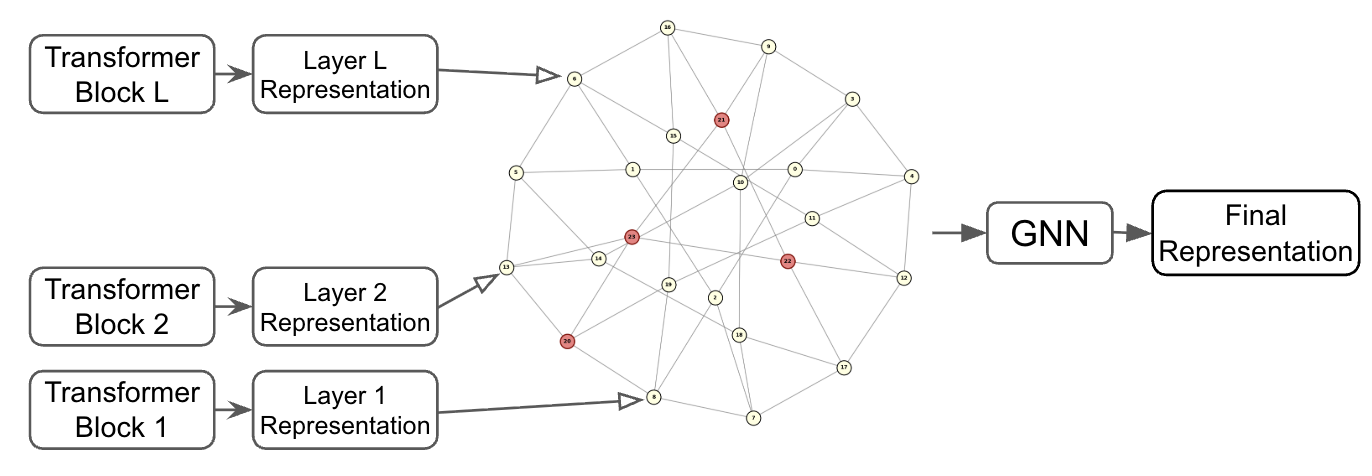
Standard LLM usage takes only the last layer representation, but intermediate layers carry complementary information. ILGE runs the input through a frozen LLM, takes the representation from every layer, and learns to combine them with a small encoder:
- Each layer's representation becomes a node in a graph.
- The nodes are connected by a Cayley graph over the group SL(2, Z_n): a sparse, regular expander graph. The smallest such graph with at least
num_layersnodes is used; extra nodes (red in the figure) are zero-initialized virtual nodes. - A GNN (GIN, GCN or GAT) passes messages over the graph, then pools the real layer nodes into the final representation. Virtual nodes help carry messages but are excluded from the pooling.
- A task head (e.g. a linear classifier) sits on top. Only the encoder and head are trained, ~300K-600K parameters.
Every node in the Cayley graph has the same small degree (4 neighbours), so the number of edges grows linearly with the number of nodes, whereas a fully-connected graph (FCConfig) grows quadratically.
Install
pip install ilge
This installs everything, including PyTorch Geometric for the Cayley and FC graph encoders. Install PyTorch for your CUDA version first if you need GPU support; see the PyG install guide if the torch-geometric install has trouble.
From source (for development):
git clone https://github.com/eyali123/ILGE.git && cd ILGE
pip install -e ".[dev]"
pytest                          # run the test suite
Three Entry Points
Which one do you need?
| Use case | Entry point |
|---|---|
| Plain text classification, want a working baseline fast | ILGEClassifier |
| Your own backbone / loss / training loop; one aggregated vector per input | build_aggregator |
| Aggregate information from all tokens across all layers in one graph (per-token or sequence-level output) | build_per_token_aggregator |
num_layers and hidden_in are the number of hidden layers + 1 (the embedding layer) and the backbone hidden size. Don't hardcode them — use num_layers_for(model) / hidden_size_for(model).
1. Sklearn-style classifier (simple text classification)
Extracts frozen layer embeddings and trains the encoder + a linear head for you. Best when you just want text classification without writing a training loop.
from ilge import ILGEClassifier, CayleyConfig

clf = ILGEClassifier("EleutherAI/pythia-410m", CayleyConfig(), num_classes=6)
clf.fit(train_texts, train_labels)
preds = clf.predict(test_texts)
acc = clf.score(test_texts, test_labels)
Layer embeddings are mean-pooled over tokens by default; pass
token_pooling="last" | "first" | "mean_including_padding" to the constructor
to change that.
2. build_aggregator (custom fine-tuning pipelines)
Pure nn.Module mapping (N, num_layers, hidden_in) -> (N, out_dim). You own the backbone, loss, optimizer, and training loop. Use it for any task where each input collapses to a single aggregated vector (classification, regression, ordinal, retrieval). Reach for it over ILGEClassifier when you need a custom head, loss, or training schedule.
import torch
import torch.nn as nn
from ilge import build_aggregator, CayleyConfig, num_layers_for, hidden_size_for

name, num_classes = "Qwen/Qwen3-8B-Base", 6
agg = build_aggregator(CayleyConfig(),
                       num_layers=num_layers_for(name),   # 37 for Qwen3-8B
                       hidden_in=hidden_size_for(name))   # 4096
head = nn.Linear(agg.out_dim, num_classes)               # your own task head

# X: per-sample layer embeddings, shape (N, num_layers, hidden_in). y: (N,) labels.
# Produce X from the frozen LLM's hidden states, mean-pooled over tokens, e.g.:
#   out = llm(**tokenizer(texts, ...), output_hidden_states=True)
#   X = torch.stack(out.hidden_states, dim=1).mean(dim=2)   # (N, num_layers, hidden_in)

opt = torch.optim.Adam(list(agg.parameters()) + list(head.parameters()), lr=1e-3)
loss_fn = nn.CrossEntropyLoss()
for epoch in range(50):                          # your training loop
    logits = head(agg(X))                        # (N, num_classes)
    loss = loss_fn(logits, y)
    opt.zero_grad(); loss.backward(); opt.step()
3. build_per_token_aggregator (multi-token Cayley graph)
Instead of first pooling each layer over tokens, this builds one Cayley graph per sample whose nodes are every (token, layer) pair. GNN message passing then aggregates information from all tokens across all layers at once. You can read the result out per token (output_mode="per_token") or as a single vector per sequence (output_mode="sequence").
Side note: a cool use case for per-token output is residue-level tasks on protein language model (PLM) embeddings, where each residue's prediction can draw on its neighbours as well as its own layer stack.
Graph size: here the graph has one node per (token, layer) pair, i.e.
seq_len × num_layersnodes, before padding. Edges still grow linearly with the number of nodes, but long sequences make big graphs. Keepseq_lenmodest or chunk long sequences; a warning is printed above 2,000 nodes.
import torch
from ilge import build_per_token_aggregator, CayleyConfig, num_layers_for, hidden_size_for

name = "Qwen/Qwen3-8B-Base"
L, D = num_layers_for(name), hidden_size_for(name)   # 37, 4096

# x: all hidden states of a short sequence, (batch, seq_len, num_layers, hidden_in)
x = torch.randn(4, 16, L, D)

# Sequence-level output: one vector per sequence (e.g. short-text classification)
agg = build_per_token_aggregator(
    CayleyConfig(conv_type="gcn"), num_layers=L, hidden_in=D,
    output_mode="sequence",
)
y = agg(x)                                 # (4, 256) -> (batch, out_dim)

# Per-token output: one vector per token (e.g. token- or residue-level tasks)
agg = build_per_token_aggregator(
    CayleyConfig(conv_type="gcn", gnn_layers=2), num_layers=L, hidden_in=D,
    output_mode="per_token",
)
y = agg(x)                                 # (4, 16, 256) -> (batch, seq_len, out_dim)
Encoder Families
| Encoder | Config class | Layer interaction |
|---|---|---|
| Cayley (GNN) | CayleyConfig |
Message passing over an SL(2, Z_n) Cayley expander graph |
| FC (GNN) | FCConfig |
Message passing over a fully-connected graph |
| DeepSet | DeepSetConfig |
None — permutation-invariant per-layer MLP, pool, MLP |
Convolution types (Cayley and FC)
All three conv types are supported via conv_type on CayleyConfig and FCConfig:
| Conv type | Parameter | Description |
|---|---|---|
"gin" (default) |
gin_mlp_layers |
GIN convolution with internal MLP — most expressive |
"gcn" |
— | GCN convolution — simpler, fewer params |
"gat" |
gat_heads |
GAT with multi-head attention — data-dependent mixing |
CayleyConfig(conv_type="gat", gat_heads=4)  # GAT with 4 attention heads
CayleyConfig(conv_type="gin", gin_mlp_layers=2)  # GIN with 2-layer MLP
CayleyConfig(conv_type="gcn")  # GCN
Hyperparameter Helpers
recommended_config — zero-search defaults
Empirically-validated defaults from an Optuna search across 3 LLMs and 6 tasks.
from ilge.tuning import recommended_config

cfg = recommended_config("cayley")                            # lr=1e-3 (small models)
cfg = recommended_config("cayley", model_size_hint="large")   # lr=1e-4 (>3B models)
cfg = recommended_config("deepset")                           # DeepSet defaults
suggest_config — Optuna search space
Call inside an Optuna objective to search over the paper's validated hyperparameter space.
import optuna
from ilge.tuning import suggest_config
from ilge import build_aggregator, num_layers_for, hidden_size_for

name = "Qwen/Qwen3-8B-Base"

def objective(trial):
    cfg = suggest_config(trial, "cayley")   # samples conv_type, hidden_dim, gnn_layers, etc.
    agg = build_aggregator(cfg, num_layers=num_layers_for(name),
                           hidden_in=hidden_size_for(name))
    model = MyModel(agg)
    return train_and_eval(model)

study = optuna.create_study(direction="minimize")
study.optimize(objective, n_trials=100)
best_cfg = suggest_config(study.best_trial, "cayley")
SQLite storage is sufficient for single-machine search (no PostgreSQL needed).
Configuration Reference
from ilge import CayleyConfig

CayleyConfig(
    conv_type="gin",       # "gin" | "gcn" | "gat"
    hidden_dim=256,        # projection dimension
    gnn_layers=1,          # number of GNN layers
    gin_mlp_layers=1,      # MLP layers inside GINConv (gin only)
    gat_heads=4,           # attention heads (gat only)
    pooling="mean",        # "mean" | "sum" (over real layer-nodes only;
                           #   Cayley virtual padding nodes are excluded)
    dropout=0.1,
    lr=1e-3,               # try 1e-4 for >3B models
    weight_decay=1e-4,     # GAT empirically prefers 1e-3
    batch_size=64,
    epochs=50,
)
FCConfig has the same parameters. DeepSetConfig has pre_pooling_layers, post_pooling_layers instead of GNN-specific params.
Defaults by model size
| Parameter | Models up to ~1B | Models >3B |
|---|---|---|
lr |
1e-3 (default) |
1e-4 |
gnn_layers |
1 |
1 |
hidden_dim |
256 |
256 |
API Summary
Aggregators
| Factory | Input | Output | Use case |
|---|---|---|---|
build_aggregator(config, L, D) |
(N, L, D) |
(N, out_dim) |
Per-sample layer aggregation |
build_per_token_aggregator(..., output_mode="per_token") |
(B, T, L, D) |
(B, T, out_dim) |
Per-token with cross-token Cayley mixing |
build_per_token_aggregator(..., output_mode="sequence") |
(B, T, L, D) |
(B, out_dim) |
Sequence-level with multi-token Cayley |
All aggregators expose .out_dim for sizing downstream heads.
ILGEClassifier
| Method | Description |
|---|---|
fit(texts, labels, val_texts=None, val_labels=None) |
Extract embeddings and train |
predict(texts) -> List[int] |
Predict class labels |
predict_proba(texts) -> np.ndarray |
Class probabilities (N, num_classes) |
score(texts, labels) -> float |
Classification accuracy |
save(path) / load(path) |
Persist encoder weights + config (not the LLM) |
unload_llm() |
Free LLM GPU memory |
Tested Models
Validated on the following transformer models. The Layers column is num_hidden_layers + 1 (the count ILGE aggregates, including the embedding layer) — i.e. num_layers_for(model).
| Model | Layers | Hidden dim | base_model string |
|---|---|---|---|
| Pythia-410m* | 25 | 1024 | "EleutherAI/pythia-410m" |
| TinyLlama-1.1B | 23 | 2048 | "TinyLlama/TinyLlama-1.1B-Chat-v1.0" |
| Gemma2-2B | 27 | 2304 | "google/gemma-2-2b" |
| Llama3-8B | 33 | 4096 | "meta-llama/Meta-Llama-3-8B" |
| Qwen3-8B* | 37 | 4096 | "Qwen/Qwen3-8B-Base" |
* Also validated on other sizes from the same family: Pythia-14m to Pythia-2.8B, and Qwen3-1.7B to Qwen3-14B.
File Structure
ilge/
    __init__.py          # Public API exports
    configs.py           # CayleyConfig, FCConfig, DeepSetConfig
    aggregator.py        # Aggregator, PerTokenAggregator, build_* factories
    classifier.py        # ILGEClassifier (sklearn-style)
    tuning.py            # recommended_config, suggest_config
    model_utils.py       # num_layers_for, hidden_size_for
    _internal/
        nn_modules.py    # GNNEncoder (GIN/GCN/GAT), DeepSetEncoder, build_gnn_encoder
        graph_ops.py     # Cayley graph construction, FC edge index
        llm.py           # LLMLayerExtractor (HF model wrapper, token pooling)
        dataset.py       # GraphDataset, TensorDataset
        training.py      # Training loop with early stopping
tests/                   # pytest suite (excluded from the built package)
assets/                  # README figure
pyproject.toml           # Package metadata and dependencies
LICENSE                  # MIT
Citation
If you use this code, please cite:
@inproceedings{blyachman2026improving,
  title={Improving LLM Final Representations with Inter-Layer Geometry},
  author={Blyachman, Eyal and Ulanovski, Tom and Bechler-Speicher, Maya},
  booktitle={Advances in Neural Information Processing Systems (NeurIPS)},
  year={2026},
  url={https://arxiv.org/abs/2603.22665}
}
1 maintainer

Release files for ilge 0.1.0
For a detailed explanation of source distributions (sdists) and built distributions (wheels), please see the package formats documentation.
Source distribution (sdist)
| File | Size | Uploaded | |
|---|---|---|---|
| ilge-0.1.0.tar.gz | 38.1 kB | Details |
Built distribution (wheel)
| File | Interpreter | ABI | Platform | Reset |
|---|---|---|---|---|
| ilge-0.1.0-py3-none-any.whl | Python 3 | none | any | Details |
Total release size: 70.6 kB
Release files / ilge-0.1.0.tar.gz
| Download URL | ilge-0.1.0.tar.gz |
|---|---|
| Size | 38.1 kB |
| Tags | Source |
|
SHA-256 checksum How to use checksums |
b9be6abd1799ccb4f338e93be1d69cbd424e4bf999f0746823c81d5270d737dc
|
|
BLAKE2b-256 checksum How to use checksums |
ea33b22ea90c171709171ebd910954d62ede633be46d40126b0759c1f1783f0b
|
| Upload date | |
|
Uploaded using Trusted Publishing? What is trusted publishing? |
No |
| Uploaded via |
twine/7.0.0 CPython/3.13.2
|
Release files / ilge-0.1.0-py3-none-any.whl
| Download URL | ilge-0.1.0-py3-none-any.whl |
|---|---|
| Size | 32.5 kB |
| Tags | Python 3 |
|
SHA-256 checksum How to use checksums |
00d27edb4c87d52e63e394cc47749d04ea3e997ec123cd64b4f03df8a5c81c62
|
|
BLAKE2b-256 checksum How to use checksums |
e9b808389eac233e97cff0aca026d2f37f4a9c888a6d3375babf9303be193378
|
| Upload date | |
|
Uploaded using Trusted Publishing? What is trusted publishing? |
No |
| Uploaded via |
twine/7.0.0 CPython/3.13.2
|













