
iLTM: Integrated Large Tabular Model





iLTM is a foundation model for tabular data that integrates tree-derived embeddings, dimensionality-agnostic representations, a meta-trained hypernetwork, multilayer perceptron (MLP) neural networks, and retrieval. iLTM automatically handles feature scaling, categorical features, and missing values.
We release open weights of pre-trained model checkpoints that consistently achieve superior performance across tabular classification and regression tasks, from small to large and high-dimensional tasks.
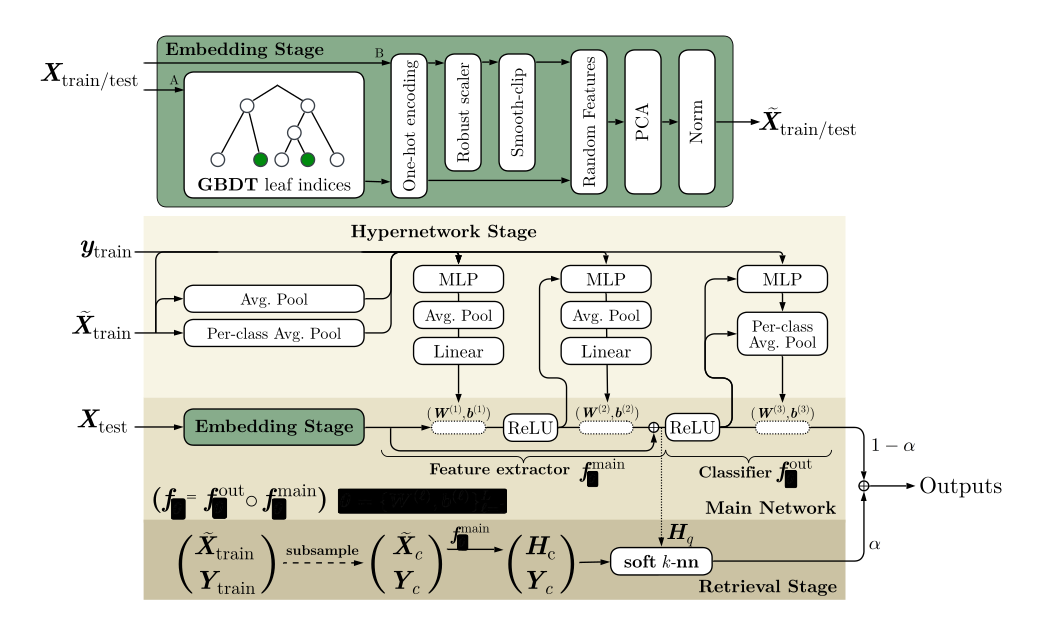
Install
iLTM is accessed through Python. You can install the package via pip:
pip install iltm
iLTM works on Linux, macOS and Windows, and can be executed on CPU and GPU, although GPU is highly recommended for faster execution.
Pre-trained model checkpoints are automatically downloaded from Hugging Face on first use.
By default, checkpoints are stored in platform-specific cache directories (e.g., ~/.cache/iltm on Linux, ~/Library/Caches/iltm on macOS).
You can specify where model checkpoints are stored by setting the ILTM_CKPT_DIR environment variable:
export ILTM_CKPT_DIR=/path/to/checkpoints
Quick Start
iLTM is designed to be easy to use, with an API similar to scikit-learn.
from iltm import iLTMRegressor, iLTMClassifier

# Regression
reg = iLTMRegressor().fit(X_train, y_train)
y_pred = reg.predict(X_test)

# Classification
clf = iLTMClassifier().fit(X_train, y_train)
proba = clf.predict_proba(X_test)
y_hat = clf.predict(X_test)

# With time limit (returns partial ensemble if time runs out)
reg = iLTMRegressor().fit(X_train, y_train, fit_max_time=3600)  # 1 hour limit
Model Checkpoints
Available checkpoint names:
"xgbrconcat"(default): Robust preprocessing + XGBoost embeddings + concatenation"cbrconcat": Robust preprocessing + CatBoost embeddings + concatenation"r128bn": Robust preprocessing with 128-dim bottleneck"rnobn": Robust preprocessing without bottleneck"xgb": XGBoost embeddings only"catb": CatBoost embeddings only"rtr": Robust preprocessing with retrieval"rtrcb": CatBoost embeddings with retrieval
You can also provide a local path to a checkpoint file.
Common key args:
- checkpoint: checkpoint name or path to model file. Default "xgbrconcat".
- device: torch device string. Default "cuda:0".
- n_ensemble: number of generated predictors.
- batch_size: batch size for weight prediction and inference.
- preprocessing: "realmlp_td_s_v0" or "minimal" or "none".
- cat_features: list of categorical column indices.
- tree_embedding: enable GBDT leaf embeddings.
- tree_model: "XGBoost_hist" or "CatBoost".
- concat_tree_with_orig_features: concatenate original features with embeddings.
- finetuning: end to end finetuning.
- Retrieval: do_retrieval, retrieval_alpha, retrieval_temperature, retrieval_distance.
Regressor only:
- clip_predictions: clip to train target range.
- normalize_predictions: fit a fixed affine output calibration before unscaling.
Classifier only:
- voting: "soft" or "hard".
Hyperparameter Optimization
iLTM performs best when you tune its hyperparameters.
Recommended search space
The package exposes a recommended search space via iltm.get_hyperparameter_search_space, a plain dictionary that maps hyperparameter names to small specs.
The checkpoint parameter is part of this space. It is responsible for selecting one of the built in model checkpoints, which in turn sets other fields such as preprocessing, tree_embedding, and others.
The specification format is intentionally minimal so that it can be re-used in any hyperparameter optimization library or custom tuning procedure.
iltm.get_hyperparameter_search_space()gives you the canonical space definition.iltm.sample_hyperparameters(rng)draws a single random configuration from that space for quick baselines and smoke tests.
Development
To run the tests:
pip install -e ".[dev]"
pytest tests/
Citation
If you use iLTM in your research, please cite our paper:
@article{bonet2026iltm,
  title.  = {iLTM: Integrated Large Tabular Model},
  author. = {Bonet, David and Comajoan Cara, Marçal and Calafell, Alvaro and Mas Montserrat, Daniel and Ioannidis, Alexander G.},
  journal = {Proceedings of the 32nd ACM SIGKDD Conference on Knowledge Discovery and Data Mining V.2},
  pages   = {186–197},
  year.   = {2026},
}
License
© Contributors, 2026. Licensed under the Apache-2.0 license.
1 maintainer

Metadata
1 maintainer
Release files for iltm 0.1.4
For a detailed explanation of source distributions (sdists) and built distributions (wheels), please see the package formats documentation.
Source distribution (sdist)
| File | Size | Uploaded | |
|---|---|---|---|
| iltm-0.1.4.tar.gz | 200.3 kB | Details |
Built distribution (wheel)
| File | Interpreter | ABI | Platform | Reset |
|---|---|---|---|---|
| iltm-0.1.4-py3-none-any.whl | Python 3 | none | any | Details |
Total release size: 281.3 kB
Release files / iltm-0.1.4.tar.gz
| Download URL | iltm-0.1.4.tar.gz |
|---|---|
| Size | 200.3 kB |
| Tags | Source |
|
SHA-256 checksum How to use checksums |
5a36654c3e406daf61af11441af72086f2fc4492a42083f932ecf28fb03e214c
|
|
BLAKE2b-256 checksum How to use checksums |
74d92b43e50a2b31c6f2de4bd300ae4ed390dffa91b5219e4d8259287db3d87d
|
| Upload date | |
|
Uploaded using Trusted Publishing? What is trusted publishing? |
Yes |
| Uploaded via |
twine/7.0.0 CPython/3.13.14
|
Provenance
Provenance describes where a file came from. On PyPI, provenance is shared via attestations, which provide a verifiable record of the build or publishing details. View details, limitations and caveats.


PyPI Publish Attestation
PyPI verified that this artifact, at this checksum, originated from the publisher listed below.
Signed by GitHub Actions, verified by PyPI on Sep 13, 2026.
Transparency logRelease files / iltm-0.1.4-py3-none-any.whl
| Download URL | iltm-0.1.4-py3-none-any.whl |
|---|---|
| Size | 81.0 kB |
| Tags | Python 3 |
|
SHA-256 checksum How to use checksums |
15aadc9f7d6457c9bce32c02607925b14b2ea0190079b4e92aea1cd55e051c7b
|
|
BLAKE2b-256 checksum How to use checksums |
fd8e4c346a9c3b655098e48a5bad8281341133c00f9dd44e9e265da04861e71a
|
| Upload date | |
|
Uploaded using Trusted Publishing? What is trusted publishing? |
Yes |
| Uploaded via |
twine/7.0.0 CPython/3.13.14
|
Provenance
Provenance describes where a file came from. On PyPI, provenance is shared via attestations, which provide a verifiable record of the build or publishing details. View details, limitations and caveats.
PyPI Publish Attestation
PyPI verified that this artifact, at this checksum, originated from the publisher listed below.
Signed by GitHub Actions, verified by PyPI on Sep 13, 2026.
Transparency log













