
Image & Sequence Visualization


This package provides GUI widgets to show images and play back image sequences.
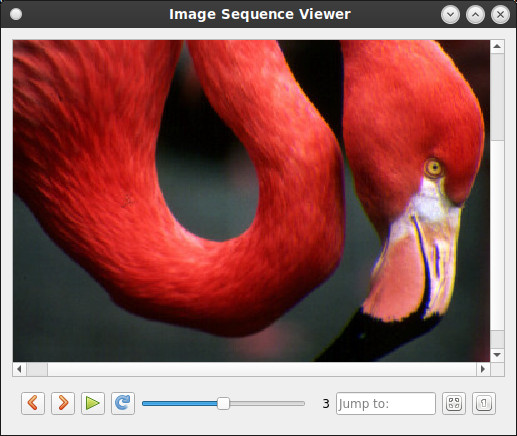
Installation
It is highly recommended to set up a separate virtual environment with an up-to-date pip:
python3 -m venv venv
source venv/bin/activate
python3 -m pip install -U pip
Then, simply install imseqvis via:
python3 -m pip install imseqvis
If you want to try the latest alpha, i.e. the latest main branch packaged and
published to TestPyPI, you can instead install it via:
python3 -m pip install --index-url https://test.pypi.org/simple/ --extra-index-url https://pypi.org/simple "imseqvis[pyside2]"
Qt Backend
imseqvis requires a Qt backend. In Python, you need to
either install PyQt
or PySide.
The default installation will not install any of these backends, you have
to select one on your own.
Optionally, you can install imseqvis with a specific backend. Currently,
pyqt5, pyqt6, pyside2, and pyside6 are supported:
# PyQt5
python3 -m pip install "imseqvis[pyqt5]"

# OR PyQt6
python3 -m pip install "imseqvis[pyqt6]"

# OR PySide2
python3 -m pip install "imseqvis[pyside2]"

# OR PySide6
python3 -m pip install "imseqvis[pyside6]"
In order to use PySide, the environmental variable QT_DRIVER should be set (as
this will be checked by qimage2ndarray). For example, to use pyside6:
import os
os.environ['QT_DRIVER'] = 'PySide6'
...
imseqvis.show_sequence(...)
Usage as Standalone Application
To quickly visualize all images within a folder or sequence (and nothing else), you can use the provided wrappers to start a standalone GUI application:
python3 -m imseqvis path/to/image-folder
Or start the viewer from within your code, either specifically for a folder or iterable image sequence (i.e. a random access container of NumPy ndarrays):
import imseqvis
# Show all images in the given folder.
imseqvis.show_folder('path/to/image-folder')

# Show all images in a random access container. For an exemplary data source
# refer to `imseqvis.sequence_viewer.ImageSequence`.
sequence = [...]
imseqvis.show_sequence(sequence)
Alternatively, you could simply use the provided show functionality:
import imseqvis
imseqvis.show('path/to/image-folder')

sequence = [...]
imseqvis.show(sequence)
Usage as Widget
To integrate the viewer into your own application, use the ImageSequenceViewer
widget:
# Prepare the image data source. This must allow random access to the images.
# For an exemplary data source refer to
# `imseqvis.sequence_viewer.ImageSequence`.
sequence = [...]

# Create & use the widget.
viewer = SequenceViewer(image_sequence=sequence)
layout.addWidget(viewer)
...

# Alternatively, the widget can also be created without a data source:
viewer = SequenceViewer(image_sequence=None)
...
# Later on, the image sequence can be set via:
viewer.setSequence(new_sequence)
To show a different sequence within the same viewer, simply call:
viewer.setSequence(new_sequence)
More detailed usage examples are provided within examples/. These also
demonstrate how to use the available signals to be notified of the user's
interactions with the viewer:
examples/demo_standalone.pydemonstrates the basic usage with a dummy sequence.examples/demo_folder.pywill playback all images within a local folder.
1 maintainer

Metadata
1 maintainer
Release files for imseqvis 0.2.8
For a detailed explanation of source distributions (sdists) and built distributions (wheels), please see the package formats documentation.
Source distribution (sdist)
| File | Size | Uploaded | |
|---|---|---|---|
| imseqvis-0.2.8.tar.gz | 16.8 kB | Details |
Built distribution (wheel)
| File | Interpreter | ABI | Platform | Reset |
|---|---|---|---|---|
| imseqvis-0.2.8-py3-none-any.whl | Python 3 | none | any | Details |
Total release size: 33.4 kB
Release files / imseqvis-0.2.8.tar.gz
| Download URL | imseqvis-0.2.8.tar.gz |
|---|---|
| Size | 16.8 kB |
| Tags | Source |
|
SHA-256 checksum How to use checksums |
de2104f991c91448e619ff3034d0fe4daea27dee380d281367010b6f579bfffe
|
|
BLAKE2b-256 checksum How to use checksums |
06dae66a50026e74be9943b5cea2377a217ab18682588e7459a1076d7d59e6c0
|
| Upload date | |
|
Uploaded using Trusted Publishing? What is trusted publishing? |
Yes |
| Uploaded via |
twine/6.1.0 CPython/3.12.9
|
Provenance
Provenance describes where a file came from. On PyPI, provenance is shared via attestations, which provide a verifiable record of the build or publishing details. View details, limitations and caveats.


PyPI Publish Attestation
PyPI verified that this artifact, at this checksum, originated from the publisher listed below.
Signed by GitHub Actions, verified by PyPI on Mar 21, 2025.
Transparency logRelease files / imseqvis-0.2.8-py3-none-any.whl
| Download URL | imseqvis-0.2.8-py3-none-any.whl |
|---|---|
| Size | 16.7 kB |
| Tags | Python 3 |
|
SHA-256 checksum How to use checksums |
9d2fd3e411cdb8fd201c218c2e293cf1670c8ffe352c8ffd41f36eb71eb09d9f
|
|
BLAKE2b-256 checksum How to use checksums |
1605154933989fbe4f7e642f67518e89996c4410e7ac3118365d4640c16436a5
|
| Upload date | |
|
Uploaded using Trusted Publishing? What is trusted publishing? |
Yes |
| Uploaded via |
twine/6.1.0 CPython/3.12.9
|
Provenance
Provenance describes where a file came from. On PyPI, provenance is shared via attestations, which provide a verifiable record of the build or publishing details. View details, limitations and caveats.
PyPI Publish Attestation
PyPI verified that this artifact, at this checksum, originated from the publisher listed below.
Signed by GitHub Actions, verified by PyPI on Mar 21, 2025.
Transparency log













