
This project has been archived by its maintainers, and is no longer receiving any updates.
imvis
Interactive visualization of 3D medical images in python


Installation
The package can be installed from PyPI using pip:
pip install imvis
Development Setup
This project uses UV for dependency management.
Install UV
# Windows (PowerShell)
irm https://astral.sh/uv/install.ps1 | iex

# Linux/macOS
curl -LsSf https://astral.sh/uv/install.sh | sh
Setup Development Environment
# Clone the repository
git clone https://github.com/MengXiangxi/imvis.git
cd imvis

# Install dependencies
uv sync

# Run tests
uv run pytest tests/test_imvis.py -v
Features
3D image visualization
imagesc3s is a function that allows to visualize 3D images in a 2D slice-by-slice fashion. It is based on the matplotlib library and allows to interactively scroll through the slices of a 3D image. It also allows to change the color map and the windowing of the image.
import imvis as iv
import pydicom

ds = pydicom.dcmread('path/to/dicom/file')
img = ds.pixel_array
iv.imagesc3s(img)
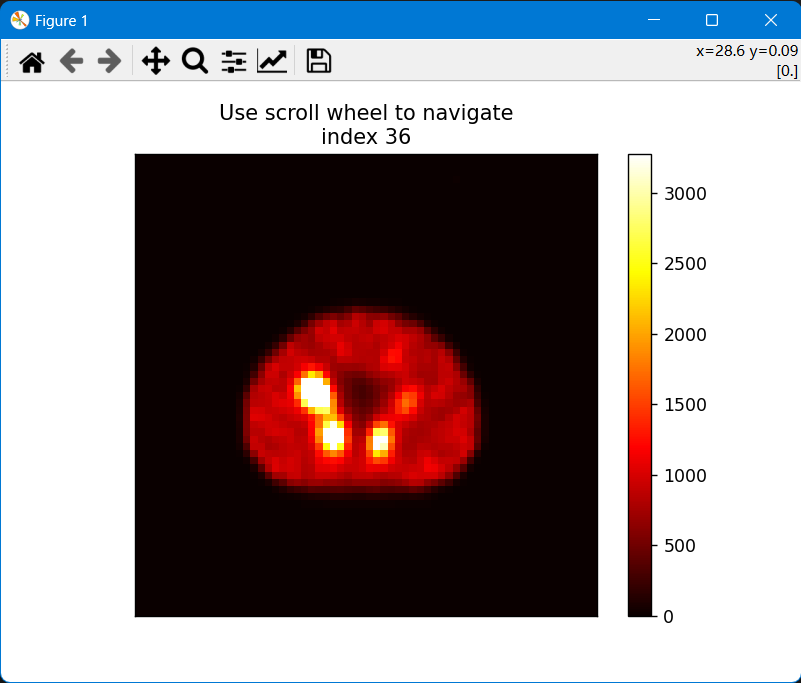
In cases where scrolling is not possible (e.g. in a Jupyter notebook), the alternative version imagesc3slider can be used. It allows to scroll through the slices of a 3D image using a slider.
iv.imagesc3slider(img)
When using Jupyter notebook, the matplotlib backend can be changed to tk or qt to enable scrolling. This can be done using the following magic command:
%matplotlib tk
iv.imagesc3slider(img)
MIP with rotation angles
mipz allows the user to obtain a maximum intensity projection (MIP) of a 3D image along the z-axis. The user can also specify the rotation angles of the MIP.
import SimpleITK as sitk
import numpy as np

img = sitk.ReadImage("/path/to/nifti")
imarray = sitk.GetArrayFromImage(img)
mip_array = np.zeros((36, imarray.shape[0], imarray.shape[1]))
for i in range(0, 360, 10):
    mip_array[int(i/10),:,:] = iv.mipz(imarray, i)
iv.imagesc3s(mip_array, [0, 10])
NIFTI image resampling in reference to another image
resample_nifti_to allows to resample a NIFTI image in reference to another image. This is useful when you want to resample a NIFTI image to the same resolution as a DICOM image.
def resample_nifti_to(nifti_in, nifti_ref, fname_out, img_type='intensity'):
    """Resample a nifti image to the same space as another nifti image.
    Parameters
    ----------
    nifti_in : string
        Path to the nifti image to be resampled.
    nifti_ref : string
        Path to the nifti image to be used as reference.
    fname_out : string
        Path to the resampled nifti image.
    img_type : string, optional
        Type of the image. Default is 'intensity'.
        'intensity': general type, no conversion.
        'BQML': PET or quantitative SPECT image, total counts are preserved.
        'mask': interger mask, interpolation will not change the value.
    """
Convert PET DICOM to NIFTI with SUV
dicom2niftiSUV allows to convert a PET DICOM image to a NIFTI image with SUV values. The SUV values are computed using the corresponding DICOM tags.
- bodyweight: "TBW" (total body weight) or "LBW" (lean body weight)
def dicom2niftiSUV(dicomdir, niftiname,bodyweight="TBW"):
    """Convert a folder of dicom files to nifti files and apply SUV conversion.
    Parameters
    ----------
    dicomdir : string
        Path to the folder containing dicom files.
    niftiname : string
        Path and filename to the output nifti file.
    """
Sort files in the DICOMDIR file into hierarchical folders
dicomdir_split allows to sort the files in a DICOMDIR file into hierarchical folders in the Patient/Study/Series fashion. This might be useful when extracting the desired DICOM series from a DICOMDIR file.
def dicomdir_split(dicomdir_path, output_folder):
    ''' Split DICOM files in the DICOMDIR into different folders based according to patient, studies, and series.
    Parameters
    ----------
    dicomdir_path : string
        Path to the DICOMDIR file.
    output_folder : string
        Path to the output folder.
    '''
1 maintainer

Metadata
1 maintainer
Release files for imvis 0.1.1
For a detailed explanation of source distributions (sdists) and built distributions (wheels), please see the package formats documentation.
Source distribution (sdist)
| File | Size | Uploaded | Provenance | Actions |
|---|---|---|---|---|
| imvis-0.1.1.tar.gz | 710.6 kB | Without provenance | Details for imvis-0.1.1.tar.gz |
Built distribution (wheel)
| File | Interpreter | ABI | Platform | Actions Reset |
|---|---|---|---|---|
| imvis-0.1.1-py3-none-any.whl | Python 3 | none | any | Details for imvis-0.1.1-py3-none-any.whl |
Total release size: 721.1 kB
Release files / imvis-0.1.1.tar.gz
| Download URL | imvis-0.1.1.tar.gz |
|---|---|
| Size | 710.6 kB |
| Tags | Source |
|
SHA-256 checksum How to use checksums |
b2ebc4007f01bbce230185fe4514835d5d8f03b2054d87a2407332b2db38fdb5
|
|
BLAKE2b-256 checksum How to use checksums |
351b52468ead88caac100e435ab7dc37ff588e8bbe6764f512296caa331536e4
|
| Upload date | |
|
Uploaded using Trusted Publishing? What is trusted publishing? |
No |
| Uploaded via |
uv/0.10.10 {"installer":{"name":"uv","version":"0.10.10","subcommand":["publish"]},"python":null,"implementation":{"name":null,"version":null},"distro":null,"system":{"name":null,"release":null},"cpu":null,"openssl_version":null,"setuptools_version":null,"rustc_version":null,"ci":null}
|
Release files / imvis-0.1.1-py3-none-any.whl
| Download URL | imvis-0.1.1-py3-none-any.whl |
|---|---|
| Size | 10.5 kB |
| Tags | Python 3 |
|
SHA-256 checksum How to use checksums |
2f47a432b97b950da893a6cca19907e7e080de7b9e14f9fc9daf0ae9c5f543e2
|
|
BLAKE2b-256 checksum How to use checksums |
0c07919b1c7719d4b786654beb8b25755c97e010bba0a45f055834ec2c2e15fb
|
| Upload date | |
|
Uploaded using Trusted Publishing? What is trusted publishing? |
No |
| Uploaded via |
uv/0.10.10 {"installer":{"name":"uv","version":"0.10.10","subcommand":["publish"]},"python":null,"implementation":{"name":null,"version":null},"distro":null,"system":{"name":null,"release":null},"cpu":null,"openssl_version":null,"setuptools_version":null,"rustc_version":null,"ci":null}
|
Security for imvis 0.1.1
Provenance
Provenance describes where a file came from. On PyPI, provenance is shared via attestations, which provide a verifiable record of the build or publishing details. View details, limitations and caveats.
No provenance found
None of the files in this release were uploaded with provenance metadata.
A note on package security
PyPI is a repository for distributing packages, not a service for auditing them. While third-party security researchers and our staff do their best to detect and remove malicious packages, PyPI cannot guarantee the quality, security or suitability of any given package.
To learn more about protecting yourself from malicious actors, visit our package security documentation.














