
InjectQ




InjectQ is a modern, lightweight Python dependency injection library focused on clarity, type-safety, and seamless framework integration.
Documentation
Full documentation is hosted at Documentation and the repository docs/ contains the source.
Key features
- Simple dict-like API for quick starts
- Decorator- and type-based injection (
@inject,Inject[T]), for sync, async and generator functions - Type-friendly:
get,aget,try_getandatry_getare typed with overloads, socontainer.get(Service)is aService(abstract classes as keys trigger mypy'stype-abstractcheck) - One resolver compiled per service (generated code, or plain closures with
InjectQ(debug=True)) - Scopes:
@singleton,@transient,@scoped("request"). A request scope is onewith container.scope("request"):block, sync or async, with exit stacks and@resourcecleanup - Safe under threads and asyncio: the current container, scopes and overrides live in
ContextVars - Context-local overrides for tests:
container.override(Key, fake)reaches every service that depends onKey - Integrations for FastAPI, FastMCP and Taskiq as optional extras: the right container and a request scope for every request, message or task
- Factory and async factory support, and hybrid factory methods that mix DI with manual arguments (
invoke(),ainvoke()) - Modules and providers, validation (
validate(),compile()), a dependency graph and a profiler - Supports Python 3.10 through 3.15, including Python 3.15 lazy imports (PEP 810)
Benchmarks
injectq compared with 13 other Python dependency injection libraries on the same object graphs. Every library first passes the same correctness checks (types, singleton identity, fresh transients, request-scope isolation), then is timed in its own process. Lower is better.
| µs/op (median, lower is better) | S1 singleton | S2 transient chain | S3 wide graph | S4 request scope | S5 injected call | S6 async chain |
|---|---|---|---|---|---|---|
| injectq | 0.083 | 0.302 | 0.550 | 0.968 | 0.143 | 0.427 |
| aioinject [1] | 0.295 | 0.787 | 1.768 | 2.278 | n/a | 0.992 |
| dependency-injector [2] | 0.057 | 1.203 | 3.038 | n/a | 1.127 | 37.8 |
| dishka [3] | 0.307 | 0.516 | 1.069 | 1.526 | 1.165 | 1.068 |
| diwire [4] | 0.424 | 0.609 | 0.884 | 4.609 | 6.820 | 0.874 |
| inject [5] | 0.158 | 4.785 | 12.2 | n/a | 2.462 | n/a |
| injector [6] | 1.331 | 42.7 | 90.6 | 14.4 | 16.8 | n/a |
| kink [7] | 0.168 | 3.688 | 12.6 | n/a | 2.366 | n/a |
| lagom [8] | 0.155 | 5.624 | 12.0 | n/a | 1.474 | n/a |
| punq [9] | 1.097 | 36.5 | 90.6 | n/a | n/a | n/a |
| rodi [10] | 0.290 | 0.758 | 1.852 | 0.836 | 1.056 | n/a |
| svcs [11] | 0.189 | 2.590 | 8.087 | 1.940 | n/a | 3.068 |
| that-depends [12] | 0.077 | 0.938 | 3.479 | 24.7 | 3.163 | 1.569 |
| wireup [13] | 0.092 | 0.512 | 1.434 | 1.130 | 0.269 | 0.676 |
| hand-written (floor) | 0.019 | 0.166 | 0.355 | 0.345 | 0.041 | 0.229 |
| injectq rank | 3 of 14 | 1 of 14 | 1 of 14 | 2 of 9 | 1 of 11 | 1 of 8 |
| fastest DI library | dependency-injector | injectq | injectq | rodi | injectq | injectq |
Bold: fastest DI library in the column (hand-written excluded). n/a: the library has no such feature.
Setup notes per library ([1]-[13])
[1] aioinject: sync SyncContainer for S1-S5/S7, async Container for S6; transients registered in the lifetime scope to resolve from the root context. n/a: S5 no generic injection decorator (per-framework inject only).
[2] dependency-injector: S6 uses providers in async mode. n/a: S4 no enter/exit request scope (only context-local singletons, a different mechanism).
[3] dishka: no transient lifetime; cache=False is its equivalent.
[4] diwire: default SCOPED lifetime at the root scope = singleton; transient via Lifetime.TRANSIENT; S5 passes diwire_resolver= explicitly.
[5] inject: one global injector; singletons via bind_to_constructor, transients via bind_to_provider, constructors wired with autoparams. n/a: S4 no request scope; S6 no async resolution.
[6] injector: request scope is a custom Scope subclass (cache swapped on enter/exit); constructors need @inject (applied to the benchmark classes). n/a: S6 no async API.
[7] kink: @inject on a class registers it (singleton; use_factory=True = transient) and mutates __init__; S7 restores __init__ before re-decorating. n/a: S4 no request scope; S6 no async resolution.
[8] lagom: unregistered classes are autowired as transient. n/a: S4 no request scope; S6 no async resolution.
[9] punq: transient is the default scope. n/a: S4 no request scope (only transient and singleton); S5 no injection decorator; S6 no async API.
[10] rodi: resolved with provider.get / provider.exec (each call creates an activation scope); S7 includes build_provider(), which validates and wires eagerly. n/a: S6 no async resolution (sync only).
[11] svcs: caches per Container, so transient = a new Container per operation (its construction is timed). n/a: S5 no generic injection decorator (framework integrations only).
[12] that-depends: S5 with @inject(scope=None); S4 via a ContextResource in ContextScopes.REQUEST.
[13] wireup: transients and scoped services resolve from a scope: S2, S3, S6 use one long-lived scope, S4/S5 enter one per operation.
14 libraries, AMD Ryzen 5 5600G with Radeon Graphics, CPython 3.13.13, median of 25 repeats, 2026-11-23. Full table, chart and method: docs/benchmarks.md.
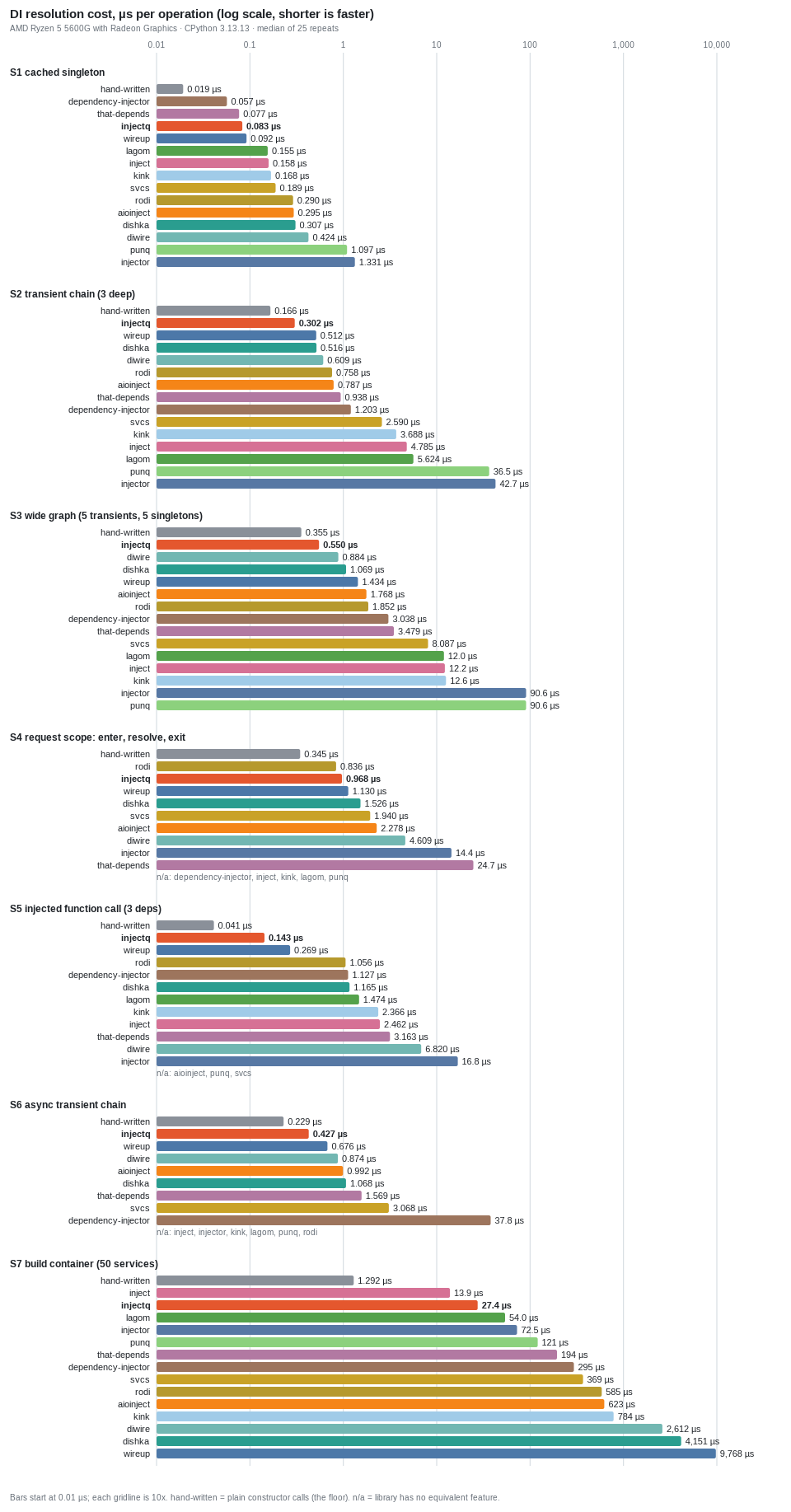
Scenarios: S1 resolve a cached singleton, S2 a 3-level transient chain, S3 a wide graph (5 transients sharing a singleton), S4 enter a request scope, resolve, exit, S5 call an @inject function with 3 dependencies, S6 S2 through the async API.
Full results, the chart, method and per-library notes: Benchmarks (source). Raw JSON for every run: benchmarks/results/. Reproduce with make bench-compare.
Upgrading from 0.5
0.6 changes how the current container, scopes, overrides and get() on async factories behave, and it renames or removes some names. Read the 0.6 migration guide (online). It lists every change with before and after code. To find old names in your code, run your tests with pytest -W error::DeprecationWarning.
Using an AI coding agent?
Using an AI coding agent (Claude Code, Cursor, Copilot, ...)? Give it docs/skill.md: one file with everything it needs to use injectq correctly: recommended approach, API, pitfalls, limitations and benchmarks. Rendered page: AI Agent Skill.
Quick Start (recommended pattern)
Prefer the exported global InjectQ.get_instance() container in examples and application code. It uses the active context container when present, otherwise falls back to a global singleton.
from injectq import InjectQ, inject, singleton

container = InjectQ.get_instance()

# Basic value binding
container[str] = "Hello, World!"

@singleton
class UserService:
    def __init__(self, message: str):
        self.message = message

    def greet(self) -> str:
        return f"Service says: {self.message}"

@inject
def main(service: UserService) -> None:
    print(service.greet())

if __name__ == "__main__":
    main()  # Prints: Service says: Hello, World!
Notes:
- Use
container[...]for simple bindings and values. - Use
@injectandInject[T]for function/class injection.
Scopes and tests
from injectq import InjectQ, ScopeError, scoped

container = InjectQ()
container.activate()          # decorators and @inject use this container


@scoped("request")
class Session: ...


with container.scope("request"):
    assert container[Session] is container[Session]   # one per block

try:
    container[Session]        # outside a block
except ScopeError:
    print("no active request scope")


class Mailer:
    def send(self) -> str:
        return "sent"


class FakeMailer(Mailer):
    def send(self) -> str:
        return "fake"


container.bind(Mailer, Mailer)
with container.override(Mailer, FakeMailer()):            # tests: swap one dependency
    assert container[Mailer].send() == "fake"
Enhanced Features
Nullable Dependencies
InjectQ supports binding None values for optional dependencies using the allow_none parameter:
from injectq import InjectQ

container = InjectQ()

# Optional service - can be None
class EmailService:
    def send_email(self, to: str, message: str) -> str:
        return f"Email sent to {to}: {message}"

class NotificationService:
    def __init__(self, email_service: EmailService | None = None):
        self.email_service = email_service

    def notify(self, message: str) -> str:
        if self.email_service:
            return self.email_service.send_email("user", message)
        return f"Basic notification: {message}"

# Bind None for optional dependency
container.bind(EmailService, None, allow_none=True)
container.bind(NotificationService, NotificationService)

service = container.get(NotificationService)
print(service.notify("Hello"))  # Prints: Basic notification: Hello
Abstract Class Validation
InjectQ automatically prevents binding abstract classes and raises a BindingError during binding (not at resolution time):
from abc import ABC, abstractmethod
from injectq import InjectQ
from injectq.utils.exceptions import BindingError

class PaymentProcessor(ABC):  # Abstract class
    @abstractmethod
    def process_payment(self, amount: float) -> str:
        pass

class CreditCardProcessor(PaymentProcessor):  # Concrete implementation
    def process_payment(self, amount: float) -> str:
        return f"Processing ${amount} via credit card"

container = InjectQ()

# This will raise BindingError immediately
try:
    container.bind(PaymentProcessor, PaymentProcessor)  # Error!
except BindingError:
    print("Cannot bind abstract class")

# This works fine
container.bind(PaymentProcessor, CreditCardProcessor)  # OK
See examples/enhanced_features_demo.py for a complete demonstration.
🆕 Hybrid Factory Methods
The new invoke() and ainvoke() methods combine dependency injection with manual arguments:
from injectq import InjectQ

container = InjectQ()
container.bind(Database, Database)
container.bind(Cache, Cache)

# Factory that needs both DI dependencies and runtime arguments
def create_user_service(db: Database, cache: Cache, user_id: str):
    return UserService(db, cache, user_id)

container.bind_factory("user_service", create_user_service)

# ❌ Old way - verbose
db = container[Database]
cache = container[Cache]
service = container.call_factory("user_service", db, cache, "user123")

# ✅ New way - automatic DI + manual args
service = container.invoke("user_service", user_id="user123")
# Database and Cache auto-injected, only provide user_id!

# Also works with async
service = await container.ainvoke("async_service", batch_size=100)
When to use invoke():
- Factory needs some DI dependencies + some runtime arguments
- You want cleaner code without manual resolution
- Mix configuration from container with user input
See examples/factory_api_showcase.py and docs/injection-patterns/factory-methods.md for details.
Installation
Install from PyPI:
pip install injectq
Optional framework integrations (install only what you need):
pip install injectq[fastapi]   # FastAPI integration (optional)
pip install injectq[fastmcp]   # FastMCP integration (optional)
pip install injectq[taskiq]    # Taskiq integration (optional)
Supported Python versions
InjectQ supports Python 3.10 and above, and is tested on 3.10 through 3.15.
Python 3.15 lazy imports
InjectQ 0.5.0+ works with Python 3.15 explicit lazy imports (PEP 810). Your imports and decorators stay the same. Lazy imports pay off for your own slow or rarely used modules (here, reports). You can turn them on in three ways:
# 1. Per module: list modules to import lazily. Ignored on Python 3.10-3.14.
__lazy_modules__ = ["reports"]
import reports

# 2. Per import: the `lazy` keyword. Python 3.15+ only (SyntaxError before).
lazy import reports
# 3. Whole process
PYTHON_LAZY_IMPORTS=all python app.py   # or: python -X lazy_imports=all app.py
One thing to check: @singleton, @transient, @scoped, @register_as and top-level container.bind(...) register services when their module is imported. With lazy imports, a module you import only for that registration (import services) is never loaded, so resolving its services fails with DependencyNotFoundError. Load such modules eagerly before resolving, for example:
import importlib

importlib.import_module("services")  # always runs immediately
See Python 3.15 Lazy Imports for the other fixes and examples/python315_lazy_imports/ for a runnable demo, and test your whole application before turning on global lazy mode in production.
Where to look next
docs/getting-started/installation.md— installation and verificationdocs/getting-started/lazy-imports.md— Python 3.15 lazy imports (runnable example)docs/injection-patterns/dict-interface.md— dict-like APIdocs/injection-patterns/inject-decorator.md—@injectusagedocs/injection-patterns/factory-methods.md— factory patterns (DI, parameterized, hybrid)docs/migration-0.6.md— upgrading from 0.5docs/core-concepts/context-and-concurrency.md— tasks, threads and the current containerdocs/scopes/scoped-services.mdanddocs/scopes/resources.md— request scopes and cleanupdocs/testing/overrides.md— overrides for testsdocs/integrations/— integration guides for FastAPI, FastMCP and Taskiq
License
MIT — see the LICENSE file.
Run tests with coverage
Activate the project's virtualenv and run pytest (coverage threshold is configured to 73%):
source .venv/bin/activate
python -m pytest
Coverage reports are written to htmlcov/ and coverage.xml.
Running the benchmarks
make bench          # injectq only, checked against benchmarks/baseline.json
make bench-compare  # injectq vs the other DI libraries, in an isolated venv
See benchmarks/README.md for the scenarios, the result files and how to add a library.
1 maintainer

Metadata
1 maintainer
Release files for injectq 0.6.1
For a detailed explanation of source distributions (sdists) and built distributions (wheels), please see the package formats documentation.
Source distribution (sdist)
| File | Size | Uploaded | Provenance | Actions |
|---|---|---|---|---|
| injectq-0.6.1.tar.gz | 410.2 kB | Without provenance | Details for injectq-0.6.1.tar.gz |
Built distribution (wheel)
| File | Interpreter | ABI | Platform | Actions Reset |
|---|---|---|---|---|
| injectq-0.6.1-py3-none-any.whl | Python 3 | none | any | Details for injectq-0.6.1-py3-none-any.whl |
Total release size: 516.0 kB
Release files / injectq-0.6.1.tar.gz
| Download URL | injectq-0.6.1.tar.gz |
|---|---|
| Size | 410.2 kB |
| Tags | Source |
|
SHA-256 checksum How to use checksums |
e1b70cf77d29b30fabfaac7065d4daaf7df5e017e72fca7146a291a31081117d
|
|
BLAKE2b-256 checksum How to use checksums |
e318e592a1d18dfc60993514908fed6414320c58eba5e79b0c7154be53490a05
|
| Upload date | |
|
Uploaded using Trusted Publishing? What is trusted publishing? |
No |
| Uploaded via |
twine/7.0.0 CPython/3.15.0
|
Release files / injectq-0.6.1-py3-none-any.whl
| Download URL | injectq-0.6.1-py3-none-any.whl |
|---|---|
| Size | 105.7 kB |
| Tags | Python 3 |
|
SHA-256 checksum How to use checksums |
642b8261bd1eac81bef654ddbe02fcafc6f3eaaa23a441cc90f78374b3aa7a92
|
|
BLAKE2b-256 checksum How to use checksums |
6764d920183e470bcf5bd9ecb5fc486ca570d0c9a29a2f68332df23b5371d89d
|
| Upload date | |
|
Uploaded using Trusted Publishing? What is trusted publishing? |
No |
| Uploaded via |
twine/7.0.0 CPython/3.15.0
|
Security for injectq 0.6.1
Provenance
Provenance describes where a file came from. On PyPI, provenance is shared via attestations, which provide a verifiable record of the build or publishing details. View details, limitations and caveats.
No provenance found
None of the files in this release were uploaded with provenance metadata.
A note on package security
PyPI is a repository for distributing packages, not a service for auditing them. While third-party security researchers and our staff do their best to detect and remove malicious packages, PyPI cannot guarantee the quality, security or suitability of any given package.
To learn more about protecting yourself from malicious actors, visit our package security documentation.














