
Interpretability for Sequence Generation Models 🔍

Project description

Intepretability for Sequence Generation Models 🔍







Inseq is a Pytorch-based hackable toolkit to democratize the access to common post-hoc interpretability analyses of sequence generation models.
Installation
Inseq is available on PyPI and can be installed with pip:
pip install inseq
Install extras for visualization in Jupyter Notebooks and 🤗 datasets attribution as pip install inseq[notebook,datasets].
Dev Installation
To install the package, clone the repository and run the following commands:cd inseq
make poetry-download # Download and install the Poetry package manager
make install # Installs the package and all dependencies
If you have a GPU available, use make install-gpu to install the latest torch version with GPU support.
For library developers, you can use the make install-dev command to install and its GPU-friendly counterpart make install-dev-gpu to install all development dependencies (quality, docs, extras).
After installation, you should be able to run make fast-test and make lint without errors.
FAQ Installation
-
Installing the
tokenizerspackage requires a Rust compiler installation. You can install Rust from https://rustup.rs and add$HOME/.cargo/envto your PATH. -
Installing
sentencepiecerequires various packages, install withsudo apt-get install cmake build-essential pkg-configorbrew install cmake gperftools pkg-config.
Example usage in Python
This example uses the Integrated Gradients attribution method to attribute the English-French translation of a sentence taken from the WinoMT corpus:
import inseq

model = inseq.load_model("Helsinki-NLP/opus-mt-en-fr", "integrated_gradients")
out = model.attribute(
  "The developer argued with the designer because her idea cannot be implemented.",
  n_steps=100
)
out.show()
This produces a visualization of the attribution scores for each token in the input sentence (token-level aggregation is handled automatically). Here is what the visualization looks like inside a Jupyter Notebook:

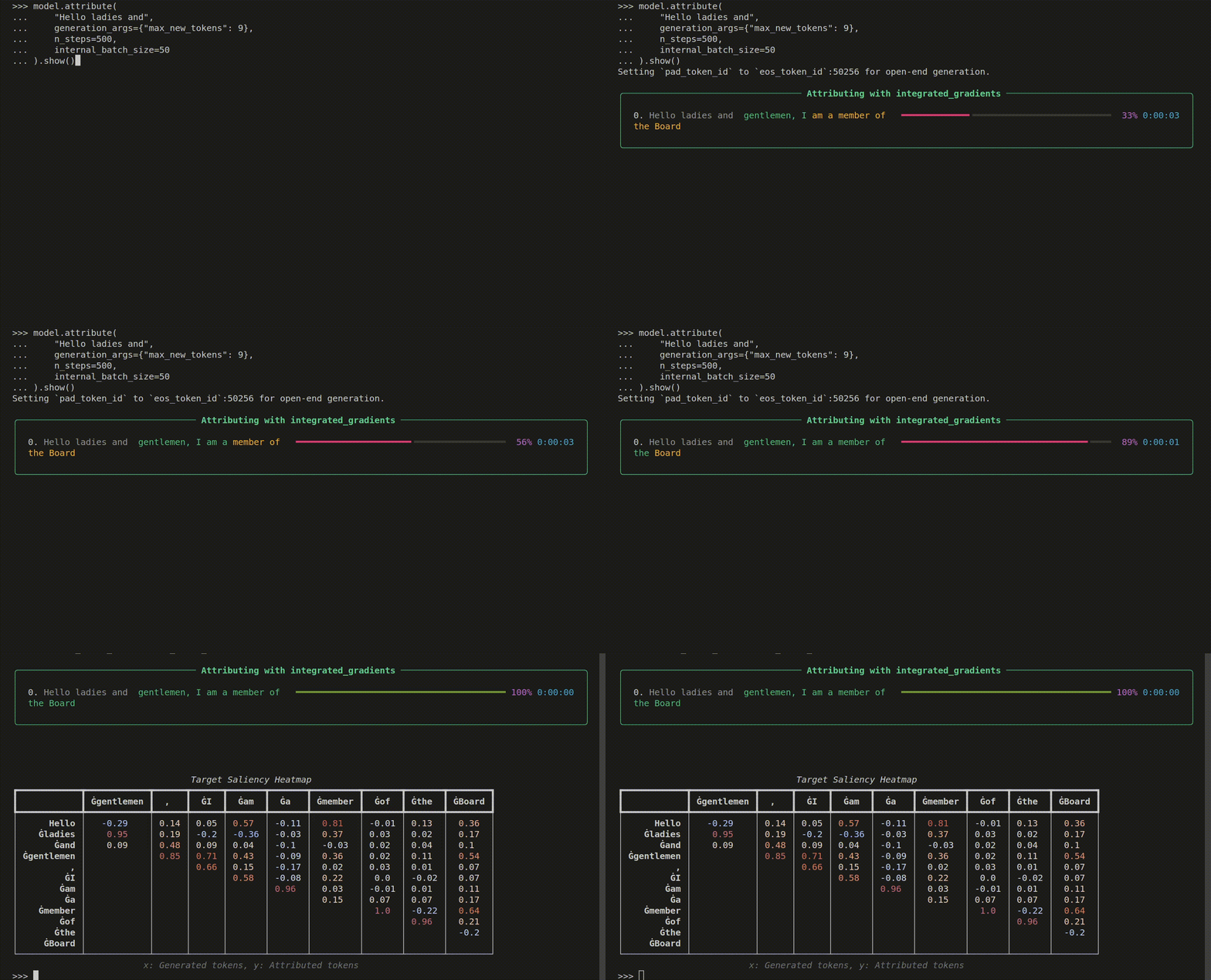
Inseq also supports decoder-only models such as GPT-2, enabling usage of a variety of attribution methods and customizable settings directly from the console:
import inseq

model = inseq.load_model("gpt2", "integrated_gradients")
model.attribute(
    "Hello ladies and",
    generation_args={"max_new_tokens": 9},
    n_steps=500,
    internal_batch_size=50
).show()
Current Features
-
🚀 Feature attribution of sequence generation for most
ForConditionalGeneration(encoder-decoder) andForCausalLM(decoder-only) models from 🤗 Transformers -
🚀 Support for single and batched attribution using multiple gradient-based feature attribution methods from Captum
-
🚀 Support for basic single-layer and layer-aggregation attention attribution methods with one or multiple aggregated heads.
-
🚀 Post-hoc aggregation of feature attribution maps via
Aggregatorclasses. -
🚀 Attribution visualization in notebooks, browser and command line.
-
🚀 CLI for attributing single examples or entire 🤗 datasets.
-
🚀 Custom attribution of target functions, supporting advanced use cases such as contrastive and uncertainty-weighted feature attributions.
-
🚀 Extraction and visualization of custom step scores (e.g. probability, entropy) alongsides attribution maps.
Planned Development
-
⚙️ Support more attention-based and occlusion-based feature attribution methods (documented in #107 and #108).
-
⚙️ Interoperability with ferret for attribution plausibility and faithfulness evaluation.
-
⚙️ Rich and interactive visualizations in a tabbed interface using Gradio Blocks.
-
⚙️ Baked-in advanced capabilities for contrastive and uncertainty-weighted feature attribution.
Using the Inseq client
The Inseq library also provides useful client commands to enable repeated attribution of individual examples and even entire 🤗 datasets directly from the console. See the available options by typing inseq -h in the terminal after installing the package.
For now, two commands are supported:
-
ìnseq attribute: Wraps theattributemethod shown above, requires explicit inputs to be attributed. -
inseq attribute-dataset: Enables attribution for a full dataset using Hugging Facedatasets.load_dataset.
Both commands support the full range of parameters available for attribute, attribution visualization in the console and saving outputs to disk.
Example: The following command can be used to perform attribution (both source and target-side) of Italian translations for a dummy sample of 20 English sentences taken from the FLORES-101 parallel corpus, using a MarianNMT translation model from Hugging Face transformers. We save the visualizations in HTML format in the file attributions.html. See the --help flag for more options.
inseq attribute-dataset \
  --model_name_or_path Helsinki-NLP/opus-mt-en-it \
  --attribution_method saliency \
  --do_prefix_attribution \
  --dataset_name inseq/dummy_enit \
  --input_text_field en \
  --dataset_split "train[:20]" \
  --viz_path attributions.html \
  --batch_size 8 \
  --hide
Contributing
Our vision for Inseq is to create a centralized, comprehensive and robust set of tools to enable fair and reproducible comparisons in the study of sequence generation models. To achieve this goal, contributions from researchers and developers interested in these topics are more than welcome. Please see our contributing guidelines and our code of conduct for more information.


Download files
Download the file for your platform. If you're not sure which to choose, learn more about installing packages.
Source Distribution
Built Distribution
Filter files by name, interpreter, ABI, and platform.
If you're not sure about the file name format, learn more about wheel file names.
Copy a direct link to the current filters
File details
Details for the file inseq-0.3.3.tar.gz.
File metadata
- Download URL: inseq-0.3.3.tar.gz
- Upload date:
- Size: 84.8 kB
- Tags: Source
- Uploaded using Trusted Publishing? No
- Uploaded via: twine/4.0.2 CPython/3.9.13
File hashes
| Algorithm | Hash digest | |
|---|---|---|
| SHA256 |
615f295cc3180e1a2f8591ce832053235e42fba16589d1dce3866ce961d903a1
|
|
| MD5 |
9d8062ccf28de5447d5c36b4fed020c8
|
|
| BLAKE2b-256 |
39c7de765c912a04a7335a12a2659218e111b6bda94abdee72b8c9d02e804c60
|
File details
Details for the file inseq-0.3.3-py3-none-any.whl.
File metadata
- Download URL: inseq-0.3.3-py3-none-any.whl
- Upload date:
- Size: 100.6 kB
- Tags: Python 3
- Uploaded using Trusted Publishing? No
- Uploaded via: twine/4.0.2 CPython/3.9.13
File hashes
| Algorithm | Hash digest | |
|---|---|---|
| SHA256 |
02c071124dbf606e5d62d026ec64ecf1779f288051159224bbc5ecba6695c82f
|
|
| MD5 |
cab3e0437a18b37ed0938ce2b791bace
|
|
| BLAKE2b-256 |
58f0ec7618a26a4f77e3805c0cc8786a15f26188fe4fe8809ee268c8773a058f
|






