
Tool implementing real-time tracking of Instagram users activities and profile changes

Project description
instagram_monitor
instagram_monitor is an OSINT tool for real-time monitoring of Instagram users' activities and profile changes.
Features
- Real-time tracking of Instagram users' activities and profile changes:
- new posts, reels and stories
- changes in followings, followers and bio
- changes in profile pictures
- changes in profile visibility (from private to public and vice versa)
- Anonymous download of users' story images and videos; the user won't know you watched their stories 😉
- Download of users' post images and post / reel videos
- Email notifications for different events (new posts, reels, stories, changes in followings, followers, bio, profile pictures, visibility and errors)
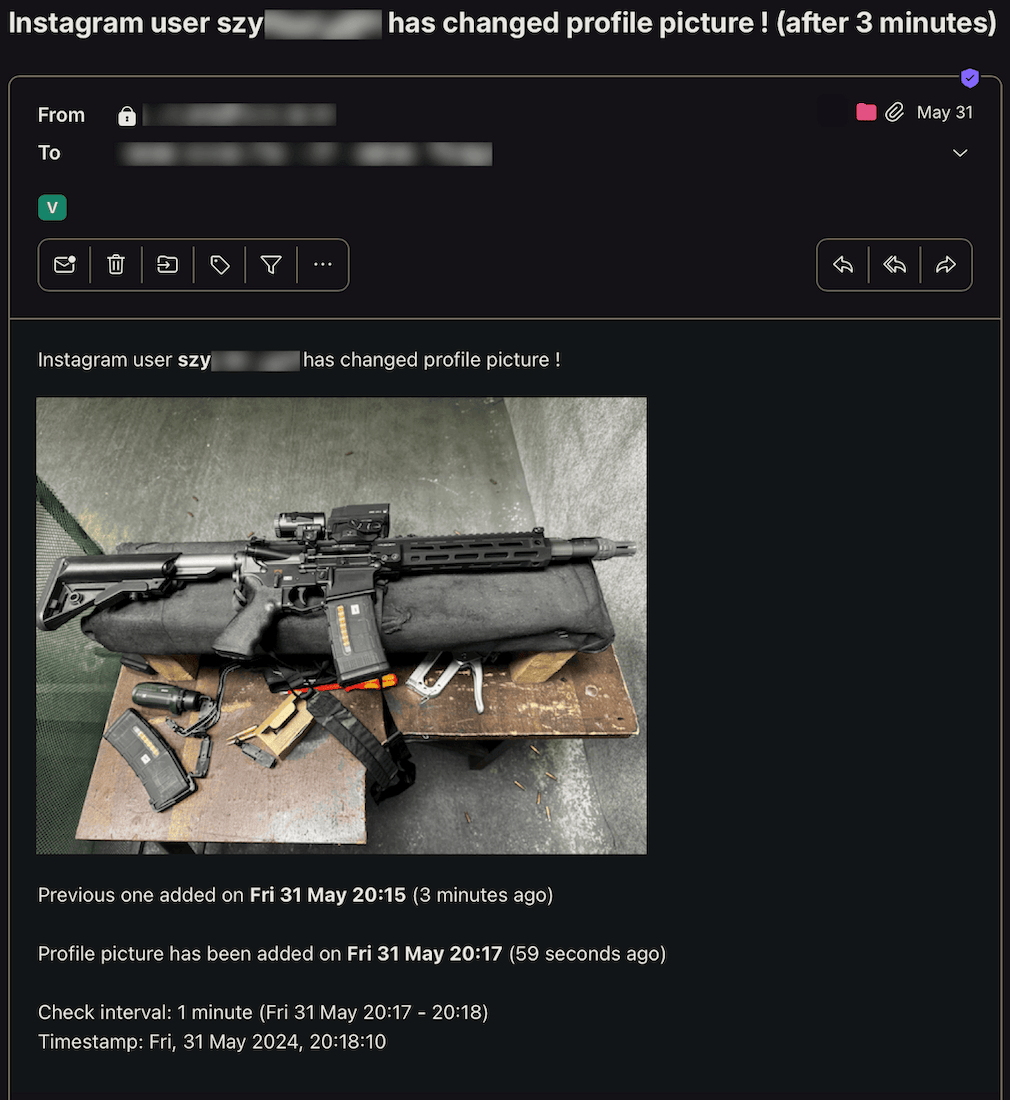
- Attachment of changed profile pictures and stories/posts/reels images directly in email notifications
- Displaying of profile pictures and stories/posts/reels images right in your terminal (if you have
imgcatinstalled) - Saving all user activities and profile changes with timestamps to a CSV file
- Support for both public and private profiles
- Two modes of operation: with or without a logged-in Instagram account
- Various mechanisms to prevent CAPTCHA and detection of automated tools
- Possibility to control the running copy of the script via signals
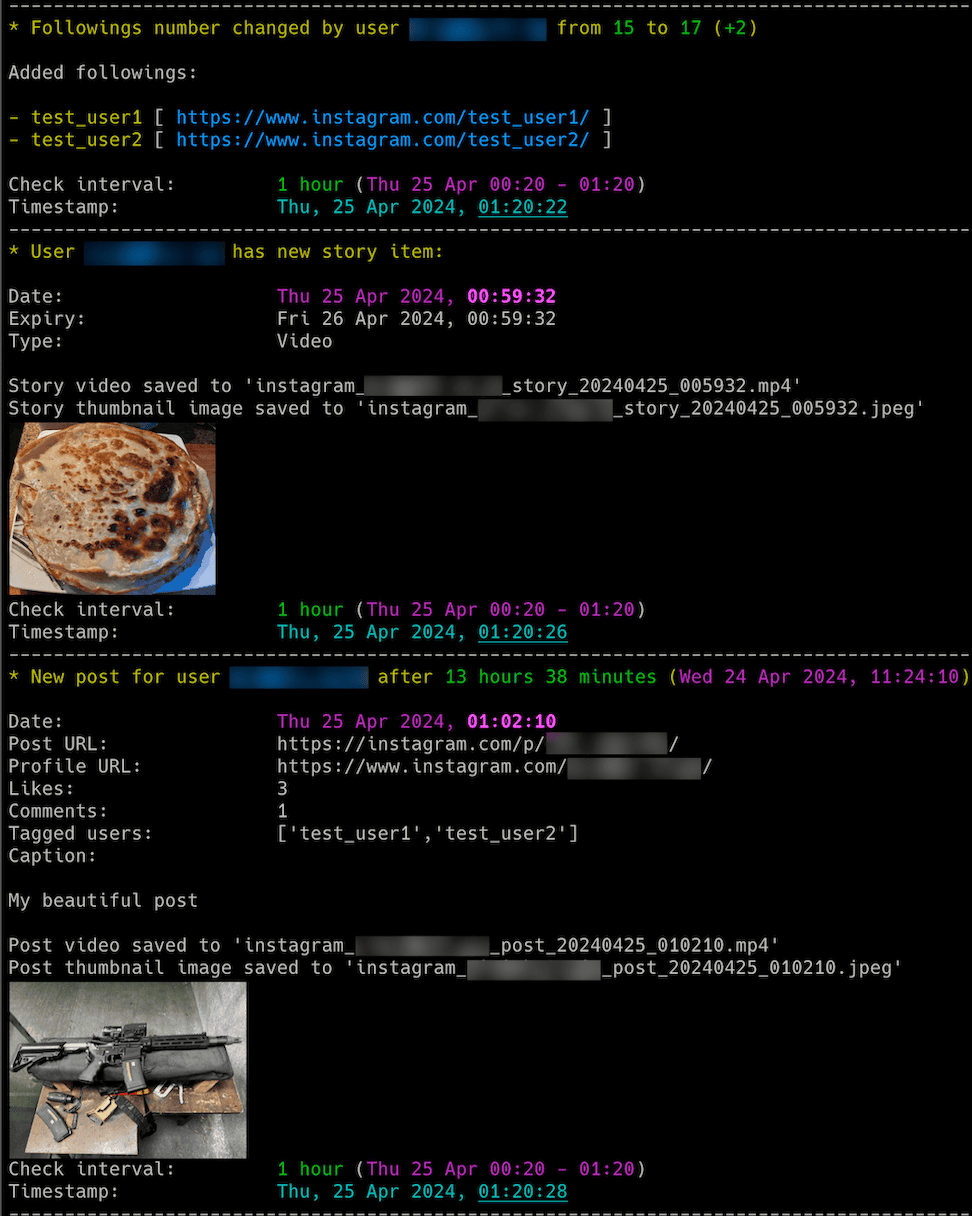
Table of Contents
Requirements
- Python 3.9 or higher
- Libraries: instaloader,
requests,python-dateutil,pytz,tzlocal,python-dotenv
Tested on:
- macOS: Ventura, Sonoma, Sequoia
- Linux: Raspberry Pi OS (Bullseye, Bookworm), Ubuntu 24, Rocky Linux 8.x/9.x, Kali Linux 2024/2025
- Windows: 10, 11
It should work on other versions of macOS, Linux, Unix and Windows as well.
Installation
Install from PyPI
pip install instagram_monitor
Manual Installation
Download the instagram_monitor.py file to the desired location.
Install dependencies via pip:
pip install instaloader requests python-dateutil pytz tzlocal python-dotenv
Alternatively, from the downloaded requirements.txt:
pip install -r requirements.txt
Quick Start
- Track the
target_insta_userin mode 1 (no session login):
instagram_monitor <target_insta_user>
Or if you installed manually:
python3 instagram_monitor.py <target_insta_user>
- Track the
target_insta_userin mode 2 (with session login via Firefox web browser):
# log in to the Instagram account (your_insta_user) via Firefox web browser
instagram_monitor --import-firefox-session
instagram_monitor -u <your_insta_user> <target_insta_user>
To get the list of all supported command-line arguments / flags:
instagram_monitor --help
Configuration
Configuration File
Most settings can be configured via command-line arguments.
If you want to have it stored persistently, generate a default config template and save it to a file named instagram_monitor.conf:
instagram_monitor --generate-config > instagram_monitor.conf
Edit the instagram_monitor.conf file and change any desired configuration options (detailed comments are provided for each).
Mode 1: Without Logged-In Instagram Account (No Session Login)
In this mode, the tool operates without logging in to an Instagram account.
You can still monitor basic user activity such as post, reel and story counts (without details due to Instagram API limits), bio changes and changes in follower/following counts. However, you won't see which specific followers/followings were added or removed and you won't get any details about posts, reels and stories.
This mode requires no setup, is easy to use and is resistant to Instagram's anti-bot mechanisms and CAPTCHA challenges.
Mode 2: With Logged-In Instagram Account (Session Login)
In this mode, the tool uses an Instagram session login to access additional data. This includes detailed insights into new posts, reels and stories, also about added or removed followers/followings.
Recommendation: use a dedicated Instagram account for monitoring. While the risk of a ban is low (in my experience accounts have remained active long-term), Instagram may occasionally show warnings for suspicious activity.
Option 1: Basic Session Login (not recommended)
You can provide your Instagram username (your_insta_user) and password directly in the instagram_monitor.conf configuration file, environment variable or via the -u and -p flags.
However, this triggers a full login every time the tool runs, increasing the chance of detection and account lockouts.
If you store the SESSION_PASSWORD in a dotenv file you can update its value and send a SIGHUP signal to the process to reload the file with the new password without restarting the tool. More info in Storing Secrets and Signal Controls (macOS/Linux/Unix).
Option 2: Session Login via Instaloader (better, but can be detected)
A better approach is to use Instaloader to perform a one-time login and save the session:
instaloader -l <your_insta_user>
This saves the session locally. However, frequent follower/following/stories changes can still lead to detection, as Instagram may flag this as automated behavior.
Option 3: Session Login Using Firefox Cookies (recommended)
The most reliable method is to reuse an existing Instagram session from your Firefox web browser.
Log in to your account (your_insta_user) in Firefox, then run:
instagram_monitor --import-firefox-session
The tool will detect available Firefox profiles with a cookies.sqlite file. If multiple profiles are found, it will prompt you to select one, then import the session and save it via Instaloader.
To use a specific Firefox profile path:
instagram_monitor --import-firefox-session --cookie-file "/path/cookies.sqlite"
You can adjust the default Firefox cookie directory permanently via FIREFOX_*_COOKIE configuration options.
This method has the added benefit of blending tool activity with regular user behavior. Interacting with Instagram via Firefox every few days (scrolling, liking posts etc.) helps maintain session trust. Occasionally, Instagram might show warnings in the browser which can be dismissed manually.
Time Zone
By default, time zone is auto-detected using tzlocal. You can set it manually in instagram_monitor.conf:
LOCAL_TIMEZONE='Europe/Warsaw'
You can get the list of all time zones supported by pytz like this:
python3 -c "import pytz; print('\n'.join(pytz.all_timezones))"
SMTP Settings
If you want to use email notifications functionality, configure SMTP settings in the instagram_monitor.conf file.
Verify your SMTP settings by using --send-test-email flag (the tool will try to send a test email notification):
instagram_monitor --send-test-email
Storing Secrets
It is recommended to store secrets like SESSION_PASSWORD or SMTP_PASSWORD as either an environment variable or in a dotenv file.
Set environment variables using export on Linux/Unix/macOS/WSL systems:
export SESSION_PASSWORD="your_instagram_session_password"
export SMTP_PASSWORD="your_smtp_password"
On Windows Command Prompt use set instead of export and on Windows PowerShell use $env.
Alternatively store them persistently in a dotenv file (recommended):
SESSION_PASSWORD="your_instagram_session_password"
SMTP_PASSWORD="your_smtp_password"
By default the tool will auto-search for dotenv file named .env in current directory and then upward from it.
You can specify a custom file with DOTENV_FILE or --env-file flag:
instagram_monitor <target_insta_user> --env-file /path/.env-instagram_monitor
You can also disable .env auto-search with DOTENV_FILE = "none" or --env-file none:
instagram_monitor <target_insta_user> --env-file none
As a fallback, you can also store secrets in the configuration file or source code.
Usage
Monitoring Mode
To monitor specific user activity in mode 1 (no session login), just type Instagram username as a command-line argument (target_insta_user in the example below):
instagram_monitor <target_insta_user>
To monitor specific user activity in mode 2 (with session login), you also need to specify your Instagram account name (your_insta_user in the example below) via SESSION_USERNAME configuration option or -u flag:
instagram_monitor -u <your_insta_user> <target_insta_user>
By default, the tool looks for a configuration file named instagram_monitor.conf in:
- current directory
- home directory (
~) - script directory
If you generated a configuration file as described in Configuration, but saved it under a different name or in a different directory, you can specify its location using the --config-file flag:
instagram_monitor <target_insta_user> --config-file /path/instagram_monitor_new.conf
The tool runs until interrupted (Ctrl+C). Use tmux or screen for persistence.
You can monitor multiple Instagram users by launching multiple instances of the script.
The tool automatically saves its output to instagram_monitor_<username>.log file. It can be changed in the settings via INSTA_LOGFILE configuration option or disabled completely via DISABLE_LOGGING / -d flag.
The tool in mode 2 (session login) also saves the list of followings & followers to these files:
instagram_<username>_followings.jsoninstagram_<username>_followers.json
Thanks to this we do not need to re-fetch it every time the tool is restarted and we can also detect changes since the last usage of the tool.
The tool also saves the user profile picture to instagram_<username>_profile_pic*.jpeg files.
It also saves downloaded posts/reels images & videos to:
instagram_<username>_post/reel_YYYYmmdd_HHMMSS.jpeginstagram_<username>_post/reel_YYYYmmdd_HHMMSS.mp4
And downloaded stories images & videos to:
instagram_<username>_story_YYYYmmdd_HHMMSS.jpeginstagram_<username>_story_YYYYmmdd_HHMMSS.mp4
Email Notifications
To enable email notifications for various events (such as new posts, reels and stories, changes in followings, bio updates, changes in profile picture and visibility):
- set
STATUS_NOTIFICATIONtoTrue - or use the
-sflag
instagram_monitor <target_insta_user> -s
To also get email notifications about changed followers:
- set
FOLLOWERS_NOTIFICATIONtoTrue - or use the
-mflag
instagram_monitor <target_insta_user> -m
To disable sending an email on errors (enabled by default):
- set
ERROR_NOTIFICATIONtoFalse - or use the
-eflag
instagram_monitor <target_insta_user> -e
Make sure you defined your SMTP settings earlier (see SMTP settings).
Example email:
CSV Export
If you want to save all Instagram user's activities and profile changes to a CSV file, set CSV_FILE or use -b flag:
instagram_monitor <target_insta_user> -b instagram_username.csv
The file will be automatically created if it does not exist.
Detection of Changed Profile Pictures
The tool can detect when a monitored user changes their profile picture. Notifications appear in the console and (if the -s flag is enabled) via email.
This feature is enabled by default. To disable it, either:
- set the
DETECT_CHANGED_PROFILE_PICtoFalse - or use the
-kflag
How It Works
Since Instagram periodically changes the profile picture URL even when the image is the same, the tool performs a binary comparison of JPEG files to detect actual changes.
On the first run, it saves the current profile picture to instagram_<username>_profile_pic.jpeg
On each subsequent check a new image is fetched and it is compared byte-for-byte with the saved image.
If a change is detected, the old picture is moved to instagram_<username>_profile_pic_old.jpeg and the new one is saved to:
instagram_<username>_profile_pic.jpeg(current)instagram_<username>_profile_pic_YYmmdd_HHMM.jpeg(for history)
Empty Profile Picture Detection
The tool also has built-in detection of empty profile pictures. Instagram does not indicate an empty user's profile image in their API; that's why the tool detects it by using an empty profile image template (which appears to be identical on a binary level for all users).
To enable this:
- download the instagram_profile_pic_empty.jpeg file
- place it in the directory where you run the tool (or change the path via
PROFILE_PIC_FILE_EMPTYconfiguration option)
Without this file, the tool will treat an empty profile picture as a regular image. For example, if a user removes their profile picture, it would be treated as a change rather than a removal.
Displaying Images in Your Terminal
If you have imgcat installed, you can use the feature of displaying profile pictures and stories/reels/posts images right in your terminal.
To do this, set the path to your imgcat binary in the IMGCAT_PATH configuration option.
If you specify only the binary name, it will be auto-searched in your PATH.
Set it to empty to disable this feature.
Check Intervals
If you want to customize polling interval, use -c flag (or INSTA_CHECK_INTERVAL configuration option):
instagram_monitor <target_insta_user> -c 3600
It is generally not recommended to use values lower than 1 hour as it will be quickly picked up by Instagram automated tool detection mechanisms.
In order to make the tool's behavior less suspicious for Instagram, by default the polling interval is randomly picked from the range:
[ INSTA_CHECK_INTERVAL (-c) - RANDOM_SLEEP_DIFF_LOW (-i) ]
                         ⇄
[ INSTA_CHECK_INTERVAL (-c) + RANDOM_SLEEP_DIFF_HIGH (-j) ]
This means each check will happen after a random delay centered around INSTA_CHECK_INTERVAL with some variation defined by RANDOM_SLEEP_DIFF_LOW and RANDOM_SLEEP_DIFF_HIGH.
So having the check interval set to 1 hour (-c 3600), RANDOM_SLEEP_DIFF_LOW set to default 15 mins (-i 900) and RANDOM_SLEEP_DIFF_HIGH set to default 3 mins (-j 180) means that the check interval will be with every iteration picked from the range of 45 mins to 1 hour and 3 mins.
That's why the check interval information is printed in the console and email notifications as it is essentially a random number.
On top of that you can also define that checks for new posts / reels should be done only in specific hour ranges by setting CHECK_POSTS_IN_HOURS_RANGE to True and then defining proper values for MIN/MAX_H1/H2 configuration options (see the comments in the configuration file for more information).
Signal Controls (macOS/Linux/Unix)
The tool has several signal handlers implemented which allow to change behavior of the tool without a need to restart it with new configuration options / flags.
List of supported signals:
| Signal | Description |
|---|---|
| USR1 | Toggle email notifications for new posts, reels & stories, changed followings, bio, profile picture, visibility (-s) |
| USR2 | Toggle email notifications for new followers (-m) |
| TRAP | Increase the user activity check interval (by 5 mins) |
| ABRT | Decrease the user activity check interval (by 5 mins) |
| HUP | Reload secrets from .env file |
Send signals with kill or pkill, e.g.:
pkill -USR1 -f "instagram_monitor <target_insta_user>"
As Windows supports limited number of signals, this functionality is available only on Linux/Unix/macOS.
Coloring Log Output with GRC
You can use GRC to color logs.
Add to your GRC config (~/.grc/grc.conf):
# monitoring log file
.*_monitor_.*\.log
conf.monitor_logs
Now copy the conf.monitor_logs to your ~/.grc/ and log files should be nicely colored when using grc tool.
Example:
grc tail -F -n 100 instagram_monitor_<username>.log
Limitations
The operation of the tool might flag the Instagram account and/or IP as being an automated tool (as described earlier).
Change Log
See RELEASE_NOTES.md for details.
License
Licensed under GPLv3. See LICENSE.
Release history Release notifications | RSS feed


Download files
Download the file for your platform. If you're not sure which to choose, learn more about installing packages.
Source Distribution
Built Distribution
Filter files by name, interpreter, ABI, and platform.
If you're not sure about the file name format, learn more about wheel file names.
Copy a direct link to the current filters
File details
Details for the file instagram_monitor-1.6.1.tar.gz.
File metadata
- Download URL: instagram_monitor-1.6.1.tar.gz
- Upload date:
- Size: 45.1 kB
- Tags: Source
- Uploaded using Trusted Publishing? No
- Uploaded via: twine/6.1.0 CPython/3.13.3
File hashes
| Algorithm | Hash digest | |
|---|---|---|
| SHA256 |
2cf1b15d5d4034e4a110c1bf55b3614c7e5bb41fbac111f56c7064d4a71c5032
|
|
| MD5 |
61e03e98736316a66c921b7934e59c7a
|
|
| BLAKE2b-256 |
29b2d9e72d1cf1f0a1a48fd72b5b4597748292322926e2834ebb234c93e3c9be
|
File details
Details for the file instagram_monitor-1.6.1-py3-none-any.whl.
File metadata
- Download URL: instagram_monitor-1.6.1-py3-none-any.whl
- Upload date:
- Size: 45.4 kB
- Tags: Python 3
- Uploaded using Trusted Publishing? No
- Uploaded via: twine/6.1.0 CPython/3.13.3
File hashes
| Algorithm | Hash digest | |
|---|---|---|
| SHA256 |
66e8e8a22f58f09d3cc75955ed2b1ef4e134fe8b42488321d989df65e5f463db
|
|
| MD5 |
c1b5836546e866043c3b23624b2bd736
|
|
| BLAKE2b-256 |
918dcb265eeeaf22eea85861f17e7dab0fd8cfd351a6218b14763073a5b85d7d
|







