
No project description provided

Project description
A compact, fast object system that can serve as the basis for a DAO model.
To that end, instruct uses __slots__ to prevent new attribute addition, properties to control types, event listeners and historical changes, and a Jinja2-driven codegen to keep a pure-Python implementation as fast and as light as possible.
Attempt to serve multiple masters:
Support multiple inheritance, chained fields and __slots__ [Done]
Support type coercions (via _coerce__) [Done]
Strictly-typed ability to define fixed data objects [Done]
Ability to drop all of the above type checks [Done]
Track changes made to the object as well as reset [Done]
Fast __iter__ [Done]
Native support of pickle [Done]/json [Partial]
Support List[type] declarations and initializations
CStruct-Base class that operates on an _cvalue cffi struct.
Cython compatibility
Design Goal
This comes out of my experience of doing multiple object systems mean to represent database relations and business rules. One thing that has proven an issue is the requirements for using as little memory as possible, as little CPU as possible yet prevent the developer from trying to stick a string where a integer belongs.
Further complicating this model is that desire to “correct” data as it comes in. Done correctly, it is possible to feed an instruct.Base-derived class fields that are not of the correct data type but are eligible for being coerced (converted) into the right type with a function. With some work, it’ll be possible to inline a lambda val: ... expression directly into the setter function code.
Finally, multiple inheritance is a must. Sooner or later, you end up making a single source implementation for a common behavior shared between objects. Being able to share business logic between related implementations is a wonderful thing.
Wouldn’t it be nice to define a heirachy like this:
class Member(Base):
    __slots__ = {
        'first_name': str,
        'last_name': str,
        'id': str,
    }
    def __init__(self, **kwargs):
        self.first_name = self.last_name = ''
        self.id = -1
        super().__init__(**kwargs)

class Organization(Base, history=True):
    __slots__ = {
        'name': str,
        'id': int,
        'members': List[Member],
        'created_date': datetime.datetime,
    }

    __coerce__ = {
        'created_date': (str, lambda obj: datetime.datetime.strptime('%Y-%m-%d', obj))
    }

    def __init__(self, **kwargs):
        self.name = ''
        self.id = -1
        self.members = []
        self.created_date = datetime.datetime.utcnow()
        super().__init__(**kwargs)
And have it work like this?
data = {
    "name": "An Org",
    "id": 123,
    "members": [
        {
            "id": 551,
            "first_name": "Jinja",
            "last_name": "Ninja",
        }
    ]
}
org = Organization(**data)
assert org.members[0].first_name == 'Jinja'
org.name = "New Name"
org.history()
Design
Solving the multiple-inheritance and __slots__ problem
Consider the following graph:
Base1    Base2
     \  /
   Class A
If both defined __slots__ = (), Class A would be able to declare __slots__ to hold variables. For now on, we shall consider both Base’s to have __slots__ = () for simplicity.
However, consider this case:
Base1    Base2
     \  /
   Class A     Class B
          \    /
          Class C
Now this isn’t possible if Class A has non-empty __slots__.
But what if we could change the rules. What if, somehow, when you __new__ ed a class, it really gave you a specialized form of the class with non-empty __slots__?
Such a graph may look like this:
Base1    Base2
     \  /
   Class A     Class B
      |  \    /     |
Class _A  Class C  Class _B
            |
          Class _C
Now it is possible for any valid multiple-inheritance chain to proceed, provided it respects the above constraints - there are either support classes or data classes (denoted with an underscore in front of their class name). Support classes may be inherited from, data classes cannot.
Solving the Slowness issue
I’ve noticed that there are constant patterns of writing setters/getters and other related functions. Using Jinja2, we can rely on unhygenic macros while preserving some semblance of approachability. It’s more likely a less experienced developer could handle blocks of Jinja-fied Python than AST synthesis/traversal.
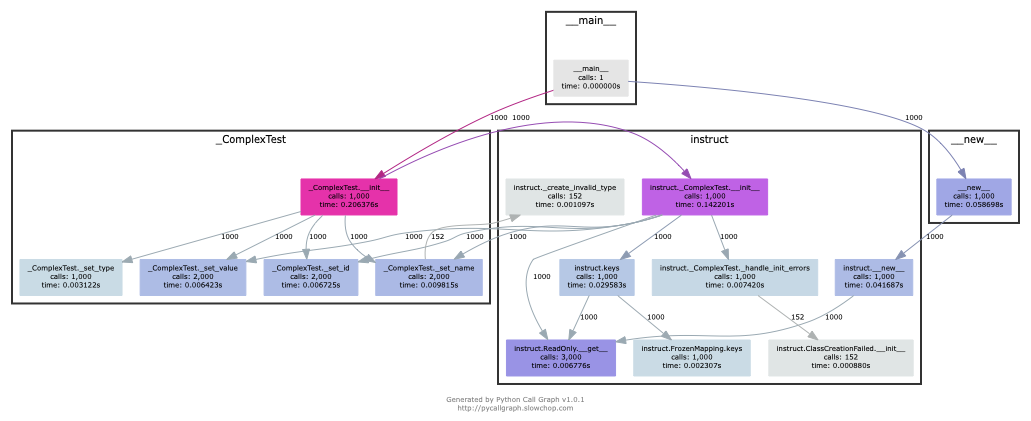
Callgraph Performance
Benchmark
Before additions of coercion, event-listeners, multiple-inheritance
$ python -m instruct benchmark
Overhead of allocation, one field, safeties on: 6.52us
Overhead of allocation, one field, safeties off: 6.13us
Overhead of setting a field:
Test with safeties: 0.40 us
Test without safeties: 0.22 us
Overhead of clearing/setting
Test with safeties: 1.34 us
Test without safeties: 1.25 us
After additions of those. Safety is expensive.
$ python -m instruct benchmark
Overhead of allocation, one field, safeties on: 19.25us
Overhead of allocation, one field, safeties off: 18.98us
Overhead of setting a field:
Test with safeties: 0.36 us
Test without safeties: 0.22 us
Overhead of clearing/setting
Test with safeties: 1.29 us
Test without safeties: 1.14 us
Release history Release notifications | RSS feed


Download files
Download the file for your platform. If you're not sure which to choose, learn more about installing packages.
Source Distribution
Built Distribution
Filter files by name, interpreter, ABI, and platform.
If you're not sure about the file name format, learn more about wheel file names.
Copy a direct link to the current filters
File details
Details for the file instruct-0.3.5.tar.gz.
File metadata
- Download URL: instruct-0.3.5.tar.gz
- Upload date:
- Size: 19.2 kB
- Tags: Source
- Uploaded using Trusted Publishing? No
- Uploaded via: twine/1.12.1 pkginfo/1.4.2 requests/2.20.1 setuptools/40.8.0 requests-toolbelt/0.8.0 tqdm/4.28.1 CPython/3.7.3
File hashes
| Algorithm | Hash digest | |
|---|---|---|
| SHA256 |
572664cfaa005f72edc0b6c218208f0c6b34dd9b96da23c0dd3013286c3418ca
|
|
| MD5 |
931d54175a02ddfa0e9e5e5bd3e6fac0
|
|
| BLAKE2b-256 |
e705ea876b6df9cd77bc82480cfd89f20d72fecbb83130f7990327f48fff30ff
|
File details
Details for the file instruct-0.3.5-py3-none-any.whl.
File metadata
- Download URL: instruct-0.3.5-py3-none-any.whl
- Upload date:
- Size: 20.3 kB
- Tags: Python 3
- Uploaded using Trusted Publishing? No
- Uploaded via: twine/1.12.1 pkginfo/1.4.2 requests/2.20.1 setuptools/40.8.0 requests-toolbelt/0.8.0 tqdm/4.28.1 CPython/3.7.3
File hashes
| Algorithm | Hash digest | |
|---|---|---|
| SHA256 |
7648ac64afbe80069042bd2d0e4875c11877e1854666cfabac21340c18cae7fb
|
|
| MD5 |
f6b591dc45a5b76b21f5d1565a7141ab
|
|
| BLAKE2b-256 |
7d41a7f2e9585792eb7426ad622fe13074c3cf289a36276d1590129062d22e22
|






