
Inertial Navigation Utilities


Project description
Inertial Navigation Utilities
Key Design Concepts
Functions
This library provides forward mechanization of inertial measurement unit sensor values (accelerometer and gyroscope readings) to get position, velocity, and attitude as well as inverse mechanization to get sensor values from position, velocity, and attitude. It also includes tools to calculate velocity from geodetic position over time, to estimate attitude from velocity, and to estimate wind velocity from ground-track velocity and yaw angle.
Accuracy
The mechanization algorithms in this library make no simplifying assumptions. The Earth is defined as an ellipsoid. Any deviations of the truth from this simple shape can be captured by more complex gravity models. The algorithms use a single frequency update structure which is much simpler than the common two-frequency update structure and just as, if not more, accurate.
Duality
The forward and inverse mechanization functions are perfect duals of each other. This means that if you started with a profile of position, velocity, and attitude and passed these into the inverse mechanization algorithm to get sensor values and then passed those sensor values into the forward mechanization algorithm, you would get back the original position, velocity, and attitude profiles. The only error would be due to finite-precision rounding.
Vectorization
When possible, the functions are vectorized in order to handle processing batches of values. A set of scalars is a 1D array. A set of vectors is a 2D array, with each vector in a column. So, a (3, 7) array is a set of seven vectors, each with 3 elements. If an input matrix does not have 3 rows, it will be assumed that the rows of the matrix are vectors.
An example of the vectorization in this library is the inv_mech (inverse
mechanization) algorithm. There is no for loop to iterate through time; rather
the entire algorithm has been vectorized. This results in an over 100x speed
increase.
Extended Kalman Filter
An extended Kalman filter can be implemented using this library. The mech_step
function applies the mechanization equations to a single time step. It returns
the time derivatives of the states. The jacobian function calculates the
continuous-domain Jacobian of the dynamics function. While this does mean that
the user must then manually integrate the derivatives and discretize the
Jacobian, this gives the user greater flexibility to decide how to discretize
them.
The example code below is meant to run within a for loop stepping through
time, where k is the time index:
# Inputs
fbbi = fbbi_t[:, k] # specific forces (m/s^2)
wbbi = wbbi_t[:, k] # rotation rates (rad/s)
z = z_t[:, k] # GPS position (rad, rad, m)

# Update
S = H @ Ph @ H.T + R # innovation covariance (3, 3)
Si = np.linalg.inv(S) # inverse (3, 3)
Kg = Ph @ H.T @ Si # Kalman gain (9, 3)
Ph -= Kg @ H @ Ph # update to state covariance (9, 9)
r = z - llh # innovation (3,)
dx = Kg @ r # changes to states (9,)
llh += dx[:3] # add change in position
vne += dx[3:6] # add change in velocity
# matrix exponential of skew-symmetric matrix
Psi = inu.rodrigues_rotation(dx[6:])
Cnb = Psi.T @ Cnb

# Save results.
tllh_t[:, k] = llh
tvne_t[:, k] = vne
trpy_t[:, k] = inu.dcm_to_rpy(Cnb.T)

# Get the Jacobian and propagate the state covariance.
F = inu.jacobian(fbbi, llh, vne, Cnb)
Phi = I + (F*T)@(I + (F*T/2)) # 2nd-order expm(F T)
Ph = Phi @ Ph @ Phi.T + Qd

# Get the state derivatives.
Dllh, Dvne, wbbn = inu.mech_step(fbbi, wbbi, llh, vne, Cnb)

# Integrate (forward Euler).
llh += Dllh * T # change applies linearly
vne += Dvne * T # change applies linearly
Cnb[:, :] = Cnb @ inu.rodrigues_rotation(wbbn * T)
inu.orthonormalize_dcm(Cnb)

# Update progress bar.
inu.progress(k, K, tic)
In the example above, H should be a (3, 9) matrix with ones along the
diagonal. The Qd should be the (9, 9) discretized dynamics noise covariance
matrix. The R should be the (3, 3) measurement noise covariance matrix. Note
that forward Euler integration has been performed on the state derivatives and a
second-order approximation to the matrix exponential has been implemented to
discretize the continuous-time Jacobian.
Functions
Mechanization: mech and mech_step
llh_t, vne_t, rpy_t = inu.mech(fbbi_t, wbbi_t,
        llh0, vne0, rpy0, T, hae_t=None,
        grav_model=somigliana, show_progress=True)
Dllh, Dvne, wbbn = inu.mech_step(fbbi, wbbi,
        llh, vne, Cnb, grav_model=somigliana)
The mech function performs forward mechanization of accelerometer and
gyroscope sensor values, given the initial conditions for position, velocity,
and attitude. This function processes an entire time-history profile of sensor
values and returns the path solution for the corresponding span of time. If you
would prefer to mechanize only one step at a time, you can call the mech_step
function instead. Actually, the mech function does call the mech_step
function within a for loop.
Inverse Mechanization: inv_mech
fbbi_t, wbbi_t = inu.inv_mech(llh_t, rpy_t, T, grav_model=somigliana)
The inv_mech function performs inverse mechanization, meaning it takes path
information in the form of position, velocity, and attitude over time and
estimates the corresponding sensor values for an accelerometer and gyroscope.
This function is fully vectorized, so there is no for loop internally. Note
that the velocity should be the exact forward Euler derivative of position:
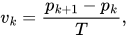
where v is the velocity, p is the position, and T is the sampling period.
Of course, to get North, East, down velocity from latitude, longitude, and
height above ellipsoid requires some coordinate conversion. If you do not
already have velocity values which are exactly equal to the forward Euler
derivative of position, use can use the llh_to_vne function.
In addition to generating velocity from position, you can also generate likely
attitude values from velocity assuming coordinated turns. The vne_to_rpy
function serves this purpose.
Jacobian: jacobian
F = inu.jacobian(fbbi, llh, vne, Cnb)
The Jacobian of the dynamics is calculated using the jacobian function. This
is a square matrix whose elements are the derivatives with respect to state of
the continuous-domain, time-derivatives of states. For example, the time
derivative of latitude is
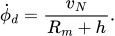
So, the derivative of this with respect to height above ellipsoid is
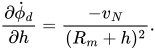
The order of the states is position (latitude, longitude, height), velocity (North, East, down), and attitude. So, the above partial derivative would be found in element (1,3) (base-1 indexing) of the Jacobian matrix.
The representation of attitude is complicated. This library uses 3x3 direction cosine matrices (DCMs) to process attitude. The rate of change in attitude is represented by a tilt error vector. So, the last three states in the Jacobian are the x, y, and z tilt errors. This makes a grand total of 9 states, so the Jacobian is a 9x9 matrix.
The above code example (and the ekf.py script in the examples folder) shows
how to use the Jacobian.
Discretization: vanloan
Phi, Bd, Qd = inu.vanloan(F, B=None, Q=None, T=None)
The extended Kalman filter (EKF) example above shows a reduced-order
approximation to the matrix exponential of the Jacobian. The Q dynamics
noise covariance matrix also needs to be discretized. This was done with a
first-order approximation by just multiplying it by the sampling period T.
This is reasonably accurate and computationally fast. However, it is an
approximation. The mathematically accurate way to discretize the Jacobian and
Q is to use the van Loan method. This is implemented with the vanloan
function.
Orientation: ned_enu
vec = inu.ned_enu(vec)
This library assumes all local-level coordinates are in the North, East, down
orientation. If your coordinates are in the East, North, up orientation or you
wish for the final results to be converted to that orientation, use the
ned_enu function.
Estimate Horizontal Winds: est_wind
wind_t = inu.est_wind(vne_t, yaw_t)
If you have heading information as well as velocity information, then you can
calculate the velocity vector due to wind using the est_wind function.
Release history Release notifications | RSS feed


Download files
Download the file for your platform. If you're not sure which to choose, learn more about installing packages.
Source Distribution
Built Distribution
Filter files by name, interpreter, ABI, and platform.
If you're not sure about the file name format, learn more about wheel file names.
Copy a direct link to the current filters
File details
Details for the file inu-1.2.4.tar.gz.
File metadata
- Download URL: inu-1.2.4.tar.gz
- Upload date:
- Size: 22.9 kB
- Tags: Source
- Uploaded using Trusted Publishing? No
- Uploaded via: twine/6.1.0 CPython/3.13.2
File hashes
| Algorithm | Hash digest | |
|---|---|---|
| SHA256 |
d78d66968a240979e65c4096ea7a3f014c71c688a2ba6263a2cfdfed01799f2b
|
|
| MD5 |
1e50b14f652c085f4804f3fd0065bcce
|
|
| BLAKE2b-256 |
165e618e405dabf1874d2d4b04319826fcd5ae59dc01f0f38529c2486e2789ed
|
File details
Details for the file inu-1.2.4-py3-none-any.whl.
File metadata
- Download URL: inu-1.2.4-py3-none-any.whl
- Upload date:
- Size: 21.7 kB
- Tags: Python 3
- Uploaded using Trusted Publishing? No
- Uploaded via: twine/6.1.0 CPython/3.13.2
File hashes
| Algorithm | Hash digest | |
|---|---|---|
| SHA256 |
29baebb8480b2eee32fe8e95d53ee245d5481a6e966fa7c273b4263d55012cf7
|
|
| MD5 |
b560d372871931062f1d85ee410945ff
|
|
| BLAKE2b-256 |
a45d2abf062d9eebb4157c8cb370c89a85af13d71e8312e462f44b8e4f815d57
|






