
Auditable strict verification for edited model checkpoints (InvarLock framework)
Verified details
These details have been verified by PyPIProject links
GitHub Statistics
Maintainers

Project description

Auditable strict verification for edited model checkpoints





Catch silent quality regressions in edited model checkpoints before they ship.
Quantizing, pruning, or otherwise editing a model's weights can silently degrade quality.
InvarLock compares an edited subject checkpoint against a fixed baseline with paired
evaluation windows, enforces the canonical guard chain (invariants -> spectral -> RMT
-> variance -> invariants), and produces a machine-readable evaluation report you can gate
in CI.
InvarLock validates baseline-vs-subject checkpoint comparisons. The subject can
come from any external edit workflow: quantization, pruning, LoRA merge,
fine-tuning, or another weight-edit pipeline. The built-in quant_rtn edit is
for demos and smoke tests; production workflows are
bring-your-own-edited-checkpoint (BYOE). The repo ships strict-verifiable BYOE
fixtures for dense magnitude pruning and LoRA-merge style subjects under
public_evidence/byoe_examples/. Real model runs under
public_evidence/real_runs/ include an external magnitude-prune BYOE run and a
tiny GPT-2 quantization smoke.
The public_evidence/ tree separates verifier fixtures from real runs. Fixtures
validate report, runtime-manifest, failure-policy, and evidence-pack contracts;
public_evidence/real_runs/ contains concrete GPT-2-family invarlock evaluate
runs with signed, fingerprint-pinned evidence packs.
The strongest public guard-value artifact is the Mistral 7B scenario package at
public_evidence/published_basis/mistral_7b/guard_value_demo/: PM-only accepts
the selected edits, while the evidence-pack PM+guards comparison records
baseline-relative spectral, RMT, and variance/VE guard movement from clean
reruns.
Why InvarLock?
- Quality gates for edited checkpoints: catch regressions before deployment.
- Paired statistical evidence: primary metrics with confidence intervals.
- Auditable evidence: deterministic pairing metadata + policy digests in
evaluation.report.json. - CI/CD-friendly: stable exit codes,
--jsonoutputs, and portable “evidence packs”. - Offline-first: network is disabled by default; enable downloads per command.
- Explicit assurance boundary: the trust model states the scope of a strict pass.
Who is this for?
- ML engineers shipping edited model checkpoints, including quantized, pruned, fine-tuned, adapter-merged, or otherwise weight-modified variants.
- MLOps and platform teams building CI gates, runtime-provenance verification, and reviewable evaluation artifacts.
- Researchers validating weight-edit, compression, and model-comparison methods with reproducible paired evaluation across text and image-text workflows supported here.
How it works
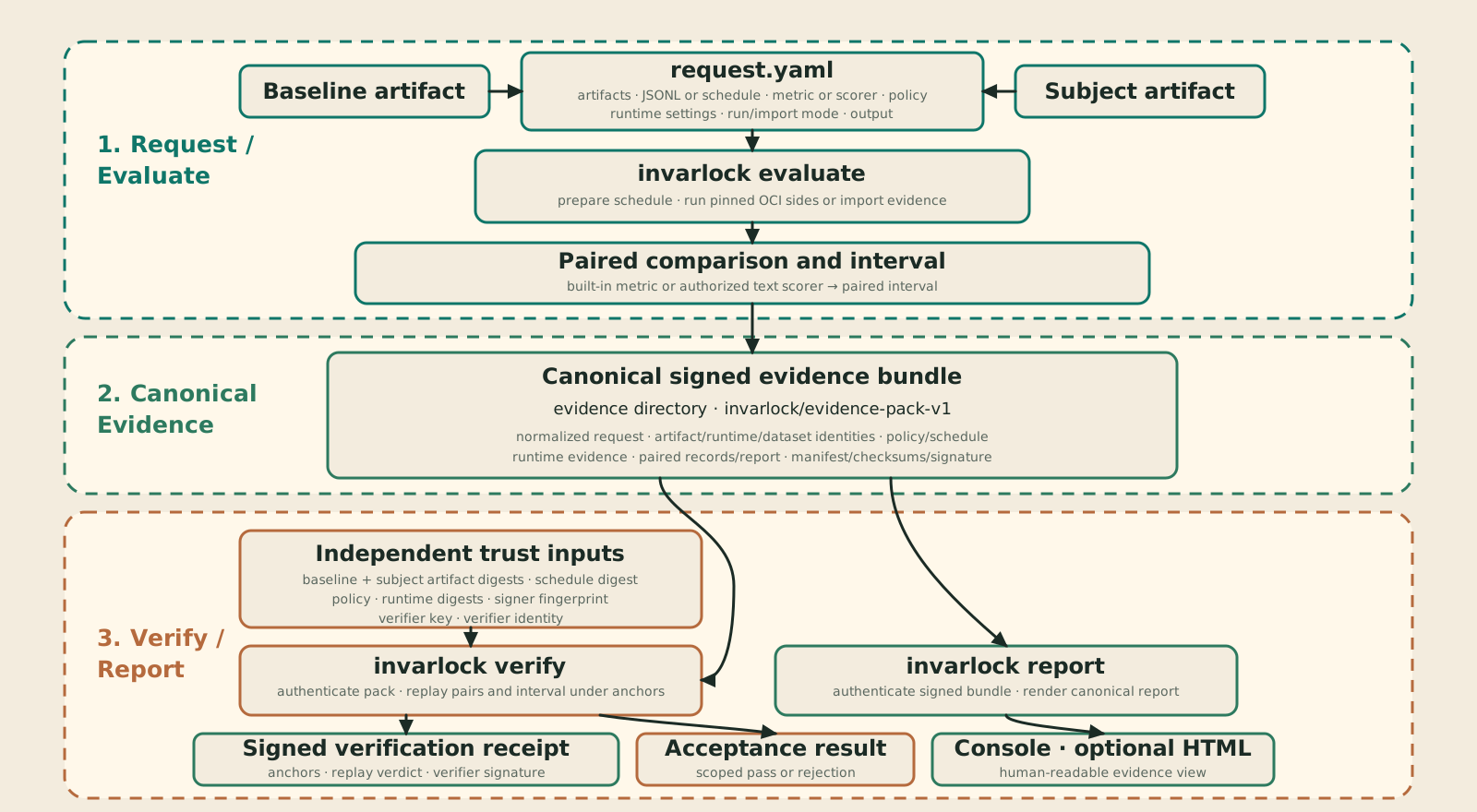
Flow summary: baseline and subject checkpoints enter invarlock evaluate,
which produces paired run traces plus evaluation.report.json and
runtime.manifest.json. invarlock verify checks schema, pairing, gates, and
runtime provenance; passing reports can then be rendered with
invarlock report html or packaged as evidence.
Quick Start
Colab (CPU-friendly):

The public front door is evaluate -> verify -> report html. The README keeps
the three common onboarding paths separate:
- Wheel user / reviewer: install
invarlock, inspect an existingevaluation.report.json, and render HTML without cloning the repository. - Evaluator: install
invarlock[hf]when you wantevaluateto load Hugging Face models and emit a fresh evaluation bundle. - Repo maintainer: clone the repo and build the local runtime image when you need maintainer smokes, repo presets, or local container-image iteration.
The default evaluate path runs model-loading commands inside the runtime
container and expects an OCI engine such as podman or docker. Host-side
workflows can opt into --execution-mode host, but the default verification
path below expects a container-backed report with sibling runtime provenance.
evaluate also defaults to the current strict assurance contract: CI/release
profile, balanced/conservative tier, canonical guard order, complete evidence,
strict paired metrics, and verified runtime provenance are required for an
assurance pass. Use --assurance off only for exploratory reports.
# Evaluator path: create a fresh bundle
pip install "invarlock[hf]"

invarlock --version

# Compare baseline vs subject (downloads require explicit network enable)
INVARLOCK_DEDUP_TEXTS=1 invarlock evaluate --allow-network \
  --baseline gpt2 \
  --subject  distilgpt2 \
  --baseline-adapter auto --subject-adapter auto \
  --profile ci \
  --assurance strict \
  --report-out reports/eval \
  --quiet

# Validate the container-backed evaluation report
test -f reports/eval/runtime.manifest.json
invarlock verify reports/eval/evaluation.report.json

# Render HTML for sharing
invarlock report html -i reports/eval/evaluation.report.json -o reports/eval/evaluation.html
Wheel-only verification path:
pip install invarlock, invarlock doctor,
invarlock verify /path/to/evaluation.report.json,
invarlock report html -i /path/to/evaluation.report.json -o /path/to/evaluation.html,
invarlock report explain --evaluation-report /path/to/evaluation.report.json,
and invarlock report export -i /path/to/evaluation.report.json --format mlflow-tags.
Repo maintainers can build the local runtime image once with make runtime-image;
InvarLock automatically prefers invarlock-runtime:local when it is present.
Artifact model:
| Artifact | Produced by | Primary consumers |
|---|---|---|
evaluation.report.json |
invarlock evaluate, invarlock report generate --format report |
invarlock verify, invarlock report html, invarlock report export, invarlock report validate, invarlock report explain --evaluation-report, invarlock advanced runtime-verify |
report.json |
Baseline/subject run directories under runs/... |
invarlock report generate, invarlock report explain --subject-report ... --baseline-report ... |
invarlock verify expects evaluation.report.json; if you only have a raw
run directory containing report.json, first build the reviewer bundle with
invarlock report generate --run <subject report.json> --baseline-run-report <baseline report.json> --format report -o <output-dir>.
invarlock advanced runtime-verify is narrower: it checks runtime manifest
binding/provenance; report/gate verification remains the reviewer-facing gate.
Example output (abridged; counts vary by profile/config):
INVARLOCK v<version> - EVALUATE
Baseline: gpt2 -> Subject: distilgpt2 - Profile: ci
Status: PASS - Gates: <passed>/<total> passed
Primary metric ratio: <ratio>
Output: reports/eval/evaluation.report.json
Runtime provenance: reports/eval/runtime.manifest.json
Command Surface
- First touch in a fresh install:
invarlock --help,invarlock --version,invarlock report --help, andinvarlock advanced --help. - Core workflow:
invarlock evaluate->invarlock verify->invarlock report html. - Follow-on report analysis after the core loop:
invarlock report generate,invarlock report explain,invarlock report export, andinvarlock report validate. - Environment and release checks:
invarlock doctorplus the JSON surfaces emitted bydoctor --jsonandadvanced plugins ... --json. - Runtime-manifest verifier:
invarlock advanced runtime-verify --report <evaluation.report.json> --manifest <runtime.manifest.json>. - The public contract catalog exposed by those JSON surfaces includes
model_classification,validation_keys,console_labels, andmetric_kinds, plus the compactpublic_evidence_index. - Advanced workflows:
invarlock advanced evidence-pack,invarlock advanced policy,invarlock advanced plugins, andinvarlock advanced calibrate. - Host execution for the core evaluate path uses
--execution-mode host. - Optional adapter/backend installs use normal Python extras such as
pip install "invarlock[hf]"rather than CLI install commands.
Evidence packs (portable evidence bundles)
Evidence packs bundle reports + verification metadata into a distributable artifact.
- Guide: https://invarlock.github.io/invarlock/0.11.0/user-guide/evidence-packs/
- Verify from an installed wheel:
invarlock advanced evidence-pack verify <dir> --strict --report-assurance strict --expected-fingerprint sha256:<64-hex-chars> - Repo harness alternative:
scripts/evidence_packs/verify_pack.sh --pack <dir> --strict --report-assurance strict --expected-fingerprint sha256:<64-hex-chars> - For recurring signers, use
--trust-store <json>or~/.config/invarlock/trusted-signers.jsonwith the package-native verifier.
Note: configs/ and most scripts/ remain repo resources and are not included in
wheels. Installed wheels include the public contracts and the
invarlock advanced evidence-pack verify verifier, so installed packages can
check bundles without cloning the repository.
Full published-basis public evidence artifacts live in the source tree and
release tags under public_evidence/; wheels carry the compact
published_basis_index.json summary with hashes, sizes, coverage, and source
paths instead of duplicating the full artifact corpus.
Installation
# Minimal CLI (no torch/transformers)
pip install invarlock

# HF workflows (torch/transformers)
pip install "invarlock[hf]"
HF-backed extras require transformers>=5.12.0; this covers text, multimodal,
and quantized adapter loading through one tested HF runtime floor.
Optional extras: invarlock[probes], invarlock[gpu],
invarlock[awq,gptq], invarlock[torchao], invarlock[hqq],
invarlock[quanto], and invarlock[compressed-tensors]. The awq and
gptq extras use GPTQModel-backed subject loading. Full setup:
https://invarlock.github.io/invarlock/0.11.0/user-guide/getting-started/.
The minimal install covers the core verification and reporting flows. Add
invarlock[hf] only for model-loading evaluate runs, and use the installed
wheel's evidence-pack verifier when you need to inspect a bundle without cloning
the repository.
Documentation
- Docs home: https://invarlock.github.io/invarlock/0.11.0/
- Quickstart: https://invarlock.github.io/invarlock/0.11.0/user-guide/quickstart/
- Compare & evaluate (BYOE): https://invarlock.github.io/invarlock/0.11.0/user-guide/compare-and-evaluate/
- Reading a report: https://invarlock.github.io/invarlock/0.11.0/user-guide/reading-report/
- CLI reference: https://invarlock.github.io/invarlock/0.11.0/reference/cli/
- Assurance case: https://invarlock.github.io/invarlock/0.11.0/assurance/00-assurance-case/
(repo source:
docs/assurance/00-assurance-case.md) - Threat model: https://invarlock.github.io/invarlock/0.11.0/security/threat-model/
Community
- Questions/ideas: https://github.com/invarlock/invarlock/discussions
- Bug reports: https://github.com/invarlock/invarlock/issues
- Contact: mailto:support@invarlock.dev
Citation
If you use InvarLock in scientific work, please cite it (canonical metadata is in CITATION.cff):
@software{invarlock,
  title  = {InvarLock: Auditable strict verification for edited model checkpoints},
  author = {{InvarLock}},
  url    = {https://github.com/invarlock/invarlock},
}
Limitations
- Results are baseline-relative to a specific configuration and evidence profile.
- The project scope is edited-checkpoint regression evidence; application-level policy and alignment assessment require separate review.
- Linux is the primary support target; Windows users should use WSL2 or Linux.
Support matrix
| Platform | Status | Notes |
|---|---|---|
| Python 3.12+ | ✅ Required | CI covers 3.12 minimum and 3.13 primary |
| Linux | ✅ Full | Primary dev target |
| macOS (Intel/M-series) | ✅ Full | MPS supported (default on Apple Silicon) |
| Windows | ❌ Not supported | Use WSL2 or a Linux container if required |
| CUDA | ✅ Recommended | For larger models |
| CPU | ✅ Fallback | Slower but functional |
Project status
InvarLock is pre-1.0 as a package, but the core evidence-artifact surfaces are
versioned and intended to be stable within their declared contract versions.
Minor releases may still change non-contract package APIs before 1.0. See
docs/reference/contracts.md and
CHANGELOG.md.
For guidance on where to ask questions, how to report bugs, and what to expect in terms of response times, see
SUPPORT.md.
Contributing
- Contributing guide:
CONTRIBUTING.md - Local setup:
make dev-install - Everyday checks:
make test,make lint, andmake docs-check - Maintainer PR gate:
git diff --check origin/staging/next...HEAD,make lock-sync,pre-commit run --all-files --show-diff-on-failure,make workflow-lint,make docs-check,make mypy-typed-surface,make coverage-enforce,make packaging-smoke-minimal, andmake security - Broader local confirmation before protected-branch PRs:
make verify
License
Apache-2.0 — see LICENSE.
Project details
Verified details
These details have been verified by PyPIProject links
GitHub Statistics
Maintainers
Release history Release notifications | RSS feed


Download files
Download the file for your platform. If you're not sure which to choose, learn more about installing packages.
Source Distribution
Built Distribution
Filter files by name, interpreter, ABI, and platform.
If you're not sure about the file name format, learn more about wheel file names.
Copy a direct link to the current filters
File details
Details for the file invarlock-0.11.0.tar.gz.
File metadata
- Download URL: invarlock-0.11.0.tar.gz
- Upload date:
- Size: 689.1 kB
- Tags: Source
- Uploaded using Trusted Publishing? Yes
- Uploaded via: twine/6.1.0 CPython/3.13.13
File hashes
| Algorithm | Hash digest | |
|---|---|---|
| SHA256 |
85da3880aae3dfe50b66eacbbbf95bdc7a775ac1e1a8dc374783208d31c20d1c
|
|
| MD5 |
36d0bb9029777723ce0d5877a7db931a
|
|
| BLAKE2b-256 |
8f133f11af5d00d2db7123b014a796ea629261246cb399725da2685ea83d7802
|
Provenance
The following attestation bundles were made for invarlock-0.11.0.tar.gz:
Publisher:
release.yml on invarlock/invarlock
-
Statement:
-
Statement type:
https://in-toto.io/Statement/v1 -
Predicate type:
https://docs.pypi.org/attestations/publish/v1 -
Subject name:
invarlock-0.11.0.tar.gz -
Subject digest:
85da3880aae3dfe50b66eacbbbf95bdc7a775ac1e1a8dc374783208d31c20d1c - Sigstore transparency entry: 1836682685
- Sigstore integration time:
-
Permalink:
invarlock/invarlock@854f69e7d08d74b86b312d1de059573649ba87ae -
Branch / Tag:
refs/tags/v0.11.0 - Owner: https://github.com/invarlock
-
Access:
public
-
Token Issuer:
https://token.actions.githubusercontent.com -
Runner Environment:
github-hosted -
Publication workflow:
release.yml@854f69e7d08d74b86b312d1de059573649ba87ae -
Trigger Event:
push
-
Statement type:
File details
Details for the file invarlock-0.11.0-py3-none-any.whl.
File metadata
- Download URL: invarlock-0.11.0-py3-none-any.whl
- Upload date:
- Size: 820.6 kB
- Tags: Python 3
- Uploaded using Trusted Publishing? Yes
- Uploaded via: twine/6.1.0 CPython/3.13.13
File hashes
| Algorithm | Hash digest | |
|---|---|---|
| SHA256 |
76c1e175105d946484127c516a727a524b360216dd7eab42cc5df4b345f3c33b
|
|
| MD5 |
4d85227ccb06a23fb049426e95117209
|
|
| BLAKE2b-256 |
fdb7e080b1f1c6957bd22fea83c7e8d2d275ff02942298b73f9138fc1bbe2ee3
|
Provenance
The following attestation bundles were made for invarlock-0.11.0-py3-none-any.whl:
Publisher:
release.yml on invarlock/invarlock
-
Statement:
-
Statement type:
https://in-toto.io/Statement/v1 -
Predicate type:
https://docs.pypi.org/attestations/publish/v1 -
Subject name:
invarlock-0.11.0-py3-none-any.whl -
Subject digest:
76c1e175105d946484127c516a727a524b360216dd7eab42cc5df4b345f3c33b - Sigstore transparency entry: 1836682945
- Sigstore integration time:
-
Permalink:
invarlock/invarlock@854f69e7d08d74b86b312d1de059573649ba87ae -
Branch / Tag:
refs/tags/v0.11.0 - Owner: https://github.com/invarlock
-
Access:
public
-
Token Issuer:
https://token.actions.githubusercontent.com -
Runner Environment:
github-hosted -
Publication workflow:
release.yml@854f69e7d08d74b86b312d1de059573649ba87ae -
Trigger Event:
push
-
Statement type:






