

🚀 InvODE: Inverse problems on Ordinary Differential Equations




A lightweight, powerful and intuitive Python library for parameter optimization in ordinary differential equation (ODE) systems. invode combines global optimization with local refinement techniques to efficiently find optimal parameter sets for complex dynamical systems.
✨ Features
🎯 Hybrid Optimization Strategy
- Global Exploration: Latin Hypercube Sampling for comprehensive parameter space coverage
- Local Refinement: Gradient-based optimization for precise convergence
- Adaptive Sampling: Progressive search region shrinking for efficient exploration
🔧 Flexible Error Functions
- Built-in metrics: MSE, MAE, RMSE, Chi-squared, Huber Loss
- Regularization: L1, L2, and Elastic Net penalties
- Weighted Fitting: Handle heteroscedastic data with confidence
- Custom Metrics: Easy integration of domain-specific error functions
📊 Advanced Analysis Tools
- Sensitivity Analysis: Identify critical parameters affecting model behavior
- Optimization History: Track convergence and parameter evolution
- Visualization: Built-in plotting for optimization progress and sensitivity
⚡ High Performance
- Parallel Processing: Multi-core evaluation of parameter candidates (to be done!)
- Efficient Sampling: Quasi-Monte Carlo methods for better space filling
- Memory Optimized: Handle large parameter spaces without memory overflow (to be done!)
🛠️ Developer Friendly
- Clean API: Intuitive interface following scikit-learn conventions
- Extensible: Easy to add custom optimization methods and error functions
- Well Documented: Comprehensive documentation with examples and tutorials
🚀 Quick Start
Minimal Example
import numpy as np
from scipy.integrate import odeint
import matplotlib.pyplot as plt
import os
import sys
import scipy.io
from invode import ODEOptimizer, lhs_sample, erf

# Define your ODE system
def lotka_volterra(z, t, params):
    x, y = z
    alpha = params['alpha']
    beta = params['beta']
    delta = params['delta']
    gamma = params['gamma']

    dxdt = alpha * x - beta * x * y
    dydt = delta * x * y - gamma * y
    return [dxdt, dydt]


true_params = {
    'alpha': 1.0,    # prey growth rate
    'beta': 0.1,     # predation rate
    'delta': 0.075,  # predator growth per prey eaten
    'gamma': 1.5     # predator death rate
}

t = np.linspace(0, 20, 200)
z0 = [40, 9]  # initial population: 40 prey, 9 predators


# Create ODE solver function
def simulate_model(params):
    sol = odeint(lotka_volterra, z0, t, args=(params,))
    return sol  # shape: (N, 2)


# Generate synthetic noisy data (in practice, use your experimental data)
t = np.linspace(0, 20, 200)
z0 = [40, 9]  # initial population: 40 prey, 9 predators
true_sol = odeint(lotka_volterra, z0, t, args=(true_params,))
noisy_data = true_sol + np.random.normal(0, 1.0, true_sol.shape)


# Set up optimization

param_bounds = {
    'alpha': (0.5, 10),
    'beta': (0.05, 0.9),
    'delta': (0.05, 0.9),
    'gamma': (1.0, 5.0)
}


optimizer = ODEOptimizer(
    ode_func=simulate_model,
    error_func=mse,
    param_bounds=param_bounds,
    seed=42,
    num_top_candidates=3
)

# Run optimization
optimizer.fit()
best_params, best_error = optimizer.fit()

print(f"Optimal parameters: {best_params}")
print(f"Final error: {best_error:.6f}")

# Analyze parameter sensitivity
from invode import ODESensitivity
sensitivity = ODESensitivity(ode_func=simulate_model,error_func=mse)
sensitivities = sensitivity.analyze_parameter_sensitivity(df)
# Identify most consistently sensitive parameters
summary['mean_abs_sensitivity'] = summary.abs().mean(axis=1)
print(summary.sort_values('mean_abs_sensitivity', ascending=False))
Expected Output
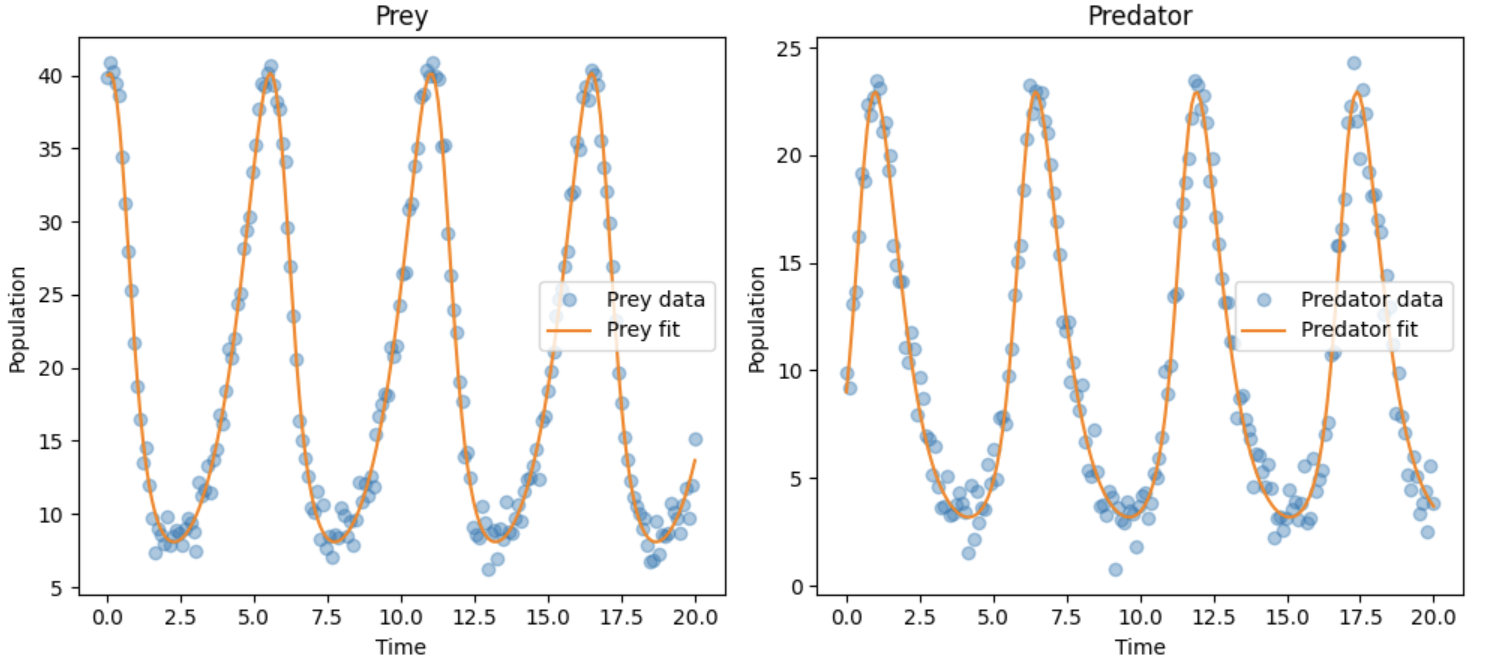
Refining params: {'alpha': 0.5483310416214465, 'beta': 0.068028770810073, 'delta': 0.1451018918331013, 'gamma': 3.1481636450536428}
Refining params: {'alpha': 0.8216385700908369, 'beta': 0.12479204383819222, 'delta': 0.0616377161233344, 'gamma': 1.615577581450748}
Refining params: {'alpha': 1.088028953494527, 'beta': 0.24201471359553078, 'delta': 0.10339353925892915, 'gamma': 1.6535395505316968}
[10]:
({'alpha': 0.9998973552849139,
  'beta': 0.09995621865139477,
  'delta': 0.07482275016126995,
  'gamma': 1.4972199684549248},
 0.9454500024300705)


Optimal parameters: {'alpha': 0.9998973552849139,
 'beta': 0.09995621865139477,
 'delta': 0.07482275016126995,
 'gamma': 1.4972199684549248}

Final error: 0.9454500024300705


correlation  rank_correlation  variance  mutual_info  \
beta      1.000000          1.000000  0.837219     1.000000
alpha     0.939654          0.821020  0.705869     0.890829
delta     0.882231          0.691107  1.000000     0.528090
gamma     0.739286          0.660998  0.000000     0.000000

       mean_abs_sensitivity
beta               0.959305
alpha              0.839343
delta              0.775357
gamma              0.350071
🛠️ Advanced Usage
Custom Error Functions
import invode.erf as erf

# Chi-squared for heteroscedastic data
sigma = np.array([0.1, 0.2, 0.15, 0.3])  # Different uncertainties
error_func = erf.chisquared(data, sigma=sigma)

# Regularized fitting to prevent overfitting
error_func = erf.RegularizedError(data, 'mse', l1_lambda=0.01, l2_lambda=0.1)

# Robust fitting with Huber loss
error_func = erf.huber(data, delta=1.5)
Parallel Optimization (Under dev)
optimizer = invode.ODEOptimizer(
    # ... other parameters
    parallel=True,          # Parallel candidate evaluation
    local_parallel=True,    # Parallel local refinement
    n_samples=100,          # More samples for better parallelization
)
Sensitivity Analysis
# Overall parameter sensitivity
sensitivity = invode.ODESensitivity(ode_func, error_func)
candidates_df = optimizer.get_top_candidates_table()

# Multiple analysis methods
summary = sensitivity.create_sensitivity_summary(
    candidates_df,
    methods=['correlation', 'variance', 'mutual_info']
)

# Evolution over iterations
iteration_sens = sensitivity.analyze_sensitivity_by_iteration(candidates_df)

# Visualize results
fig = sensitivity.plot_sensitivity_analysis(sensitivities)
📄 License
This project is licensed under the MIT License - see the LICENSE file for details.
Why MIT? We believe in open science and want invode to be as widely useful as possible. The MIT license allows both academic and commercial use while maintaining attribution.
🙏 Acknowledgments
- SciPy Community: For providing the foundational numerical computing tools
- Contributors: All the amazing people who have contributed code, documentation, and feedback
- Users: The researchers and engineers who trust invode with their important work
- Academic Partners: Universities and research institutions supporting open source development
Made with ❤️ for the scientific computing community
• 📚 Docs • 🐛 Issues • 💬 Discussions
1 maintainer

Release files for invode 0.1.2
For a detailed explanation of source distributions (sdists) and built distributions (wheels), please see the package formats documentation.
Source distribution (sdist)
| File | Size | Uploaded | |
|---|---|---|---|
| invode-0.1.2.tar.gz | 29.5 kB | Details |
Built distribution (wheel)
| File | Interpreter | ABI | Platform | Reset |
|---|---|---|---|---|
| invode-0.1.2-py3-none-any.whl | Python 3 | none | any | Details |
Total release size: 63.3 kB
Release files / invode-0.1.2.tar.gz
| Download URL | invode-0.1.2.tar.gz |
|---|---|
| Size | 29.5 kB |
| Tags | Source |
|
SHA-256 checksum How to use checksums |
b126a2577639b191a86eb477b9a7d4b717b9291695818dc172550dbd9eaf3254
|
|
BLAKE2b-256 checksum How to use checksums |
009eb481a0371c1782fc644df6f6fc884316a8c59d47e015ec904dac2e0f0c04
|
| Upload date | |
|
Uploaded using Trusted Publishing? What is trusted publishing? |
No |
| Uploaded via |
twine/6.2.0 CPython/3.11.9
|
Release files / invode-0.1.2-py3-none-any.whl
| Download URL | invode-0.1.2-py3-none-any.whl |
|---|---|
| Size | 33.9 kB |
| Tags | Python 3 |
|
SHA-256 checksum How to use checksums |
9b78c58cb5ec774629b72ab41ec13dd852089fc95e6ddf04684d986e50804438
|
|
BLAKE2b-256 checksum How to use checksums |
c952efc6f7f73709429861e01d8abb26a9e1dcce1a2c69a1f008cc38944817f7
|
| Upload date | |
|
Uploaded using Trusted Publishing? What is trusted publishing? |
No |
| Uploaded via |
twine/6.2.0 CPython/3.11.9
|













