
InvoiceGuard





Freelancer payment enforcement: deposit links tied to a contract with a late-fee clause — then automated, escalating collections.
Solo freelancers don't get paid. A Kaplan Group report (April 2026) found 85% of freelancers experience late payment; a Freelancers Union survey found 91% have experienced late/overdue payments, with 54% waiting 3+ months. InvoiceGuard's wedge:
- Before work starts: generate a contract with a late-fee clause, create a Stripe deposit payment link. The client acknowledges the contract by accepting (paying) the deposit link.
- After the due date: an automated 3-stage email escalation — day-1 polite nudge → day-7 firm reminder → day-15 formal notice quoting the late-fee clause (also sent as an SMS/WhatsApp message when Twilio messaging is configured) — until a Stripe webhook marks the invoice paid.
Local-first (SQLite), open-source (Apache-2.0), works alongside your existing invoicing tools via Stripe. No platform switch required.
Honest scope: contracts are signed electronically in the browser (typed name + drawn signature, SHA-256 hash of the signed text stored as tamper evidence) — a captured signature, not a qualified third-party e-signature service. See Limits of v1.
5-minute quickstart
0. Install
pip install invoiceguard
# or, from a local clone:  pip install -r requirements.txt && pip install -e .
invoiceguard init               # creates ~/.invoiceguard (config template, DB, email templates)
1. Add your Stripe test key (~2 min)
- Go to https://dashboard.stripe.com/test/apikeys (toggle Test mode on).
- Developers → API keys → Create secret key, copy the
sk_test_...value. - Paste it into
~/.invoiceguard/config.yamlasstripe_secret_key, or export it:export INVOICEGUARD_STRIPE_SECRET_KEY="sk_test_..."
2. Add your SMTP details (~2 min) — how dunning emails are sent. In ~/.invoiceguard/config.yaml:
smtp:
  host: "smtp.gmail.com"
  port: 587
  username: "you@example.com"
  password: "YOUR_GMAIL_APP_PASSWORD"   # or export INVOICEGUARD_SMTP_PASSWORD
  from_addr: "you@example.com"
  use_tls: true
(Gmail: create an App Password at Google Account → Security → 2-Step Verification → App passwords. Any SMTP provider works.)
3. Create a client, project, and deposit link (~1 min)
invoiceguard client add --name "Acme Corp" --email "billing@acme.com"

invoiceguard project create --client "Acme Corp" --title "Website redesign" \
  --amount 2000 --deposit-pct 50 --late-fee-pct 1.5 --ack
# ^ generates the contract markdown (with the late-fee clause) and records
#   client acknowledgment (--ack = client accepted the deposit link)

invoiceguard invoice create --project 1 --kind deposit
# => invoice #1 (deposit): $1,000.00
#    pay link: https://buy.stripe.com/...
#    due: 2026-10-07   status: sent
Send the pay link to the client. That's the whole pre-work flow.
4. Let collections run themselves
# add to your crontab (runs the dunning scan every morning at 9:00):
0 9 * * * /path/to/venv/bin/invoiceguard check-due >> ~/.invoiceguard/check-due.log 2>&1
invoiceguard check-due scans invoices past their due date and sends the next escalation stage (day1 → day7 → day15), using the editable markdown templates in ~/.invoiceguard/templates/. It's idempotent — a stage is never sent twice for the same invoice. Per-client dunning policies (v0.7.0) let each client override the 1/7/15 thresholds or disable stages entirely (invoiceguard client set-dunning-policy) — useful for VIP clients or agency workspaces with different collections rhythms. When the client pays, Stripe's webhook flips the invoice to paid automatically. An invoice whose client has no email on file is skipped with a clear reason (one email-less client no longer crashes the whole run); add the email with invoiceguard client set-email and the stage goes out on the next run. Likewise, if one invoice's email send fails (transient SMTP error), the failure is isolated — reported as a failed line, nothing recorded for that invoice, and the rest of the batch still goes out; the stage retries on the next run.
5. Stripe webhook (so payments mark invoices paid)
- In the Stripe dashboard: Developers → Webhooks → Add endpoint.
- URL:
https://YOUR-HOST/webhooks/stripe(the dashboard app serves this; see below). - Select event:
checkout.session.completed. - Copy the Signing secret (
whsec_...) intostripe_webhook_secretin the config (or exportINVOICEGUARD_STRIPE_WEBHOOK_SECRET). The dashboard webhook reads the secret from the env var first, then the config file, then the legacySTRIPE_WEBHOOK_SECRETenv var.
⭐ If InvoiceGuard helped you, a star means a lot — it helps other developers find the project.
CLI reference
| Command | What it does |
|---|---|
invoiceguard init |
Create ~/.invoiceguard/ (config template, DB, email templates) |
invoiceguard client add --name N --email E [--phone +15551234567] |
Add a client (phone enables SMS/WhatsApp escalation) |
invoiceguard client set-phone ID [--phone +15551234567] |
Set or clear a client's phone number |
invoiceguard client set-email ID [--email billing@acme.com] |
Set or clear a client's email address (dunning) |
invoiceguard client set-dunning-policy ID [--day1 N] [--day7 N] [--day15 N] [--reset] |
Per-client dunning thresholds (v0.7.0); 0 disables a stage |
invoiceguard client list |
List clients (shows [dunning ...] overrides) |
invoiceguard freelancer add --name N [--email E] [--phone +15551234567] |
Add a freelancer to the agency roster (v0.8.0) |
invoiceguard freelancer set-email ID [--email E] / set-phone ID [--phone P] / list |
Manage or list freelancers (v0.8.0) |
invoiceguard project create --client N --title T --amount 2000 [--deposit-pct 50] [--late-fee-pct 1.5] [--late-fee-grace-days 15] [--ack] |
Create project + generate contract markdown |
invoiceguard project ack ID |
Record client acknowledgment of the contract (deposit-link path) |
invoiceguard project sign-request ID |
Create a one-time e-signature link for the contract (/sign/<token>) |
invoiceguard project sign-status ID |
Show pending/signed state, signer, timestamp, contract hash |
invoiceguard project list |
List projects |
invoiceguard invoice create --project ID --kind deposit|milestone|final [--amount X] [--due-days 7] |
Create a Stripe payment link (status → sent) |
invoiceguard invoice list [--freelancer ID] |
List invoices (shows the attributed freelancer) |
invoiceguard invoice assign ID --freelancer ID / --none |
Attribute an invoice to a freelancer, or clear the attribution (v0.8.0; bookkeeping only) |
invoiceguard invoice record-payment ID --amount 250 [--note "check #1"] [--method bank] |
Record a (partial) payment; clearing the balance marks the invoice paid, otherwise it becomes partially-paid |
invoiceguard invoice mark-paid ID |
Manually mark paid (records the full outstanding balance in the payment ledger) |
invoiceguard invoice void ID |
Void an invoice |
invoiceguard invoice notify ID [--channel sms|whatsapp] [--dry-run] |
Send an SMS/WhatsApp payment reminder now (--dry-run prints the message without sending) |
invoiceguard invoice report [--as-of DATE] [--freelancer ID] [--csv PATH] [--payments-csv PATH] |
Read-only receivables report: aging buckets, oldest debt first, per-client and per-freelancer totals, accrued late fees; CSV export for accounting (- prints to stdout) |
invoiceguard check-due |
Run the dunning scan (cron target) |
invoiceguard dashboard [--port 8000] |
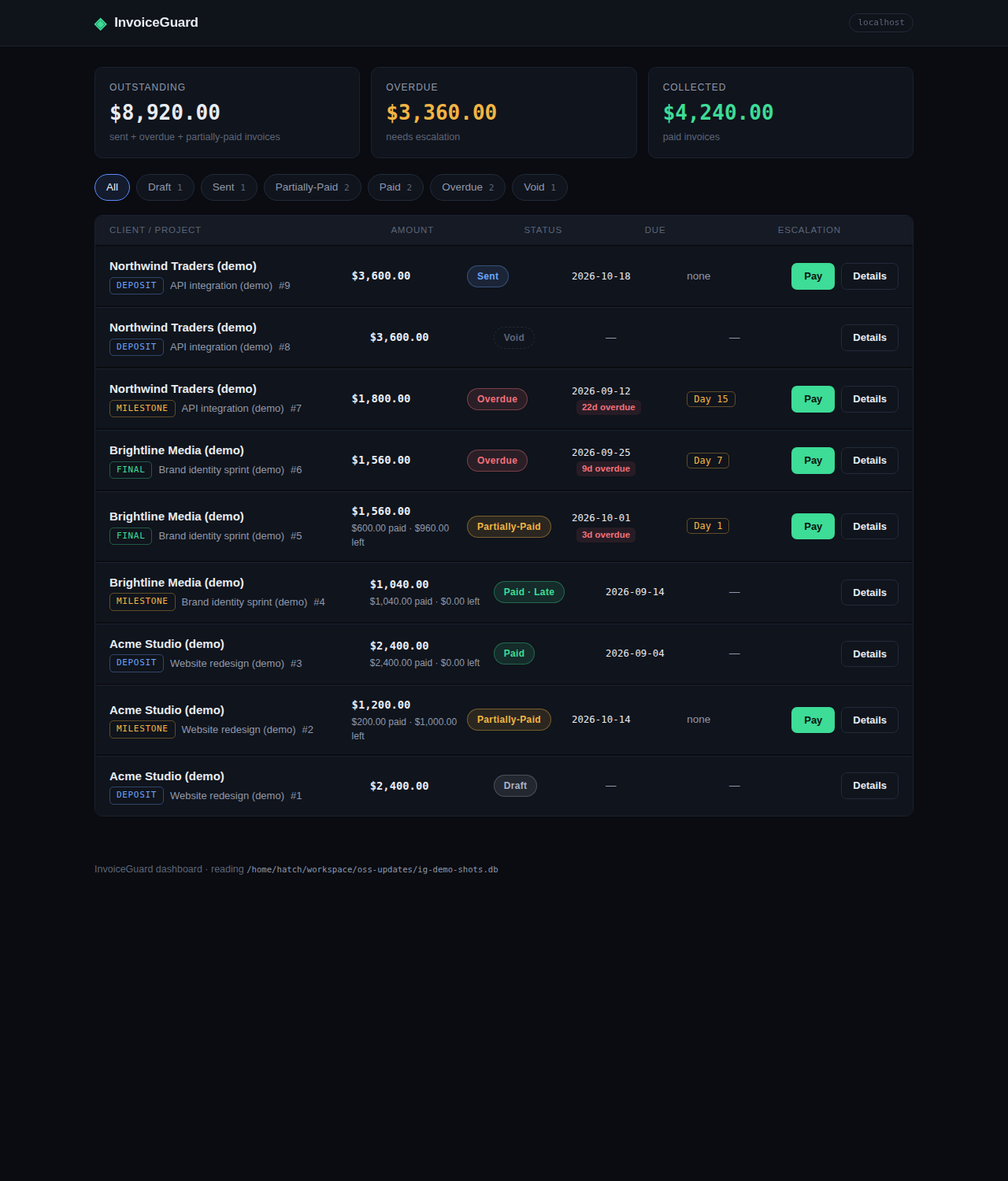
Launch the local web dashboard (http://127.0.0.1:8000) — invoice list, detail with escalation timeline, Stripe webhook receiver |
Kind defaults: deposit = deposit_pct% of project total; final = remainder after deposit; milestone = full amount unless --amount overrides.
Configuration
~/.invoiceguard/config.yaml (override path with $INVOICEGUARD_CONFIG; DB with $INVOICEGUARD_DB):
stripe_secret_key: "sk_test_..."        # or INVOICEGUARD_STRIPE_SECRET_KEY
stripe_webhook_secret: "whsec_..."       # or INVOICEGUARD_STRIPE_WEBHOOK_SECRET
smtp:
  host: "smtp.gmail.com"
  port: 587
  username: "you@example.com"
  password: "APP_PASSWORD"              # or INVOICEGUARD_SMTP_PASSWORD
  from_addr: "you@example.com"
  use_tls: true
app:
  base_url: "http://localhost:8000"
# Optional SMS/WhatsApp escalation via Twilio (day-15 + `invoice notify`):
# messaging:
#   channel: "sms"                      # or "whatsapp"
#   account_sid: "AC_..."               # or INVOICEGUARD_TWILIO_ACCOUNT_SID
#   auth_token: "your-auth-token"       # or INVOICEGUARD_TWILIO_AUTH_TOKEN
#   from_number: "+10000000000"         # or INVOICEGUARD_TWILIO_FROM_NUMBER
Keys come only from config/env — never hardcoded, never committed (.gitignore covers config.yaml, .env, *.key, and the local DB).
Dunning templates
~/.invoiceguard/templates/day1.md, day7.md, day15.md — plain markdown with {variables}:
{client_name} {project_title} {amount} {paid} {outstanding} {due_date} {days_overdue} {late_fee_pct} {pay_url}
{amount} is the original invoice amount; {paid} / {outstanding} track the payment ledger so a client who already paid part of the bill sees their remaining balance. Edit them freely; check-due picks them up on the next run. Stage timing: day1 fires at ≥1 day overdue, day7 at ≥7, day15 at ≥15 — earliest unsent due stage wins, one email per invoice per run. Invoices stay in dunning until the outstanding balance is zero (sent/overdue/partially-paid with due_date in the past).
SMS / WhatsApp escalation (v0.5.0): when the messaging: config section is set (Twilio credentials + from-number) and the client has a phone number on file, the day-15 stage also goes out as a short SMS or WhatsApp message — same amounts, pay link included. Sends are recorded in the message_events ledger, at most once per stage per invoice, and a failed message never blocks the email. invoiceguard invoice notify <id> sends the same reminder on demand (--dry-run previews it). Without messaging config, dunning stays email-only.
Database schema (contract with the dashboard app)
SQLite, default ~/.invoiceguard/invoiceguard.db. The dashboard app reads/writes these exact tables — column names and types are frozen; additive migrations only:
CREATE TABLE clients(id INTEGER PRIMARY KEY, name TEXT NOT NULL, email TEXT, phone TEXT, created_at TEXT NOT NULL);
CREATE TABLE projects(id INTEGER PRIMARY KEY, client_id INTEGER NOT NULL REFERENCES clients(id), title TEXT NOT NULL, amount_cents INTEGER NOT NULL, currency TEXT NOT NULL DEFAULT 'USD', deposit_pct REAL NOT NULL DEFAULT 50.0, late_fee_pct REAL NOT NULL DEFAULT 1.5, late_fee_grace_days INTEGER NOT NULL DEFAULT 15, contract_md TEXT NOT NULL, contract_ack INTEGER NOT NULL DEFAULT 0, contract_ack_at TEXT, created_at TEXT NOT NULL);
CREATE TABLE invoices(id INTEGER PRIMARY KEY, project_id INTEGER NOT NULL REFERENCES projects(id), kind TEXT NOT NULL, amount_cents INTEGER NOT NULL, currency TEXT NOT NULL DEFAULT 'USD', status TEXT NOT NULL DEFAULT 'draft', stripe_url TEXT, stripe_session_id TEXT, due_date TEXT, sent_at TEXT, paid_at TEXT, created_at TEXT NOT NULL);
CREATE TABLE dunning_events(id INTEGER PRIMARY KEY, invoice_id INTEGER NOT NULL REFERENCES invoices(id), stage TEXT NOT NULL, sent_at TEXT NOT NULL);
CREATE TABLE payments(id INTEGER PRIMARY KEY, invoice_id INTEGER NOT NULL REFERENCES invoices(id), amount_cents INTEGER NOT NULL CHECK (amount_cents > 0), method TEXT NOT NULL DEFAULT 'manual', note TEXT, paid_at TEXT NOT NULL);
CREATE TABLE signatures(id INTEGER PRIMARY KEY, project_id INTEGER NOT NULL REFERENCES projects(id), token TEXT NOT NULL UNIQUE, status TEXT NOT NULL DEFAULT 'pending', signer_name TEXT, signature_image TEXT, contract_hash TEXT, signed_at TEXT, created_at TEXT NOT NULL);
CREATE TABLE message_events(id INTEGER PRIMARY KEY, invoice_id INTEGER NOT NULL REFERENCES invoices(id), channel TEXT NOT NULL DEFAULT 'sms', stage TEXT NOT NULL, to_addr TEXT NOT NULL, provider_sid TEXT, sent_at TEXT NOT NULL);
kinds: deposit | milestone | final. statuses: draft | sent | partially-paid | paid | overdue | void. stages: day1 | day7 | day15.
The payments ledger (added in v0.2.0) records every payment — record-payment, mark-paid, and Stripe webhooks all write rows here, so outstanding balances are always derivable. Databases created before v0.2.0 get an automatic, labeled backfill row for invoices already marked paid.
Web dashboard
invoiceguard dashboard launches the web dashboard for real — uvicorn serving
invoiceguard.web.main:app (default http://127.0.0.1:8000, --port to
change it). It shares this SQLite database: invoice list with status filters
(including partially-paid) and escalation stages, per-invoice detail with
paid/outstanding amounts, a payments ledger, a chronological timeline, and
the POST /webhooks/stripe endpoint that records the payment when Stripe
reports a completed checkout session (a session for less than the balance
leaves the invoice partially-paid).
Quick webhook smoke test (no network — the payload is signed locally):
INVOICEGUARD_DB=/tmp/ig-demo.db .venv/bin/python seed_demo.py --fresh
INVOICEGUARD_DB=/tmp/ig-demo.db INVOICEGUARD_STRIPE_WEBHOOK_SECRET=whsec_test_x \
  .venv/bin/invoiceguard dashboard
# -> http://127.0.0.1:8000/  (Ctrl-C to stop)
Docker
docker compose up -d                 # CLI container, data in the invoiceguard-data volume
docker compose run --rm app check-due # one-off dunning scan
Put secrets in a .env file next to docker-compose.yml (never committed): INVOICEGUARD_STRIPE_SECRET_KEY, INVOICEGUARD_STRIPE_WEBHOOK_SECRET, INVOICEGUARD_SMTP_PASSWORD. Port 8000 is exposed for the dashboard.
Running tests
python -m venv .venv && .venv/bin/pip install -r requirements.txt && .venv/bin/pip install -e .
.venv/bin/python -m pytest tests/ -q
195 tests, all green (2026-10-16): contract clause rendering (incl. the e-signature sign-off wording and the contract deposit amount's Decimal half-up rounding, agreeing with the CLI quote and the deposit invoice), CLI money parsing (Decimal half-up amounts, deposit split, invalid/non-positive rejection), dunning stage selection + idempotency + email-less-client skip (no crash, reported reason, other invoices still sent; stage fires after client set-email) + dunning send-failure isolation (one failed send is reported, nothing recorded, rest of batch still sent; stage retries next run) + per-client dunning policies (custom thresholds fire at the custom day, disabled stages skipped in escalation, all-disabled client reported as skipped dunning, order/negative validation, additive migration on old DBs), client set-email (set/clear/unknown-client error), client set-dunning-policy (set/reset/validation/unknown-client), template rendering, webhook signature verification (real HMAC check, offline), Stripe link creation (mocked SDK, params asserted), CLI flows (incl. project sign-request/sign-status), e-signature DB ops (idempotent request, single-use token, tamper-evidence hash, ack flip) + full web signing flow (page render, validation, signed receipt, single-use enforcement), dashboard integration (page rendering + offline webhook checks incl. the invoiceguard_invoice_id metadata-key regression, the webhook-secret resolution regression, and the void-invoice webhook regression — a webhook for a voided invoice records nothing and leaves it void), SMS/WhatsApp messaging (phone normalization, Twilio payload with mocked HTTP, config resolution, day-15 escalation + invoice notify incl. dry-run), receivables aging report (bucket boundaries, dashboard-consistent outstanding totals, per-currency aggregation, late-fee agreement with the §3 calculator) + invoice/payment CSV exports, freelancer roster + invoice attribution (CRUD, assign/clear, unknown-id rejection, state untouched, old-DB migration, per-freelancer report + CSV column, CLI flows), and a full end-to-end (init → client → project → invoice → check-due against a real local SMTP server → assert email captured + dunning_events row written).
Limits of v1
- No live Stripe call was verified in this build environment — Stripe's connector isn't connected here.
invoice createwas verified with a mockedstripeSDK asserting the exactPaymentLink.createparams (line items, price data, metadata); webhook handling was verified with realstripe.Webhook.construct_eventsignature verification using a test secret (works offline). You add your own test key (2 min, above) and the live path is standard Stripe API. - E-signature is browser-captured, not qualified.
project sign-requestgives the client a one-time signing link: typed name + drawn signature on the contract, with the exact signed text hashed (SHA-256) and stored as tamper evidence. It is NOT a qualified third-party e-signature service (DocuSign/HelloSign); legal weight varies by jurisdiction. The older acknowledgment path still exists: paying the deposit link, orproject ack. - Email deliverability is yours. InvoiceGuard sends via your SMTP. Use a reputable provider (Gmail App Password, SendGrid, etc.) and warm up new addresses; check spam folders in testing.
- Messaging needs your own Twilio account. SMS/WhatsApp escalation sends through Twilio with your credentials and your Twilio number (WhatsApp needs a Twilio-approved WhatsApp sender). Sends were verified with the HTTP layer mocked — no live Twilio call was made in the build environment. Only message clients who agreed to be contacted; consent rules vary by jurisdiction.
- Late-fee enforceability varies by jurisdiction. The clause is a contractual starting point, not legal advice. Adjust
late_fee_pct/ grace days per project.
Roadmap
Real e-signature— shipped in v0.3.0:project sign-request/project sign-status, one-time/sign/<token>page with typed-name + drawn-signature capture and SHA-256 tamper evidence.Late-fee accrual calculator— shipped in v0.4.0:invoice late-fees <id>with monthly-compounding breakdown, dashboard "Accrued late fees" / "Total with fees" rows,{late_fee_due}/{total_with_late_fees}dunning variables.SMS / WhatsApp escalation— shipped in v0.5.0: day-15 also goes out as an SMS/WhatsApp message via Twilio when configured (invoice notifysends one-off reminders).- Agency mode — multi-freelancer workspaces (unshipped); per-client dunning policies shipped in v0.7.0 (
invoiceguard client set-dunning-policy); freelancer roster + invoice attribution shipped in v0.8.0 (invoiceguard freelancer add,invoiceguard invoice assign). Partial payments / payment plans— shipped in v0.2.0.
Changelog
Release history lives in CHANGELOG.md — newest first, no fluff.
License
Apache-2.0 — see LICENSE.
1 maintainer

Metadata
1 maintainer
Release files for invoiceguard 0.8.0
For a detailed explanation of source distributions (sdists) and built distributions (wheels), please see the package formats documentation.
Source distribution (sdist)
| File | Size | Uploaded | |
|---|---|---|---|
| invoiceguard-0.8.0.tar.gz | 87.4 kB | Details |
Built distribution (wheel)
| File | Interpreter | ABI | Platform | Reset |
|---|---|---|---|---|
| invoiceguard-0.8.0-py3-none-any.whl | Python 3 | none | any | Details |
Total release size: 152.4 kB
Release files / invoiceguard-0.8.0.tar.gz
| Download URL | invoiceguard-0.8.0.tar.gz |
|---|---|
| Size | 87.4 kB |
| Tags | Source |
|
SHA-256 checksum How to use checksums |
58827d0aa073fe09a952e031bcfda5aa69da06c6a1d94e7003642eeffa1421cc
|
|
BLAKE2b-256 checksum How to use checksums |
cfc6c6ed1a64f3668d630f09a95ac14ba2538d9a1abe4c2993adc2df7f521b9c
|
| Upload date | |
|
Uploaded using Trusted Publishing? What is trusted publishing? |
No |
| Uploaded via |
okfsmith-pypi-skill/1.0
|
Release files / invoiceguard-0.8.0-py3-none-any.whl
| Download URL | invoiceguard-0.8.0-py3-none-any.whl |
|---|---|
| Size | 65.0 kB |
| Tags | Python 3 |
|
SHA-256 checksum How to use checksums |
b6a604705760e9db1a7317999f666100f99fe88c18391a657ec8e19138a7c152
|
|
BLAKE2b-256 checksum How to use checksums |
48b8f58b9cd66df6a5eb837b2c5383772730305955a925129975f0a82618f10e
|
| Upload date | |
|
Uploaded using Trusted Publishing? What is trusted publishing? |
No |
| Uploaded via |
okfsmith-pypi-skill/1.0
|














